Small Business Health Insurance in Michigan: 2026 Group Plans & ICHRA
Small business health insurance in Michigan for 2026 offers employers several pathways — traditional group plans through Blue Cross Blue Shield of Michigan, Priority Health, and Meridian, SHOP marketplace coverage on HealthCare.gov with federal tax credits for qualifying small businesses, or Individual Coverage Health Reimbursement Arrangements (ICHRAs) that reimburse employees for individual Michigan marketplace plans. Michigan’s small group market saw a statewide average rate increase of 11.1% for 2026 — lower than the 20.1% individual market increase. This guide walks through each option for Michigan employers with 1–50 employees, including how Michigan’s seven-carrier individual market makes ICHRA particularly attractive.

What does your Michigan business need?
Small Business Health Insurance Options in Michigan
Small business health insurance in Michigan for 2026 gives employers with 1–50 employees three primary coverage pathways: traditional small group plans purchased directly from carriers like BCBS of Michigan, Priority Health, and Meridian; the federal SHOP marketplace on HealthCare.gov with access to the Small Business Health Care Tax Credit; or an Individual Coverage Health Reimbursement Arrangement (ICHRA) that reimburses employees for individual Michigan marketplace plans on a tax-free basis. Michigan small group rates increased 11.1% on average for 2026.
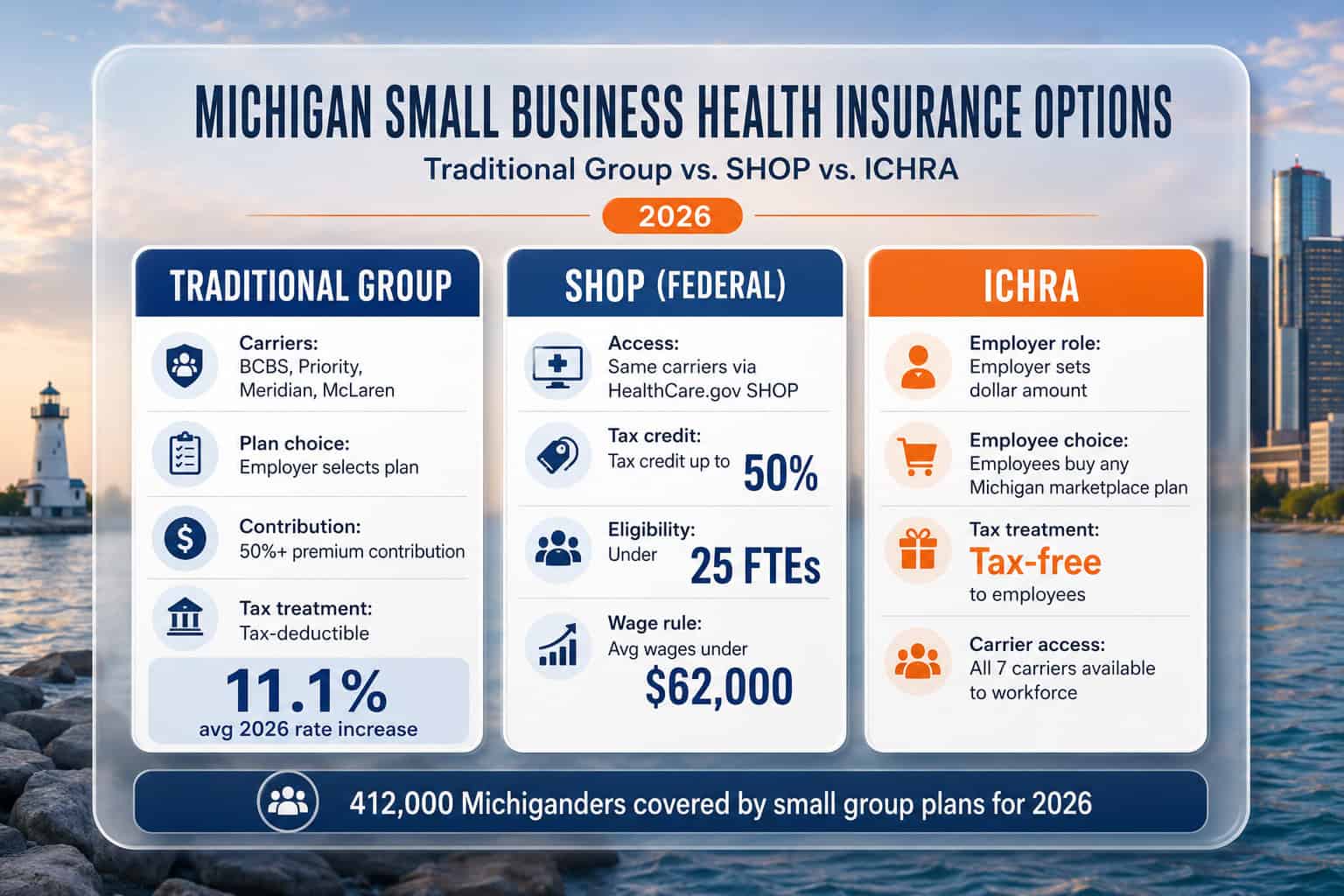
| Option | Eligible Businesses | Carriers in MI | Tax Credit Eligible | Employee Choice |
|---|---|---|---|---|
| Traditional small group | 1–50 FTE | BCBS, Priority, Meridian, McLaren | No (unless through SHOP) | Employer selects plan; employees enroll |
| SHOP (federal HealthCare.gov) | 1–50 FTE | Same carriers via SHOP | Yes — under 25 FTE + avg wages under $62,000 | Employees may choose from available metal tiers |
| ICHRA | Any size | All 7 MI marketplace carriers available to employees | No (but contributions tax-free) | Full employee choice via HealthCare.gov or off-exchange |
| QSEHRA | Under 50 FTE, no group plan | Any — employees choose own plan | No (but contributions tax-free) | Full employee choice; max $6,350/individual in 2026 |
For many Michigan small businesses — particularly those with employees across multiple counties where marketplace carrier availability differs dramatically — the ICHRA model offers unique advantages. Detroit metro employees have access to all seven 2026 carriers, west Michigan employees typically have three or four, and Upper Peninsula employees may have only two. Rather than selecting a single group plan that may have network gaps for some employees, the business sets a monthly dollar amount (e.g., $450/employee) and each employee uses it to purchase whichever Michigan marketplace plan fits their county and providers. A Grand Rapids employee picks Priority Health while an Ann Arbor employee selects BCBS PPO for University of Michigan Health access.
Small Business Health Care Tax Credit in Michigan
Michigan small businesses purchasing coverage through the federal SHOP marketplace may qualify for the Small Business Health Care Tax Credit — worth up to 50% of the employer’s premium contributions (35% for tax-exempt organizations). To qualify, the business must have fewer than 25 full-time equivalent employees, pay average annual wages under $62,000 (indexed annually), and cover at least 50% of employee-only premium costs. For a qualifying 10-employee Michigan business, this credit can save $4,500–$12,000 per year depending on wage profile.
The credit is claimed on the employer’s annual federal tax return using IRS Form 8941. The maximum 50% credit applies to businesses with 10 or fewer FTEs and average wages under $32,000, phasing out as headcount approaches 25 and wages approach $62,000. Tax-exempt Michigan organizations — including nonprofits and religious organizations — can claim up to 35% as a refundable credit. The credit is only available for SHOP-purchased plans, not for direct-to-carrier group plans from BCBS, Priority Health, Meridian, or McLaren. SHOP enrollment for Michigan happens through the HealthCare.gov Small Business portal.
Example: Ann Arbor Research Firm, 9 Employees
An Ann Arbor research firm with 9 full-time employees averaging $46,000/year purchases SHOP coverage through HealthCare.gov, contributing $520/month per employee toward a BCBS Silver plan. Annual employer contribution: $56,160. The Small Business Health Care Tax Credit at approximately 32% (phased based on wages) returns roughly $17,971 — reducing effective employer cost to $38,189, or about $354/month per employee. Total small business health insurance in Michigan contributions decrease significantly after the credit.
Does Michigan Require Employers to Offer Health Insurance?
Michigan has no state employer mandate requiring businesses to offer health insurance. The federal ACA employer mandate applies only to Applicable Large Employers with 50 or more full-time equivalent employees — Michigan businesses with fewer than 50 FTEs face no federal penalty for not offering coverage. Approximately 90% of Michigan businesses have fewer than 20 employees, making the vast majority exempt from any employer mandate.
For Michigan businesses at or near the 50-FTE threshold, the federal penalty for not offering affordable, minimum-value coverage is $2,970 per full-time employee (minus the first 30) for 2026. A 55-FTE Michigan business not offering coverage would face a potential penalty of approximately $74,250/year. Businesses approaching this threshold should evaluate whether group coverage or ICHRA is more cost-effective than absorbing the penalty — particularly given Michigan’s 11.1% 2026 small group rate increase, which was notably lower than the 20.1% individual market increase. Michigan small group coverage is regulated by the Michigan Department of Insurance and Financial Services.
Michigan Small Group Carriers for 2026
Small group health insurance in Michigan is available from Blue Cross Blue Shield of Michigan, Blue Care Network, Priority Health, Meridian, and McLaren Health Plan. BCBS offers the only statewide PPO small group option, covering nearly every hospital and major health system, while Priority Health dominates west Michigan via Corewell integration. Michigan small group rates rose 11.1% on average for 2026 — far below the 20.1% individual-market increase, reflecting the more stable employer risk pool.
Michigan small group plans are community-rated — premiums are based on employee ages, tobacco use, and county, not on the group’s health history. A 10-person group in Oakland County with an average employee age of 38 can expect Silver small group premiums of approximately $520–$620/month per employee before employer contributions, typical for small business health insurance in Michigan at that group size. For businesses exploring ICHRA, the Michigan carrier comparison guide details the seven individual-market carriers employees would choose from under an ICHRA arrangement, including Oscar Health and UnitedHealthcare Community Plan which operate only in the individual market.
Compare Michigan Small Business Health Plans
See group plan options from BCBS of Michigan, Priority Health, Meridian, and McLaren. Check SHOP tax credit eligibility and explore ICHRA alternatives with access to all seven Michigan marketplace carriers for your business.
ICHRA — An Alternative to Traditional Group Plans in Michigan
An Individual Coverage Health Reimbursement Arrangement lets Michigan employers set a fixed monthly dollar amount per employee — typically $400–$600 — which employees use to purchase individual plans through HealthCare.gov or off-exchange. Employer contributions are tax-deductible to the business and tax-free to the employee. Employees buying through HealthCare.gov with ICHRA funds may also qualify for premium tax credits if the employer contribution is below ACA affordability thresholds. Approximately 90% of Michigan individual market enrollees qualify for subsidies.
ICHRAs work particularly well for small business health insurance in Michigan because of the state’s geographic carrier variation. A traditional group plan locks all employees into one carrier and network — suboptimal when a Detroit metro employee has access to all seven 2026 carriers while an employee in a rural Upper Peninsula county has access to only BCBS and Blue Care Network. With an ICHRA, each employee selects the Michigan marketplace plan that works best for their county and provider preferences, and the employer’s per-employee cost stays fixed regardless of location or carrier selection.
ICHRA works well when
Michigan employees are spread across multiple counties with different carrier availability — particularly businesses with Detroit metro, west Michigan, and Upper Peninsula locations. The business wants predictable, fixed monthly costs. Employees have diverse healthcare needs and prefer choosing their own plan type and metal tier.
Traditional group works well when
All Michigan employees are in the same metro area with similar carrier options. The business qualifies for SHOP tax credits (under 25 FTE, wages under $62,000). Employees prefer having the employer handle plan selection and administration. The business wants to offer BCBS of Michigan PPO statewide coverage as a recruitment advantage.
How to Set Up Small Business Health Insurance in Michigan
Setting up small business health insurance in Michigan involves four decisions: coverage type (group plan, SHOP, or ICHRA), carrier selection for group plans, contribution level (minimum 50% of employee-only premiums for SHOP tax credit eligibility), and enrollment timing (group plans can start any month, not restricted to Open Enrollment). A licensed Michigan enrollment assistant can walk through all options at no cost to the business.
Determine employee count and budget
Count full-time equivalent employees (30+ hours/week). Michigan businesses under 25 FTE with average wages under $62,000 should evaluate SHOP for the tax credit. Businesses with 1–5 employees often find ICHRA or QSEHRA more cost-effective than traditional group rates, particularly given the 11.1% 2026 group rate increase.
Choose a coverage approach
Traditional group (employer selects carrier and plan), SHOP (employees may choose metal tier, tax credit available), or ICHRA (employer sets dollar amount, employees buy on HealthCare.gov). Each has different cost and administrative implications for Michigan employers.
Get quotes from Michigan carriers
For group plans: BCBS of Michigan, Blue Care Network, Priority Health, Meridian, and McLaren serve the Michigan small group market. Provide employee census data (ages, ZIPs, tobacco status) for accurate quotes. For ICHRA: set the monthly allowance and let employees quote individual HealthCare.gov plans themselves.
Enroll and communicate to employees
Group plans can start the first of any month — no Open Enrollment restriction. SHOP enrollment goes through the federal HealthCare.gov Small Business portal. Provide Michigan employees with plan details, contribution amounts, and network information. Coverage activates once the first premium payment clears.
Frequently Asked Questions About Michigan Small Business Coverage
Is health insurance required for small businesses in Michigan?
No. Michigan has no state employer mandate. The federal ACA employer mandate applies only to businesses with 50 or more full-time equivalent employees. Michigan businesses with fewer than 50 FTEs can offer small business health insurance voluntarily without penalty. Approximately 90% of Michigan businesses fall below the 50-FTE threshold.
What is the Small Business Health Care Tax Credit?
The tax credit is worth up to 50% of the employer’s premium contributions (35% for tax-exempt organizations) for small businesses purchasing coverage through the federal SHOP marketplace on HealthCare.gov. To qualify, the Michigan business must have fewer than 25 full-time equivalent employees, pay average annual wages under $62,000, and cover at least 50% of employee-only premiums. Claimed on the federal tax return using IRS Form 8941.
What carriers offer small group plans in Michigan?
Blue Cross Blue Shield of Michigan, Blue Care Network, Priority Health, Meridian Health Plan, and McLaren Health Plan are the primary small group carriers in Michigan for 2026. BCBS of Michigan offers the only statewide PPO. Priority Health dominates west Michigan with Corewell Health integration. Small group rate increases for 2026 averaged 11.1%, lower than the individual market’s 20.1% increase. Approximately 412,000 Michiganders are covered by small group plans.
What is an ICHRA and how does it work in Michigan?
An Individual Coverage Health Reimbursement Arrangement lets employers set a fixed monthly dollar amount per employee for health insurance. Employees use that allowance to buy individual plans through HealthCare.gov or off-exchange. Employer contributions are tax-deductible and tax-free to employees. ICHRAs work particularly well for Michigan businesses with employees across multiple counties where carrier availability varies from two to seven.
Can my employees keep HealthCare.gov subsidies with an ICHRA?
It depends on the ICHRA contribution amount and employee income. If the employer’s ICHRA contribution is considered “affordable” under ACA standards, the employee generally cannot also claim HealthCare.gov premium tax credits. If the contribution is below the affordability threshold, the employee can decline the ICHRA and receive subsidies instead. Approximately 90% of Michigan individual market enrollees qualify for subsidies. A licensed enrollment assistant can run the affordability calculation for each employee.
How much does small business health insurance cost in Michigan?
Small group Silver premiums in Michigan for 2026 run approximately $520–$620/month per employee for a group with an average age of 38 in Oakland County. Costs vary by employee ages, county, carrier, and metal tier. Businesses qualifying for the SHOP tax credit can reduce effective costs by up to 50% of premium contributions. ICHRA costs are fixed at whatever monthly amount the employer sets — there is no minimum requirement.
Michigan Health Insurance Resources
Explore related guides for Michigan coverage overall, marketplace enrollment, strategies for finding affordable coverage, and PPO options to help navigate health insurance decisions across the Great Lakes State.
Plans, costs, carriers, and enrollment basics for the whole state.
Marketplace & EnrollmentHow to enroll on HealthCare.gov, deadlines, and qualifying life events.
Affordable CoverageSubsidies, tax credits, Healthy Michigan Plan, and low-cost plans.
Insurance CompaniesThe carriers operating in Michigan, their networks, and service areas.
Find Coverage for Your Michigan Team
Compare group plans from BCBS of Michigan, Priority Health, Meridian, and McLaren. Check SHOP tax credit eligibility through HealthCare.gov and explore ICHRA options with access to all seven Michigan marketplace carriers. Licensed enrollment assistance at no cost.
Broker Disclosure
ForHealthInsurance.com is an independent health insurance agency serving Michigan businesses. We are not affiliated with any carrier or government agency. We help you compare plans and enroll in coverage that meets your needs at no extra cost to you.