Ohio Health Insurance Marketplace 2026: How HealthCare.gov Works for Ohio
The Ohio health insurance marketplace operates entirely through HealthCare.gov — the federally facilitated platform Ohio uses instead of running its own state-based exchange. For 2026, the Ohio health insurance marketplace serves about 463,086 enrolled Ohioans across 11 participating carriers, with premium tax credits and Cost-Sharing Reductions available to subsidy-eligible households below 400% of the federal poverty level. This Ohio health insurance marketplace guide walks through how subsidies actually calculate, what changed when enhanced premium tax credits expired at the end of 2025, how Ohio’s federally-facilitated structure differs from neighboring state-based exchanges in Pennsylvania and Kentucky, and the mechanics of enrolling for 2026 coverage or switching mid-year through a Special Enrollment Period.

What brings you here today?
What Is the Ohio Health Insurance Marketplace?
The Ohio health insurance marketplace is the federally-facilitated exchange operated through HealthCare.gov for Ohio residents. Unlike state-based exchanges in California, New York, or neighboring Pennsylvania, Ohio uses the federal platform for plan comparison, eligibility determination, and enrollment. The Ohio Department of Insurance regulates carriers and approves rate filings, but HealthCare.gov handles the consumer-facing enrollment process. About 463,086 Ohioans use the marketplace for 2026 coverage across 11 participating carriers.
The federally-facilitated structure means Ohio shoppers follow federal default timelines, federal application forms, and federal eligibility rules. Open enrollment windows match the federal schedule; Special Enrollment Period definitions match federal rules; subsidy calculations use federal formulas applied to Ohio-specific benchmark Silver plan pricing. This contrasts with Pennsylvania, which moved to a state-based exchange (Pennie) in 2021 — Pennsylvania residents use Pennie.com instead of HealthCare.gov, and the state has flexibility around enrollment windows and outreach that the Ohio health insurance marketplace doesn’t.
For Ohio shoppers, the practical implication is consistency with federal defaults. The HealthCare.gov call center, document upload portal, plan comparison interface, and eligibility determination process are identical for Ohioans as for residents of any other federally-facilitated state. The Ohio Department of Insurance focuses on carrier oversight, market conduct, and complaint resolution rather than direct enrollment support. Free enrollment help is available from certified navigators, application counselors, and licensed brokers — all three channels offer the same plans at the same prices.
Honest enrollment channels for the Ohio marketplace
Ohioans can enroll in marketplace coverage through three legitimate channels: directly at HealthCare.gov (free, government-run, fully self-service), through a certified navigator funded by federal grants (free, neutral guidance), or through a licensed broker like ForHealthInsurance.com (free to you, paid by carriers regardless of channel). All three channels offer the same plans at the same prices — the difference is how much guidance you receive during enrollment and whether you have ongoing support for claims questions, plan changes, and Special Enrollment events. The “right” channel depends on how much help you want.
How Ohio Marketplace Subsidies Work in 2026
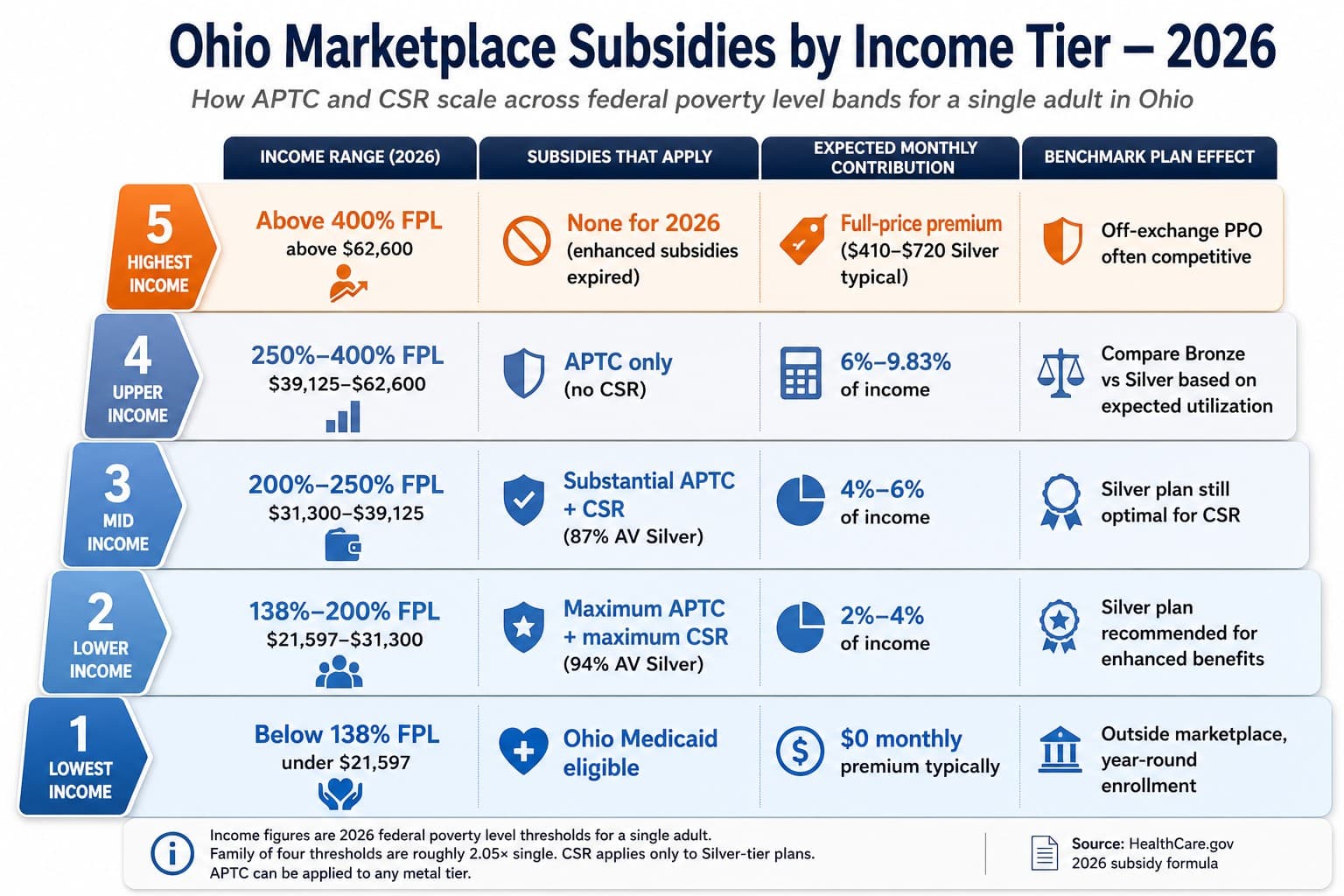
The Ohio health insurance marketplace offers two types of subsidies: Advance Premium Tax Credits (APTC), which lower your monthly premium, and Cost-Sharing Reductions (CSR), which lower deductibles, copays, and out-of-pocket maximums on Silver-tier plans only. For 2026, APTC eligibility caps at 400% of the federal poverty level — the enhanced subsidies that eliminated this cliff expired at the end of 2025. CSR eligibility caps at 250% of FPL and applies only to Silver plans.
The APTC formula works as follows: federal law caps your “expected contribution” toward premiums at a percentage of your income (sliding from 2% at 100% of FPL to 9.83% at 400% of FPL for 2026, restored from the 8.5% cap that applied during the enhanced subsidy years). The marketplace then calculates the cost of the second-lowest-cost Silver plan in your county (the “benchmark”) and pays the difference between that benchmark cost and your expected contribution as a tax credit. You can apply this credit to any plan tier — Bronze, Silver, Gold, or Platinum — but the credit dollar amount is calculated against the benchmark Silver only.
CSR works differently. If you qualify based on income (under 250% of FPL) and enroll in a Silver plan specifically, the carrier delivers a richer version of the Silver plan with lower deductibles and copays. The CSR enhancement is invisible at quote time — same plan name, same monthly premium — but the underlying benefits scale automatically based on your income tier. For Ohio shoppers between 100% and 250% of FPL, choosing Silver is almost always the right call because of CSR, even if a Bronze plan looks cheaper at the premium-only level.
Repayment caps eliminated for 2026
HR 1 (the One Big Beautiful Bill Act) eliminated the previous repayment cap on excess premium tax credits effective for the 2026 plan year. Before 2026, even substantial subsidy underestimates were capped at modest amounts at tax-time reconciliation. For 2026 and beyond, the entire excess subsidy must be repaid if your projected income comes in too low compared to actual income. Ohio shoppers with variable income should err toward overestimating slightly rather than under to avoid surprise tax-time bills on Form 8962.
Ohio Marketplace Metal Tiers: Bronze, Silver, Gold, Platinum
The Ohio health insurance marketplace organizes plans into four metal tiers based on the percentage of average medical costs each tier covers. Bronze plans cover about 60% of average costs, Silver plans about 70%, Gold plans about 80%, and Platinum plans about 90%. The remaining percentage you pay through deductibles, copays, and coinsurance. Bronze plans have the lowest premiums and highest out-of-pocket exposure; Platinum plans reverse that. Silver is the strategic tier for most subsidy-eligible Ohioans because of Cost-Sharing Reductions.
| Metal Tier | Plan Pays | You Pay | Best For Ohioans Who… |
|---|---|---|---|
| Bronze | ~60% | ~40% | Are healthy, want lowest premium, can absorb high deductible |
| Silver (with CSR) | 73%–94% effective | 6%–27% effective | Qualify for CSR (under 250% FPL) — usually the best deal |
| Silver (without CSR) | ~70% | ~30% | Above 250% FPL, want balanced cost/coverage |
| Gold | ~80% | ~20% | Have ongoing prescriptions or expect frequent care |
| Platinum | ~90% | ~10% | Have high expected medical costs, prioritize predictability |
The Silver tier deserves special attention because of Cost-Sharing Reductions. For Ohioans below 250% of the federal poverty level, choosing Silver triggers an automatic plan enhancement — the carrier delivers a Silver plan with lower deductibles, lower copays, and a lower out-of-pocket maximum than the standard Silver plan, while the monthly premium remains the same as standard Silver. For an Ohio shopper at 200% of FPL, a Silver plan with CSR effectively covers 87% of medical costs (closer to Gold) at Silver pricing. Below 200% of FPL, the CSR enhancement scales up to 94% effective coverage — better than Platinum at Silver pricing.
The strategic implication for Ohio marketplace shoppers: if you qualify for CSR, choosing Bronze over Silver to save $20-50 a month often costs you thousands in actual care because you forgo the CSR enhancement. The general rule for subsidy-eligible Ohio shoppers under 250% of FPL: enroll in Silver, ignore the lower-premium Bronze options, and capture the CSR savings. Above 250% of FPL, the standard premium-vs-deductible math applies and Bronze can be the right call for healthy shoppers.
Carriers in the Ohio Marketplace for 2026
Eleven carriers participate in the Ohio health insurance marketplace for 2026, down from 13 in 2025 after two carriers exited. Major Ohio health insurance marketplace carriers include Anthem Blue Cross Blue Shield, Medical Mutual of Ohio, Buckeye Health Plan (Ambetter from Centene), CareSource, Molina, Oscar Health, UnitedHealthcare, AmeriHealth Caritas, and Antidote Health Plan of Ohio. Carrier availability varies by Ohio county — every county has at least 2 carrier options, with major metros offering 6 or more.
Medical Mutual of Ohio
Ohio’s largest carrier, headquartered in Cleveland since 1934. Strong network depth across all 88 Ohio counties. Long-standing inclusion of Cleveland Clinic and University Hospitals.
Anthem Blue Cross Blue Shield
National Blue Cross Blue Shield licensee with the largest national network reciprocity available to Ohio shoppers. BlueCard travel coverage for Ohioans who travel for work.
Buckeye Health Plan (Ambetter)
Centene’s Ohio carrier branded as Ambetter from Buckeye Health Plan. Competitive Bronze and Silver pricing, particularly attractive to subsidy-eligible Ohioans.
CareSource
Ohio-headquartered nonprofit Medicaid-managed-care company offering marketplace plans. Strong primary care network and integrated Medicaid-to-marketplace continuity.
Oscar Health Insurance
Tech-forward national carrier with rapidly expanding Ohio presence. Strong app-based experience and Cleveland Clinic in-network statewide for 2026.
Molina, UnitedHealthcare, and others
Molina Healthcare offers competitive HMO plans across Ohio. UnitedHealthcare, AmeriHealth Caritas, and Antidote Health Plan of Ohio round out the 11-carrier marketplace.
The 2026 contraction from 13 to 11 carriers means roughly 1 in 8 Ohio counties saw a carrier exit, forcing affected enrollees to switch plans. The remaining 11 carriers cover all 88 Ohio counties with at least 2 carrier options in every county. Ohio shoppers whose previous carrier exited can either accept HealthCare.gov’s auto-enrollment in a similar plan or actively choose during the open enrollment window — auto-enrollment is the default if no action is taken. The detailed carrier comparison page in this Ohio cluster covers network differences, customer satisfaction ratings, and pricing patterns by major metro.
Compare All 11 Ohio Marketplace Carriers Now
A licensed Ohio agent can pull subsidy-aware quotes across all 11 marketplace carriers in your county, verify your existing doctors are in-network with each option, and produce a side-by-side total annual cost comparison — at no cost and no obligation. The full review takes about 20 minutes by phone or video call.
Free instant quote — see Ohio marketplace plans and prices in 60 seconds.
Ohio Marketplace Open Enrollment Windows
For 2026 coverage, the Ohio health insurance marketplace open enrollment window ran November 1, 2025 through January 15, 2026. The window for 2027 coverage will be shorter — November 1, 2026 through December 15, 2026 — due to a federal rule change. All plans selected during 2027 open enrollment take effect January 1, 2027 regardless of when during the window you enroll. Outside open enrollment, Ohio shoppers need a qualifying life event to trigger a 60-day Special Enrollment Period.
The federal rule change shortening open enrollment for 2027 affects Ohio because Ohio uses HealthCare.gov. Pennsylvania’s state-based exchange (Pennie) has flexibility to extend its enrollment window past December 15 if Pennsylvania chooses; Ohio doesn’t have that flexibility. Ohio shoppers should plan accordingly — the 45-day window for 2027 is materially tighter than the 76-day window Ohio had for 2026 coverage.
The mechanics of open enrollment have practical implications. Plans selected November 1 through December 15, 2026 will start January 1, 2027. There is no later effective date option for 2027 — historically the federal exchange offered a February 1 start date for plans selected in the final days of open enrollment, but that flexibility is gone for 2027. The shortened window also affects auto-renewals — if you don’t actively select a plan during the November 1 – December 15, 2026 window, HealthCare.gov will auto-enroll you in the same plan you had for 2026 if it’s still available, or in a similar plan if your 2026 carrier exited.
Special Enrollment Periods for Ohio Marketplace Coverage
Ohio shoppers can enroll in Ohio health insurance marketplace coverage outside open enrollment if they experience a qualifying life event triggering a 60-day Special Enrollment Period. Common qualifying events include job loss, marriage, divorce, birth, adoption, permanent move to Ohio, aging off a parent’s plan at 26, and certain income changes. Documentation is required to prove the qualifying event, and the 60-day window starts on the date of the event itself, not the date you discover or act on it.
Most common qualifying events
- Loss of job-based coverage (60-day SEP from coverage-loss date)
- Marriage (60-day SEP from marriage date)
- Divorce that results in coverage loss
- Birth or adoption (60-day SEP, can backdate)
- Permanent move to Ohio from another state
- Aging off a parent’s plan at 26 (end of birthday month)
- Loss of Medicaid eligibility
- Certain income changes (newly subsidy-eligible)
Year-round enrollment categories
- Native American tribal members enroll year-round
- Ohio Medicaid-eligible Ohioans enroll year-round
- CHIP-eligible families enroll year-round
- People in certain hardship circumstances
- Members of recognized health-care-sharing ministries (special rules)
The most common SEP scenario for Ohio shoppers is job loss. The 60-day window starts on the coverage-loss date, not the termination date — these can differ if the employer continues coverage through end of month. Documentation is a termination letter, COBRA election notice, or final coverage date statement from the former employer. After job loss, household income often drops, which usually qualifies the former employee for substantially larger subsidies than they received during employment. Most Ohioans save money by switching to marketplace coverage instead of electing COBRA.
How to Enroll in Ohio Marketplace Coverage Step-by-Step
Enrolling in Ohio health insurance marketplace coverage takes five steps: estimate your projected modified adjusted gross income (MAGI), run the HealthCare.gov prescreener for subsidy and Medicaid eligibility, compare plans across all 11 Ohio carriers in your county, verify your existing doctors are in-network with your top picks, and complete enrollment before the deadline. The full process typically runs 30 to 60 minutes when documents are ready, and free help is available from licensed brokers and certified navigators.
Gather your information
Zip code, ages of all covered household members, projected 2026 MAGI, tobacco use status, household size, current coverage status, and prescription list. Self-employed Ohioans should have prior-year Schedule C numbers handy. W-2 employees should know whether their employer offers “affordable” coverage under 8.39% of household income.
Run the HealthCare.gov prescreener
At HealthCare.gov, the prescreener returns subsidy eligibility, Medicaid eligibility, and CSR eligibility before you commit to creating a full account. It uses current 2026 rates and accurate Ohio-specific subsidy math. Takes about five minutes and gives you a strong baseline for comparison shopping.
Compare plans by total annual cost
Multiply quoted monthly premium by 12, add expected out-of-pocket spending (deductible if you’ll hit it, plus copays for routine care). Adjust for network gaps and prescription formulary differences. The lowest total annual cost wins — not the lowest monthly premium. A subsidized Silver plan with CSR often beats a $0-premium Bronze for anyone who uses care.
Verify networks before enrolling
For your top 2-3 plan picks, pull each carrier’s provider directory and search for your doctors by name and NPI. Call each doctor’s office to confirm they accept that specific plan — not just the carrier in general. Pharmacy network is similarly important if you fill prescriptions regularly.
Enroll on time and pay first premium
Open enrollment for 2027 coverage runs November 1 through December 15, 2026 — substantially shorter than 2026’s window. Coverage starts January 1, 2027 regardless of when during the window you enroll. The first month’s premium must be paid to activate coverage. If you miss the deadline, you’ll need a qualifying life event to enroll mid-year.
The most expensive enrollment mistake Ohio marketplace shoppers make is buying off-exchange directly from a carrier when they qualify for marketplace subsidies. The same plan from the same carrier never qualifies for premium tax credits when sold off-exchange. For the 90%+ of Ohio marketplace enrollees who received APTC in 2025, this single mistake costs an average of $500 per month — roughly $6,000 per year — for an identical plan. Always start with the on-exchange prescreener before considering an off-exchange option. The HealthCare.gov enrollment portal is the federal platform Ohio uses, the Ohio Department of Insurance publishes carrier rate filings, and the KFF subsidy explainer walks through the premium tax credit math by income tier.
Frequently Asked Questions
Common questions about the Ohio health insurance marketplace cover whether Ohio has its own exchange (no, it uses HealthCare.gov), what the open enrollment dates are, how subsidies changed for 2026, what counts as a qualifying life event for Special Enrollment, the difference between APTC and CSR, and how to switch plans if your carrier exited at the end of 2025. Answers below reflect 2026 plan year rules and current Ohio guidance.
Does Ohio have its own state-based health insurance marketplace?
No. Ohio uses the federal HealthCare.gov platform rather than running a state-based exchange. Ohio shoppers compare and enroll directly through HealthCare.gov, while the Ohio Department of Insurance regulates carriers and approves rate filings. This is structurally different from neighboring Pennsylvania (Pennie, state-based since 2021) and Kentucky (kynect, state-based since 2014). The federally-facilitated structure means Ohio enrollment timelines and rules generally follow federal defaults rather than state-specific variations.
When is Ohio marketplace open enrollment for 2027 coverage?
The Ohio health insurance marketplace open enrollment window for 2027 coverage runs November 1, 2026 through December 15, 2026 — substantially shorter than the November 1, 2025 through January 15, 2026 window Ohio had for 2026 coverage. Federal rule changes shortened the window. All plans selected during 2027 open enrollment take effect January 1, 2027. Outside this window, Ohio shoppers need a qualifying life event to trigger a 60-day Special Enrollment Period.
Why are 2026 Ohio marketplace subsidies smaller than 2025?
Enhanced premium tax credits enacted under the American Rescue Plan and Inflation Reduction Act expired at the end of 2025. Before 2026, those enhancements eliminated the 400% federal poverty level “subsidy cliff” and capped premium contributions at 8.5% of household income for higher earners. For 2026, those enhancements expired — households above 400% FPL no longer qualify for any subsidy, and households below 400% FPL receive smaller subsidies than they received in 2025. The result: average net premiums rose materially for Ohio enrollees, contributing to the 21% enrollment drop from 2025 to 2026.
What’s the difference between APTC and CSR in the Ohio marketplace?
APTC (Advance Premium Tax Credit) lowers your monthly premium and applies to plans at any metal tier — Bronze, Silver, Gold, or Platinum. CSR (Cost-Sharing Reduction) lowers deductibles, copays, and out-of-pocket maximums and applies only when you enroll in a Silver plan and your income is under 250% of FPL. The strategic implication: if you qualify for CSR, choosing Silver over Bronze captures the CSR enhancement, often saving thousands annually even though the Silver premium looks higher than Bronze at the quote level.
Can I get Ohio marketplace coverage if I missed open enrollment?
Only if you’ve experienced a qualifying life event in the last 60 days. Common qualifying events include job loss, marriage, divorce, birth, adoption, permanent move to Ohio, aging off a parent’s plan at 26, and certain income changes. Documentation is required. If you don’t have a qualifying event but need coverage, your options are: Ohio Medicaid (year-round enrollment if income-eligible), short-term limited duration insurance (4-month maximum, not ACA-compliant), or waiting for the next open enrollment window.
Can I keep my current doctor on a new Ohio marketplace plan?
Often yes, but verify before enrolling. Each Ohio marketplace carrier’s network differs slightly, even within the same major system like the Cleveland Clinic or OhioHealth network. The most reliable check is to pull each carrier’s provider directory by your doctor’s name and NPI, then call the doctor’s office to confirm they accept that specific plan. Don’t rely on the receptionist’s general statement that the office accepts a carrier — ask whether the office is in-network for the specific plan being considered. Network match is one of the top reasons broker-assisted enrollment beats DIY.
What if my Ohio marketplace carrier exited at the end of 2025?
Two carriers exited Ohio’s marketplace at the end of 2025. If your 2025 carrier was one of them and you didn’t actively select a new plan during the November 1, 2025 – January 15, 2026 open enrollment window, the Centers for Medicare and Medicaid Services may have automatically enrolled you in a similar plan from a different carrier. Check your January 2026 mail and email for an enrollment confirmation. If you weren’t auto-enrolled or want to switch to a better-fit plan, you’ll need a qualifying life event to enroll mid-year, or wait for the November 1 – December 15, 2026 open enrollment window for 2027 coverage.
Run an Ohio Marketplace Quote in Under 20 Minutes
A licensed Ohio agent can pull accurate 2026 quotes across all 11 marketplace carriers, apply your subsidy, verify network match for your existing doctors, and produce a side-by-side total annual cost comparison — at no cost and no obligation. Most quote reviews take 15 to 20 minutes by phone or video call.
Get accurate Ohio health insurance marketplace quotes from all 11 carriers in one session.
Related Ohio Health Insurance Resources
Compare top Ohio carriers by network, customer satisfaction, and total cost.
Affordable Ohio Health InsuranceLower your monthly cost with subsidies, Medicaid, and lowest-premium plan strategies.
Ohio Individual Health InsuranceCoverage for self-employed Ohioans, freelancers, and individual buyers.
Ohio Health Insurance QuotesFree side-by-side comparison of 2026 Ohio marketplace plans by zip code.
Ohio Small Business Health InsuranceGroup plans, ICHRA, QSEHRA, and SHOP options for Ohio employers with 1-50 employees.
Ohio Health Insurance GuideComplete state pillar guide to coverage options, costs, and carriers in Ohio.
Broker Disclosure
ForHealthInsurance.com is an independent health insurance agency serving Ohio residents. We are not affiliated with any carrier or government agency. We help you compare plans and enroll in coverage that meets your needs at no extra cost to you.