Affordable Health Insurance Ohio 2026: Cheap Plans by Income Tier
Affordable health insurance Ohio shoppers can find in 2026 looks different at every income tier — and the cheapest path is rarely the lowest-premium plan. For Ohioans below 138% of the federal poverty level, Ohio Medicaid is essentially free at zero monthly premium. Between 138% and 250% of FPL, a Silver-tier marketplace plan with Cost-Sharing Reductions usually beats a $0-premium Bronze on total annual cost. Above 400% of FPL where 2026 subsidies no longer apply, off-exchange PPO programs sometimes beat full-price marketplace plans. This affordable health insurance Ohio guide walks through cheap, cheapest, and inexpensive options at each income tier with concrete dollar figures — because what’s affordable for an Ohioan earning $25,000 looks nothing like what’s affordable for one earning $80,000.

What brings you here today?
What “Affordable Health Insurance Ohio” Actually Means in 2026
Affordable health insurance Ohio shoppers can access in 2026 means different things at different income levels. Below 138% of FPL (about $21,597 single), Ohio Medicaid is essentially free. Between 138% and 250% of FPL, Silver marketplace plans with Cost-Sharing Reductions cost most enrollees $50 to $200 per month after subsidies. Between 250% and 400%, Advance Premium Tax Credits apply but CSR doesn’t. Above 400% of FPL, no marketplace subsidies apply — the 2026 cliff returned when enhanced credits expired.
The 2026 affordability landscape in Ohio is meaningfully different from 2025. Enhanced premium tax credits enacted under the American Rescue Plan and Inflation Reduction Act expired at the end of 2025. Before 2026, those enhancements had eliminated the 400% FPL “subsidy cliff” and capped premium contributions at 8.5% of household income for higher earners. For 2026, the cliff returned — Ohioans above 400% FPL no longer qualify for any subsidy — and households below 400% FPL receive smaller subsidies than they got in 2025. Ohio’s marketplace enrollment dropped 21% from 2025 to 2026 partly because of these changes.
What “cheapest” actually means is also nuanced. The plan with the lowest monthly premium isn’t always the cheapest plan once you account for actual healthcare utilization. A subsidized $0-premium Bronze plan with a $9,000 deductible costs nothing if you don’t use care, but $9,000 if you have a hospital event. A Silver plan at $150/month with a $4,000 deductible after CSR enhancement costs $1,800/year if you don’t use care, but only $5,800/year in the same hospital scenario versus the Bronze’s $9,000+. Total annual cost — premium × 12 plus expected out-of-pocket — is the honest measure.
The 21% enrollment drop tells the story
Ohio’s marketplace enrollment dropped from nearly 600,000 in 2025 to 463,086 in 2026 — a 21% decline driven primarily by the expiration of enhanced premium tax credits at year-end 2025. Some of those 137,000 Ohioans found other coverage (employer plans, Medicaid, age-out to Medicare); others became uninsured because affordable coverage no longer existed at their income level. The enrollment data is a real-time indicator that affordability got materially harder for middle-income Ohioans in 2026 — particularly those between 250% and 400% of FPL who saw subsidy reductions but still don’t qualify for Medicaid.
Ohio Medicaid: The Cheapest Health Insurance Path
Ohio Medicaid is the cheapest health insurance Ohio offers — typically zero monthly premium, zero deductible, and minimal copays. Eligibility caps at 138% of the federal poverty level under Ohio’s 2014 Medicaid expansion, which for 2026 means about $21,597 in annual income for a single Ohioan or $44,367 for a family of four. Ohio Medicaid covers all ten essential health benefits including hospital care, prescriptions, mental health services, and preventive care. Enrollment is year-round, not limited to open enrollment windows.
Single adult Ohio Medicaid
$0/monthAnnual income under $21,597 (138% FPL for household of 1). For this group, Medicaid is the most affordable health insurance Ohio provides — full coverage of essential health benefits with $0 premium and minimal cost-sharing.
- Year-round enrollment
- No deductible
- Copays $0–$4 typical
Family of four Ohio Medicaid
$0/monthAnnual household income under $44,367 (138% FPL for household of 4). Same comprehensive coverage as single adult Medicaid, applied to entire family.
- Children covered through Medicaid or CHIP
- Pregnancy coverage included
- Dental and vision for children
Ohio Healthy Start (CHIP)
$0–low costOhio’s Children’s Health Insurance Program covers kids in households earning up to 206% of FPL — about $66,261 for a family of four. Higher income limit than adult Medicaid.
- Children only (under 19)
- Adult parents may need separate coverage
- Year-round enrollment
Ohio Medicaid managed care
$0/monthOhio Medicaid is delivered through managed care organizations including Buckeye Health Plan, CareSource, Molina Healthcare, AmeriHealth Caritas, and others. Same plan-by-plan network logic as marketplace.
- Choose MCO at enrollment
- Verify your doctors are in MCO network
- Switch MCOs once per year
The Ohio Medicaid eligibility check should be the first step for any Ohioan looking for cheap health insurance. The HealthCare.gov prescreener automatically routes income-eligible applicants to Ohio Medicaid rather than the marketplace. Direct enrollment is also available at Benefits.Ohio.gov. The application asks about household income, household size, and other qualifying factors. Many Ohioans who think they’re “too high income for Medicaid” actually qualify — the 138% FPL threshold is higher than many people assume, and recent income changes (job loss, reduced hours) can make a previously ineligible household newly eligible.
Ohio Medicaid covered approximately 3 million Ohioans before recent eligibility tightening through the federal “unwinding” process reduced enrollment between 2023 and 2025 by about 600,000. Some of that decline reflects Ohioans who genuinely no longer qualified after returning to work; some reflects eligible Ohioans who lost coverage for procedural reasons (missed paperwork, address changes, mailing issues). If you’ve previously had Ohio Medicaid and lost it, re-applying when eligible is straightforward — eligibility resets when your circumstances meet current thresholds.
Cheapest Marketplace Plan: Bronze vs Silver+CSR Strategy
For Ohioans above the Medicaid threshold but below 250% of FPL, the cheapest health insurance Ohio marketplace plan on total annual cost is almost always Silver with Cost-Sharing Reductions — not Bronze. The Bronze plan looks cheaper at the premium level (often $0/month after subsidies) but has a $9,000+ deductible. Silver+CSR has a $50-150/month premium but a deductible reduced to $4,000-$1,500 depending on income tier. Silver+CSR is the cheapest plan for anyone who actually uses healthcare.
The Cost-Sharing Reduction enhancement is the most underused affordable health insurance Ohio strategy. CSR is invisible at the marketplace shopping level — same Silver plan name, same premium, same provider network. But once you enroll, the deductible, copays, and out-of-pocket maximum all scale automatically based on your income tier. For Ohioans below 150% FPL, Silver+CSR effectively delivers Platinum-level benefits (94% actuarial value) at Silver pricing. For Ohioans between 150% and 200% FPL, Silver+CSR delivers 87% AV (between Gold and Platinum) at Silver pricing.
Why Ohio shoppers miss this regularly: the cheapest-monthly-premium plan attracts attention because it’s the easiest to compare. A $0 Bronze premium with a $9,000 deductible looks structurally cheaper than a $150 Silver premium until you do the total annual cost math. Run the math: Bronze costs $0/month × 12 + actual healthcare expenses (deductible-capped at ~$9,000) = $0-$9,000 annually depending on utilization. Silver+CSR costs $150/month × 12 + actual healthcare expenses (deductible-capped at ~$2,000-$4,000) = $1,800-$5,800 annually. The Silver plan wins for most Ohioans who use any care.
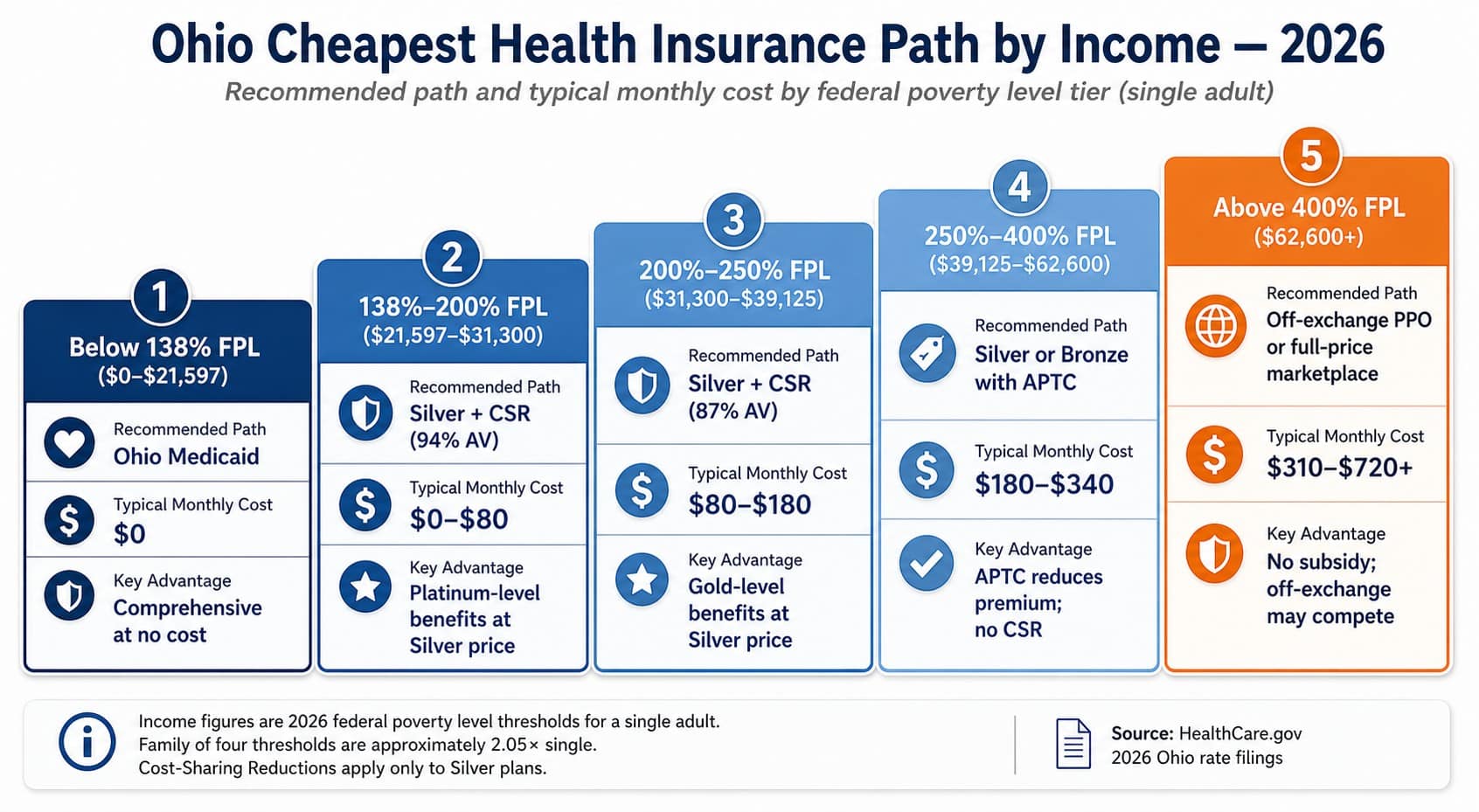
The total annual cost framing is also why “free health insurance Ohio” search results require care. Free coverage genuinely exists for Medicaid-eligible Ohioans — that’s straightforward. But “$0 premium Bronze plans” sometimes marketed as “free” can have $9,000 deductibles and substantial out-of-pocket exposure. The free part is the monthly premium; the not-free part is everything else. For most Ohioans, free or near-free coverage is the Silver+CSR strategy at the lowest income tiers, not the Bronze “free premium” tier — because Silver+CSR caps total annual exposure at substantially lower numbers.
Find the Cheapest Ohio Plan for Your Income
A licensed Ohio agent can run your subsidy estimate, check Medicaid eligibility, and compare cheapest-by-total-cost options across all 11 Ohio carriers — in about 15 minutes. Free help that gets you to the actually-cheapest plan, not just the lowest premium that costs the most when you use care.
Free Ohio affordable health insurance review across all eligibility paths.
Affordable Health Insurance Ohio for Above 400% FPL Households
For Ohioans above 400% of the federal poverty level — about $62,600 single or $128,600 family of four for 2026 — no marketplace subsidies apply. The cheapest plan options are full-price marketplace Bronze ($310-$520/month for a 40-year-old depending on county) or off-exchange PPO programs through national broker channels, which often beat full-price marketplace pricing for working Ohioans. Ohio’s lack of a state reinsurance program means full-price marketplace premiums run higher than in states like Maryland or New Jersey.
Full-price marketplace Bronze
For Ohioans above 400% FPL who want ACA-compliant coverage with the broadest plan choice, marketplace Bronze is the cheapest tier. Premiums run $310-$520/month for a 40-year-old depending on county. Higher for older Ohioans (3× at age 64).
- 11 Ohio marketplace carriers
- All 88 Ohio counties served
- $8,000-$10,600 deductibles typical
Off-exchange PPO (working Ohioans)
National PPO programs sold off-exchange to working Ohioans (W-2, 1099, or self-employed) often compete favorably with full-price marketplace pricing, particularly for ages 35-60 where ACA age-rating runs steepest. Nationwide network access included.
- Requires active employment income
- Nationwide network reciprocity
- Off-exchange — no subsidies apply
HSA-eligible high-deductible plans
For above-400% FPL Ohioans wanting tax-advantaged savings on healthcare costs, HSA-eligible HDHPs allow $4,400 (single) or $8,750 (family) annual tax-deductible contributions for 2026. The triple tax advantage materially reduces effective net premium cost.
- Available on marketplace and off-exchange
- Triple tax advantage
- Bronze tier most commonly HSA-eligible
Self-employed deduction strategy
Self-employed Ohioans can deduct 100% of health insurance premiums on Schedule 1, Line 17 of the federal 1040 — including premiums for spouse and dependents. Effective after-tax cost is materially lower than the sticker premium.
- Limited to business net profit
- Reduces both federal and Ohio state tax
- Confirm with a CPA for your situation
The lack of a state reinsurance program in Ohio matters most for this income tier. States with operating 1332 reinsurance waivers have demonstrably lower full-price marketplace premiums — Maryland’s reinsurance reduces statewide premiums by about 13.6%, Pennsylvania’s by 11.7%, New Jersey’s by 15.0%. Ohio submitted a 1332 reinsurance application years ago that was deemed incomplete and never modified. As a result, full-price Ohio premiums for above-400% FPL households run higher than peers in reinsurance states with similar demographic profiles. Off-exchange alternatives become more competitive in this comparison.
Cheapest Ohio Health Insurance Pricing by Region
Ohio’s cheapest health insurance pricing varies significantly by region. Major metros (Columbus, Cleveland, Cincinnati) typically have lower full-price premiums because more carriers compete there — driving rate competition. Rural Ohio counties often have higher full-price premiums because fewer carriers serve those markets. Subsidized pricing varies less across regions because the federal premium tax credit formula adjusts to local benchmark pricing — net premium for a subsidy-eligible Ohioan tends to be similar across regions at the same income.
| Ohio Region | Carrier Competition | Typical Cheapest Bronze (full-price) |
|---|---|---|
| Columbus (Franklin County) | 6+ carriers | $310–$390/month (40-year-old) |
| Cleveland (Cuyahoga County) | 5+ carriers | $320–$410/month |
| Cincinnati (Hamilton County) | 5+ carriers | $330–$420/month |
| Akron (Summit County) | 4+ carriers | $340–$430/month |
| Dayton (Montgomery County) | 4+ carriers | $340–$440/month |
| Toledo (Lucas County) | 4+ carriers | $350–$450/month |
| Rural Ohio counties | 2–3 carriers | $380–$520/month |
The county pricing variation matters most for above-400% FPL Ohioans paying full price. For subsidized shoppers, the ACA premium tax credit formula adjusts to local benchmark pricing — a Cleveland resident at 250% FPL pays roughly the same net premium as a rural Ohio resident at the same income, because the federal subsidy fills the gap to keep the expected contribution capped at the same percentage of income. The benefit of metro carrier competition flows mostly to unsubsidized buyers; subsidy-eligible shoppers see similar net costs across Ohio regions. Cleveland Clinic access via Medical Mutual or Oscar is one factor that varies more by region than price.
Strategies to Make Ohio Health Insurance More Affordable
Beyond choosing the right plan tier, several Ohio-specific strategies can reduce total annual healthcare cost. Maximize tax-advantaged HSA contributions if you have an HSA-eligible plan. For self-employed Ohioans, deduct premiums on Schedule 1 of the federal 1040. Use preventive care fully (covered at $0 cost-sharing on all ACA-compliant plans). Verify formulary tier for prescriptions before enrolling — same drug can be Tier 1 on one carrier and Tier 4 on another. Consider generic alternatives for any brand-name medications.
For many households, the most affordable health insurance Ohio offers comes from pairing a high-deductible plan with this approach. The HSA strategy is particularly powerful for Ohioans choosing high-deductible Bronze or HSA-compatible plans. The 2026 HSA contribution limit is $4,400 for self-only coverage and $8,750 for family coverage. Contributions are tax-deductible (reducing federal and Ohio state income tax), grow tax-free, and withdraw tax-free for qualified medical expenses. For a 35-year-old Ohioan in the 22% federal bracket, maxing out an HSA saves about $968 annually in federal taxes alone — effectively reducing the after-tax cost of an HSA-eligible plan by that amount. The combination of HSA savings and Ohio state income tax deduction makes HSA-eligible plans materially cheaper on a net basis than the sticker premium suggests.
Preventive care use is another underutilized Ohio affordability strategy. Annual physicals, recommended screenings (mammograms, colonoscopies, blood pressure checks), routine vaccinations, and contraception are all covered at $0 cost-sharing on every ACA-compliant Ohio plan — including Bronze. Ohioans who skip preventive care to “save money” actually cost themselves more in the long run because conditions caught early at no cost are dramatically cheaper to treat than conditions discovered later. The free preventive care benefits apply on both marketplace and Medicaid plans.
The independent HealthCare.gov lower-costs guide covers federal subsidy eligibility in detail. The Ohio Department of Medicaid provides direct enrollment and eligibility information for Ohio Medicaid. The KFF subsidy explainer walks through the post-2025 subsidy math by income tier.
Frequently Asked Questions
Common questions about affordable health insurance Ohio shoppers face cover Ohio Medicaid eligibility, whether $0-premium plans are really free, the difference between Bronze and Silver+CSR, what happens at the 400% FPL cliff, and how to find the cheapest plan that includes your doctors. Answers below reflect 2026 plan year rules and the post-HR 1 subsidy environment.
What’s the cheapest health insurance in Ohio for 2026?
For Ohioans below 138% of the federal poverty level (under $21,597 for a single adult or $44,367 for a family of four), Ohio Medicaid is the cheapest at essentially $0 monthly premium. Above that income threshold but below 250% of FPL, Silver-tier marketplace plans with Cost-Sharing Reductions are typically cheapest on total annual cost — beating $0-premium Bronze plans for anyone who actually uses healthcare. Above 400% of FPL where no subsidy applies, off-exchange PPO programs through national broker channels often compete favorably with full-price marketplace plans.
Is “free health insurance Ohio” really free?
Free Ohio coverage genuinely exists for Medicaid-eligible Ohioans — that’s straightforward and comprehensive. But “$0 premium” marketplace Bronze plans marketed as “free” only cover the monthly premium; you still pay deductibles, copays, and coinsurance up to the plan’s out-of-pocket maximum (often $9,000+ for Bronze). The free part is just the premium; everything else is full cost until you hit the deductible. For most Ohioans, the actually-cheapest plan once healthcare is used is Silver+CSR, not Bronze with $0 premium.
How do I qualify for Ohio Medicaid in 2026?
Ohio expanded Medicaid in 2014 under the Affordable Care Act. For 2026, you generally qualify if your annual household income is below 138% of the federal poverty level — about $21,597 for a single adult, $29,221 for a household of two, or $44,367 for a family of four. Other criteria apply (Ohio residency, U.S. citizenship or lawful presence, not currently incarcerated). Ohio Healthy Start (CHIP) covers children in higher-income families up to 206% of FPL. Application is through Benefits.Ohio.gov or by running the HealthCare.gov prescreener which routes Medicaid-eligible applicants automatically.
Why did affordable health insurance Ohio prices go up for 2026?
Three forces pushed 2026 Ohio marketplace prices higher than 2025: enhanced premium tax credits expired at the end of 2025, returning the 400% FPL subsidy cliff and reducing subsidy amounts for households below 400% FPL; two carriers exited the Ohio marketplace at year-end, reducing competition in some counties; and underlying medical cost inflation continued at roughly 5-8% annually. The combination drove Ohio’s marketplace enrollment down 21% from 2025 to 2026 — about 137,000 Ohioans lost or didn’t renew coverage. Subsidized Ohio shoppers below 400% FPL still receive substantial help, just less than they got in 2025.
Is Bronze cheaper than Silver+CSR in Ohio?
Only at the monthly premium level — and only if you don’t use healthcare. Bronze plans have lower monthly premiums (often $0 after subsidies for Ohioans under 250% FPL) but high deductibles ($8,000-$10,600). Silver plans with CSR enhancement for Ohioans below 250% FPL have higher monthly premiums ($50-$200) but dramatically lower deductibles ($1,500-$4,000) and out-of-pocket maximums. Total annual cost (premium × 12 plus expected out-of-pocket) is what matters. For anyone who uses any healthcare, Silver+CSR is cheaper. Bronze only wins if you go a year with zero healthcare utilization beyond preventive care.
What’s the cheapest Ohio plan above 400% FPL?
Above 400% of FPL where no marketplace subsidies apply for 2026, two paths typically compete for cheapest: full-price marketplace Bronze plans ($310-$520/month for a 40-year-old depending on county) and off-exchange PPO programs through national broker channels for working Ohioans. Off-exchange PPO often beats full-price marketplace pricing in the 35-60 age range where ACA age-rating runs steepest. Off-exchange programs require active employment income (W-2, 1099, or self-employed) and don’t qualify for any federal subsidies — but they offer nationwide network access not available on most Ohio marketplace plans.
Get the Cheapest Ohio Health Insurance for Your Income
A licensed Ohio agent can check Ohio Medicaid eligibility, run subsidy-aware quotes across all 11 marketplace carriers, compare Silver+CSR against Bronze on total annual cost, and identify off-exchange alternatives if you’re above 400% FPL — at no cost and no obligation. Free 15-minute review by phone.
Free affordable Ohio health insurance review across all eligibility paths.
Related Ohio Health Insurance Resources
How HealthCare.gov works for Ohio shoppers — plans, subsidies, and 2026 enrollment.
Best Ohio Health Insurance PlansCompare top Ohio carriers by network, customer satisfaction, and total cost.
Ohio Individual Health InsuranceCoverage for self-employed Ohioans, freelancers, and individual buyers.
Ohio Health Insurance QuotesFree side-by-side comparison of 2026 Ohio marketplace plans by zip code.
Ohio Small Business Health InsuranceGroup plans, ICHRA, QSEHRA, and SHOP options for Ohio employers with 1-50 employees.
Ohio Health Insurance GuideComplete state pillar guide to coverage options, costs, and carriers in Ohio.
Broker Disclosure
ForHealthInsurance.com is an independent health insurance agency serving Ohio residents. We are not affiliated with any carrier or government agency. We help you compare plans and enroll in coverage that meets your needs at no extra cost to you.