Ohio Health Insurance Quotes 2026: How to Compare Plans Across 11 Carriers
Ohio health insurance quotes look simple at first — a monthly dollar figure attached to a plan name. The reality is that two quotes for the same family in the same Columbus zip code can differ by hundreds of dollars per month because the source pulled different data, applied different subsidy assumptions, or quoted before Ohio’s 2026 rate filings closed. This guide walks through what Ohio health insurance quotes actually contain, what information you need before requesting one, why two quote sources can show you wildly different prices for the same plan, and how to compare quotes across all 11 of Ohio’s 2026 marketplace carriers without making the apples-to-oranges mistakes most first-time shoppers make.

What brings you here today?
What’s Actually in an Ohio Health Insurance Quote?
A complete Ohio health insurance quote shows the monthly premium, deductible, out-of-pocket maximum, metal tier, carrier name, plan type (HMO, EPO, PPO), and — critically — whether subsidies have been applied. A quote without explicit subsidy assumptions can’t be compared. The 2025 average net premium for subsidy-eligible Ohio enrollees was about $79 per month after an average $500 tax credit. The same plan at full price ranged from $410 to $720 for benchmark Silver in Franklin County.
The line items every Ohio health insurance quote should include are straightforward but often hidden. Monthly premium is the headline number. Deductible is what you pay out-of-pocket before insurance starts contributing. Coinsurance is the percentage you pay after the deductible (typically 20–40% on Bronze plans, 10–20% on Gold). Out-of-pocket maximum caps your annual exposure — once you hit it, the plan covers 100%. Copays are the flat fees for routine visits and prescriptions.
Two numbers that look optional but aren’t: whether the plan is on-exchange or off-exchange, and what subsidy figure (if any) was applied to produce the quoted premium. An off-exchange quote at $440/month and an on-exchange quote at $80/month for the same plan from the same carrier is the result of subsidies, not different plans. Similarly, a quote pulled before the Ohio Department of Insurance approved final 2026 rates reflects 2025 prices — confirmed too late, that price difference vanishes the moment you enroll.
SBC: the document behind the quote
Every HealthCare.gov plan available to Ohio shoppers publishes a Summary of Benefits and Coverage (SBC) document — a standardized 8-page summary required by federal law. The SBC has the actual numbers behind a quote: deductibles, copays for specific services, prescription coverage tiers, and example cost scenarios for common medical events (childbirth, diabetes management, broken leg). When two quotes look identical at the premium level, comparing SBCs side-by-side is how you find the actual differences.
What You Need Before Requesting Ohio Health Insurance Quotes
Accurate Ohio health insurance quotes require seven pieces of information: your home zip code, the ages of everyone covered, your projected 2026 household income (MAGI), tobacco use status, household size, current employer coverage status, and any prescription drugs you take regularly. Missing any one of these turns the quote into a generic placeholder rather than a personalized number you can act on.
Identifying details
- Home zip code (county is derived from this)
- Age of each covered household member
- Tobacco use status for each adult
- Sex assigned at birth (used for benchmark math)
- U.S. citizenship or lawful presence documentation
Income and household
- Projected 2026 MAGI (modified adjusted gross income)
- Total household size for tax-filing purposes
- Whether anyone is a tax dependent
- Self-employment versus W-2 income breakdown
- Expected retirement-account withdrawals (for early retirees)
Current coverage status
- Whether you have access to employer coverage
- If yes, the employee-only premium amount
- Whether you’re enrolled in Ohio Medicaid or Medicare
- Date current coverage ends (if applicable)
- Whether a qualifying life event recently applied
Care and prescription needs
- List of current providers (primary care, specialists)
- Regular prescription drugs and dosages
- Any planned procedures in 2026
- Pregnancy or planned pregnancy
- Chronic conditions requiring ongoing care
The two pieces most often gotten wrong are projected MAGI and current employer coverage status. For self-employed Ohioans, MAGI requires Schedule C net profit minus several deductions, not gross 1099 income — getting this wrong distorts the subsidy estimate by hundreds of dollars per month. For W-2 Ohioans, having access to “affordable” employer coverage (under 8.39% of household income for self-only coverage in 2026) makes you ineligible for marketplace subsidies even if you don’t enroll, so reporting the employer plan accurately is critical.
Why Do Ohio Health Insurance Quotes Vary by Source?
Ohio health insurance quotes from different sources can diverge by hundreds of dollars per month because each source applies different subsidy assumptions, plan-year data, and network filters. The HealthCare.gov prescreener uses official 2026 rates with your actual MAGI. Carrier-direct quotes typically show full price without subsidies. Aggregator sites often quote stale data or 2025 rates. A licensed broker quote uses current HealthCare.gov data with your specific situation.
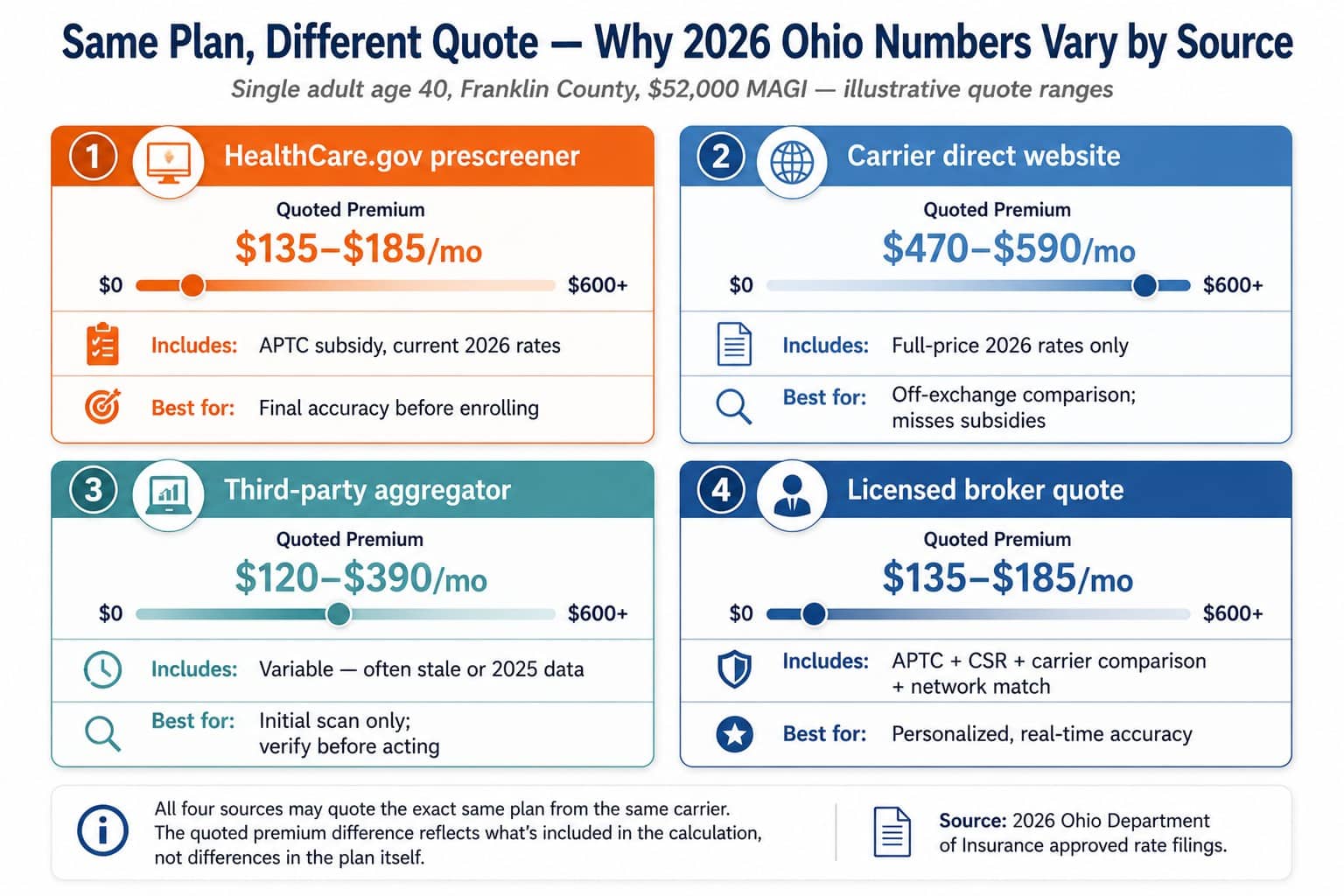
The HealthCare.gov prescreener is the most accurate source for subsidized Ohio health insurance quotes because it pulls real-time 2026 rate data and applies your actual MAGI to the federal subsidy formula. Carrier-direct quotes from Anthem, Medical Mutual, or any of the other Ohio marketplace carriers reflect the full retail price — useful for off-exchange comparison but typically two to four times what most Ohioans actually pay after subsidies.
Third-party aggregator sites are the most variable. Some pull current HealthCare.gov API data; others scrape carrier websites at intervals and may show stale prices. The 2026 Ohio rate filings closed in late summer 2025, but quotes pulled before the Ohio Department of Insurance approved the final rates may show preliminary numbers that changed before open enrollment opened on November 1. The most reliable check is to confirm the displayed plan year matches the year you’re shopping for.
| Quote Source | Typical Quoted Premium (single, age 40) | What’s Included | Best For |
|---|---|---|---|
| HealthCare.gov prescreener | $135–$185/mo (with APTC) | Subsidy applied, current 2026 rates | Final accuracy before enrolling |
| Carrier direct website | $470–$590/mo (full price) | Full-price 2026 rates only | Off-exchange comparison; misses subsidies |
| Third-party aggregator | $120–$390/mo (variable) | Often stale or 2025 data | Initial scan only; verify before acting |
| Licensed broker quote | $135–$185/mo (with APTC + CSR) | APTC, CSR, network and formulary match | Personalized real-time accuracy |
How to Compare Ohio Health Insurance Quotes Apples-to-Apples
Comparing Ohio health insurance quotes correctly requires three normalizations: convert each quote to total annual cost (premium × 12 plus expected out-of-pocket), verify the same network status for your providers across all carriers, and compare prescription formulary coverage for any drugs you take regularly. A $80/month Bronze quote and a $180/month Silver-with-CSR quote are not directly comparable — total annual cost is the only honest metric.
Method 1: Total Annual Cost
Premium × 12 + OOPMultiply quoted monthly premium by 12, then add expected out-of-pocket spending (deductible if you’ll hit it, plus copays for routine care). The plan with the lowest total — not the lowest premium — wins.
- Use 2025 medical spending as baseline
- Add 5–10% for 2026 cost inflation
- Cap OOP at the plan’s annual maximum
Method 2: Network Match Cost
In-net vs out-of-netFor each quote, check whether your existing primary care doctor and specialists are in-network. Out-of-network care costs 1.5–3× in-network rates and may not count toward your deductible or out-of-pocket maximum.
- Search by NPI on each carrier’s directory
- Confirm by phone with the doctor’s office
- Adjust total annual cost up if network gaps exist
Method 3: Drug Formulary Match
Tier-based copaysEach Ohio carrier’s formulary places drugs in tiers (1 through 4 typically). The same drug can be Tier 1 on one carrier and Tier 4 on another — affecting copays by hundreds of dollars per fill.
- Check each carrier’s 2026 formulary PDF
- Note the tier for each regular prescription
- Calculate annual prescription cost by carrier
Method 4: Subsidy Re-verification
Confirm APTC + CSRFor each quote that includes a subsidy, confirm the subsidy figure used. A Silver-tier quote that doesn’t include CSRs for an Ohioan eligible for them is undercounting savings by $1,000–$3,000 annually.
- Verify income tier matches CSR threshold
- Confirm Silver-only application of CSRs
- Re-run if income changed since last quote
The four-method comparison sounds elaborate but takes about 30 minutes when documents are in hand. The shortcut: any quote that doesn’t include all four data points is incomplete. A licensed Ohio broker can run all four normalizations against all 11 of Ohio’s 2026 marketplace carriers in roughly 20 minutes by phone — at no cost, since broker fees are built into plan pricing whether used or not. The HealthCare.gov plan-shopping guide covers the same comparison principles at a federal level, the Ohio Department of Insurance publishes carrier rate filings, and the KFF subsidy explainer walks through how the premium tax credit math is applied to quotes.
Get Real Ohio Health Insurance Quotes — All 11 Carriers
A licensed Ohio agent can run accurate 2026 quotes across all 11 marketplace carriers using your actual MAGI, verify your doctors’ network status, and produce a side-by-side total annual cost comparison — at no cost and no obligation. The full quote review takes about 20 minutes by phone or video call.
Compare 2026 Ohio quotes from all 11 carriers — accurate to your situation.
Step-by-Step: Getting Ohio Health Insurance Quotes for 2026
Getting accurate Ohio health insurance quotes for 2026 takes five steps: gather your information, run the HealthCare.gov prescreener, request quotes from each relevant carrier (or a broker), compare quotes by total annual cost, and verify networks before enrolling. The full process typically runs 60–90 minutes when documents are ready, and the prescreener step alone takes about five minutes.
Gather your seven required data points
Zip code, ages, MAGI projection, tobacco status, household size, current coverage, and prescription list. Self-employed Ohioans should have prior-year Schedule C numbers handy. Early retirees should know expected 2026 retirement-account withdrawals — Roth versus Traditional matters for MAGI calculation.
Run the HealthCare.gov prescreener
At HealthCare.gov, the prescreener returns your subsidy eligibility, Ohio Medicaid eligibility, and CSR eligibility before you commit to creating a full account. It uses current 2026 rates and accurate Ohio-specific subsidy math. This is the most accurate single quote source available to Ohioans without engaging a broker.
Pull comparison quotes from carriers or a broker
Either request quotes from each Ohio carrier directly through their websites (full-price only — no subsidies applied) or work with a licensed broker who pulls subsidized quotes across all 11 carriers in one session. Broker quotes save time when comparing more than two carriers and are free of charge to you.
Compare quotes by total annual cost
Multiply each quoted monthly premium by 12 and add expected out-of-pocket spending. Adjust for network gaps and prescription formulary differences. The lowest total annual cost wins — not the lowest monthly premium. A subsidized Silver plan often beats a $0-premium Bronze plan for anyone who uses care.
Verify networks before enrolling
For the top two or three quotes, pull each carrier’s provider directory and search for your doctors by name and NPI. Call each doctor’s office to confirm they accept that specific plan — not just the carrier in general. Pharmacy network is similarly important if you fill prescriptions regularly.
When Do Ohio Health Insurance Quotes Change?
Ohio health insurance quotes change at predictable points in the year. Annual rate filings close in late summer for the following plan year. New rates take effect January 1. Subsidy amounts can change quarterly if your income tracks differently from your initial projection. Mid-year carrier exits or new carrier entries shift quotes for affected zip codes — the two carrier exits at the end of 2025 are the most recent major Ohio examples.
The annual cycle for Ohio quotes follows a fixed pattern. Carriers file proposed rates with the Ohio Department of Insurance in spring or early summer. The Department reviews and approves final rates by late summer. Plans become viewable on HealthCare.gov in October. Open enrollment opens November 1 with the new rates already locked in. Coverage starts January 1. A quote pulled in July may reflect 2025 prices; a quote pulled in late October will reflect 2026 prices.
Within a plan year, quotes can shift for individual Ohioans for two reasons. Income changes (a new job, a major freelance contract, a retirement-account withdrawal) update your subsidy calculation when you report them — and you’re required to report material changes within 30 days. Household changes (marriage, divorce, birth, death) similarly recalculate subsidies. Both changes are handled through the HealthCare.gov account portal and don’t require a new application — only an update to existing data.
Quote prices ≠ what you’ll pay
The number on an Ohio health insurance quote is what you would pay if your projected income proves accurate. The actual amount is reconciled at tax time on Form 8962. If your income comes in higher than projected, you may owe back some or all of the subsidy advance. Under HR 1, those repayment caps were eliminated for 2026 and beyond, so substantial income overshoots can produce large tax-time bills. The quote is a real-time estimate, not a guarantee.
Frequently Asked Questions
Common questions about Ohio health insurance quotes cover whether quotes are binding, how often quotes refresh, what happens if your income changes mid-year, why broker quotes match HealthCare.gov prescreener quotes, group quote questions for small businesses, and how Ohio’s lack of a state reinsurance program affects quoted premiums. Answers below reflect 2026 plan year rules and the post-HR 1 reconciliation environment.
Are Ohio health insurance quotes binding?
No. An Ohio health insurance quote is an estimate based on your reported information at the time of the quote. The premium becomes binding only after you complete enrollment and the carrier accepts the application. Even after enrollment, the actual amount you pay is reconciled at tax time on IRS Form 8962 against your final 2026 MAGI. If your income comes in higher than the quote assumed, the IRS may recover some of the subsidy at tax time. Quotes are accurate snapshots, not contracts.
How often should I refresh my Ohio health insurance quote?
Refresh your Ohio health insurance quotes whenever any of the seven required data points changes — particularly MAGI estimate, household size, current coverage status, or zip code. Self-employed Ohioans with variable income should refresh quarterly or after any major contract or payment. W-2 Ohioans typically only need to refresh at open enrollment unless a qualifying life event occurs mid-year. Within the 60-day SEP window after a qualifying event, a fresh quote is required to enroll.
Do broker quotes cost extra in Ohio?
No. Licensed Ohio brokers are paid by carriers, not by you. The same plan from the same carrier costs the same whether you enroll directly through HealthCare.gov, through a broker, or through a certified navigator. Broker fees are built into plan pricing across all 11 Ohio marketplace carriers regardless of enrollment channel. The benefit of using a broker is that you get personalized comparison work and ongoing support — claims questions, SEP changes, network verification — at no cost to you.
Why does my Ohio health insurance quote include a subsidy?
If you ran your quote through the HealthCare.gov prescreener or worked with a licensed Ohio broker, the quote applied an Advance Premium Tax Credit (APTC) based on your projected 2026 MAGI. For 2025, over 90% of Ohio marketplace enrollees received an APTC averaging $500 per month, dropping the effective monthly premium for most Ohioans to roughly $79 (smaller for 2026 after enhanced subsidies expired). If your quote shows a much higher number — typically $470 to $590 for a Silver plan — it likely came from a carrier-direct site that doesn’t apply subsidies. Always confirm whether subsidies are included.
What about Ohio group health insurance quotes for small businesses?
Group health insurance quotes for Ohio small businesses follow a different process than individual marketplace quotes. Ohio small businesses purchase coverage directly from carriers or through licensed brokers, not through HealthCare.gov’s individual marketplace prescreener. Group quotes require employer-side information (employee census with ages and zip codes, employer contribution percentage, plan tier preferences) rather than household-side MAGI data. The detailed Ohio small business health insurance page in this cluster covers group quote mechanics in depth, including SHOP marketplace options and ICHRA alternatives.
What if my income changes after I get a quote?
Report material income changes to HealthCare.gov within 30 days. Your subsidy will be recalculated based on the updated MAGI projection — increasing the subsidy if income drops, decreasing it if income rises. The change takes effect the first of the month after you report it. End-of-year reconciliation on IRS Form 8962 corrects any difference between your quoted subsidy and your actual eligibility. Under HR 1, repayment caps that previously protected against substantial underestimates were eliminated for 2026, so accurate mid-year reporting matters more than it used to.
Run Your Ohio Health Insurance Quote in Under 20 Minutes
A licensed Ohio agent can pull accurate 2026 quotes across all 11 marketplace carriers, apply your subsidy, verify your doctors’ networks, and produce a side-by-side total annual cost comparison — at no cost and no obligation. Most quote reviews take 15 to 20 minutes by phone or video call.
Get accurate Ohio health insurance quotes from all 11 carriers in one session.
Related Ohio Health Insurance Resources
How HealthCare.gov works for Ohio shoppers — plans, subsidies, and 2026 enrollment.
Best Ohio Health Insurance PlansCompare top Ohio carriers by network, customer satisfaction, and total cost.
Affordable Ohio Health InsuranceLower your monthly cost with subsidies, Medicaid, and lowest-premium plan strategies.
Ohio Individual Health InsuranceCoverage for self-employed Ohioans, freelancers, and individual buyers.
Ohio Small Business Health InsuranceGroup plans, ICHRA, QSEHRA, and SHOP options for Ohio employers with 1-50 employees.
Ohio Health Insurance GuideComplete state pillar guide to coverage options, costs, and carriers in Ohio.
Broker Disclosure
ForHealthInsurance.com is an independent health insurance agency serving Ohio residents. We are not affiliated with any carrier or government agency. We help you compare plans and enroll in coverage that meets your needs at no extra cost to you.