Ohio Small Business Health Insurance 2026: SHOP, ICHRA, and Group Plans
Ohio small business health insurance options for 2026 are broader than in many states. Ohio uses HealthCare.gov’s Small Business Health Options Program (SHOP) marketplace, giving employers with 1–50 full-time equivalent employees access to ACA-compliant group plans plus eligibility for the federal Small Business Health Care Tax Credit (up to 50% of premiums). The Ohio small business health insurance market includes major carriers like Anthem Blue Cross Blue Shield, Medical Mutual of Ohio, UnitedHealthcare, Aetna (still in the group market though it exited Ohio’s individual market at the end of 2025), and Humana. Ohio employers can also choose ICHRA, QSEHRA, or level-funded plan structures as alternatives to traditional group coverage.

What brings you here today?
What Is Ohio Small Business Health Insurance?
Ohio small business health insurance is group health coverage purchased by an employer with 1 to 50 full-time equivalent (FTE) employees. Plans must follow Affordable Care Act rules including community rating, guaranteed issue, and the ten essential health benefits. Ohio uses HealthCare.gov’s SHOP marketplace, plus direct-to-carrier purchasing and licensed broker channels. Small group premiums in Ohio typically run $400 to $850 per employee per month depending on plan design, employee ages, and county.
The federal definition of a “small employer” sets the boundary at 1 to 50 FTE employees. An Ohio business with one W-2 employee (other than the owner or family members) qualifies for small group coverage. The 50-FTE ceiling is calculated by combining all full-time employees (30+ hours per week) plus the part-time equivalent of part-time employees averaged over the year. Crossing the 50-FTE threshold moves a business into the “Applicable Large Employer” (ALE) category with materially different obligations under the federal employer mandate.
Ohio’s small group market follows ACA rules that protect employers and employees. Carriers can’t deny applications based on the medical history of any employee or family member. Premium rates are based on the group’s combined risk pool — adjusted only by age, county of residence, tobacco use, family size, and plan tier. The combination of guaranteed issue and community rating makes the small group market structurally accessible. Ohio Department of Insurance regulates carrier filings and approves rate changes annually.
Ohio uses SHOP — unlike some states
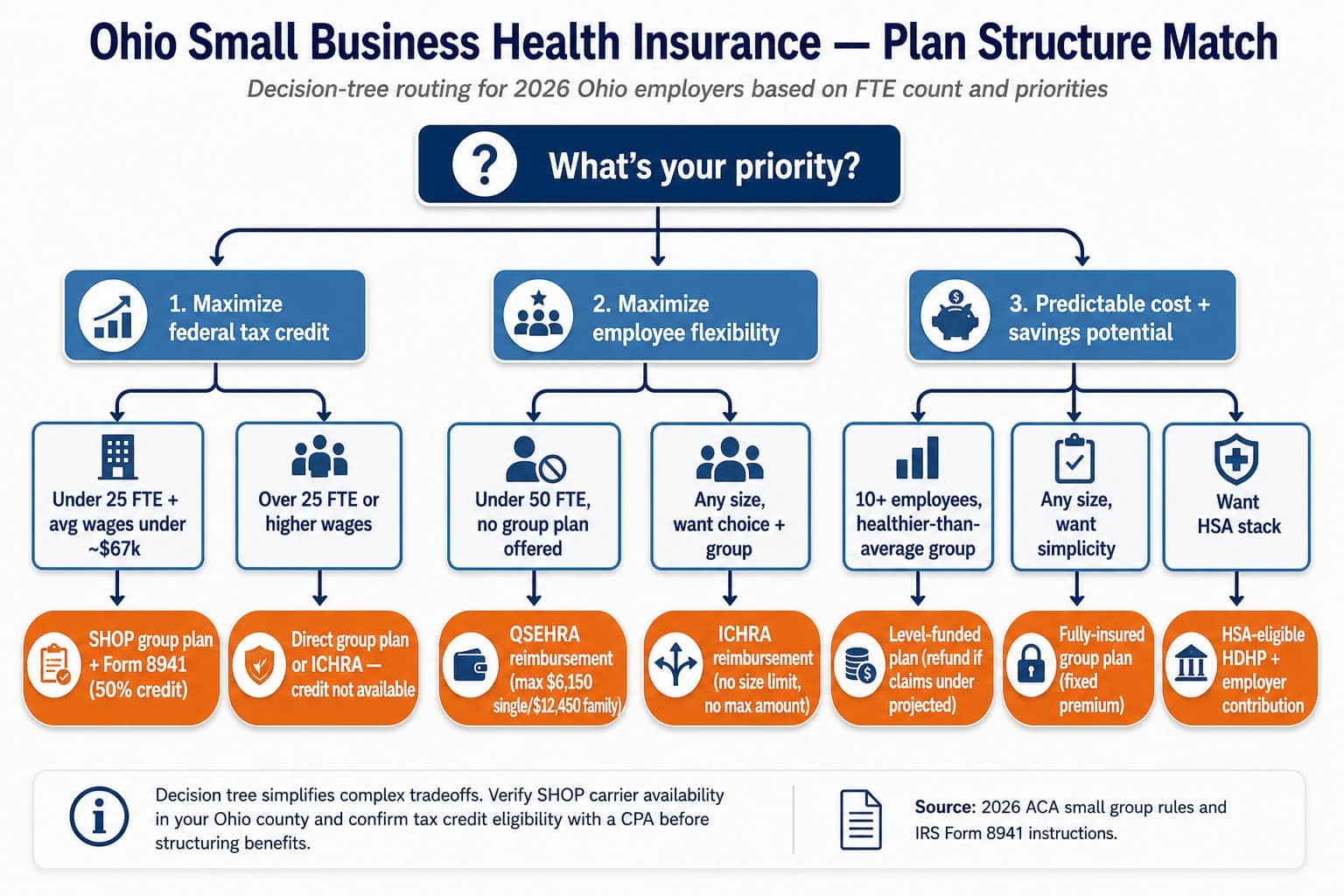
Ohio still has access to the federal Small Business Health Options Program (SHOP) marketplace through HealthCare.gov, unlike some states (Nevada, Washington, Minnesota) where carriers stopped offering SHOP plans. This matters because the federal Small Business Health Care Tax Credit — worth up to 50% of premiums for eligible Ohio small employers — generally requires SHOP enrollment. Ohio small businesses with under 25 FTE and average annual wages under approximately $67,000 (2026 indexed threshold) should evaluate whether SHOP is the right channel for tax credit eligibility before considering off-SHOP alternatives.
Carriers in the Ohio Small Group Market
Major carriers in the Ohio small business health insurance market for 2026 include Anthem Blue Cross Blue Shield, Medical Mutual of Ohio, UnitedHealthcare, Aetna, and Humana. Aetna exited Ohio’s individual marketplace at the end of 2025 but continues offering group plans for 2026. Each carrier offers PPO, HMO, EPO, and HDHP/HSA-compatible structures, with networks varying significantly between Cleveland (Cuyahoga County), Columbus (Franklin County), Cincinnati (Hamilton County), and rural Ohio counties.
Medical Mutual of Ohio
Ohio’s largest carrier, headquartered in Cleveland since 1934. Strong network depth across all 88 Ohio counties, with particular strength in Northeast Ohio. Long-standing inclusion of Cleveland Clinic and University Hospitals.
- Cleveland Clinic in network
- Strong rural Ohio reach
- Ohio-headquartered
Anthem Blue Cross Blue Shield
National Blue Cross Blue Shield licensee with the largest national network reciprocity available in Ohio’s small group market. Strong PPO options with BlueCard reciprocity for employees who travel for work.
- National BlueCard travel reciprocity
- Multiple plan tiers and structures
- Strong Cincinnati and Columbus presence
UnitedHealthcare
National UnitedHealthcare-branded small group plans. National network strength makes UHC competitive for Ohio businesses with multi-state operations or remote employees outside Ohio.
- National provider network
- Multiple plan tiers and structures
- Strong for multi-state employers
Aetna
Aetna exited the Ohio individual marketplace at the end of 2025 but continues offering small group plans for 2026. Network strength varies by region; PPO and HMO options available for small employers.
- Group market only (no individual)
- National network access
- Member services tied to CVS/Aetna integration
Humana
National carrier with Ohio small group presence. Often competitive on price for niche groups and small businesses willing to accept narrower networks. Strong dental and vision integration available.
- Competitive Bronze pricing
- Dental and vision riders available
- Network depth varies by Ohio region
Sierra Health & Life and others
Several other carriers participate in regional Ohio small group markets including Sierra Health & Life (Aetna affiliate) and CareSource. Carrier availability varies by employer size and region.
- Regional specialists serve local markets
- Sometimes competitive on price for niche groups
- Network depth varies significantly
Choosing a carrier for Ohio small business health insurance comes down to where your employees live and work. A Cleveland-based business with all employees in Cuyahoga County will weigh Medical Mutual, Anthem, and UnitedHealthcare differently than a Cincinnati business with employees across Hamilton County. Multi-region Ohio employers — particularly those with employees in both Northern and Southern Ohio — often default to Anthem or UnitedHealthcare because of broader cross-region network reach. Always verify employees’ existing primary care physicians by NPI before committing to any carrier.
How Much Does Ohio Small Business Health Insurance Cost?
Ohio small business health insurance premiums for 2026 typically run $400 to $850 per employee per month depending on plan design, employee ages, and county. A Columbus small business with 10 employees and average age 38 might pay $5,000 to $7,000 monthly for a Bronze group plan, or $7,000 to $10,500 monthly for a Gold-equivalent plan with broader networks. Group plan premiums in Ohio are generally higher than individual marketplace plans, but family pricing favors group structure.
Six factors drive the per-employee premium on Ohio small business health insurance: the average age of the employee group (older groups cost more under ACA rating rules), county distribution (rural Ohio generally costs more than Columbus, Cleveland, or Cincinnati), tobacco use rates, plan metal tier (Bronze through Platinum), network depth (HMO narrower than PPO), and any additional rider benefits such as dental, vision, or accident coverage. Family enrollments cost roughly 2.4 to 3.0 times single coverage, depending on age structure.
Employer contribution rules for Ohio small group plans typically require the employer to pay at least 50% of the employee-only premium. Carrier-specific participation rules also require that at least 70% to 75% of eligible employees enroll (or have other qualifying coverage) — preventing the employer from offering a plan that only the highest-utilization employees would buy. These structural rules keep the small group risk pool stable but create a coordination challenge: if not enough employees enroll, the plan can’t be issued.
| Group Size | Bronze (per employee/mo) | Silver (per employee/mo) | Gold (per employee/mo) |
|---|---|---|---|
| 2–10 employees | $400–$540 | $490–$680 | $610–$830 |
| 11–25 employees | $410–$560 | $510–$700 | $640–$850 |
| 26–50 employees | $430–$580 | $530–$720 | $670–$870 |
| Family coverage multiplier | 2.4×–3.0× | 2.4×–3.0× | 2.4×–3.0× |
The numbers above reflect typical 2026 Ohio small group ranges for a 38-year-old average employee in Franklin County (Columbus). Actual premiums for any specific group can run materially higher or lower depending on the age curve of the employee population, tobacco use, county distribution, and rider benefits. Ohio small business health insurance quotes are typically valid for 30 to 60 days, and rates can be locked in for the plan year once the group enrolls.
Ohio Small Business Health Care Tax Credit
Eligible Ohio small businesses can claim the federal Small Business Health Care Tax Credit — up to 50% of employer-paid health insurance premiums (35% for tax-exempt organizations) for two consecutive tax years. Eligibility requires fewer than 25 FTE, average annual wages under approximately $67,000 (2026 indexed threshold), at least 50% employer contribution to each employee’s premium, and SHOP marketplace enrollment. The credit is calculated on IRS Form 8941 and claimed via Form 3800.
The Ohio Small Business Health Care Tax Credit is one of the most powerful federal tax incentives for small employers offering health benefits. The maximum 50% credit applies to small businesses with under 10 FTE and average annual wages around $32,000 or less. As FTE count rises toward 25 or wages rise toward the upper limit, the credit phases down on a sliding scale. A typical eligible Ohio bakery with 8 FTE, $30,000 average wages, and $48,000 in annual employer-paid premiums might receive a $24,000 federal tax credit — meaningfully reducing the after-tax cost of providing employee benefits.
The two-year limit matters for planning. Ohio small businesses can only claim the credit for two consecutive tax years starting with the first year they file Form 8941 attached to their income tax return (or Form 990-T for tax-exempt entities). After the two-year window closes, the credit isn’t available again. This makes timing the credit deliberately — typically when the business first offers health benefits or when wages and FTE counts are most favorable — a meaningful strategy decision worth discussing with a CPA familiar with Ohio small business filings.
Tax credit eligibility requires SHOP enrollment
The federal Small Business Health Care Tax Credit specifically requires coverage purchased through the SHOP Marketplace. Ohio small businesses that purchase off-SHOP (direct from carrier or through a broker outside SHOP) generally don’t qualify for the credit, even if the plan would otherwise be identical. This is an important consideration when comparing SHOP versus off-SHOP enrollment paths for eligible Ohio small employers — the tax savings can offset the administrative friction of SHOP enrollment. A licensed Ohio small group broker can run the math both ways.
QSEHRA and ICHRA Alternatives to Group Plans
Two reimbursement-based alternatives let Ohio small businesses fund employees’ individual health coverage instead of buying a group plan: QSEHRAs (Qualified Small Employer HRAs, for employers under 50 FTE) and ICHRAs (Individual Coverage HRAs, no size limit). With either structure, the employer reimburses employees tax-free for individual market premiums and qualified medical expenses, employees keep their HealthCare.gov plans through job changes, and the employer avoids the participation-rate coordination problems of traditional group plans.
QSEHRA — Qualified Small Employer HRA
For Ohio employers with under 50 FTE who don’t offer a group plan. Reimburses employees tax-free for individual market premiums and qualified medical expenses. 2026 federal maximum reimbursement: $6,150 single, $12,450 family per year.
- Employer must not offer group coverage
- Same terms must apply to all eligible employees
- Reimbursements reduce ACA subsidy eligibility
- Simple to administer; no participation rules
ICHRA — Individual Coverage HRA
For Ohio employers of any size. Reimburses employees tax-free for individual market premiums. Can be offered alongside a traditional group plan to different employee classes (full-time vs part-time, etc.). No federal maximum on reimbursement amount.
- No employer size limit
- Can vary by employee class
- Employees use HealthCare.gov plans
- Counts toward employer mandate for ALEs
Level-funded plan
A type of self-funded coverage where the employer pays one predictable monthly amount that covers expected claims, stop-loss insurance, and admin fees. If actual claims come in lower than projected, unused dollars are refunded to the business at year-end.
- Typically requires 10+ employees
- Predictable monthly cost
- Refund potential for healthier groups
- Underwriting required (unlike fully insured)
HSA — Health Savings Account contributions
Employer contributions to employee HSAs alongside an HSA-eligible high-deductible group plan. Triple tax advantage. 2026 limits: $4,400 single, $8,750 family.
- Requires HSA-eligible HDHP
- Employer contributions are tax-deductible
- Funds belong to employee permanently
- Compatible with traditional group plans
The decisive question between traditional group plans and ICHRA for Ohio small businesses is administrative simplicity versus customization. Traditional group plans require coordinating one plan across all employees with shared deductibles, networks, and copays — straightforward to administer but constrained for businesses with diverse employee needs. ICHRAs let each employee buy the HealthCare.gov plan that fits their family, doctor relationships, and prescription needs — more administrative work to track reimbursements, but better individual fit for diverse workforces. Many growing Ohio small businesses are migrating from traditional group plans to ICHRA structures as the regulatory framework matures.
Compare Ohio Small Business Plans Across All Carriers
A licensed Ohio agent can pull quotes from all small group carriers, run a side-by-side cost comparison against ICHRA and QSEHRA alternatives, calculate Small Business Health Care Tax Credit eligibility, and produce a custom recommendation for your specific employee group — at no cost and no obligation. The full review takes 30 to 45 minutes.
Get a free comprehensive comparison of group, ICHRA, and QSEHRA options for your Ohio business.
The 50-FTE Employer Mandate Threshold
Ohio employers crossing the 50 full-time equivalent (FTE) employee threshold become Applicable Large Employers (ALEs) under the federal employer mandate. ALEs must offer affordable, minimum-value coverage to at least 95% of full-time employees and their dependents or face penalties. The 2026 affordability threshold is 8.39% of household income for self-only employee coverage. Penalties for non-compliance can run $2,970 to $4,460 per full-time employee annually depending on the violation type.
Calculating your FTE count is the first step in determining whether your Ohio business is approaching the threshold. Full-time employees (30+ hours per week) count as 1.0 FTE each. Part-time employees count by dividing their total monthly hours by 120. Seasonal employees working fewer than 120 days per year are excluded. The annual FTE count is the average of the 12 monthly FTE numbers. An Ohio business with 45 full-time employees and 12 part-time employees averaging 60 hours per month has about 51 FTE — making it an ALE.
The two penalty types matter to know about in advance. The “A” penalty ($2,970 per full-time employee annually for 2026) applies when an ALE fails to offer coverage to at least 95% of full-time employees and at least one full-time employee receives a marketplace subsidy. The “B” penalty ($4,460 per full-time employee receiving a subsidy for 2026) applies when an ALE offers coverage that is unaffordable or doesn’t meet minimum value. The B penalty caps at the A penalty amount, so the total exposure is bounded by the A calculation.
Ohio Small Business Health Insurance for Under-50 Employers
Ohio small business health insurance for employers with fewer than 50 FTE is voluntary — there’s no federal employer mandate. Ohio small businesses choose to offer coverage primarily for talent retention, recruitment, and employee productivity. The decision typically comes down to cost-of-coverage versus cost-of-talent-loss, with most growing Ohio employers concluding that some form of contribution beats none. The average Ohio small group premium contribution is roughly 60% to 75% of employee-only premium and 50% to 60% of family premium.
Decide between group plan, SHOP, and ICHRA/QSEHRA
Group plan via SHOP: best for businesses under 25 FTE wanting Small Business Health Care Tax Credit eligibility. Direct group plan: best for businesses with similar employee demographics and willingness to manage one plan. ICHRA: best for diverse workforces where employees benefit from picking their own HealthCare.gov plans. QSEHRA: best for very small Ohio businesses (typically under 25 employees) wanting administrative simplicity.
Set the employer contribution level
Carriers typically require minimum 50% employer contribution to employee-only premium. Many Ohio small businesses set 70% to 80% on employee-only and 50% on family. The contribution level affects both employee take-up and the perceived value of the benefit. For tax credit eligibility, the contribution must be at least 50% of each employee’s premium.
Choose carrier and metal tier
Pull quotes from each Ohio small group carrier through a licensed broker. Compare networks against your employees’ existing primary care doctors. Choose Bronze for lowest premium and HSA compatibility, Silver for balance, or Gold for richest benefits. Most Ohio small employers settle on Silver as the standard offering.
Enroll employees and meet participation rules
Carriers typically require 70% to 75% employee participation (counting employees with other qualifying coverage). Run open enrollment within the carrier’s specified window. Collect employee elections, dependent enrollments, and waiver documentation for those declining coverage due to spouse’s plan or other qualifying alternatives.
Annual renewal and tax credit filing
Ohio small group plans renew annually with new rates effective on the plan anniversary. Compare renewal rates against fresh quotes from competing carriers each year — renewal cost increases of 8% to 15% are typical for 2026 and competing carriers may offer better terms. Eligible businesses should file IRS Form 8941 with the income tax return to claim the Small Business Health Care Tax Credit.
Mid-Size Ohio Employers (11–49 FTE): Approaching the Threshold
Ohio employers with 11 to 49 FTE occupy a strategic middle zone — large enough to have meaningful insurance buying power but small enough to retain flexibility on plan structure. The most common pattern is a traditional group plan paired with an HSA contribution or supplementary HRA. Mid-size Ohio employers should also model the FTE trajectory carefully because crossing 50 FTE triggers the federal employer mandate. Level-funded plans become an attractive option in this size range.
The 11-49 FTE range is where Ohio small businesses typically gain access to better carrier rates. Carriers price small group plans on a sliding scale, and groups of 25+ employees typically qualify for slightly more favorable rates than groups of 5. The negotiation leverage isn’t large in absolute terms, but combined with the option to threaten to switch carriers at renewal, mid-size Ohio employers can realize 5% to 10% savings versus the standard small group rate card.
Level-funded plans become an option starting in this size range. Level-funded plans are technically self-insured but operate similarly to fully insured group plans from the employee perspective — predictable monthly cost, comprehensive coverage, ACA-compliant. The advantage is that healthier-than-average groups can receive a refund of unused claims dollars at year-end. The disadvantage is that worse-than-average claim years can result in a true-up cost. Level-funded structures generally require minimum 10 to 15 employees and are increasingly popular for Ohio employers in the 15-49 FTE range.
The independent KFF Employer Health Benefits Survey publishes annual data on small group plan structures and contribution patterns nationally — useful benchmarks for Ohio small business health insurance decisions. The Ohio Department of Insurance regulates the state’s small group market and publishes carrier-specific filings. The HealthCare.gov SHOP marketplace for Ohio covers the federal SHOP enrollment and Small Business Health Care Tax Credit details.
Frequently Asked Questions
Common questions about Ohio small business health insurance cover the SHOP marketplace, the 50-FTE employer mandate threshold, the Small Business Health Care Tax Credit eligibility, the difference between group plans and ICHRAs, how QSEHRAs work for very small Ohio employers, and what counts as a full-time equivalent employee. Answers below reflect 2026 federal rules including HR 1 changes and current Ohio-specific guidance.
What’s the smallest Ohio business that can buy group health insurance?
Under ACA rules, an Ohio business with at least one W-2 employee (other than the owner, partners, or family members) can qualify for small group health insurance. A solo entrepreneur with no employees other than themselves typically buys individual coverage through HealthCare.gov rather than a group plan. Once the business has even one non-family W-2 employee, the small group market becomes available. A common pattern: a business adds its first employee, the owner moves their personal coverage into the new group plan along with the employee.
Does Ohio offer SHOP coverage for small businesses?
Yes. Ohio uses HealthCare.gov’s Small Business Health Options Program (SHOP) marketplace for small employers with 1–50 full-time equivalent employees. Unlike Nevada, Washington, Minnesota, and several other states where carriers stopped offering SHOP plans, Ohio still has active SHOP carrier participation. SHOP enrollment is required for the Small Business Health Care Tax Credit (up to 50% of premiums) for eligible Ohio small businesses with under 25 FTE and average annual wages under approximately $67,000.
Can my Ohio small business get the Small Business Health Care Tax Credit?
Eligibility requires: under 25 FTE, average annual wages under approximately $67,000 (2026 indexed threshold), at least 50% employer contribution to each employee’s premium, and SHOP marketplace enrollment. The credit is up to 50% of employer-paid premiums (35% for tax-exempt) for two consecutive tax years. Calculated on IRS Form 8941, claimed via Form 3800. Average wage and FTE thresholds adjust annually for inflation. The credit is most valuable for businesses with under 10 FTE and average wages around $32,000 or less, where the full 50% applies before sliding-scale phase-down begins.
What’s the difference between group health insurance and ICHRA in Ohio?
Group health insurance is a single plan the employer purchases that covers all participating employees with shared deductibles, networks, and copays. ICHRA (Individual Coverage HRA) is a reimbursement structure where the employer gives each employee a tax-free monthly stipend to purchase their own HealthCare.gov plan. Group plans are simpler to administer; ICHRAs offer more individual flexibility for diverse workforces. Both meet ACA employer mandate requirements for Applicable Large Employers when structured correctly. Most Ohio small businesses still use traditional group plans, but ICHRA adoption is growing rapidly.
How do I count full-time equivalent employees for the 50-FTE threshold?
Full-time employees (30+ hours per week) count as 1.0 FTE each. Part-time employees count by dividing their total monthly hours by 120. Seasonal employees working fewer than 120 days per year are excluded. The annual FTE count is the average of all 12 monthly FTE numbers. An Ohio business with 35 full-time employees and 18 part-time employees averaging 80 hours per month has 35 + (18 × 80 ÷ 120) = 47 FTE — still below the 50 threshold. The IRS provides a worksheet for the calculation in the Form 1095-C instructions.
What’s the cheapest Ohio small business health insurance for a 5-employee business?
For an Ohio business with 5 employees, the lowest-cost compliant options typically rank: (1) QSEHRA reimbursement of employees’ individual HealthCare.gov plans — often the lowest total cost when employees qualify for marketplace subsidies, (2) Bronze-tier traditional group plan via SHOP with HSA contribution and Small Business Health Care Tax Credit — competitive when wages and FTE qualify for the credit, (3) ICHRA reimbursement — flexible but more administrative work. Total annual cost depends heavily on employee ages and family enrollments. A licensed Ohio broker can model all three structures against your specific employee data in roughly 30 minutes.
Get Ohio Small Business Health Insurance Quotes
A licensed Ohio agent can compare quotes across all small group carriers, run an ICHRA versus group plan analysis for your specific employee population, calculate Small Business Health Care Tax Credit eligibility, and identify which structure best matches your business — at no cost and no obligation.
Get a free comprehensive review of all Ohio small business health insurance options.
Related Ohio Health Insurance Resources
How HealthCare.gov works for Ohio shoppers — plans, subsidies, and 2026 enrollment.
Best Ohio Health Insurance PlansCompare top Ohio carriers by network, customer satisfaction, and total cost.
Affordable Ohio Health InsuranceLower your monthly cost with subsidies, Medicaid, and lowest-premium plan strategies.
Ohio Individual Health InsuranceCoverage for self-employed Ohioans, freelancers, and individual buyers.
Ohio Health Insurance QuotesFree side-by-side comparison of 2026 Ohio marketplace plans by zip code.
Ohio Health Insurance GuideComplete state pillar guide to coverage options, costs, and carriers in Ohio.
Broker Disclosure
ForHealthInsurance.com is an independent health insurance agency serving Ohio businesses. We are not affiliated with any carrier or government agency. We help you compare plans and enroll in coverage that meets your needs at no extra cost to you.