Best Health Insurance in Ohio 2026: Top Carriers Compared
The best health insurance in Ohio for 2026 isn’t a single carrier — it’s the right match between your specific situation and one of the 11 carriers in Ohio’s marketplace. The best Ohio health insurance plan for a Cleveland family that uses Cleveland Clinic for primary care is structurally different from the best Ohio health insurance plan for a self-employed Columbus freelancer who travels frequently. This Ohio carrier comparison walks through which carriers excel in which scenarios — by hospital system access, regional network depth, customer satisfaction ratings from third-party reviewers, prescription formulary coverage, and total annual cost after subsidies — so you can identify which is the best health insurance in Ohio for your specific use case.

What brings you here today?
How to Define “Best Health Insurance in Ohio” for Your Situation
There is no single best health insurance in Ohio for every household. The right answer depends on which doctors and hospital systems you use, whether you qualify for marketplace subsidies, your monthly premium budget, your expected medical utilization, and which Ohio county you live in. The best Ohio health insurance plan for a 35-year-old Columbus marketing freelancer earning $48,000 differs structurally from the best plan for a 58-year-old Cleveland early retiree with chronic care needs.
Five factors determine which carrier is best for any specific Ohio shopper. Network match is the most important — verify that your existing primary care doctor and any specialists are in-network with the carrier you’re considering. Total annual cost (premium × 12 plus expected out-of-pocket) is more accurate than comparing monthly premiums alone. Subsidy eligibility shifts the math dramatically — a Silver plan with Cost-Sharing Reductions often beats a $0-premium Bronze for anyone who uses care. Prescription formulary coverage matters if you take regular medications. And carrier customer service quality, claim denial rates, and provider directory accuracy all factor into the experience after enrollment.
Third-party rating sources help benchmark Ohio carrier quality. NerdWallet’s 2026 Ohio health insurance ratings evaluated plans representing about 97% of Ohio marketplace enrollment across cost, claims handling, government quality data, and complaint patterns. The Centers for Medicare and Medicaid Services publishes Quality Star Ratings for all marketplace carriers in Ohio annually. The National Committee for Quality Assurance (NCQA) accredits and rates health plans on clinical quality measures. The most reliable approach is to consult multiple sources rather than relying on any single ranking.
Third-party reviews and comparison data
Carrier rankings, customer satisfaction scores, and quality ratings cited on this page reference third-party sources including NerdWallet, the Centers for Medicare and Medicaid Services Quality Star Ratings, and the National Committee for Quality Assurance. Specific numerical scores change annually, and ranking methodologies vary across sources. Direct quotes and proprietary scoring data are not reproduced here. For current carrier-specific ratings, consult the third-party source directly. Carrier availability and plan specifics also vary by Ohio county — what’s true for Cleveland may not apply in Toledo or Dayton.
Best Health Insurance in Ohio by Hospital System
For Ohioans who use a specific hospital system for primary care or specialty treatment, the best Ohio health insurance choice usually starts with which carriers include that system in-network. Cleveland Clinic, University Hospitals, OhioHealth, Premier Health, Mercy Health, and ProMedica are the major systems shaping carrier selection across Ohio. Network inclusion varies year to year as carriers and systems renegotiate contracts — verify current network status before enrolling.
Cleveland Clinic patients
Cleveland Clinic has historically had narrower marketplace network inclusion than other major Ohio systems. For 2026, Medical Mutual of Ohio and Oscar Health Insurance both include Cleveland Clinic statewide.
- Medical Mutual: longest-standing Cleveland Clinic carrier
- Oscar: expanded Cleveland Clinic statewide for 2026
- Verify specific provider NPIs before enrolling
University Hospitals patients
University Hospitals (UH) network has broader carrier inclusion than Cleveland Clinic. Most major Ohio marketplace carriers include UH facilities and physicians, though specialty department coverage varies.
- Most Ohio marketplace carriers include UH
- Verify specific specialty department coverage
- UH primary care more universally covered
OhioHealth patients
OhioHealth is the dominant system across Columbus and central Ohio. Most Ohio marketplace carriers include OhioHealth in-network. Anthem Blue Cross Blue Shield, Medical Mutual, and Oscar all have strong central Ohio coverage.
- Broad carrier inclusion across central Ohio
- Anthem strongest national network reciprocity
- Riverside Methodist a major OhioHealth anchor
Mercy Health and Premier Health
Cincinnati and Dayton residents typically choose between Mercy Health (Catholic system) and Premier Health (regional system). Both have broad Ohio marketplace carrier inclusion across major carriers serving the region.
- Mercy Health: strong Cincinnati and Toledo presence
- Premier Health: Dayton metro anchor
- Anthem strongest in southwest Ohio
ProMedica patients
ProMedica is the dominant Toledo-area system. Carrier coverage of ProMedica varies more than other Ohio systems — verifying network inclusion is particularly important for Toledo-area shoppers.
- Toledo-anchored regional system
- Carrier coverage less consistent than other systems
- Verify ProMedica network inclusion before enrolling
Multi-system or out-of-state needs
Ohioans whose care patterns cross multiple Ohio hospital systems, or who need access to providers in neighboring states (Pittsburgh, Indianapolis, Lexington), benefit from carriers with broader network reciprocity.
- Anthem BlueCard: best national reciprocity
- Off-exchange PPO: nationwide network
- UnitedHealthcare: national network strength
The most reliable network verification approach is to pull each carrier’s 2026 provider directory by your doctor’s name and NPI, then call the doctor’s office to confirm they accept that specific plan — not just the carrier in general. Provider directories change year to year as contracts renegotiate, and a carrier that included Cleveland Clinic in 2025 may not in 2026 (or vice versa). Don’t assume continuity.
Best Health Insurance Ohio Carriers by Metro Area
Ohio carrier strength varies significantly by metro area. Cleveland (Cuyahoga County) shoppers face different carrier choices than Columbus (Franklin County) or Cincinnati (Hamilton County) shoppers. The best Ohio health insurance for any specific metro depends on which carriers serve that county, network depth in that region, and which hospital system patterns dominate locally. Rural Ohio counties typically have fewer carrier options — sometimes only 2 or 3 — making the comparison simpler but the outcome more constrained.
| Ohio Metro | Strong Carrier Choices | Notable Local Factor |
|---|---|---|
| Cleveland (Cuyahoga County) | Medical Mutual, Oscar, Anthem, CareSource | Cleveland Clinic access via Medical Mutual + Oscar |
| Columbus (Franklin County) | Anthem, Medical Mutual, Oscar, Buckeye/Ambetter | OhioHealth dominant; broad carrier choice |
| Cincinnati (Hamilton County) | Anthem, Buckeye/Ambetter, Medical Mutual | Mercy Health network; UC Health teaching hospital |
| Toledo (Lucas County) | Anthem, Medical Mutual, Buckeye/Ambetter | ProMedica access varies; verify carefully |
| Akron (Summit County) | Medical Mutual, Anthem, Buckeye/Ambetter | Summa Health network; Cleveland Clinic accessible |
| Dayton (Montgomery County) | Anthem, Medical Mutual, CareSource (HQ) | Premier Health network; CareSource hometown advantage |
| Rural Ohio counties | Anthem, Medical Mutual (typically 2–3 options) | Fewer choices; verify county-specific availability |
The Cleveland market deserves special attention because of Cleveland Clinic. For 2026, Medical Mutual of Ohio and Oscar Health are the two carriers consistently including Cleveland Clinic in-network statewide. Other carriers include Cleveland Clinic in some plans but not others, or include limited departments rather than the full system. Cleveland-area shoppers who use Cleveland Clinic for primary care or specialty treatment should verify the specific 2026 plan-level Cleveland Clinic inclusion before assuming any carrier covers their care.
Columbus shoppers benefit from broader carrier competition — most Ohio marketplace carriers serve Franklin County with multiple plan options each. The OhioHealth network anchored by Riverside Methodist is broadly covered, and choosing among carriers comes down to formulary, premium, and customer service rather than network access. Cincinnati shoppers face a similar competitive landscape with Mercy Health as the dominant network. Rural Ohio counties have less competition — Anthem and Medical Mutual typically serve the broadest set of rural counties, with Buckeye Health Plan and CareSource also offering rural plans.
Get a Personalized Best Ohio Plan Recommendation
A licensed Ohio agent can verify your existing doctors are in-network with each option, run subsidy-aware quotes across all 11 marketplace carriers, factor in prescription formulary coverage for your specific medications, and recommend the best Ohio health insurance plan for your situation — at no cost and no obligation. Free 15-minute review by phone.
Compare carriers side-by-side based on your specific doctors, prescriptions, and budget.
Best Health Insurance Ohio Carriers by Buyer Type
Ohio shopper situations break into recognizable patterns that predict carrier fit. Subsidy-eligible Ohioans below 250% of FPL usually get the best deal on Silver plans from Buckeye Health Plan, CareSource, or Molina because of competitive pricing combined with Cost-Sharing Reductions. Self-employed Ohioans typically benefit from Anthem’s national network reciprocity. Early retirees often find Medical Mutual’s Cleveland Clinic access valuable. Families with school-age children often prioritize OhioHealth or Mercy Health pediatric network depth.
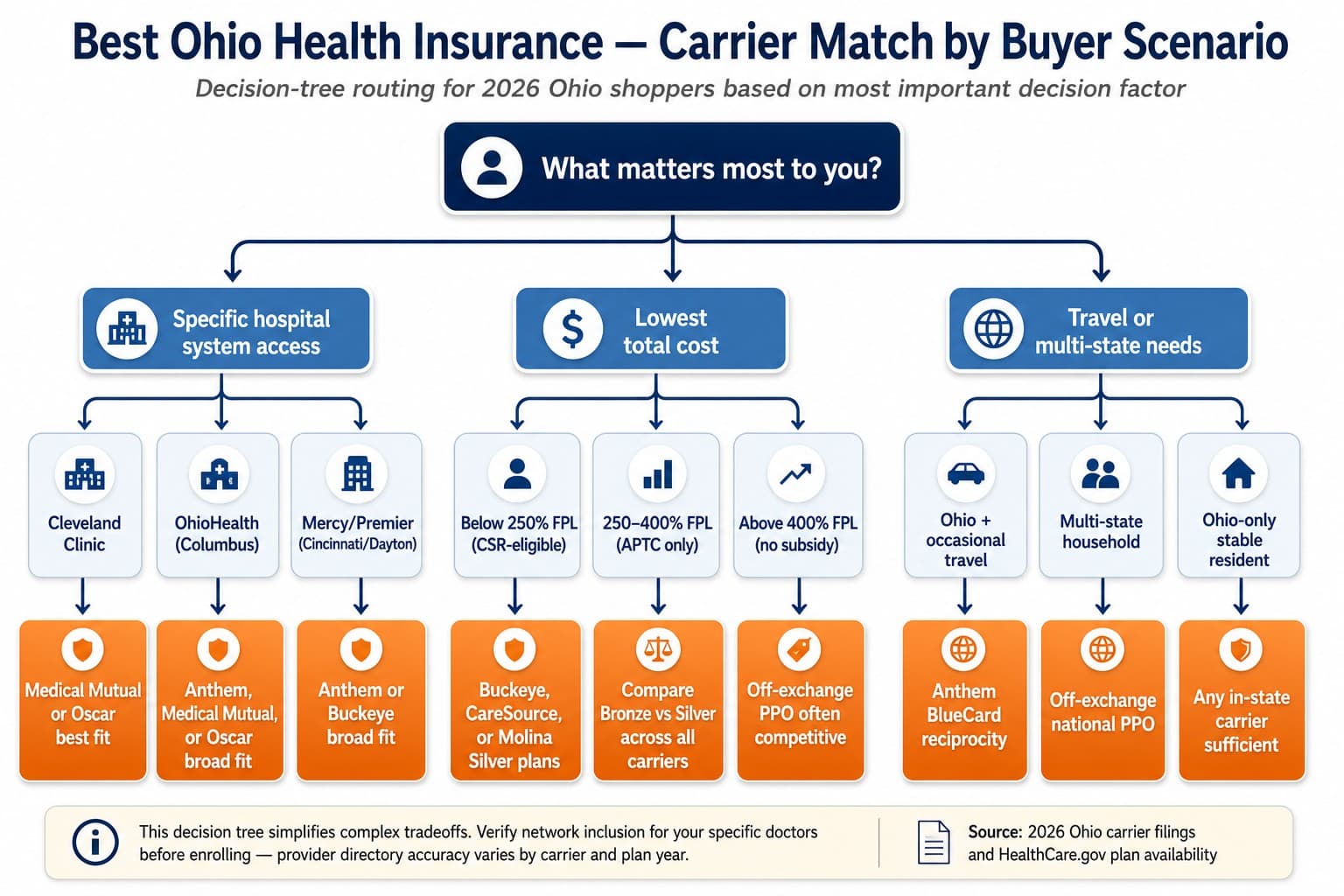
Subsidy-eligible Ohioans (under 400% FPL)
For 90%+ of Ohio marketplace enrollees who receive Advance Premium Tax Credits, Buckeye Health Plan (Ambetter from Centene), CareSource, and Molina Healthcare typically file the most competitive Silver pricing. Anthem and Medical Mutual offer broader networks at slightly higher subsidized cost.
Self-employed and 1099 Ohioans
Self-employed Ohioans often benefit from Anthem’s national BlueCard reciprocity if they travel for work, or off-exchange PPO plans for nationwide network access. CareSource is a strong nonprofit alternative for Ohio-anchored self-employed shoppers.
Early retirees ages 55–64
Early retirees facing 3× age-rated premiums benefit from Medical Mutual’s broad Ohio network depth and Cleveland Clinic access. For early retirees above 400% FPL no longer subsidy-eligible, off-exchange PPO programs through national broker channels often beat full-price marketplace pricing.
Families with school-age children
Pediatric network depth matters most for families with school-age kids. OhioHealth (Columbus), Mercy Health (Cincinnati/Toledo), and Akron Children’s Hospital (Akron) all have broad carrier inclusion. CareSource has a strong pediatric Medicaid-to-marketplace continuity story for income-variable families.
Cleveland Clinic patients
For Ohioans who use Cleveland Clinic specifically, Medical Mutual of Ohio has the longest history of Cleveland Clinic network inclusion. Oscar Health expanded Cleveland Clinic statewide for 2026. Other carriers may include limited departments but not the full system.
Above 400% FPL households
Ohioans no longer subsidy-eligible as of 2026 face full-price premiums. Off-exchange PPO plans for working Ohioans often compete favorably with full-price marketplace plans, particularly for those who want nationwide network access without referrals.
Customer Satisfaction and Quality Ratings for Ohio Carriers
Customer satisfaction and quality ratings vary across Ohio’s 11 marketplace carriers. Third-party sources including NerdWallet’s 2026 Ohio analysis, Centers for Medicare and Medicaid Services Quality Star Ratings, and the National Committee for Quality Assurance accreditation evaluate Ohio carriers on different criteria. NerdWallet’s Ohio rankings are publicly available; CMS Quality Star Ratings are listed on HealthCare.gov for each plan; NCQA accreditation status is published on the NCQA website. Each source weighs different factors.
What different rating sources measure: NerdWallet’s 2026 Ohio rankings emphasize cost (premiums, deductibles, copays, out-of-pocket maximums), claims handling, government quality data, and complaint patterns. CMS Quality Star Ratings on HealthCare.gov focus on member experience, medical care quality, and plan administration — typically 1 to 5 stars per plan. NCQA accreditation evaluates plans on clinical quality measures and member experience surveys (HEDIS, CAHPS). The three sources don’t always agree because they weight different dimensions.
Practical advice for Ohio shoppers using ratings: don’t rely on any single ranking. NerdWallet’s “best plan in Ohio” may not be the right choice for your specific situation if it doesn’t include your doctor in-network. CMS Quality Star Ratings are useful for comparing plans within the same metal tier from the same carrier. NCQA accreditation is a baseline credibility signal but doesn’t differentiate between accredited carriers. The right approach is to use third-party ratings as a filter to narrow your choices, then verify network match and total cost for your finalists.
The independent HealthCare.gov plan quality ratings page publishes the federal Quality Star Ratings used to evaluate marketplace plans. The Ohio Department of Insurance publishes carrier complaint data and consumer resources. For broader context, KFF publishes ongoing analysis of marketplace carrier performance and quality measures.
How to Choose the Best Health Insurance in Ohio for You
Choosing the best health insurance in Ohio for your specific situation comes down to a five-step verification process: identify your existing primary care doctor and any specialists, run quotes across all carriers serving your county, verify network inclusion for each finalist, check prescription formulary coverage, and compare total annual cost. The plan with the lowest total cost that includes your providers is the best Ohio health insurance for you — regardless of which carrier ranks highest on any third-party list.
The most common mistake Ohio shoppers make is choosing a “best ranked” plan without verifying it includes their doctors. A NerdWallet top-ranked plan that excludes your primary care physician will cost you more than a lower-ranked plan that includes them — once you factor in either switching doctors or paying out-of-network rates. Network match should always be the first verification, not the last. The provider directory on each carrier’s website is the authoritative source, but provider listings can be out of date — calling the doctor’s office to confirm specific plan acceptance is the most reliable verification.
Total annual cost is more accurate than monthly premium for comparing plans. A plan with a $80/month premium but a $9,000 deductible costs $9,960 if you actually use care that meets the deductible. A plan with a $200/month premium but a $4,000 deductible costs $6,400 in the same scenario — better. The shortcut: estimate annual healthcare utilization (a regular physical, expected prescription fills, any planned procedures), then add expected out-of-pocket cost to annual premium. The plan with the lowest combined number wins.
Frequently Asked Questions
Common questions about the best health insurance in Ohio cover which carrier ranks highest overall (no single answer), which carriers include Cleveland Clinic, the difference between marketplace and off-exchange options, how to handle a 2025 carrier exit for 2026, and whether to switch carriers at renewal versus auto-enrolling. Answers below reflect 2026 plan year rules and current Ohio carrier participation.
Which is the single best health insurance company in Ohio?
There is no single best health insurance company in Ohio for every household. The right choice depends on which doctors and hospital systems you use, your county, your subsidy eligibility, and your expected medical utilization. Different third-party sources rank Ohio carriers differently because they measure different dimensions — NerdWallet emphasizes cost and complaints, CMS Quality Star Ratings emphasize member experience and care quality, NCQA accreditation focuses on clinical quality. The best approach is to use these rankings as a filter to narrow candidates, then verify network match and total cost for your specific situation.
Which Ohio carriers include Cleveland Clinic in-network for 2026?
For 2026, Medical Mutual of Ohio and Oscar Health Insurance both include Cleveland Clinic in-network statewide. Medical Mutual has been the longest-standing Cleveland Clinic carrier; Oscar expanded Cleveland Clinic statewide for 2026 after several years of partial inclusion. Other Ohio marketplace carriers may include limited Cleveland Clinic departments but not the full system. Verify specific 2026 plan-level inclusion by pulling each carrier’s provider directory or calling Cleveland Clinic patient services to confirm which plans they accept.
What’s the best affordable health insurance in Ohio?
For Ohio shoppers below 250% of the federal poverty level, the most affordable Ohio coverage is typically Ohio Medicaid (free at $0 monthly premium for income-eligible Ohioans) or a Silver-tier marketplace plan with Cost-Sharing Reductions from Buckeye Health Plan, CareSource, or Molina Healthcare. For Ohio shoppers between 250% and 400% of FPL, marketplace plans with Advance Premium Tax Credits from any of the 11 carriers can be affordable depending on county pricing. Above 400% FPL where no subsidy applies, off-exchange PPO programs for working Ohioans often beat full-price marketplace pricing. The detailed affordable Ohio coverage page covers all these paths.
Should I switch Ohio carriers at renewal or auto-enroll?
Generally yes, you should actively shop and compare each year rather than auto-enrolling. Carrier participation, network composition, formulary tiers, and rate filings all change year to year. Even if your 2025 carrier still serves your county for 2026, the specific plan you had may have changed deductibles or copays, and another carrier may now offer a better fit for your situation. Auto-enrollment is a safety net to prevent gaps in coverage, not an optimal plan-selection mechanism. Plan to compare options during open enrollment each year — about 30 minutes of effort can save hundreds annually.
Is the best health insurance in Ohio always on the marketplace?
For most Ohio shoppers, yes — the marketplace is the right channel because it’s the only place to receive federal premium tax credits and Cost-Sharing Reductions, and 90%+ of Ohio marketplace enrollees received APTC averaging $500/month in 2025. For Ohio shoppers above 400% of FPL who don’t qualify for any subsidy, off-exchange options can be competitive — particularly off-exchange PPO programs with nationwide network access for working Ohioans who travel or have multi-state household needs. The marketplace is the default; off-exchange is an alternative for the narrow band of high-income Ohioans without subsidy access.
What happened to Aetna in Ohio for 2026?
Aetna was a major carrier in Ohio’s marketplace through 2025 but exited the individual marketplace nationwide at the end of 2025, including Ohio. Aetna continues to offer employer-sponsored group plans in Ohio, but no longer sells individual or family marketplace plans. Ohioans who had Aetna marketplace coverage in 2025 needed to either actively select a new 2026 carrier during the November 1, 2025 – January 15, 2026 open enrollment window, or accept HealthCare.gov’s auto-enrollment in a similar plan from a different carrier.
Find the Best Ohio Health Insurance for Your Situation
A licensed Ohio agent can verify your existing doctors are in-network with each carrier option, check your prescription formulary coverage across plans, run subsidy-aware quotes, and recommend the best Ohio health insurance plan for your specific situation — at no cost and no obligation. The full review takes about 15 to 20 minutes.
Free best-fit Ohio health insurance recommendation across all 11 carriers.
Related Ohio Health Insurance Resources
How HealthCare.gov works for Ohio shoppers — plans, subsidies, and 2026 enrollment.
Affordable Ohio Health InsuranceLower your monthly cost with subsidies, Medicaid, and lowest-premium plan strategies.
Ohio Individual Health InsuranceCoverage for self-employed Ohioans, freelancers, and individual buyers.
Ohio Health Insurance QuotesFree side-by-side comparison of 2026 Ohio marketplace plans by zip code.
Ohio Small Business Health InsuranceGroup plans, ICHRA, QSEHRA, and SHOP options for Ohio employers with 1-50 employees.
Ohio Health Insurance GuideComplete state pillar guide to coverage options, costs, and carriers in Ohio.
Broker Disclosure
ForHealthInsurance.com is an independent health insurance agency serving Ohio residents. We are not affiliated with any carrier or government agency. We help you compare plans and enroll in coverage that meets your needs at no extra cost to you.