Affordable Health Insurance in Virginia 2026: Subsidies
Affordable health insurance in Virginia for 2026 looks different than it did a year ago. Premiums on Marketplace.Virginia.gov rose by an average of 21.6% before subsidies, driven by the expiration of enhanced federal Advanced Premium Tax Credits at the end of 2025. About 86% of Virginia marketplace enrollees still qualified for subsidies in 2026, but many saw after-subsidy premium increases of $30–$150 per month. For Virginia residents at or below 138% of the federal poverty level, Cardinal Care Medicaid still covers about 1.8 million Virginians at no monthly premium. FAMIS covers approximately 183,526 children at no premium up to 200% of FPL. Virginia’s reinsurance program (in effect since 2023) moderates increases for non-subsidized enrollees. This guide covers every It anchors the affordable health insurance Virginia residents rely on.

What brings you here today?
Why Virginia Premiums Jumped 21.6% in 2026
Virginia’s 2026 ACA marketplace premiums increased by an average of 21.6% before subsidies, according to the SCC Bureau of Insurance — the largest single-year increase since the early ACA years. The primary driver was the expiration of enhanced federal Advanced Premium Tax Credits at the end of 2025. Their expiration shifted cost back to enrollees and altered risk pool dynamics, which carriers reflected in 2026 rate filings.
Approved 2026 rate changes by carrier ranged widely. Optimum Choice (UnitedHealthcare) was approved at +35.4% — the largest increase in Virginia. Cigna at +22.8%, Sentara Health Plans at +22.4%, Anthem HealthKeepers at +20.9%, CareFirst BlueChoice at +18.2%, and Kaiser Mid-Atlantic at the lowest +11.8%. Aetna Health Inc. exited Virginia’s individual market entirely, leaving approximately 13,721 Virginia members to find a new 2026 plan. The Virginia Bureau of Insurance reviews each carrier’s filing through SERFF (System for Electronic Rate and Form Filing) That review affects the affordable health insurance Virginia shoppers seek.
The 21.6% headline figure is calculated before subsidies. For most subsidized Virginians, the after-subsidy premium increase was much smaller — often $30–$150 per month rather than 21.6% on a full premium — because the subsidy formula adjusts to keep the enrollee’s contribution proportional to income. Virginians who experienced sticker shock on January 2026 renewal notices should log into Marketplace.Virginia.gov, update household income and information for 2026, and re-shop the subsidy. Many enrollees who skip the income update miss subsidy adjustments they qualify for. Some Virginians switched to higher-deductible plans for lower monthly premiums; others enrolled in shorter or more limited coverage; and roughly 20,000 households dropped marketplace coverage entirely Trends shape the affordable health insurance Virginia families plan around.
Virginia’s Reinsurance Program: Quiet Premium Help
Virginia’s reinsurance program took effect in 2023 and reimburses health insurance carriers for very high-cost individual market claims — reducing the amount carriers need to charge in premiums for catastrophic medical events. The program runs under a Section 1332 State Innovation Waiver approved by CMS. It primarily benefits non-subsidized Virginians — those above 400% of FPL who pay full premium without Advance Premium Tax Credit help.
Reinsurance works invisibly to enrollees. Virginia residents don’t apply for it or receive any direct payment. Instead, the program reduces the underlying cost of selling insurance in Virginia, which carriers reflect in their rate filings to the SCC Bureau of Insurance. Without reinsurance, Virginia’s 2026 premium increases would have been higher across all carriers — typically by an additional 5–10 percentage points — because carriers would need to fully fund catastrophic claims through premium pricing. The program is most valuable to households above 400% of FPL who buy coverage at full price; subsidized enrollees see less direct benefit because their out-of-pocket cost is already Subsidies build the affordable health insurance Virginia residents can reach.
Who benefits most from Virginia’s reinsurance program
Non-subsidized Virginians are the primary beneficiaries. A self-employed Northern Virginia consultant earning $120,000 (above the 400% FPL threshold for a single adult) buys Marketplace.Virginia.gov coverage at full price — with no Advance Premium Tax Credit. Reinsurance moderates the premium that consultant pays for a Silver or Gold plan, often saving several hundred dollars per year compared to a no-reinsurance scenario. Subsidized enrollees benefit indirectly because reinsurance keeps benchmark premiums lower, which Income drives the affordable health insurance Virginia buyers qualify for.
Cardinal Care: Virginia Medicaid for Adults Below 138% FPL
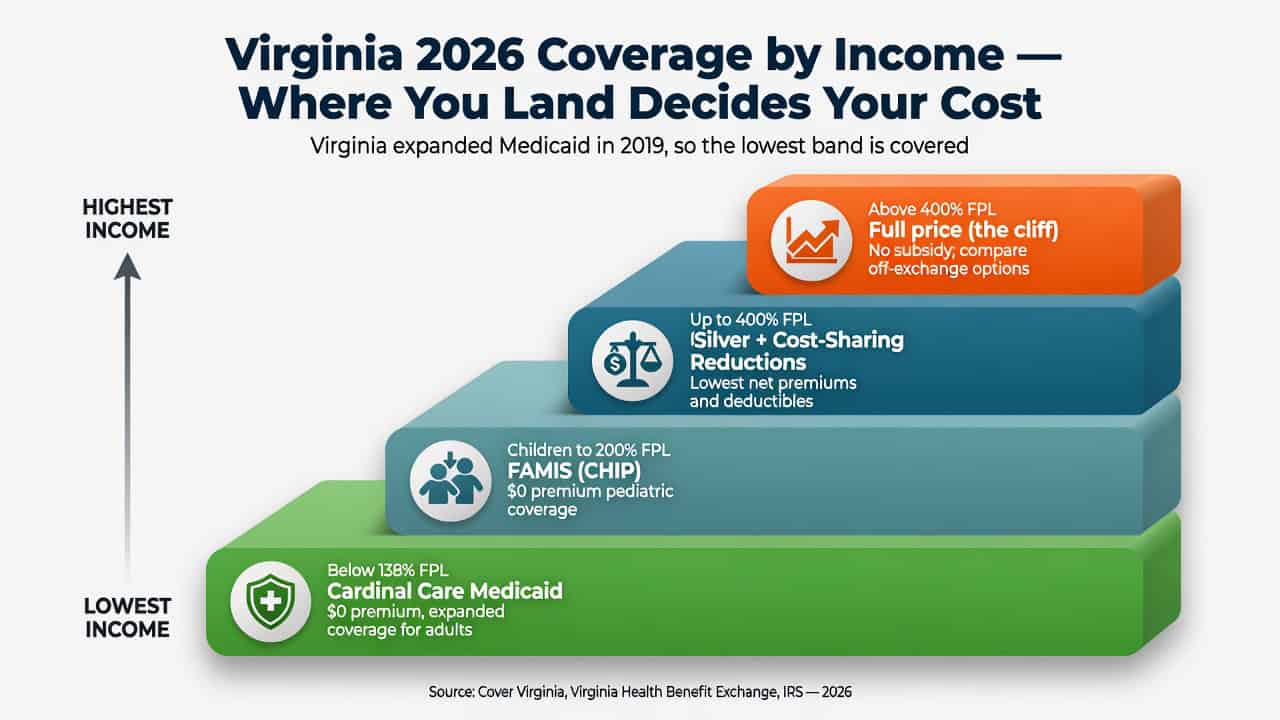
Cardinal Care is Virginia’s umbrella brand for Medicaid coverage. Virginia expanded Medicaid in 2019 under Governor Northam, and Cardinal Care now covers about 1.8 million Virginians as of December 2025, including roughly 443,472 expansion adults at or below 138% of the federal poverty level. Coverage costs $0 in monthly premiums for income-eligible Virginians and is delivered through five managed care organizations. Enrollment is year-round through Cover Virginia.
Cardinal Care eligibility is based primarily on household income and composition. The 138% FPL threshold for adults in 2026 is approximately $21,597 for a single adult and $44,367 for a family of four. Pregnant women qualify up to 205% of FPL. Children qualify for FAMIS up to 200% of FPL (covered separately below). Cardinal Care covers the 10 ACA essential health benefits — hospital care, prescriptions, mental health, maternity, preventive care, and emergency services — plus dental through Medicaid underpins the affordable health insurance Virginia low earners receive.
Five managed care organizations deliver Cardinal Care coverage statewide. Anthem HealthKeepers Plus (the Medicaid version of Anthem’s individual marketplace HealthKeepers brand) covers the largest share of Cardinal Care members. Sentara Community Plan, Aetna Better Health, UnitedHealthcare Community Plan, and Humana Healthy Horizons round out the lineup. Humana Healthy Horizons replaced Molina Healthcare in July 2025 — Molina members were automatically transitioned to Humana, with the option to switch to a different MCO during a transition enrollment window. Cardinal Care members can change MCOs once per year during the annual open enrollment window or FAMIS extends the affordable health insurance Virginia children depend on.
FAMIS: Children’s Coverage Up to 200% FPL
FAMIS — Family Access to Medical Insurance Security — is Virginia’s Children’s Health Insurance Program (CHIP). FAMIS covers about 183,526 Virginia children in families with incomes typically up to 200% of the federal poverty level — roughly $64,300 for a family of four in 2026. FAMIS provides comprehensive pediatric coverage at $0 premium for income-eligible families, including dental and vision through the same five managed care organizations that serve Cardinal Care adults.
FAMIS coverage includes pediatric primary care, specialist visits, hospital care, prescriptions, dental (through Cardinal Care Smiles), vision, mental health, and developmental services. Children enrolled in FAMIS receive 12 months of protected continuous coverage from their enrollment date — coverage cannot be terminated during this period except in narrow circumstances (the child turns 19, permanently moves out of Virginia, or the parent or guardian requests termination). This continuous-coverage protection means temporary income increases or paperwork lapses don’t disrupt a child’s care during the 12-month enrollment year.
To enroll, apply through Marketplace.Virginia.gov (which screens for both Cardinal Care and FAMIS together as part of the same application) or directly through Cover Virginia at coverva.dmas.virginia.gov, or by calling 1-855-242-8282. Enrollment is open year-round — there is no enrollment window. Children in families above the FAMIS income threshold but who don’t have access to affordable employer or marketplace coverage may qualify for FAMIS Plus, a slightly different These tiers define the affordable health insurance Virginia parents use.
Find Your 2026 Virginia Subsidy
Where your income lands on Virginia’s ladder decides everything: below 138% of FPL you may qualify for Cardinal Care, children up to 200% for FAMIS, and above that for APTC and cost-sharing reductions. A licensed Virginia agent runs your exact number on Marketplace.Virginia.gov across all 12 MSAs. Free, no obligation.
Virginia Marketplace Costs Vary by MSA
Full-price Virginia Silver-tier marketplace premiums for a 40-year-old non-smoker run roughly $490 to $760 per month before subsidies depending on Metropolitan Statistical Area. Northern Virginia (MSA 10) is the most expensive at about $720 to $760; far southwest Virginia (MSA 5, Bristol) is the cheapest at $490 to $540. With Advance Premium Tax Credits, typical after-subsidy costs drop to $80 to $280 per month for subsidized Silver plans.
| Virginia MSA | Major Cities | Silver 40-year-old (full-price) | After APTC (typical) |
|---|---|---|---|
| MSA 10 — Northern Virginia | Arlington, Alexandria, Fairfax | $720–$760/mo | $120–$280/mo |
| MSA 9 — Hampton Roads | Virginia Beach, Norfolk, Chesapeake | $580–$640/mo | $100–$240/mo |
| MSA 7 — Richmond | Richmond, Henrico, Chesterfield | $560–$610/mo | $95–$220/mo |
| MSA 8 — Roanoke | Roanoke, Salem, Blacksburg | $540–$590/mo | $90–$210/mo |
| MSA 11 — Winchester | Winchester, Frederick County | $530–$580/mo | $85–$200/mo |
| MSA 12 — Lynchburg | Lynchburg, Bedford | $520–$570/mo | $85–$200/mo |
| MSA 5 — Bristol | Bristol, far southwest VA | $490–$540/mo | $80–$190/mo |
The MSA pricing differences reflect underlying provider cost differences. Inova Health System, HCA Virginia hospitals in NoVA, and DC-metro physician groups command higher reimbursement than Carilion Clinic in the Roanoke and southwest Virginia regions or Ballad Health in far southwest Virginia. For Virginians at the same income level, choosing where to live within the state can change after-subsidy premiums by $30–$90 per month — though most Virginians don’t relocate Geography shapes the affordable health insurance Virginia shoppers see.
Silver + CSR: How to Get Near-Zero Premiums Above Medicaid
Virginia households between 138% and 250% of the federal poverty level who don’t qualify for Cardinal Care can access near-zero or very low monthly premiums by choosing a Silver-tier marketplace plan with cost-sharing reductions (CSR). CSR is automatically applied at the Silver tier for income-eligible enrollees and reduces deductibles, copayments, and out-of-pocket maximums substantially — often making Silver plans cheaper to use than Bronze plans even though Silver premiums are typically slightly higher.
Cost-sharing reductions are available only on Silver-tier plans for households between 100% and 250% of FPL. CSR variants come in three levels: 94% actuarial value (for households 100–150% FPL), 87% (150–200% FPL), and 73% (200–250% FPL) — meaning the 94% Silver CSR plan covers 94% of expected medical costs. By comparison, a regular Silver plan covers about 70%. The CSR is invisible at enrollment — Marketplace.Virginia.gov simply shows Silver plans with substantially lower deductibles for CSR-eligible households. Many Virginia households in this income range pay $40–$170 per month for Silver + CSR coverage, with deductibles below $1,500 and out-of-pocket maximums under $4,000.
Silver + CSR is particularly valuable for Virginia households that expect to use medical care during the year — chronic conditions, planned surgeries, family with children needing pediatric specialists, ongoing prescriptions. For a young, healthy adult between 200–250% FPL who rarely uses care, a Bronze plan with lower premium may make more sense. Marketplace.Virginia.gov displays the actuarial value of each plan during shopping, which makes the Silver + CSR advantage immediately visible.
Free and Low-Cost Health Care for Uninsured Virginians
Virginians who don’t qualify for Cardinal Care, FAMIS, or Marketplace.Virginia.gov subsidies can still access free and low-cost care through Virginia’s network of free clinics and federally qualified health centers. The Virginia Association of Free and Charitable Clinics operates more than 60 free clinics statewide. FQHCs offer sliding-scale fees based on income and serve patients regardless of insurance status. Hospital charity care programs reduce or eliminate medical bills for uninsured Virginians below 200% FPL.
Virginia Free Clinics (60+ statewide)
The Virginia Association of Free and Charitable Clinics operates a network of more than 60 free clinics across the state. Free clinics provide primary care, prescription assistance, dental care, mental health services, and basic specialty care for uninsured and underinsured Virginians at no cost. Locations include the CrossOver Healthcare Ministry in Richmond, the Free Clinic of the New River Valley in Christiansburg, the Olde Towne Medical and Dental Center in Williamsburg, and similar clinics in every region. Eligibility is typically tied to household income (often up to 200% Free clinics backstop the affordable health insurance Virginia gaps that remain.
Federally Qualified Health Centers (FQHCs)
FQHCs operate under a federal program that requires sliding-scale fees based on income for all patients. Virginia has FQHC networks operated by Bon Secours Care-A-Van, Daily Planet Health Services in Richmond, Central Virginia Health Services, and others across the state. FQHCs serve patients regardless of insurance status — uninsured Virginians pay according to a sliding scale that often makes a primary care visit cost $0–$30 depending on household income. FQHCs accept Cardinal Care, FAMIS, marketplace coverage, and self-pay patients.
Hospital Charity Care
Major Virginia hospital systems — Inova, HCA Virginia, Sentara, Bon Secours, Carilion Clinic, VCU Health, and UVA Health — operate charity care programs that reduce or eliminate medical bills for uninsured Virginians who meet income and asset thresholds. Eligibility typically extends to households below 200% of FPL with limited assets. Apply directly through the hospital’s billing or financial assistance office. Charity care covers emergency care, hospitalization, and related professional services — They supplement the affordable health insurance Virginia residents still need.
RX Assistance & Prescription Programs
Virginia’s RX Partnership and the Virginia Health Care Foundation partner with pharmaceutical manufacturers to provide free or low-cost prescription medications for uninsured Virginians. Most major drug manufacturers operate patient assistance programs for income-eligible patients. The 340B drug pricing program — used by FQHCs and certain hospital outpatient pharmacies — provides reduced-cost prescriptions for eligible patients. Combined with FQHC sliding-scale primary care, these programs cover the gap between marketplace coverage and hospital Charity care fills where the affordable health insurance Virginia cannot reach everyone.
Frequently Asked Questions
Common questions about affordable Virginia health insurance cover the cheapest plan options, why premiums increased 21.6% for 2026, free coverage through Cardinal Care and FAMIS, the reinsurance program that helps non-subsidized enrollees, and how to enroll children in FAMIS through Marketplace.Virginia.gov or Cover Virginia.
What is the cheapest health insurance in Virginia for 2026?
The cheapest health insurance in Virginia for 2026 is Cardinal Care Medicaid for adults at or below 138% of the federal poverty level — coverage costs $0 in monthly premiums for income-eligible Virginians. Above that threshold, Marketplace.Virginia.gov Bronze and Silver plans with subsidies typically run $40–$200 per month for households between 138% and 250% of FPL after Advance Premium Tax Credits and cost-sharing reductions. Free programs include FAMIS (children’s CHIP up to 200% FPL), free clinics through the Virginia Association of Free and Charitable Clinics, and federally qualified health centers Clinics widen the affordable health insurance Virginia access overall.
Why did Virginia premiums increase 21.6% for 2026?
Virginia’s 2026 ACA marketplace premiums increased by an average of 21.6% before subsidies because the enhanced federal Advanced Premium Tax Credits expired at the end of 2025. The enhanced credits — originally enacted in the American Rescue Plan Act and extended by the Inflation Reduction Act — had reduced subsidized premiums significantly. Their expiration shifted more cost back to enrollees and changed risk pool dynamics for carriers. Approved Virginia rate increases ranged from Kaiser at +11.8% to Optimum Choice (UnitedHealthcare) at +35.4%. Virginia’s reinsurance program (in effect since 2023) moderates increases for non-subsidized enrollees by reimbursing carriers for very high-cost claims.
How do I qualify for free health insurance in Virginia?
Free health insurance in Virginia is available primarily through Cardinal Care Medicaid (adults at or below 138% of the federal poverty level) and FAMIS (children up to 200% of FPL). Cardinal Care covers about 1.8 million Virginians as of December 2025. Apply through Marketplace.Virginia.gov or directly through Cover Virginia at coverva.dmas.virginia.gov — enrollment is year-round with no open enrollment window. Pregnant women qualify for Cardinal Care up to 205% of FPL. Above the Medicaid threshold, marketplace Silver plans with cost-sharing reductions can reduce premiums close to zero for some households between 138% and 250% of FPL.
What is Virginia’s reinsurance program?
Virginia’s reinsurance program took effect in 2023 and reimburses health insurance carriers for very high-cost claims, reducing the amount carriers need to charge in premiums to cover catastrophic medical events. The program is funded through state appropriations and federal pass-through funding under a Section 1332 State Innovation Waiver approved by CMS. It primarily benefits non-subsidized Virginians — those above 400% of FPL — who pay full premium without Advance Premium Tax Credit help. Reinsurance moderates the upward pressure on premiums for this group, typically delivering single-digit-percent premium savings compared to a no-reinsurance scenario.
What is Cardinal Care and what does it cover?
Cardinal Care is Virginia’s umbrella brand for Medicaid coverage, rebranded by the Virginia Department of Medical Assistance Services in October 2023. Cardinal Care covers about 1.8 million Virginians including approximately 443,472 expansion adults at or below 138% of FPL. It covers the 10 ACA essential health benefits — hospital care, prescriptions, mental health, maternity, preventive care — plus dental through Cardinal Care Smiles administered by DentaQuest. Coverage is delivered through five managed care organizations: Anthem HealthKeepers Plus, Sentara Community Plan, Aetna Better Health, UnitedHealthcare Community Plan, and Humana Healthy Horizons (which Carrier shifts touch the affordable health insurance Virginia buyers compare.
How do I enroll my children in FAMIS?
Apply for FAMIS through Marketplace.Virginia.gov (which screens for both Cardinal Care and FAMIS eligibility together) or directly through Cover Virginia at coverva.dmas.virginia.gov, or by calling 1-855-242-8282. FAMIS covers approximately 183,526 Virginia children in families with incomes typically up to 200% of the federal poverty level. Coverage includes pediatric primary care, specialist visits, hospital care, prescriptions, dental, vision, and mental health services through the same five managed care organizations that serve Cardinal Care adults. Children enrolled in FAMIS receive 12 months of protected continuous coverage from their enrollment date — coverage cannot be terminated during this period except in narrow circumstances.
Find Affordable 2026 Virginia Coverage
Two Virginia families at the same income can pay very different premiums depending on MSA and whether they clear the Cardinal Care or FAMIS thresholds. A licensed Virginia agent works your subsidy, screens both programs, and finds the lowest-total-cost plan on Marketplace.Virginia.gov. Free, no obligation.
Virginia affordability help — covers all programs in one call.
Related Virginia Health Insurance Resources
The complete pillar guide to Virginia health insurance for 2026.
Virginia Health Insurance MarketplaceMarketplace.Virginia.gov enrollment, January 30 deadline, and subsidies.
Best Health Insurance in VirginiaAll 8 carriers compared head-to-head on cost, network, and MSA.
Individual Health Insurance in VirginiaSelf-employed, freelancer, and family individual marketplace coverage.
SCC Bureau of InsuranceVirginia’s insurance regulator and the source of approved 2026 rate filings behind the increase.
Virginia Small Business Health InsuranceGroup plans, SHOP, ICHRA, and QSEHRA for Virginia employers.
Cover Virginia (Cardinal Care / FAMIS)Official Cardinal Care Medicaid and FAMIS application portal.
Virginia Free Clinics Directory60+ free clinics statewide for uninsured Virginians.
Broker Disclosure
ForHealthInsurance.com is an independent health insurance agency serving Virginia residents. We are not affiliated with any carrier or government agency. We help you compare plans and enroll in coverage that meets your needs at no extra cost to you.