Small Business Health Insurance in Virginia 2026 Guide
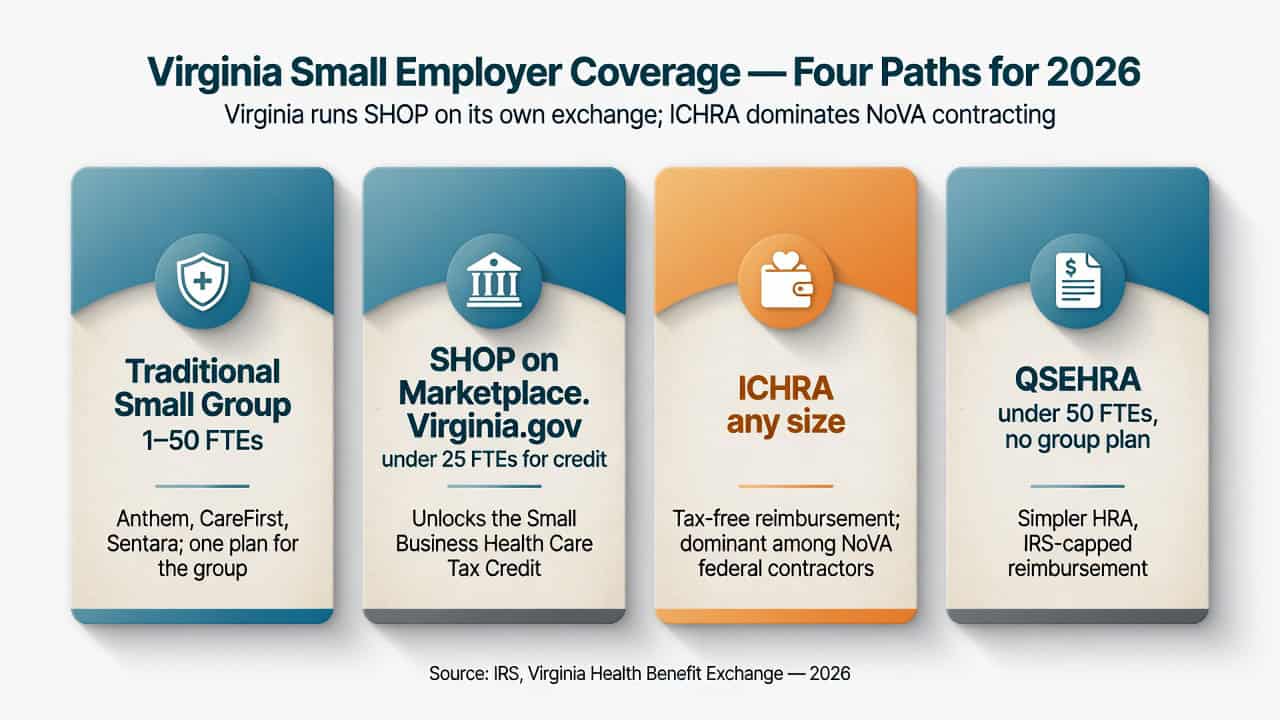
Small business health insurance in Virginia is shaped by two distinctive forces. First, Northern Virginia’s dense federal contractor ecosystem — Virginia has the second-highest concentration of federal civilian employees and contractors in the U.S. — has driven widespread adoption of ICHRA arrangements that let small contractors compete with larger firms on benefits. Second, Virginia’s state-based exchange Marketplace.Virginia.gov operates the SHOP platform for small group coverage alongside the individual marketplace, making it one of the few state-based exchanges with a fully integrated small employer pathway. Virginia small businesses with fewer than 50 full-time-equivalent employees have four practical paths for offering health coverage in 2026: traditional small group plans through carriers like Anthem and CareFirst, SHOP coverage on Marketplace.Virginia.gov, ICHRA reimbursement of individual marketplace coverage, and QSEHRA for very small employers. This guide covers each path, the cost structures involved, and which path fits That decides the small business health insurance Virginia owners choose.

What brings you here today?
Northern Virginia Federal Contractors and ICHRA
Virginia is the U.S. state with the second-highest concentration of federal civilian employees and contractors, and Northern Virginia carries most of that workforce. Small federal contractors competing for talent against larger firms (Booz Allen, Leidos, SAIC, MITRE) increasingly use ICHRA — the Individual Coverage Health Reimbursement Arrangement — to offer small business health insurance without administering a traditional group plan. ICHRA matches NoVA’s individual marketplace ecosystem because Northern Virginia (MSA 10) has all 8 Virginia carriers competing.
ICHRA works simply for federal contractors. The contracting firm sets a fixed monthly reimbursement amount per employee — for example, $700 per month for self-only coverage or $1,400 per month for family coverage. Employees buy their own individual health plan on Marketplace.Virginia.gov from any of the 8 NoVA carriers (Anthem HealthKeepers, Sentara, Cigna, Kaiser, CareFirst BlueChoice, Optimum Choice, Group Hospitalization, Oscar) and submit proof of premium and continuous coverage. The contractor reimburses up to the monthly cap. Reimbursements are tax-free for both employer and employee when properly structured under IRS Notice 2018-100 and Federal rules shape the small business health insurance Virginia firms buy.
The advantages for Virginia federal contractors are concrete. First, employees choose their own carrier — a Fairfax employee with Inova primary care, a Loudoun employee with CareFirst BlueChoice for DC-metro coverage, and an Arlington employee with Kaiser Mid-Atlantic can each pick their best fit. Second, ICHRA has no minimum participation requirements like traditional group plans. Third, the contractor’s cost is fixed and predictable — no annual renewal surprises, no carrier rate increase exposure (the employer’s contribution is fixed, individual market premium fluctuations are absorbed by employees). Fourth, federal contractors with employees in multiple Virginia MSAs (Tysons HQ, Norfolk satellite office, Richmond engagement) avoid the geographic ICHRA eases the small business health insurance Virginia multistate teams need.
Four Paths for Virginia Small Business Health Insurance
How small business health plans work in Virginia comes down to four practical paths for 2026: traditional small group plans (off-marketplace, sold by Anthem, CareFirst, Sentara, others), SHOP coverage on Marketplace.Virginia.gov, ICHRA reimbursement of individual marketplace coverage, or QSEHRA for very small employers under 50 FTEs not offering group coverage. Each path has distinct cost structures, employer obligations, and employee experiences.
| Path | Best for Employer Size | Employer Cost Structure | Employee Experience |
|---|---|---|---|
| Traditional group plan | 10–50 FTEs | Variable (50–75% of premium) | Single carrier, single network |
| SHOP (Marketplace.Virginia.gov) | 1–50 FTEs | Variable (50–75% of premium) | Choice of plans within SHOP |
| ICHRA | 2–500+ FTEs | Fixed monthly per employee | Choose own marketplace plan |
| QSEHRA | 1–49 FTEs (no group plan) | Up to $6,350 single / $12,800 family annually (2026) | Choose own marketplace plan |
Off-Marketplace Small Group Plan
Sold directly by Virginia carriers — Anthem HealthKeepers, CareFirst BlueChoice, Sentara Health Plans, Cigna, Aetna for small group, and others. Employer contracts with one carrier, employees enroll in plans offered through that carrier’s small group portfolio. Premium typically $550–$850 per employee per month for single coverage in 2026, $1,500–$2,400 per employee for family. Employers usually contribute 50–75% of single coverage premium and a smaller share of family coverage. Best fit for stable Virginia employers with 10+ employees in similar geography Group plans suit the small business health insurance Virginia owners who prefer simplicity.
SHOP on Marketplace.Virginia.gov
The Small Business Health Options Program runs through Virginia’s state-based exchange. Available to Virginia employers with 1–50 FTEs. Plans sold by the same carriers that participate in SHOP — typically Anthem HealthKeepers, Sentara Health Plans, and CareFirst BlueChoice. SHOP coverage may make a Virginia employer eligible for the Small Business Health Care Tax Credit if they have fewer than 25 FTEs with average annual wages below approximately $62,000 and pay at least 50% of employee premiums — credit can offset up to 50% of employer premium contributions.
ICHRA — Individual Coverage HRA
Employer sets fixed monthly reimbursement per employee class (e.g., $700/month single, $1,400/month family). Employees buy individual marketplace coverage on Marketplace.Virginia.gov and submit proof of premium for tax-free reimbursement. No minimum participation requirements. Particularly popular with Northern Virginia federal contractors and small businesses with employees in multiple Virginia MSAs. ICHRA can be structured by employee class (full-time vs part-time, salaried vs hourly, geographic location) but Those rules govern how the small business health insurance Virginia employers design coverage.
QSEHRA — Qualified Small Employer HRA
Specifically for Virginia small employers with fewer than 50 FTEs who don’t offer a group plan. Tax-free reimbursement for individual health insurance premiums and qualified medical expenses up to IRS limits ($6,350 self-only, $12,800 family in 2026). Simpler administration than ICHRA. Employees must have minimum essential coverage (Marketplace.Virginia.gov plan, off-exchange, or spouse’s employer plan). Best fit for Virginia employers under 25 FTEs who want to provide health benefits without administering group coverage.
Get a Virginia Small Business Health Quote
Four paths, one decision. A licensed Virginia agent prices a traditional group plan against SHOP on Marketplace.Virginia.gov, ICHRA, and QSEHRA for your headcount, runs the Small Business Health Care Tax Credit check that only SHOP unlocks, and weighs ICHRA for employees spread across multiple Virginia MSAs. Free, no obligation.
Virginia Small Group Plan Carriers
Virginia’s small group market has more carrier diversity than the individual market. Anthem HealthKeepers dominates statewide group coverage. CareFirst BlueChoice serves the NoVA / DC-metro corridor. Sentara Health Plans is dominant in Hampton Roads. Cigna, Aetna, and UnitedHealthcare also offer Virginia small group products even though Aetna exited the individual market at the end of 2025 — group market risk pools and underwriting differ from individual.
Anthem Health Plans of Virginia (the parent of Anthem HealthKeepers) is the largest Virginia small group carrier, offering HMO and PPO products statewide. Anthem’s network covers most major Virginia health systems — HCA Virginia, Inova in NoVA, Bon Secours across multiple regions, Carilion in the Roanoke area, and Sentara in Tidewater. Anthem small group plans are available across all 12 Virginia MSAs. CareFirst BlueChoice is the Northern Virginia leader for federal contractors and DC-metro businesses needing integrated DC + Maryland + NoVA coverage — a regional Blue Cross territory not replicated by other Virginia carriers. CareFirst’s BlueCard reciprocity provides national network access Reciprocity widens the small business health insurance Virginia contractors value.
Sentara Health Plans dominates Hampton Roads small group, anchored around Sentara Healthcare’s hospital system. Cigna offers small group PPO and HMO products in Richmond, NoVA, Winchester, and Lynchburg with broader national network reciprocity. Aetna — even though it exited Virginia’s individual market at the end of 2025 — continues to sell small group products in Virginia, alongside UnitedHealthcare. The right Virginia small business health insurance carrier depends on employee geographic distribution, preferred provider networks (Inova vs Sentara vs Bon Secours vs HCA Virginia), employer budget, and Network reach shapes the small business health insurance Virginia firms select.
How ICHRA Works for Virginia Employers
ICHRA implementation in Virginia involves five practical steps: establishing a written ICHRA plan document, defining employee classes (the rules that determine which employees are eligible for which reimbursement amounts), setting reimbursement amounts by class, providing required notices to employees 90 days before the plan year, and administering ongoing substantiation and reimbursement claims. Employers can self-administer ICHRA or use third-party administrators specializing in HRA administration.
Employee classes are central to ICHRA design. IRS rules permit employer classes by full-time vs part-time, seasonal, salaried vs hourly, geographic location, and employees in waiting periods. A Virginia federal contractor might define separate classes for full-time engineers in the Tysons HQ ($800/month single reimbursement), full-time engineers at the Norfolk satellite office ($650/month — reflecting Hampton Roads’s lower individual market premiums), and part-time contract staff ($400/month). Employer reimbursement amounts within a class must be uniform across employees of similar age — but classes themselves can carry different reimbursement levels. The class structure must be set before the plan year and Documentation protects the small business health insurance Virginia employers offer.
The 90-day employee notice requirement is critical. ICHRA employers must provide a written notice at least 90 days before each plan year (or before an employee’s eligibility start date, whichever is later) explaining the reimbursement amount, how the ICHRA interacts with marketplace subsidies, and how employees enroll in individual coverage. The notice typically directs employees to Marketplace.Virginia.gov for individual plan selection. Employees who accept ICHRA reimbursement become ineligible for marketplace premium tax credits during the plan year — but if the ICHRA is “unaffordable” under IRS rules (employee’s required contribution exceeds 9.96% of household income for 2026), the employee may opt out of ICHRA Affordability tests affect the small business health insurance Virginia staff receive.
QSEHRA and the Small Business Health Care Tax Credit
Very small Virginia employers, typically under 25 FTEs, have two paths designed for them. QSEHRA lets a small employer not offering group coverage reimburse employees tax-free up to $6,350 single and $12,800 family in 2026. The Small Business Health Care Tax Credit can offset up to 50% of employer premium contributions for SHOP coverage on Marketplace.Virginia.gov for employers under 25 FTEs with average wages below about $62,000.
QSEHRA is structurally similar to ICHRA but simpler. The employer cannot offer a group plan if it offers QSEHRA — the two are mutually exclusive. QSEHRA reimbursements are subject to annual IRS limits ($6,350 self-only, $12,800 family in 2026, indexed annually), unlike ICHRA which has no statutory cap. Employees must have minimum essential coverage (a Marketplace.Virginia.gov plan, an off-exchange individual plan, or coverage through a spouse’s employer plan) to receive QSEHRA reimbursement. Reimbursements can cover not just premium but also qualified medical expenses listed in IRS Pub 502. QSEHRA is the right fit for Virginia employers under 25 employees who want to provide a meaningful benefit without administering a group plan.
The Small Business Health Care Tax Credit applies only to SHOP coverage on Marketplace.Virginia.gov — not to off-marketplace group plans, ICHRA, or QSEHRA. Eligibility requires fewer than 25 full-time-equivalent employees, average annual wages per FTE below approximately $62,000 (the threshold is indexed annually), purchase of SHOP coverage, and employer payment of at least 50% of employee single coverage premium. The credit can offset up to 50% of employer contributions (35% for tax-exempt eligible employers) and is claimed on IRS Form 8941. The credit is available for two consecutive tax years per employer. For Virginia small businesses meeting all four eligibility criteria, the credit can substantially offset SHOP coverage costs The credit lowers the small business health insurance Virginia startups pay.
Virginia Small Group Cost Ranges and Employer Contributions
Virginia small business health insurance premiums in 2026 typically run $550–$850 per employee per month for single coverage and $1,500–$2,400 per employee per month for family coverage, varying by Metropolitan Statistical Area, employer demographics, plan tier, and carrier. Northern Virginia (MSA 10) is at the high end; Bristol (MSA 5) is at the low end. Most Virginia small employers contribute 50–75% of single coverage premiums and a smaller share of family coverage premiums.
| Coverage Type | NoVA (MSA 10) | Richmond (MSA 7) | Hampton Roads (MSA 9) | Bristol (MSA 5) |
|---|---|---|---|---|
| Single — Bronze | $580–$680/mo | $520–$600/mo | $540–$620/mo | $460–$520/mo |
| Single — Silver | $680–$820/mo | $610–$720/mo | $630–$740/mo | $540–$620/mo |
| Single — Gold | $820–$980/mo | $740–$870/mo | $760–$890/mo | $650–$760/mo |
| Family — Silver | $1,900–$2,400/mo | $1,700–$2,150/mo | $1,750–$2,200/mo | $1,500–$1,820/mo |
Employer contribution levels follow industry norms but vary widely. Most Virginia small employers contribute 50–75% of single coverage premiums; family coverage employer contribution is typically lower (often 25–50% of family premium). Northern Virginia federal contractors competing for senior engineering talent often contribute 80–100% of single premiums and 50–75% of family premiums to match larger contractor benefits. Small Virginia retail and service businesses more commonly contribute the 50% minimum required for the Small Business Health Care Tax Credit on SHOP coverage. ICHRA employers set fixed monthly reimbursement amounts that effectively translate to fixed-dollar contributions rather than percentage-based — typically $500–$1,000 per month for single coverage depending Contributions set the small business health insurance Virginia teams expect.
Frequently Asked Questions
Common questions about small business health insurance in Virginia cover employer mandate thresholds, SHOP through Marketplace.Virginia.gov, ICHRA mechanics for federal contractors, QSEHRA for very small employers, typical cost ranges by Metropolitan Statistical Area, and how Northern Virginia federal contractors structure benefits to compete with larger firms.
Do small businesses in Virginia have to offer health insurance?
No — Virginia small businesses with fewer than 50 full-time-equivalent employees are not required by federal or Virginia state law to offer health insurance. The ACA employer mandate applies only at 50+ FTEs. However, many Virginia small businesses offer health benefits voluntarily to attract and retain employees, particularly in Northern Virginia where federal contractors compete for talent against larger employers offering FEHB-equivalent benefits. Small employers offering coverage can choose between traditional group plans, SHOP coverage on Marketplace.Virginia.gov, ICHRA reimbursement arrangements, or QSEHRA for very small employers.
What is SHOP in Virginia?
SHOP — the Small Business Health Options Program — is the small group marketplace operated through Marketplace.Virginia.gov for Virginia employers with 1–50 full-time-equivalent employees. SHOP plans are sold by Anthem HealthKeepers, Sentara Health Plans, CareFirst BlueChoice, and other Virginia carriers. Small employers can compare and enroll in group health plans for their employees through the SHOP platform. The Small Business Health Care Tax Credit may be available for very small Virginia employers (fewer than 25 FTEs with average annual wages below approximately $62,000) who purchase SHOP coverage and pay at least 50% of employee premiums — the credit can offset up to 50% of employer premium contributions.
What is ICHRA and how does it work for Virginia employers?
ICHRA — Individual Coverage Health Reimbursement Arrangement — is a federal tax-advantaged arrangement that lets Virginia employers reimburse employees tax-free for individual health insurance premiums purchased on Marketplace.Virginia.gov or off-exchange. Instead of buying a group plan, the employer sets a monthly reimbursement allowance per employee. Employees buy their own individual coverage and submit proof of premium for reimbursement. ICHRA is particularly common among Northern Virginia federal contractors, professional services firms, and small businesses with employees across multiple Virginia MSAs — because it lets each employee choose the carrier and plan that best fits their MSA, providers, and family situation.
What is QSEHRA and which Virginia businesses qualify?
QSEHRA — Qualified Small Employer Health Reimbursement Arrangement — is a tax-advantaged arrangement specifically for Virginia small employers with fewer than 50 full-time-equivalent employees who do NOT offer group health coverage. The employer reimburses employees tax-free up to annual IRS limits ($6,350 for self-only coverage and $12,800 for family coverage in 2026) for individual health insurance premiums and qualified medical expenses. Employees must have minimum essential coverage (typically Marketplace.Virginia.gov, an off-exchange plan, or a spouse’s employer plan) to receive QSEHRA reimbursement. QSEHRA is simpler than ICHRA and works well for very small Virginia employers — typically under 25 employees — who want to provide health benefits without administering a group plan.
How much does small business health insurance cost in Virginia?
Virginia small business group health plan premiums typically run $550–$850 per employee per month for single coverage and $1,500–$2,400 per employee per month for family coverage in 2026, depending on plan tier, employer size, employee demographics, and Metropolitan Statistical Area. Northern Virginia (MSA 10) is at the higher end; Bristol (MSA 5) is at the lower end. Most Virginia small employers contribute 50% to 75% of single coverage premiums and a smaller percentage of family premiums. ICHRA and QSEHRA arrangements give employers control over the monthly cost — employers set the reimbursement amount based on their budget. SHOP coverage on Marketplace.Virginia.gov often runs comparable to off-marketplace small group rates.
Can a Northern Virginia federal contractor offer health insurance through ICHRA?
Yes — ICHRA is increasingly common among Northern Virginia federal contractors, particularly small and mid-size contracting firms that don’t offer traditional group plans. ICHRA lets a Virginia federal contractor set a fixed monthly reimbursement per employee, while employees independently choose their individual plan on Marketplace.Virginia.gov from any of the 8 NoVA carriers — including CareFirst BlueChoice for DC-metro reciprocity, Kaiser Mid-Atlantic, Anthem HealthKeepers, or Cigna. ICHRA reimbursements are tax-free for both employer and employee when properly structured. Federal contractors using ICHRA must comply with all standard ICHRA rules including class-based eligibility and substantiation requirements.
Compare Virginia Small Business Health Options
Tell us your team size, where your employees live, and your budget per worker, and a licensed Virginia agent returns the lowest-total-cost path, whether that is an Anthem or CareFirst group plan, SHOP with the tax credit, ICHRA for NoVA contractors, or QSEHRA. Free, no obligation.
Virginia small business health help — covers all four paths in one call.
Related Virginia Health Insurance Resources
The complete pillar guide to Virginia health insurance for 2026.
Virginia Health Insurance MarketplaceMarketplace.Virginia.gov enrollment, January 30 deadline, and subsidies.
Best Health Insurance in VirginiaAll 8 carriers compared head-to-head on cost, network, and MSA.
Affordable Virginia Health InsuranceCardinal Care, FAMIS, free clinics, and the 21.6% rate increase explained.
Individual Health Insurance in VirginiaSelf-employed, freelancer, and family individual marketplace coverage.
SCC Bureau of InsuranceVirginia’s insurance regulator overseeing small group and SHOP carrier filings.
Virginia’s Insurance Marketplace SHOPVirginia’s official SHOP small group enrollment portal.
IRS Form 8941 (Small Business Tax Credit)Federal Small Business Health Care Tax Credit form and guidance.
Broker Disclosure
ForHealthInsurance.com is an independent health insurance agency serving Virginia businesses. We are not affiliated with any carrier or government agency. We help you compare plans and enroll in coverage that meets your needs at no extra cost to you.