Affordable Vermont Health Insurance 2026: Subsidies, Costs and Options
Finding affordable Vermont health insurance in 2026 means understanding what plans actually cost and what financial help is available to reduce that cost — federal subsidies, Vermont Premium Assistance, state cost-sharing reductions, and Medicaid eligibility. Vermont has the highest individual market sticker prices in the country, but multiple subsidy layers mean most enrollees pay far less than the posted premium.
What are you trying to figure out?
What Vermont Health Insurance Costs in 2026
Vermont has the highest individual market sticker premiums in the country in 2026 — an MVP Silver HMO runs approximately $850 per month for any adult, and a comparable blue-cross-blue-shield-of-vermont Silver EPO runs around $1,040 per month. Vermont prohibits age rating, so the same premium applies whether you are 25 or 64. The Green Mountain Care Board approved a 1.3% increase for MVP and 9.6% for BCBSVT for 2026 — among the lowest approved rates nationally.
High sticker prices do not reflect what most Vermonters actually pay when shopping for affordable Vermont health insurance. Vermont’s combination of federal APTC, Vermont Premium Assistance, and state cost-sharing reductions means the majority of marketplace enrollees receive significant discounts. The figures below are pre-subsidy sticker prices for a single adult in Vermont’s single statewide rating area.
MVP Health Care — Silver HMO
Sticker price, any adult age. $3,050 deductible. GMCB-approved +1.3% for 2026.
BCBSVT — Silver EPO
Sticker price, any adult age. Referral-free EPO network. GMCB-approved +9.6% for 2026.
MVP Bronze HMO (lowest tier)
Sticker price. All MVP Bronze plans HSA-eligible. Higher deductible, lower premium.
After subsidies (typical subsidized enrollee)
Estimated net Silver premium after federal APTC and Vermont Premium Assistance for a single adult earning $30,000–$50,000.
No age rating in Vermont: Vermont and New York are the only states that prohibit age rating on individual market plans. A 30-year-old and a 62-year-old pay the same sticker premium for the same plan. This makes Vermont’s high sticker prices equally applicable across all adult ages — but also means that the subsidy benefit is the same regardless of how old you are.
Federal and State Subsidies That Lower Vermont Premiums
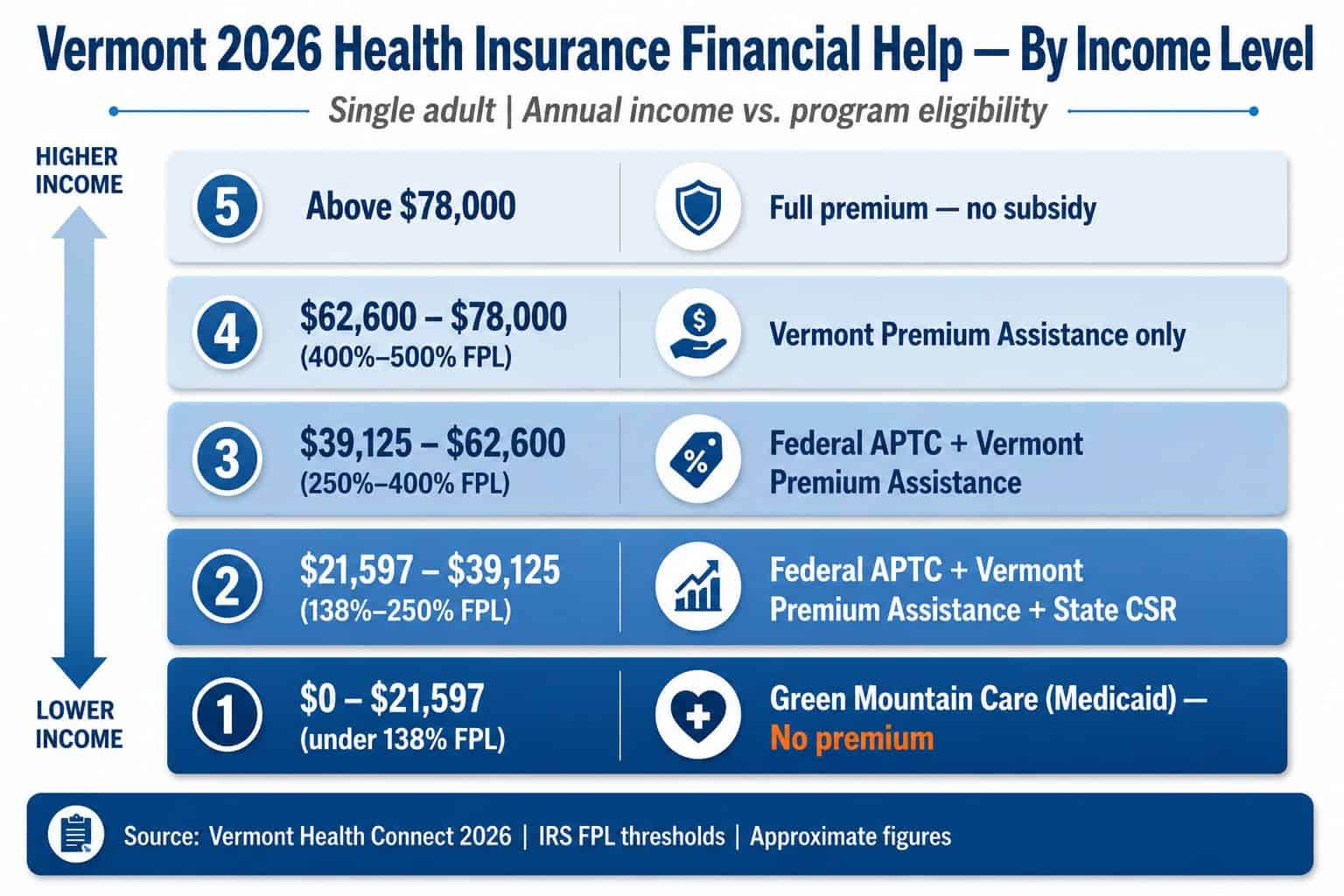
Vermont enrollees can layer up to three subsidy programs: federal Advance Premium Tax Credits (APTC), Vermont Premium Assistance (VPA), and state Cost-Sharing Reduction (CSR). All three are applied automatically through Vermont Health Connect — no separate applications are needed. The 2026 tax year marks the expiration of enhanced APTC, reducing subsidy amounts for many Vermont households compared to 2024 and 2025.
Federal Advance Premium Tax Credits (APTC)
Federal APTC reduces your monthly premium for plans bought through Vermont Health Connect. For 2026, the credit is available to households with income between 100% and 400% of the Federal Poverty Level — approximately $15,650 to $62,600 for a single adult. The amount is based on the cost of the second-lowest Silver plan in Vermont and your projected household income. HealthCare.gov provides the baseline federal subsidy calculator.
Enhanced APTC expired December 31, 2025. The Inflation Reduction Act’s enhanced subsidies — which extended credits above 400% FPL and increased amounts below it — expired at year end. Vermont households that received enhanced APTC in 2024 or 2025 will see lower subsidy amounts in 2026. Additionally, starting with the 2026 tax year, there is no repayment cap if your income exceeds your estimate — you owe back all excess APTC to the IRS at tax time.
Vermont Premium Assistance (VPA)
VPA is a Vermont-funded supplement that stacks on top of federal APTC, reducing premiums further for households between 138% and approximately 300% FPL. It is applied automatically at Vermont Health Connect — no separate application. VPA is available only on plans purchased through the marketplace, not on direct off-exchange plans.
State and Federal Cost-Sharing Reductions (CSR)
CSR programs reduce the deductible, copayment, and out-of-pocket maximum on Silver-tier plans for qualifying households. Federal CSR applies to households under 250% FPL. Vermont adds a state-funded CSR layer on top for eligible enrollees, further reducing out-of-pocket costs at the point of care. Both apply only to Silver plans purchased through Vermont Health Connect.
| Program | Who Qualifies | What It Reduces | How to Apply |
|---|---|---|---|
| Federal APTC | 100%–400% FPL (single: $15,650–$62,600) | Monthly premium | Automatic via Vermont Health Connect application |
| Vermont Premium Assistance (VPA) | 138%–~300% FPL (single: $21,597–$46,950) | Monthly premium (stacks on APTC) | Automatic via Vermont Health Connect application |
| Federal CSR | 100%–250% FPL on Silver plans | Deductible, copay, OOP max | Automatic — enroll in Silver plan on VHC |
| Vermont State CSR | Same as federal CSR — Silver plans | Additional reduction on deductible/OOP (stacks on federal CSR) | Automatic via Vermont Health Connect |
Scenario: Single adult in Burlington, $38,000 income
A single adult living in Burlington earns $38,000 per year — about 243% of the 2026 Federal Poverty Level. She is eligible for federal APTC, Vermont Premium Assistance, and federal CSR on a Silver plan. Shopping on Vermont Health Connect, the MVP Silver HMO sticker price of approximately $850/month drops to roughly $175/month after APTC and VPA. Her Silver plan CSR reduces the standard $3,050 MVP deductible to approximately $900, and her out-of-pocket maximum drops to roughly $3,500. She pays less per month than the national average Silver premium — despite Vermont having the highest sticker prices in the country.
Free or Low-Cost Coverage: Green Mountain Care and Dr. Dynasaur
Green Mountain Care — Vermont’s Medicaid program — is available at no premium for adults earning up to 138% of the Federal Poverty Level, approximately $21,597 for a single adult or $44,367 for a family of four in 2026. Dr. Dynasaur covers children up to 312% FPL and pregnant women at no or minimal cost. Both accept applications year-round through Vermont Health Connect — no need to wait for open enrollment.
Green Mountain Care (Medicaid)
Adults who earn at or below 138% FPL qualify for Green Mountain Care with no monthly premium. Coverage includes hospitalization, physician visits, prescriptions, behavioral health, maternity care, and emergency services. Vermont expanded Medicaid under the Affordable Care Act, so the income threshold is higher than it was before 2014. The Department of Vermont Health Access administers the program.
Dr. Dynasaur (CHIP)
Vermont’s CHIP program, Dr. Dynasaur, covers children up to age 19 in households earning up to 312% FPL — about $100,308 for a family of four in 2026. Pregnant women qualify regardless of immigration status. Most enrollees pay no monthly premium, and coverage includes dental, vision, prescriptions, preventive care, and hospitalization. Dr. Dynasaur is one of the most generous CHIP income thresholds in the country.
| Program | Who Qualifies | Income Limit (2026) | Premium |
|---|---|---|---|
| Green Mountain Care (Medicaid) | Adults 19–64 | ≤138% FPL ($21,597 single / $44,367 family of 4) | None |
| Dr. Dynasaur (CHIP) | Children under 19 | ≤312% FPL ($100,308 family of 4) | None for most families |
| Dr. Dynasaur (CHIP) | Pregnant women | Varies — regardless of immigration status | None |
Want to see your actual 2026 Vermont premium after subsidies?
A licensed agent runs the numbers against your income, applies APTC and VPA, and shows you both MVP and BCBSVT options side by side — at no cost.
How Vermont’s Single Rating Area Affects Costs
Vermont is a single statewide rating area — premiums are identical in Chittenden County, Windham County, and every county in between. There is no Burlington premium vs. Rutland premium vs. Northeast Kingdom premium. This is unusual: most states have multiple rating regions where rural areas often pay more than urban ones. Vermont’s single zone means a Vermonter in a small town pays the same sticker price as someone in Burlington.
The single rating area has implications for how subsidy amounts are calculated. Federal APTC is benchmarked to the second-lowest Silver plan cost in the rating area — and since Vermont is one area, every Vermonter uses the same benchmark. That contrasts with states like Texas or California where residents in expensive urban counties get larger APTC because the benchmark Silver plan there is pricier.
Vermont also prohibits age rating, so the combined effect is a flat premium structure: same price in every county, same price at every adult age. What varies is income — and Vermont’s stacked subsidy system (federal APTC plus VPA plus CSR) is designed to make those flat high sticker prices manageable for most income levels below 300% FPL.
Choosing the Most Affordable Plan Type
For most subsidized Vermonters, a Silver plan is the most affordable choice because cost-sharing reductions only apply to Silver tier. Bronze plans have lower premiums but higher deductibles — valuable for healthy adults who rarely use care. For households qualifying for Green Mountain Care, the marketplace is not needed at all.
Silver plans with CSR are often the best financial value for households between 138% and 250% FPL. The subsidy-enhanced Silver plan can have a deductible as low as $300–$900 and an out-of-pocket max around $2,000–$3,500 — comparable to employer-sponsored coverage — while the monthly premium after APTC and VPA is typically lower than off-marketplace options.
MVP’s Bronze HMO lineup is worth considering for healthy adults above 250% FPL who want the lowest possible monthly premium and plan to use an HSA for tax-advantaged savings. Every MVP Bronze plan is HSA-eligible in 2026, and the annual HSA contribution limit for self-only coverage is $4,300. A Vermonter on an MVP Bronze who maximizes their HSA contribution effectively reduces their net health care cost by that pre-tax amount annually.
For Vermont small business owners and self-employed individuals, the Vermont small business health insurance page covers group plan options under the 2026 GMCB small group rates, where BCBSVT’s small group premiums increased 4.4% and MVP’s increased 2.5%.
Related Vermont Health Insurance Resources
Frequently Asked Questions
What is the cheapest health insurance option in Vermont for 2026?
For Vermonters who qualify, Green Mountain Care (Medicaid) has no premium and covers adults up to 138% of the Federal Poverty Level — about $21,597 for a single adult. For those above that threshold, MVP Health Care’s Bronze HMO plans are the lowest-cost marketplace option, with all Bronze plans HSA-eligible. After federal APTC and Vermont Premium Assistance, a single adult earning $35,000 typically pays well under $200 per month for a Silver plan.
How does Vermont Premium Assistance work?
Vermont Premium Assistance (VPA) is a state-funded subsidy that stacks on top of federal Advance Premium Tax Credits. It is applied automatically when you complete a Vermont Health Connect application — no separate form is required. VPA is most valuable for households between 138% and 300% of the Federal Poverty Level and is available only on plans purchased through Vermont Health Connect.
Does Vermont have free health insurance?
Yes, for qualifying Vermonters. Green Mountain Care covers adults up to 138% FPL with no monthly premium. Dr. Dynasaur covers children up to 312% FPL and pregnant women with no or minimal cost sharing. Both programs are administered year-round through Vermont Health Connect.
How much does health insurance cost in Vermont in 2026?
Vermont has the highest individual market sticker premiums in the country. An MVP Silver HMO sticker price runs approximately $850 per month for any adult — Vermont prohibits age rating, so premiums do not vary by age. After federal APTC and Vermont Premium Assistance, most subsidized enrollees pay significantly less. The Green Mountain Care Board approved a 1.3% increase for MVP and 9.6% for BCBSVT for 2026.
What is the income limit for subsidies in Vermont for 2026?
Federal premium tax credits are available to households between 100% and 400% of the Federal Poverty Level — approximately $15,650 to $62,600 for a single adult in 2026. Vermont Premium Assistance provides additional state-funded help, particularly for households between 138% and 300% FPL. Households above 400% FPL receive no federal subsidy in 2026 following the expiration of enhanced APTC.
Can I get cost-sharing reductions in Vermont?
Yes. Federal cost-sharing reductions (CSR) are available for Silver plan enrollees with household income up to 250% FPL, reducing deductibles and copayments. Vermont also funds a state CSR program that stacks on top of federal CSR for eligible enrollees. Both apply automatically when you enroll in a Silver plan through Vermont Health Connect.
Get a free affordable Vermont health insurance quote
Compare MVP and BCBSVT plans with subsidies applied. Licensed agents find the most affordable plan for your income — no cost to you.
Broker Disclosure
ForHealthInsurance.com is an independent health insurance agency serving Vermont residents. We are not affiliated with any carrier or government agency. We help you compare plans and enroll in coverage that meets your needs at no extra cost to you.