Vermont Health Insurance Marketplace 2026: Vermont Health Connect Guide
This guide explains how the Vermont health insurance marketplace works in 2026 — who runs it, how to apply, what plans are available, and how to qualify for financial help. Vermont’s marketplace is state-based and called Vermont Health Connect, and it operates differently than the HealthCare.gov marketplaces most other states use.

What brings you here today?
What Vermont Health Connect Is
Vermont Health Connect (healthconnect.vermont.gov) is the state-based health insurance marketplace administered by the Department of Vermont Health Access. It is the only place Vermonters can buy individual coverage and receive federal premium tax credits or Vermont Premium Assistance. Plans purchased directly from BCBSVT or MVP off-exchange are full-priced with no subsidy eligibility.
Vermont was one of the first states to build a state-based exchange when the Affordable Care Act took effect in 2014, and it has continued to operate Vermont Health Connect rather than transition to HealthCare.gov. The Department of Vermont Health Access (DVHA) runs the marketplace, manages enrollment, and processes applications for Medicaid and CHIP alongside private plan enrollment.
The marketplace serves three populations simultaneously: Vermonters buying individual private coverage from BCBSVT or MVP, Vermonters applying for Green Mountain Care (Medicaid), and Vermonters applying for Dr. Dynasaur (CHIP for children up to 312% of the Federal Poverty Level). One application screens for eligibility across all three programs.
For 2026, only two private carriers offer plans through Vermont Health Connect: Blue Cross Blue Shield of Vermont and MVP Health Care. BCBSVT plans use an EPO network structure, while MVP plans use an HMO structure. The marketplace is the single statewide pricing region — premiums do not vary by Vermont county.
How to Apply for 2026 Coverage
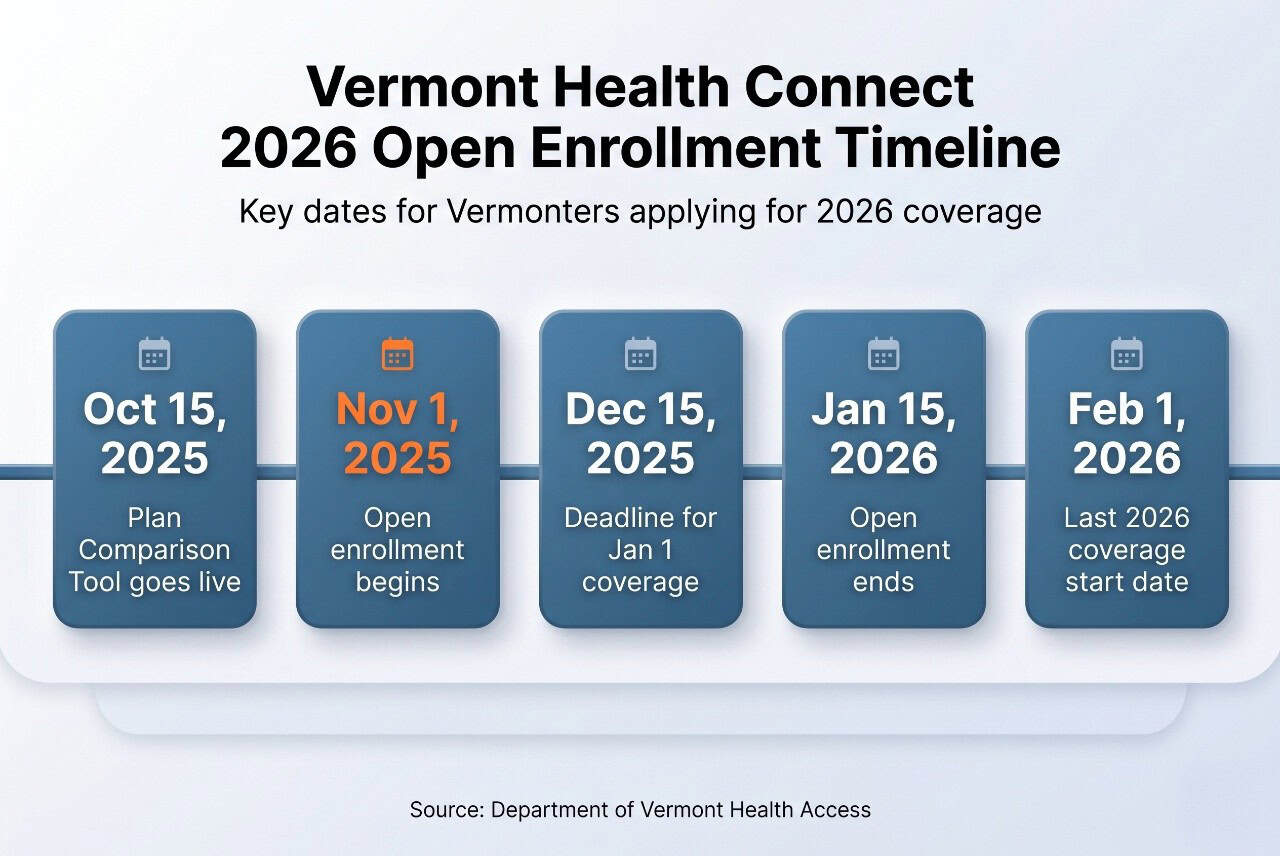
Apply online at healthconnect.vermont.gov, by phone at 1-855-899-9600, or in person with a certified Assister. Open enrollment for 2026 plan year ran November 1, 2025 through January 15, 2026. Outside that window, a qualifying life event opens a 60-day Special Enrollment Period. The Plan Comparison Tool became available October 15, 2025 — two weeks before enrollment opened.
Key 2026 Enrollment Dates
| Date | What Happens |
|---|---|
| October 2025 | Vermont Health Connect mails renewal notices with 2026 plan information |
| October 15, 2025 | Plan Comparison Tool goes live for 2026 plans |
| November 1, 2025 | Open enrollment begins |
| December 15, 2025 | Deadline for January 1, 2026 coverage start |
| January 15, 2026 | Open enrollment ends |
| February 1, 2026 | Coverage starts for enrollments completed December 16 – January 15 |
Three Ways to Apply
Online. Create an account at healthconnect.vermont.gov, enter household income and family size, and the system tells you which programs you qualify for and shows side-by-side plan comparisons.
By phone. Call Vermont Health Connect at 1-855-899-9600. A customer service representative walks through the application. This is the fastest route if you have documents in hand but find the website confusing.
With an Assister. Vermont funds a statewide network of certified Assisters who help with applications at no charge. An Assister can complete the application on your behalf with your formal permission. Find one through the Vermont Health Connect Assister directory.
Auto-renewal note: Most Vermonters enrolled in 2025 plans were auto-renewed into a 2026 plan unless they actively switched. Vermont Health Connect mails renewal notices in early October — read carefully, since the auto-renewed plan may not be the best 2026 option after the GMCB-approved rate changes.
Plans Available on the 2026 Exchange
Two carriers sell Qualified Health Plans on Vermont Health Connect for 2026: Blue Cross Blue Shield of Vermont (EPO) and MVP Health Care (HMO). Each carrier offers plans across all metal tiers — Bronze, Silver, Gold, Platinum, plus Catastrophic for those under 30 or with hardship exemptions. All Bronze and Catastrophic plans on Vermont’s exchange are HSA-eligible for 2026.
Metal Tiers Explained
Plans are sorted into tiers based on how costs are split between you and the carrier. Lower tiers (Bronze) have lower monthly premiums and higher deductibles. Higher tiers (Platinum) have higher premiums and lower out-of-pocket costs. The tier has nothing to do with quality of care or provider networks.
| Tier | You Pay | Plan Pays | Best For |
|---|---|---|---|
| Bronze | ~40% | ~60% | Low premiums; rare doctor visits; HSA-eligible in VT for 2026 |
| Silver | ~30% | ~70% | Most subsidized enrollees; CSR available below 250% FPL |
| Gold | ~20% | ~80% | Regular care needs; ongoing prescriptions |
| Platinum | ~10% | ~90% | High annual care needs; chronic conditions |
| Catastrophic | Limited | EHB after deductible | Under 30 or hardship exemption; HSA-eligible |
2026 HSA expansion: Every Bronze plan in MVP’s 2026 lineup qualifies for a Health Savings Account, including CDHP options. BCBSVT offers 2 HSA-eligible Bronze plans out of 5. Catastrophic plans from both carriers are HSA-eligible for the first time in 2026, opening tax-advantaged savings to a broader group of Vermonters.
Reflective Silver Plans
Vermonters who do not qualify for federal subsidies have an extra option: “reflective silver” plans sold directly by BCBSVT or MVP off-exchange. These are nearly identical to the on-exchange Silver plans but cost less because they do not carry the loaded premium for federal Cost-Sharing Reductions. If your household income exceeds 400% FPL — about $62,600 for a single adult or $128,600 for a family of four — and you cannot get subsidies, reflective silver may offer better value than buying through Vermont Health Connect.
Need help comparing Vermont plans for 2026?
Licensed agents help you compare BCBSVT and MVP across all metal tiers and confirm your subsidy eligibility. No cost to you.
Income, Subsidies, and Financial Help
Vermonters receive federal Advance Premium Tax Credits (APTC) based on household income relative to the Federal Poverty Level. Vermont adds two state-funded supplements on top — Vermont Premium Assistance (VPA) and state Cost-Sharing Reduction (CSR). Both stack on federal APTC and CSR automatically when you enroll through Vermont Health Connect. Enhanced federal APTC expired December 31, 2025, so 2026 subsidies follow the original Affordable Care Act formula.
2026 Federal Poverty Level (Continental U.S.)
| Household Size | 100% FPL | 138% FPL (Medicaid cap) | 250% FPL (CSR cap) | 400% FPL (APTC cap) |
|---|---|---|---|---|
| 1 | $15,650 | $21,597 | $39,125 | $62,600 |
| 2 | $21,150 | $29,187 | $52,875 | $84,600 |
| 3 | $26,650 | $36,777 | $66,625 | $106,600 |
| 4 | $32,150 | $44,367 | $80,375 | $128,600 |
Federal Premium Tax Credits (APTC)
The federal premium tax credit reduces your monthly premium for marketplace plans. For 2026, it is available to households between 100% and 400% FPL. The credit amount depends on income, household size, and the cost of the second-lowest Silver plan in Vermont. HealthCare.gov explains how the calculation works, and the IRS Form 8962 instructions govern how the credit is reconciled at tax time.
APTC repayment changes for 2026: Starting with the 2026 tax year, there is no longer a cap on how much excess APTC a household must repay to the IRS if income ends up higher than estimated. Report income changes throughout the year at Vermont Health Connect to avoid surprise tax bills.
Vermont Premium Assistance (VPA)
VPA is Vermont’s state-funded supplement to federal APTC. It reduces the monthly premium further than federal subsidies alone, particularly for households between 138% and 300% FPL. VPA is automatic — there is no separate application. When you complete the Vermont Health Connect application, the system applies federal APTC first, then VPA on top.
Vermont State Cost-Sharing Reduction
The state CSR program reduces deductibles, copayments, and coinsurance for enrollees in Silver-tier plans. State CSR stacks on top of the federal CSR program for households under 250% FPL, lowering out-of-pocket costs at the point of care. Both VPA and state CSR are available only to enrollees who buy through Vermont Health Connect — not through off-exchange direct purchases.
Green Mountain Care and Dr. Dynasaur
Vermont’s Medicaid program is called Green Mountain Care, covering adults up to 138% of the Federal Poverty Level. Children up to 312% FPL and pregnant women qualify for Dr. Dynasaur, Vermont’s CHIP program. Both accept enrollment year-round through Vermont Health Connect — not limited to the November-to-January window. The same application screens for private plan and Medicaid eligibility simultaneously.
Green Mountain Care (Medicaid)
Green Mountain Care is administered by the Department of Vermont Health Access and covers adults whose household income falls at or below 138% FPL — approximately $21,597 for a single adult or $44,367 for a family of four in 2026. Coverage includes hospital care, doctor visits, prescriptions, behavioral health, maternity care, and emergency services with minimal or no cost sharing. Vermont expanded Medicaid in 2014 under the Affordable Care Act, which is why the 138% FPL threshold applies rather than the lower pre-expansion limits some states retain.
Dr. Dynasaur (CHIP)
Dr. Dynasaur is Vermont’s name for its Children’s Health Insurance Program. Children up to age 19 qualify in households earning up to 312% FPL — about $100,308 for a family of four in 2026 — one of the most generous CHIP income thresholds in the country. Pregnant women qualify for Dr. Dynasaur prenatal and postpartum coverage regardless of immigration status. Most Dr. Dynasaur enrollees pay no monthly premium, and the program covers preventive care, hospitalization, prescriptions, dental, and vision.
Year-round enrollment: Green Mountain Care and Dr. Dynasaur are not limited to open enrollment. If your income drops or your household composition changes mid-year, you can apply for either program at any time through Vermont Health Connect.
Special Enrollment Periods
A Special Enrollment Period is a 60-day window outside open enrollment when you can sign up for a Vermont Health Connect plan after a qualifying life event. Common events include losing job-based coverage, getting married, having a baby, moving into or within Vermont, or aging off a parent’s plan at 26. You must report the event to Vermont Health Connect and provide documentation.
Qualifying Life Events
| Event | SEP Window | Coverage Start |
|---|---|---|
| Loss of job-based coverage | 60 days before or after | First of month following enrollment |
| Marriage | 60 days after | First of month following enrollment |
| Birth or adoption | 60 days after | Date of birth/adoption |
| Move into Vermont or within Vermont | 60 days after | First of month following enrollment |
| Aging off parent’s plan at 26 | 60 days after | First of month following loss of coverage |
| Income change qualifying for Medicaid | Year-round | Per Vermont Health Connect determination |
Scenario: Job loss in Burlington, March 2026
A 40-year-old single Vermonter loses her job in Burlington on March 10, 2026, ending her employer-sponsored coverage on March 31. She has a 60-day Special Enrollment Period — until May 30 — to enroll in a Vermont Health Connect plan. She applies online April 5, qualifies for federal APTC plus Vermont Premium Assistance based on unemployment income, and her new MVP Silver HMO coverage begins May 1, 2026 with no gap.
After You Enroll: Paying Your First Premium
Coverage does not start until you pay your first month’s premium. Vermont Health Connect sends your application and plan selection to BCBSVT or MVP, and the carrier mails a premium bill within days. For coverage starting January 1, the first payment was typically due by the carrier’s mid-to-late December deadline. Missing the first payment voids the enrollment.
Once your first premium is paid, the carrier mails your member ID card and any other documentation. Future premiums are paid directly to BCBSVT or MVP — not to Vermont Health Connect. Subsidies (APTC and VPA) are applied automatically as a discount on each monthly bill; you do not receive a check.
If your income changes during the year, report it through Vermont Health Connect promptly. A mid-year income increase means your APTC was too high, and you may owe repayment at tax time. A mid-year income decrease means you qualify for more APTC and VPA — and the system can adjust your monthly subsidy forward, reducing your premium for the rest of the year.
The Vermont Office of the Health Care Advocate (1-800-917-7787) is a free state-funded resource for Vermonters who have problems with their carrier, billing disputes, or denied claims. Use it before escalating to the Department of Financial Regulation.
Ready to apply for 2026 Vermont coverage?
A licensed agent can walk you through the Vermont Health Connect application, confirm your subsidies, and pick between BCBSVT EPO and MVP HMO plans.
Related Vermont Health Insurance Resources
Frequently Asked Questions
What is Vermont Health Connect?
Vermont Health Connect (healthconnect.vermont.gov) is the state-based health insurance marketplace administered by the Department of Vermont Health Access. It is the only place Vermonters can buy individual coverage and receive federal premium tax credits or Vermont Premium Assistance.
When does open enrollment for 2026 coverage end in Vermont?
Open enrollment for 2026 ran November 1, 2025 through January 15, 2026. To enroll outside this window, you need a qualifying life event such as job loss, marriage, birth of a child, or a move into Vermont, which opens a 60-day Special Enrollment Period.
Can I get a subsidy if I buy a plan directly from BCBSVT or MVP?
No. Federal premium tax credits and Vermont Premium Assistance are only available on plans purchased through Vermont Health Connect. Plans bought directly from BCBSVT or MVP off-exchange are full-priced with no subsidy eligibility.
How do I qualify for Green Mountain Care or Dr. Dynasaur?
Green Mountain Care (Vermont Medicaid) covers adults up to 138% of the Federal Poverty Level. Dr. Dynasaur covers children up to 312% FPL and pregnant women regardless of immigration status. Both accept enrollment year-round through Vermont Health Connect.
What is a Special Enrollment Period?
A Special Enrollment Period (SEP) is a 60-day window outside open enrollment when you can sign up for a Vermont Health Connect plan after a qualifying life event. Common events include losing job-based coverage, getting married, having a baby, moving into Vermont, or aging off a parent’s plan at 26.
What happens after I enroll through Vermont Health Connect?
After you select a plan, BCBSVT or MVP will mail you a premium bill. Coverage does not start until the first premium is paid. For coverage starting January 1, 2026, the first payment was due by the carrier’s deadline in mid-to-late December 2025.
Get a free Vermont Health Connect quote
No fee to use a broker. Compare BCBSVT and MVP plans with help that knows the application process inside out.
Broker Disclosure
ForHealthInsurance.com is an independent health insurance agency serving Vermont residents. We are not affiliated with any carrier or government agency. We help you compare plans and enroll in coverage that meets your needs at no extra cost to you.