Individual Health Insurance Tennessee 2026: Self-Employed
Individual health insurance Tennessee residents shop for in 2026 covers a substantial slice of the state’s working-age population — about one in eight Tennesseans ages 19 to 64 buys individual coverage rather than receiving health insurance through an employer. The Tennessee individual market includes self-employed Nashville music industry workers, Memphis FedEx contract drivers, healthcare consultants serving Vanderbilt and HCA TriStar systems, real estate agents in Knoxville, freelance creative workers in Chattanooga, recent college graduates aging off parental coverage at 26, early retirees bridging to Medicare, and employees of small Tennessee businesses that don’t offer benefits. About 555,000 Tennesseans selected individual marketplace plans for 2026 across the state’s six carriers — BlueCross BlueShield of Tennessee, Cigna Healthcare, Oscar Insurance, Celtic/Ambetter, UnitedHealthcare, and Alliant Health Plans — with subsidies averaging $455 per month for the 77% who qualified for Advance Premium Tax Credits. This guide covers every individual health insurance Tennessee path for 2026: on-exchange marketplace plans through HealthCare.gov, off-exchange plans sold directly by carriers without subsidies, ICHRA-compatible products through Ambetter Health Solutions, and the income and life-event circumstances that route Tennesseans into each path.

What brings you here today?
Who Buys Individual Health Insurance in Tennessee
About one in eight Tennesseans ages 19 to 64 buys individual health insurance Tennessee carriers offer rather than receiving employer coverage. The largest groups include self-employed workers, early retirees bridging to Medicare, contract workers, recent college graduates aging off parental plans at 26, and employees of small businesses without health benefits. Roughly 555,000 Tennesseans selected individual marketplace plans for 2026.
The composition of the individual health insurance Tennessee market reflects the state’s economic structure. Nashville’s music and entertainment industry produces tens of thousands of self-employed creative professionals — songwriters, session musicians, producers, audio engineers, music publishers, touring artists, and supporting freelance roles — who structure income through LLCs and 1099 contracts rather than W-2 employment. Memphis’s logistics economy, anchored by FedEx, includes substantial owner-operator trucking and contract delivery work that generates 1099 income. The Tennessee healthcare industry — Vanderbilt, HCA TriStar, Methodist Le Bonheur, Erlanger, UT Medical Center, and the Tennessee operations of national systems — produces a large freelance and contract consultant population. Real estate agents, financial advisors, and small-business owners across all four major Tennessee metros buy individual coverage as a standard cost of self-employment.
Beyond the self-employed, the individual health insurance Tennessee market also serves several distinct life-event populations. Recent college graduates aging off parental coverage at 26 enroll on their own — a substantial annual flow given the University of Tennessee, Vanderbilt, Belmont, MTSU, ETSU, and Memphis-area institutions producing tens of thousands of graduates annually. Early retirees ages 55 to 64 who left employer coverage before Medicare eligibility need bridge coverage for the gap years. Tennesseans who lose employer coverage through layoff, business closure, or COBRA expiration enter the individual market mid-year through Special Enrollment Periods. And employees of small Tennessee businesses below 50 FTE that don’t offer health benefits buy individual coverage as the practical alternative.
Tennessee’s individual market is bigger than its non-expansion status suggests
States that expanded Medicaid under the ACA typically have smaller individual marketplaces because lower-income workers are routed to Medicaid below 138% of FPL. Tennessee’s non-expanded TennCare program means Tennesseans between 100% and 138% of FPL go to the individual marketplace rather than to Medicaid — making the state’s individual health insurance Tennessee market structurally larger as a share of working-age population than expansion-state markets. Approximately 555,000 marketplace enrollees in 2026 represents about 8% of Tennessee’s total population, comparable to or higher than expansion states like Kentucky despite Tennessee’s smaller population. The trade-off is the coverage gap below 100% of FPL, where 100,000 to 150,000 Tennesseans fall through with no Medicaid pathway and no marketplace subsidies.
Three Coverage Paths for Tennessee Individual Buyers
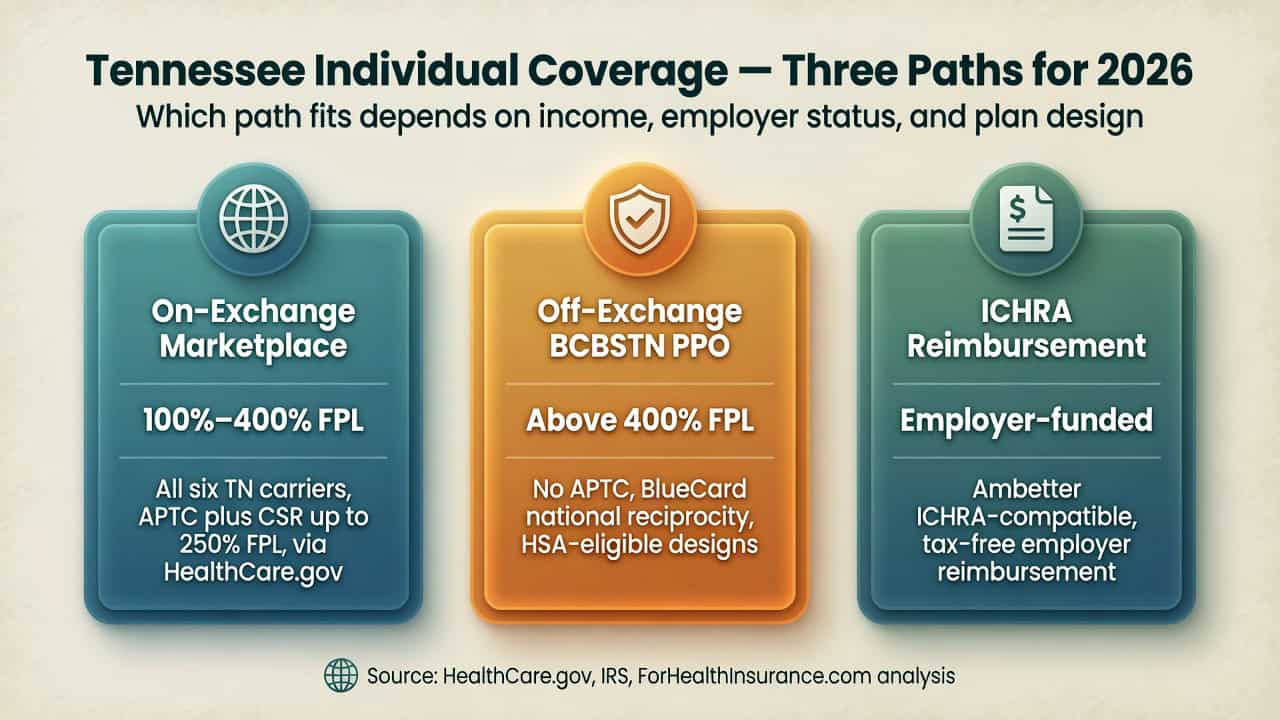
Tennessee individual buyers route through one of three primary coverage paths in 2026: on-exchange marketplace plans through HealthCare.gov for those between 100% and 400% of FPL who qualify for APTC, off-exchange plans sold directly by BCBSTN and other carriers for above-cliff households or specific plan designs, or ICHRA-compatible plans through Ambetter Health Solutions when an employer reimburses individual coverage.
On-exchange marketplace via HealthCare.gov
The default path for most Tennessee individual buyers. Plans from all six Tennessee carriers — BCBSTN, Cigna, Oscar, Ambetter, UnitedHealthcare, and Alliant — are available with APTC subsidies and CSR for households up to 250% of FPL. Roughly 77% of Tennessee marketplace enrollees received APTC in 2026, averaging $455 per month. Open enrollment for 2027 runs November 1 through December 15, 2026 only.
- All six TN carriers available
- APTC for 100%–400% FPL households
- CSR on Silver up to 250% FPL
- 2027 OEP: Nov 1 – Dec 15, 2026
Off-exchange plans direct from carrier
Sold directly by BlueCross BlueShield of Tennessee and other carriers without going through HealthCare.gov. Off-exchange plans never qualify for APTC regardless of income. The right path for Tennesseans above the 400% FPL cliff (single $62,600+, family of four $128,600+) and for those wanting specific plan designs like HSA-eligible PPOs not always available on-exchange. BCBSTN BlueCard reciprocity gives broader networks.
- BCBSTN PPO with broader networks
- BlueCard national reciprocity
- Year-round availability for some plans
- No APTC eligibility
ICHRA-compatible individual plans
For Tennesseans whose employer offers an Individual Coverage Health Reimbursement Arrangement (ICHRA) instead of group health insurance. The employee buys individual coverage and the employer reimburses tax-free up to a defined limit. Ambetter Health Solutions offers ICHRA-compatible products for Tennessee employees of ICHRA-using employers. Growing adoption among small Tennessee employers that previously didn’t offer health benefits.
- Ambetter Health Solutions ICHRA-compatible
- Employer reimburses individual premium
- Tax-free reimbursement up to ICHRA limit
- Growing among small TN employers
The choice between these three paths depends on income, employer status, and plan design priorities. For Tennesseans below 400% of FPL with no employer coverage offer, on-exchange through HealthCare.gov almost always wins on total cost because APTC and CSR provide federal subsidies unavailable through any other path. For above-cliff Tennesseans or those wanting BCBSTN PPO designs with BlueCard reciprocity, off-exchange direct-from-carrier shopping typically produces better network value. For Tennesseans whose employer reimburses through an ICHRA, Ambetter Health Solutions or other ICHRA-compatible products are the right path. Many Tennesseans benefit from running all three calculations to see which actually wins for their specific income, household, and care-use pattern.
Self-Employed Tennessee: Tax Strategy and Plan Selection
Self-employed Tennesseans benefit from a federal tax deduction for individual health insurance Tennessee premiums — the self-employed health insurance deduction allows above-the-line deduction of premium costs from federal taxable income. Combined with HSA contributions and accurate income projection for APTC, self-employed Tennesseans typically pay less for individual coverage than W-2 employees do for the employee share of employer plans.
The self-employed health insurance deduction is the most undervalued benefit for self-employed Tennesseans buying individual health insurance Tennessee carriers offer. Schedule C filers, partners in partnerships, and S corporation more-than-2% shareholders can deduct premiums paid for individual health insurance Tennessee marketplace and off-exchange plans alike — including the employee’s own coverage, spouse coverage, and dependent coverage — directly on Form 1040 above the line. The deduction reduces both federal income tax and self-employment tax for sole proprietors, producing a federal tax saving of roughly 22%-37% of premiums depending on marginal bracket plus an additional 15.3% self-employment tax saving for sole proprietors below the Social Security wage base. Tennessee has no state income tax on wages, so there’s no state benefit on top of the federal — but the federal deduction alone is substantial. For a Nashville self-employed musician paying $640 per month off-exchange ($7,680 annually), the federal tax saving runs roughly $1,690 to $2,840 depending on bracket — meaningfully reducing the effective cost of individual health insurance Tennessee self-employed buyers face.
Self-employed Tennesseans should also consider HSA-eligible plan designs. All BlueCross BlueShield of Tennessee Bronze plans are HSA-eligible for 2026, and other carriers offer HSA-compatible options. The 2026 HSA contribution limit is $4,300 self-only, $8,550 family. HSA contributions are deductible (federal — no Tennessee state benefit on wages) on top of the self-employed health insurance deduction. A self-employed Tennessean in the 32% federal bracket with family coverage who contributes the maximum $8,550 to an HSA reduces federal tax by approximately $2,736 — stacked on top of the premium deduction. Combined, self-employed Tennesseans buying individual health insurance Tennessee high-deductible plans can effectively reduce the after-tax cost of coverage by 30% to 50% versus the headline premium.
Income projection for APTC: more consequential for self-employed Tennesseans
Self-employed Tennesseans face more APTC reconciliation risk than W-2 employees because self-employment income fluctuates. Under-projecting income (estimating 380% of FPL when actual ends up 410%) means HealthCare.gov gives APTC during the year and the IRS recovers the entire annual subsidy at tax time when actual income exceeds the cliff. After Tennessee’s 37.5% rate increase for 2026, the dollar value of recovered APTC for above-cliff households is substantially larger than in prior years. Self-employed Tennesseans with variable income — Nashville music industry royalties, real estate commissions, healthcare consulting day rates, freelance project work — should project conservatively or shop off-exchange BCBSTN PPO to eliminate the cliff exposure entirely. The off-exchange path doesn’t qualify for APTC anyway, so the risk simply doesn’t apply.
Get Your Tennessee Individual Coverage Quote
Self-employed or between jobs in Tennessee? A licensed Tennessee agent lines up all six carriers, checks your APTC eligibility, works the self-employed deduction into the math, and tells you whether on-exchange or off-exchange BCBSTN PPO lands lower once taxes are counted. One call, your real number.
Lost Employer Coverage: SEP, COBRA, and the Marketplace
Tennesseans who lose employer-sponsored coverage qualify for a 60-day Special Enrollment Period on HealthCare.gov to enroll in individual health insurance Tennessee marketplace plans with APTC subsidies. The alternative is COBRA continuation, which lets you keep your former employer’s plan but at full premium plus a 2% administrative fee. For most Tennesseans, marketplace coverage with APTC wins on cost — but the right answer depends on income, family situation, and whether you’ve already met your deductible for the year.
Loss of employer coverage is a qualifying life event that triggers a 60-day Special Enrollment Period on HealthCare.gov. The 60-day clock starts from the date of coverage loss, not from when you submit documentation. During the SEP, Tennesseans can enroll in any of the six on-exchange Tennessee carriers’ individual plans with full APTC eligibility based on their projected post-job-loss household income. For Tennesseans whose income drops substantially after job loss, this often means qualifying for far larger APTC than they would have during open enrollment based on their prior income — and CSR if income drops below 250% of FPL.
COBRA is the alternative federal continuation right for Tennesseans whose former employer had 20+ employees. COBRA lets you keep your former employer’s plan for up to 18 months (sometimes longer for specific qualifying events) at the full premium amount plus a 2% administration fee. Without the employer’s premium contribution, COBRA premiums often run $700 to $1,800 per month for individual coverage and $1,800 to $2,800 for family coverage. For the substantial majority of Tennesseans who lose employer coverage, individual marketplace plans with APTC produce dramatically lower total cost than COBRA — often 50% to 80% lower for subsidized households.
The exception is Tennesseans who have already met their deductible and out-of-pocket maximum on the employer plan for the current calendar year. Switching to a new individual plan resets the deductible and OOP max for the remainder of the year, which can produce thousands of dollars in additional out-of-pocket exposure if a major medical event occurs. For Tennesseans mid-treatment, mid-pregnancy, or with a major scheduled procedure within the calendar year, COBRA’s higher monthly premium often wins on total cost by preserving the deductible already met. Run the math both ways before deciding — and remember that you can elect COBRA initially and switch to a marketplace plan later only during open enrollment or another QLE, not at will.
The 2027 OEP shorter window changes the SEP-vs-OEP calculus for Tennessee individual buyers
Tennessee’s 2027 open enrollment runs November 1 through December 15, 2026 only — shorter than the 2026 cycle. Tennesseans who lose employer coverage between mid-October and late December 2026 face a critical timing question: enroll under SEP (which gives 60 days but locks plan choice for the year), wait for open enrollment (which closes December 15, 2026), or both in sequence. For coverage starting January 1, 2027, the December 15 deadline applies — even if a SEP would otherwise extend further. Tennesseans losing employer coverage in November or early December 2026 should typically enroll through SEP for immediate coverage, then re-evaluate during the remainder of OEP if a different individual health insurance Tennessee plan turns out to be a better fit for 2027.
Above 400% FPL: Off-Exchange BCBSTN PPO and ICHRA Paths
Self-employed Tennesseans and individual buyers above 400% of FPL get zero APTC in 2026 with the return of the subsidy cliff, and they face the full 37.5% rate increase. For these above-cliff individual buyers, off-exchange BCBSTN PPO often produces better total value than on-exchange marketplace plans — broader networks, BlueCard national reciprocity, HSA-eligible designs, and competitive pricing that often undercuts on-exchange Silver after the rate increase.
The 400% FPL cliff hits Tennessee individual buyers harder than employer-covered W-2 workers because individual buyers pay the full premium themselves rather than splitting cost with an employer. A 60-year-old Nashville self-employed couple earning $135,000 (about 810% of FPL) gets zero APTC in 2026 and faces full-price marketplace premiums in the $1,800 to $2,400 per month range after the rate increase. Off-exchange BlueCross BlueShield of Tennessee PPO at the same age typically runs $1,400 to $1,900 per month combined and offers BlueCard national reciprocity, broader provider networks, and HSA-eligible plan designs not always available on-exchange. For above-cliff individual buyers — particularly self-employed Tennesseans whose income tends to vary above the cliff threshold — off-exchange BCBSTN PPO is frequently the lower-total-cost path.
ICHRA-compatible individual plans are a separate above-cliff path worth evaluating. Some small Tennessee employers — particularly tech, healthcare consulting, professional services, and creative agencies — have shifted from group health insurance to Individual Coverage Health Reimbursement Arrangements (ICHRAs), where the employer reimburses employees tax-free for individual health insurance premiums up to a defined monthly limit. Ambetter Health Solutions offers ICHRA-compatible individual plans designed specifically for this employer reimbursement model, and several other Tennessee carriers participate. For Tennesseans whose employer offers ICHRA, an ICHRA-compatible individual plan combined with employer reimbursement frequently produces better economics than either on-exchange marketplace plans or traditional employer group health insurance.
For Tennesseans evaluating off-exchange PPO options nationwide — particularly self-employed and above-cliff individual buyers who want quotes by ZIP code, network footprint, and HSA-eligible designs — off-exchange PPO health insurance plans are available with quotes by ZIP code and no referrals required. Start with the Tennessee health insurance plans page for designs, or the Tennessee health insurance pillar for the full market. Above-cliff Tennessee individual buyers frequently come out ahead off-exchange when they account for network breadth, BlueCard national reciprocity, and HSA tax savings on top of premium — making off-exchange BCBSTN PPO a structural answer to individual health insurance Tennessee above-cliff buyers most often need to evaluate first.
Tennessee Individual Coverage: Real Cost Examples
Real-world Tennessee individual buyers experience the marketplace very differently depending on income band, age, county, and employment status. The four examples below — a self-employed Nashville musician, a Memphis freelance contractor, a Knoxville recent college graduate, and a Chattanooga early retiree — illustrate how individual health insurance Tennessee shoppers find varies by household circumstance.
| Tennessee Individual Buyer | Income / FPL | Best Path | Approx. Monthly Cost |
|---|---|---|---|
| Nashville self-employed musician, age 32 | $58,000 (370% FPL) | On-exchange Silver from Cigna or BCBSTN + self-employed deduction | $220–$320/mo after APTC |
| Memphis freelance contractor, age 45 | $42,000 (267% FPL) | On-exchange Silver from Oscar or Ambetter (no CSR — just above 250%) | $190–$280/mo after APTC |
| Knoxville recent grad aging off parental at 26 | $36,000 (229% FPL) | On-exchange Silver with CSR from Cigna or BCBSTN | $45–$130/mo after APTC + CSR |
| Chattanooga early retiree couple, ages 62 and 60 | $95,000 combined (430% FPL) | Off-exchange BCBSTN PPO (above cliff) | $1,600–$2,000/mo combined |
The Nashville self-employed musician scenario captures one of the largest individual health insurance Tennessee subgroups: creative professionals at moderate-to-high income who benefit from both APTC and the self-employed deduction. At 370% of FPL, this musician qualifies for APTC but not CSR, so Silver (rather than Bronze with CSR-equivalent benefits) is the right tier choice. The Cigna or BCBSTN Silver plan after APTC runs $220 to $320 per month, and the federal self-employed health insurance deduction reduces the effective annual cost by roughly $700 to $1,300 depending on marginal bracket. Total effective annual cost is in the $1,800 to $2,500 range.
The Knoxville recent graduate scenario illustrates the highest-leverage individual health insurance Tennessee outcome: a 26-year-old at 229% of FPL who picks Silver gets both APTC and CSR. CSR transforms the Silver plan to 73% AV with substantially lower deductible and OOP max compared to standard Silver. Cigna or BCBSTN Silver with CSR after APTC often runs $45 to $130 per month — sometimes lower than the employer-share of comparable W-2 employer plans. For recent graduates choosing between a low-paying first job with employer coverage and a higher-paying contract role with individual coverage, the math frequently favors the contract role when individual marketplace economics are evaluated honestly.
Frequently Asked Questions
Common questions about individual health insurance Tennessee residents shop for in 2026 cover who needs individual coverage versus employer plans, the difference between on-exchange and off-exchange paths, actual cost ranges, when enrollment is open, and whether individual coverage is more expensive than employer plans.
Who needs individual health insurance in Tennessee?
Tennessee residents typically need individual health insurance when they don’t have access to employer-sponsored coverage. The largest groups buying individual health insurance Tennessee carriers offer include self-employed Tennesseans (Nashville’s music industry, real estate agents, contract healthcare consultants, freelance creative workers), early retirees ages 55-64 bridging to Medicare, recent college graduates aging off parental coverage at 26, contract workers, employees of small Tennessee businesses that don’t offer health benefits, and unemployed Tennesseans who don’t qualify for COBRA continuation. About one in eight Tennesseans ages 19-64 buy their own health insurance through the marketplace or directly from carriers.
What’s the difference between on-exchange and off-exchange individual plans in Tennessee?
On-exchange plans are sold through HealthCare.gov and qualify for Advance Premium Tax Credits for households between 100% and 400% of FPL. Off-exchange plans are sold directly by carriers like BlueCross BlueShield of Tennessee without the federal subsidy pathway. For Tennesseans with income between 100% and 400% of FPL, on-exchange almost always wins on total cost because of APTC. For Tennesseans above the 400% FPL cliff (single $62,600+, family of four $128,600+), off-exchange BCBSTN PPO often produces better value with broader networks, BlueCard national reciprocity, and HSA-eligible plan designs not always available on-exchange.
How much does individual health insurance cost in Tennessee?
Full-price individual health insurance in Tennessee for a 40-year-old non-tobacco user runs approximately $508 to $880 per month in 2026 depending on metal tier — Bronze $508-$582, Silver $670-$747, Gold $690-$880, and Alliant Platinum around $859. After Advance Premium Tax Credits, the average subsidy-eligible Tennessean paid substantially less in 2026 — federal subsidies averaged around $455 per month for the 77% of marketplace enrollees who qualified. Off-exchange BCBSTN PPO premiums for the same age typically run $640 to $820 per month. Costs vary by age, county, plan tier, tobacco use, and household composition.
When can I enroll in individual health insurance in Tennessee?
Open enrollment for 2027 individual health insurance Tennessee residents can buy through HealthCare.gov runs November 1, 2026 through December 15, 2026 — shorter than prior years due to a federal rule change. Coverage takes effect January 1, 2027. Outside open enrollment, a qualifying life event triggers a 60-day Special Enrollment Period. Qualifying events include losing job-based coverage, marriage, divorce, birth or adoption, moving to or within Tennessee, and aging off a parent’s plan at 26. Off-exchange individual plans from BCBSTN and Ambetter Health Solutions are available year-round without open-enrollment restriction for some plan types.
Is individual health insurance more expensive than employer plans in Tennessee?
Without subsidies, individual health insurance in Tennessee is typically more expensive than the employee share of employer-sponsored coverage because employers usually cover 70%-80% of the premium. With APTC, however, individual marketplace plans are often comparable to or cheaper than employer coverage for Tennesseans below 400% of FPL — particularly self-employed Tennesseans who can deduct individual health insurance premiums above the line on their federal tax return. For Tennesseans choosing between COBRA continuation after job loss and individual marketplace coverage, individual plans almost always win on cost: COBRA requires the full premium plus a 2% administration fee, while marketplace plans qualify for APTC.
Compare 2026 TN Individual Plans
From a Music Row freelancer to a pre-Medicare retiree, a licensed Tennessee agent weighs subsidized HealthCare.gov plans, the self-employed deduction, ICHRA reimbursement, and off-exchange BCBSTN PPO, then points you to the path that costs your household the least for 2027.
Free TN individual plan comparison — covers all six carriers and on-exchange/off-exchange.
Related Tennessee Health Insurance Resources
Complete TN coverage guide — six carriers, TennCare, costs, and the 37.5% rate increase.
TN Health Insurance MarketplaceHealthCare.gov enrollment, the shorter 2027 OEP, and the application walkthrough.
TN Health Insurance PlansCarrier comparison, plan tiers, and HMO vs PPO vs EPO designs.
Affordable Coverage in TennesseeSubsidy strategies, average costs, and how to lower your 2026 premium.
KFF Tennessee Health FactsIndependent state-level data on coverage, the uninsured rate, and the marketplace.
HealthCare.gov (Official)Tennessee’s official federal marketplace enrollment portal.
IRS Self-Employed Deduction GuideFederal rules for the self-employed health insurance deduction on Schedule 1.
TN Department of Commerce & InsuranceCarrier rate filings, consumer complaints, and licensed agent verification.
Broker Disclosure
ForHealthInsurance.com is an independent health insurance agency serving Tennessee residents. We are not affiliated with any carrier or government agency. We help you compare plans and enroll in coverage that meets your needs at no extra cost to you.