Tennessee Health Insurance Marketplace 2026: HealthCare.gov
The marketplace for Tennessee residents — also called the Tennessee health insurance exchange — runs through HealthCare.gov, the federally-facilitated platform Tennessee uses (the state never built its own exchange). Six carriers participate for 2026: BlueCross BlueShield of Tennessee, Cigna Healthcare, Oscar Insurance, Celtic/Ambetter, UnitedHealthcare, and Alliant Health Plans. About 555,000 Tennesseans selected coverage for 2026 — roughly 77% received Advance Premium Tax Credits averaging $455 per month, bringing subsidy-eligible Tennesseans’ average premium substantially below the full-price benchmark. The 37.5% weighted average rate increase for 2026 was among the largest in eight years, driven primarily by the December 2025 expiration of enhanced American Rescue Plan subsidies. The 2027 open enrollment window will be shorter than 2026 — running November 1 through December 15, 2026 only — under a federal rule change that took effect in 2025. This guide walks through the open enrollment window, how subsidies work in 2026, how to compare the six carriers, the step-by-step HealthCare.gov application process, and the alternatives for households above the 400% FPL subsidy threshold.

What brings you here today?
Why Tennessee Uses HealthCare.gov, Not a State Exchange
Tennessee uses the federally-facilitated marketplace at HealthCare.gov — the same federal platform serving 30 states for the 2026 plan year. Tennessee never built its own exchange after the ACA passed in 2010, choosing instead to default to the federal platform. This means Tennesseans cannot enroll through any state-run portal; HealthCare.gov is the only legitimate channel for marketplace coverage with premium tax credits.
When the ACA’s exchange provisions took effect in 2014, states had three implementation options: build a fully state-based health insurance exchange, build a state-based exchange that uses the federal HealthCare.gov technology platform, or default to the federally-facilitated marketplace entirely. Tennessee chose the third option. Neighboring states made varied choices — Kentucky operates a state-based exchange (Kynect), Georgia operates its own SBE for 2026, and Alabama, Mississippi, North Carolina, Virginia, and Arkansas use HealthCare.gov in various forms. The practical consequence for Tennessee residents is that all marketplace shopping, plan comparison, subsidy calculation, and enrollment happens through HealthCare.gov — with one exception described below.
The Tennessee Department of Commerce and Insurance regulates the carriers that participate in the marketplace, but Tennessee no longer operates an effective state rate review program — meaning the Centers for Medicare and Medicaid Services (CMS) reviews and approves rate filings filed by Tennessee carriers each year. The Tennessee Division of TennCare administers the state’s non-expanded Medicaid program, which HealthCare.gov screens for automatically before displaying marketplace plan options. The federal exchange and TennCare are connected through a real-time eligibility determination — but because Tennessee didn’t adopt Medicaid expansion, the determination logic in Tennessee differs from expansion states. The HealthCare.gov enrollment portal is the only authoritative entry point for Tennessee marketplace plans.
2027 Open Enrollment Period for Tennessee
Open enrollment for 2027 plans in Tennessee runs November 1, 2026 through December 15, 2026 on HealthCare.gov — shorter than the 2026 cycle due to a federal rule change that took effect in 2025. There is no January extension for 2027. Coverage selected during open enrollment takes effect January 1, 2027. Outside this window, a qualifying life event creates a 60-day special enrollment period.
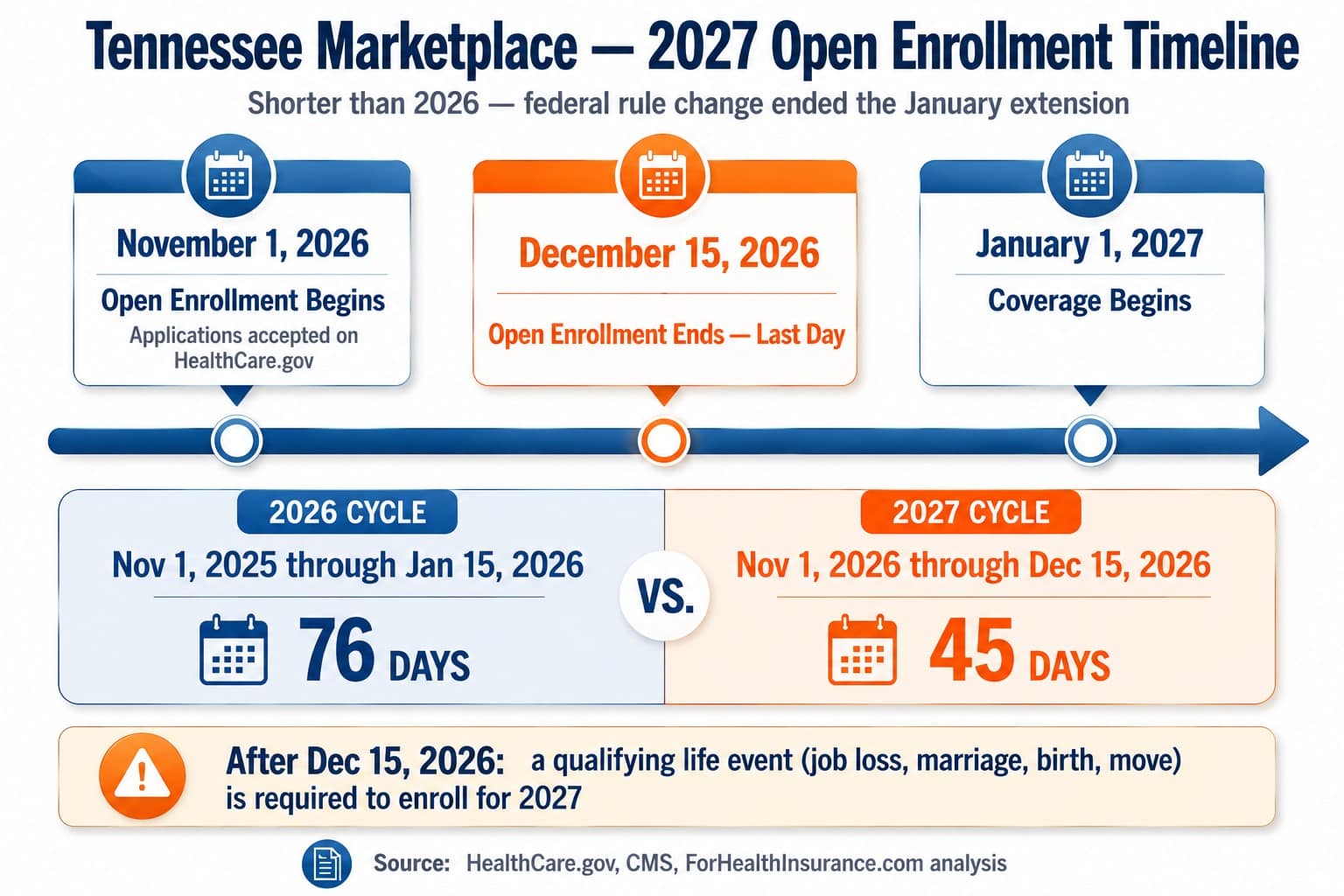
The shortened open enrollment window is the most consequential procedural change for Tennessee marketplace shoppers in 2026 going into 2027. From 2022 through 2025, Tennessee’s open enrollment ran 76 days from November 1 through January 15. The federal rule change that took effect in 2025 reduced that to 45 days starting with the 2027 plan year — November 1 through December 15 only. There is no two-tier deadline structure for 2027 (the prior split between January 1 and February 1 effective dates is eliminated). Tennessee carriers and the Department of Commerce and Insurance are both publicizing the shorter window heavily because Tennesseans accustomed to the January 15 deadline risk missing 2027 coverage entirely if they don’t act by December 15, 2026.
Outside the open enrollment window, enrollment requires a qualifying life event (QLE) that triggers a 60-day special enrollment period. Qualifying events include losing other coverage (job loss, COBRA expiration, aging off a parent’s plan at age 26, divorce), getting married, having or adopting a child, moving to Tennessee or to a different ZIP code with different plan availability, becoming a U.S. citizen, and certain other specific circumstances. The 60-day clock starts on the date of the event — not the date the applicant submits documentation. With the shorter 2027 open enrollment window, more Tennesseans are likely to need SEP enrollment in early 2027 than in prior years, when the January 15 extension absorbed late enrollers.
Auto-renewal will catch many Tennesseans who miss the December 15 deadline
HealthCare.gov auto-renews most Tennessee marketplace enrollees who don’t actively select a plan during open enrollment — typically into the same plan from the same carrier, with updated 2027 premium and subsidy amounts. Auto-renewal is convenient but can produce expensive surprises in 2027 because of the 37.5% rate increase that hit Tennessee for 2026 (and additional 2027 rate changes carriers are filing now). Tennesseans who auto-renewed into 2026 plans saw monthly premiums jump substantially in many cases. Active shopping during the shorter November 1 – December 15, 2026 window — even just a 30-minute review — almost always identifies lower total annual cost options, particularly if you’ve changed jobs, Reporting those changes keeps a Tennessee health insurance marketplace plan accurate.
Tennessee Subsidies: APTC, CSR, and the 2025 Cliff Return
Tennesseans between 100% and 400% of FPL qualify for Advance Premium Tax Credits in 2026; about 77% of enrollees received subsidies averaging $455 per month. Households up to 250% of FPL also qualify for Cost-Sharing Reductions on Silver plans, which lower deductibles and out-of-pocket costs. The American Rescue Plan enhancements expired at the end of 2025, so the 400% subsidy cliff has returned for 2026.
The subsidy structure is built around the federal poverty level published by the Department of Health and Human Services. For 2026 marketplace coverage, the FPL thresholds applicable in Tennessee are: 100% of FPL is approximately $15,650 for a single adult and $32,150 for a family of four (the lower bound for marketplace subsidy eligibility because Tennessee did not expand Medicaid — below 100% of FPL, residents fall into the coverage gap with no TennCare pathway and no marketplace subsidies). 250% of FPL is approximately $39,125 for a single adult and $80,375 for a family of four (the upper bound for Cost-Sharing Reductions). 400% of FPL is approximately $62,600 for a single adult and $128,600 for a family of four (the upper bound for Advance Premium Tax Credits in 2026 The cliff reshaped how the Tennessee health insurance marketplace prices coverage.
| 2026 Income Level | Single Adult | Family of 4 | What You Qualify For |
|---|---|---|---|
| Below 100% FPL | < $15,650 | < $32,150 | Tennessee coverage gap (TennCare not expanded) |
| 100%–150% FPL | $15,650–$23,475 | $32,150–$48,225 | APTC + maximum CSR (94% AV Silver) |
| 150%–200% FPL | $23,475–$31,300 | $48,225–$64,300 | APTC + strong CSR (87% AV Silver) |
| 200%–250% FPL | $31,300–$39,125 | $64,300–$80,375 | APTC + limited CSR (73% AV Silver) |
| 250%–400% FPL | $39,125–$62,600 | $80,375–$128,600 | APTC only (no CSR) |
| Above 400% FPL | > $62,600 | > $128,600 | Full price — subsidy cliff in 2026 |
The Tennessee coverage gap deserves special attention. Because Tennessee did not adopt the ACA Medicaid expansion, residents below 100% of FPL who don’t qualify for TennCare under the state’s limited eligibility categories (pregnant women, children, certain disabled adults) are typically left without affordable coverage options — they fall below the marketplace subsidy threshold and don’t have a TennCare pathway. This is in contrast to expansion states like Kentucky or Virginia, where residents below 138% of FPL are covered by Medicaid. Approximately 100,000–150,000 Tennesseans are estimated to fall into the coverage gap, depending on the year. Tennessee residents in this band may qualify for community health center sliding-scale care, hospital charity care programs, or limited federally qualified health center (FQHC) services — but standard health For them, the Tennessee health insurance marketplace is rarely the right route.
For Tennesseans squeezed by the 400% FPL cliff at the upper end, off-exchange shopping becomes more attractive because off-exchange plans (which never qualified for APTC) compete on full-price terms anyway. BlueCross BlueShield of Tennessee off-exchange PPO plans frequently offer broader provider networks and BlueCard national reciprocity at premium points comparable to on-exchange Silver plans without subsidies — and after Tennessee’s 37.5% on-exchange rate increase for 2026, the gap narrowed considerably. Off-exchange BCBSTN PPO health insurance plans are available across Tennessee for households above the cliff. Compare designs and tiers on the Tennessee health insurance plans page, or weigh subsidy strategies on affordable health insurance in Tennessee.
Get a Quote Through HealthCare.gov
Before you pick a 2027 plan on HealthCare.gov, a licensed Tennessee agent can confirm whether you fall into TennCare or CoverKids, estimate your premium tax credit and any cost-sharing help, and line up BlueCross BlueShield of Tennessee against the Cigna, Oscar, Ambetter, UnitedHealthcare, and Alliant networks for your county. One call covers every Tennessee carrier.
Comparing the Six Tennessee Marketplace Carriers
The six carriers on HealthCare.gov for Tennessee — BlueCross BlueShield of Tennessee, Cigna Healthcare, Oscar Insurance, Celtic/Ambetter, UnitedHealthcare, and Alliant Health Plans — each occupy distinct strategic positions. BCBSTN dominates the statewide and PPO market with BlueCard reciprocity. Five other carriers primarily offer EPO designs anchored on regional networks and metro footprints, with Ambetter the only carrier outside BCBSTN with universal 95-county availability.
BlueCross BlueShield of Tennessee
Tennessee-headquartered nonprofit and the dominant carrier for individual marketplace plans. Network E expanded to all regions for 2026; 12 plan options across Bronze, Silver, and Gold; the only marketplace carrier offering broad PPO designs with BlueCard national reciprocity. Best fit for Tennesseans who travel, have providers across systems, or live outside the major metros.
- Statewide all 95 counties
- Only major PPO carrier on-exchange
- BlueCard national reciprocity
- +41% approved rate increase 2026
Cigna Healthcare
National managed care carrier serving Chattanooga, Knoxville, Nashville, Memphis, Jackson, and the Tri-Cities. EPO designs across Bronze, Silver, and Gold tiers. Strongest on primary care and specialist office visit cost-sharing — many Cigna plans cover those visits before the deductible, Such gaps show why comparing the Tennessee health insurance marketplace county by county matters.
- National carrier, TN metro + Tri-Cities
- EPO Bronze, Silver, Gold
- Low PCP and specialist copays
- No adult dental embedded
Oscar Insurance
Tech-enabled marketplace carrier with concentrated Nashville and Memphis footprints. Lowest average premium statewide on average. Strong digital member experience and virtual primary care included. Best fit for healthy under-40 Tennesseans in covered counties It remains a budget option within the Tennessee health insurance marketplace.
- Nashville and Memphis primary
- Lowest avg TN premium
- Strong telehealth tools
- +28% rate increase 2026
Celtic/Ambetter of Tennessee
Centene Corporation subsidiary underwritten by Celtic Insurance Company. The only non-BCBSTN carrier covering all 95 Tennessee counties. EPO design with three-tier structure focused on lower deductibles. My Health Pays rewards program offers up to $500 in 2026. Ambetter Health Solutions also offers off-exchange ICHRA-compatible plans.
- All 95 counties
- EPO three-tier structure
- $500 My Health Pays rewards 2026
- ICHRA-compatible off-exchange
UnitedHealthcare
Re-entered the Tennessee marketplace in 2021 after a multi-year absence. Coverage in Chattanooga, Jackson, Memphis, Nashville, and West Middle Tennessee including Columbia, Dickson, and Lawrenceburg in Rating Area 8. Broader networks than other EPO carriers in covered counties. Strongest national-carrier servicing.
- National carrier, TN metros + Rating Area 8
- Broader networks in covered counties
- National-carrier servicing strength
- Re-entered TN 2021
Alliant Health Plans
Regional carrier headquartered in Dalton, Georgia, serving Southeast Tennessee and North Georgia. Bronze, Silver, Gold, and Platinum tier availability — the only Tennessee marketplace carrier offering Platinum for 2026. Approved only +0.3% rate increase for 2026, Even small carriers list plans on the Tennessee health insurance marketplace.
- Southeast TN / North GA regional
- Bronze, Silver, Gold, Platinum tiers
- +0.3% rate increase 2026
- Only carrier with TN Platinum
The choice between the six carriers in Tennessee comes down to where you live and which providers you use. Statewide and PPO buyers gravitate to BCBSTN. Major-metro residents in Nashville, Memphis, Knoxville, and Chattanooga can compare all six and optimize on premium and provider network match. Rural Tennesseans typically have access to BCBSTN, Ambetter, and one or two additional carriers depending on county. Provider directory verification is essential — Tennessee’s six-carrier landscape produces meaningful variation in which physicians and hospitals are in-network Network checks come before buying any Tennessee health insurance marketplace plan.
How to Apply Through HealthCare.gov in Tennessee
Applying for Tennessee marketplace coverage takes about 30 to 60 minutes on HealthCare.gov for most households. The application collects household composition, projected annual income, current coverage status, and citizenship verification, then automatically screens for TennCare and CoverKids before displaying marketplace plan options with your real-time APTC amount. Apply by December 15, 2026 for 2027 coverage starting January 1, 2027.
Gather your documents before you start
You will need household composition (everyone on your tax return — spouse, dependents), Social Security numbers for everyone applying, projected 2027 household income (annual MAGI), employer information if anyone has access to employer-sponsored coverage that meets ACA affordability standards, and immigration documents if applying for non-citizen household members. Tennesseans whose income fluctuates — sales commission workers, music industry freelancers, real estate agents, contract workers in healthcare — should estimate full-year projected income realistically rather That mistake is common when shopping the Tennessee health insurance marketplace.
Create or log into your HealthCare.gov account
Visit HealthCare.gov and create an account or log into your existing account if you’ve enrolled before. Returning enrollees should review prior-year information for accuracy — particularly income, household size, and current coverage. Tennesseans who enrolled in 2026 will have most of their information pre-filled and only need to update what has changed. Be aware that auto-renewal may have placed you in a 2026 plan with materially different premium than your 2025 plan The increase hit every Tennessee health insurance marketplace tier.
Complete the eligibility application
The HealthCare.gov application asks about household composition, income, current coverage, and any employer-sponsored coverage offers. The system runs a real-time eligibility determination that screens for TennCare (limited categorical eligibility — pregnant women, children, certain disabilities) and CoverKids (children up to 250% of FPL). If routed to TennCare, your application is forwarded to the Tennessee Division of TennCare for final determination. Tennesseans below 100% of FPL who don’t fit a TennCare category The coverage gap is the hard edge of the Tennessee health insurance marketplace.
Compare plans from all six Tennessee carriers
If you qualify for marketplace coverage, HealthCare.gov displays plan options from all six Tennessee carriers — BCBSTN, Cigna, Oscar, Ambetter, UnitedHealthcare, and Alliant — with your APTC and CSR amounts already applied. Compare on monthly premium after subsidy, deductible, out-of-pocket maximum, network breadth (BCBSTN broadest, Ambetter all 95 counties, others vary by county), and prescription drug formulary if you take medications regularly. Use each carrier’s provider directory to verify your specific physicians and Confirming providers protects a Tennessee health insurance marketplace choice.
Select a plan and pay your first premium
After selecting a plan, HealthCare.gov forwards your enrollment to the chosen carrier. Coverage does not begin until you pay your first premium directly to the carrier — BCBSTN, Cigna, Oscar, Ambetter, UnitedHealthcare, or Alliant, depending on which plan you selected. Most carriers offer auto-pay enrollment from a checking account or credit card. For 2027 coverage, enroll by December 15, 2026; coverage begins January 1, 2027.
Tennessee residents who want help with the application can work with a free Navigator through Tennessee’s network of HealthCare.gov-certified navigators, listed through the Tennessee Department of Commerce and Insurance. The federal HealthCare.gov call center (1-800-318-2596) is also available 24/7. Tennesseans who prefer a licensed broker rather than a navigator — particularly those evaluating off-exchange BCBSTN PPO options or Ambetter Health Solutions ICHRA plans alongside marketplace plans — can work with ForHealthInsurance.com at 888-215-4045. For the Tennessee Department of Commerce and Insurance’s official consumer guide and rate filing information, see Tennessee Department of Commerce and Insurance.
When the Marketplace Isn’t the Right Fit
The marketplace works well for Tennesseans between 100% and 400% of FPL who qualify for subsidies. It works less well for households above the 400% FPL cliff facing the full 37.5% rate increase, those who need broader networks than the EPO designs offered by five of six carriers, and those whose providers span multiple states. For these Tennesseans, off-exchange shopping — particularly BCBSTN PPO designs with BlueCard national reciprocity — often produces better value.
The clearest case for off-exchange shopping in Tennessee is the household above the 400% FPL subsidy cliff. A 60-year-old couple in Nashville earning $135,000 (about 810% of FPL) gets zero APTC in 2026 and faces full-price marketplace premiums in the $1,800–$2,400 per month range after the 37.5% increase. BlueCross BlueShield of Tennessee off-exchange PPO designs at this premium point often offer broader provider networks, BlueCard national reciprocity, and access to HSA-eligible plan designs not always available on-exchange — features valuable to a couple at this income level who travel, have providers in multiple states, or want maximum network flexibility. Off-exchange premiums for a 40-year-old in 2026 typically run $640–$820 per month; for older buyers above the cliff, the premium gap between on-exchange and off-exchange narrows considerably and sometimes inverts.
The second case is Tennesseans who travel for work or split time across state lines — country music industry professionals splitting time between Nashville and Los Angeles or Austin, healthcare consultants serving multiple regional systems, retirees who winter in Florida, regional sales representatives, professional athletes. Five of the six Tennessee marketplace carriers offer EPO designs that provide limited or no out-of-state coverage outside emergencies. BCBSTN BlueCard reciprocity gives Tennesseans in-network access to any BCBS-contracted provider in any state — Vanderbilt’s clinical partners, Mayo Clinic, Cleveland Clinic, MD Anderson, or routine care wherever a Tennessean happens to be at the time. For Tennesseans who need this geographic flexibility, the marketplace’s EPO-dominant carrier mix is often a poor fit even with subsidies.
Frequently Asked Questions
Common questions about the Tennessee marketplace cover what the marketplace is, the shorter 2027 open enrollment window, subsidy eligibility thresholds, the six participating carriers, and whether PPO plans are available through HealthCare.gov.
What is the Tennessee health insurance marketplace?
The Tennessee health insurance marketplace — also called the Tennessee health insurance exchange — is the federally-facilitated platform at HealthCare.gov where Tennessee residents shop for, compare, and enroll in ACA-compliant individual and family coverage. Tennessee does not operate a state-based exchange. The marketplace offers plans from six carriers for 2026: BlueCross BlueShield of Tennessee, Cigna Healthcare, Oscar Insurance, Celtic/Ambetter, UnitedHealthcare, and Alliant Health Plans. About 555,000 Tennesseans Enrollment growth shows the Tennessee health insurance marketplace is widely used.
When is the Tennessee marketplace open enrollment period for 2027?
The 2027 open enrollment period in Tennessee runs November 1, 2026 through December 15, 2026 on HealthCare.gov — shorter than the 2026 cycle due to a federal rule change that took effect in 2025. There is no January extension for 2027. Coverage selected during open enrollment takes effect January 1, 2027. Outside open enrollment, a qualifying life event — job loss, marriage, divorce, birth or adoption, moving to or within Tennessee, loss of other coverage — triggers a 60-day special enrollment period. American Indian and Alaska Native Tennesseans can enroll year-round Those programs sit beside the Tennessee health insurance marketplace, not inside it.
How do I qualify for marketplace subsidies in Tennessee?
Tennesseans with household incomes between 100% and 400% of the federal poverty level qualify for Advance Premium Tax Credits through the marketplace. For 2026, that range is approximately $15,650 to $62,600 for a single adult and $32,150 to $128,600 for a family of four. About 77% of Tennessee marketplace enrollees received APTC in 2026, with subsidies averaging $455 per month. Households up to 250% of FPL also qualify for Cost-Sharing Reductions on Silver-tier plans, which lower deductibles and out-of-pocket costs. Below 100% of FPL, Tennessee’s coverage gap leaves residents typically ineligible for both TennCare and marketplace subsidies because Tennessee did not adopt Medicaid expansion.
Which carriers participate in the Tennessee marketplace for 2026?
Six carriers participate in the Tennessee marketplace through HealthCare.gov for 2026: BlueCross BlueShield of Tennessee (statewide, dominant PPO carrier), Cigna Healthcare (major metros and Tri-Cities), Oscar Insurance (Nashville and Memphis primary), Celtic/Ambetter of Tennessee (all 95 counties), UnitedHealthcare (metros plus Rating Area 8), and Alliant Health Plans (Southeast Tennessee and North Georgia). BCBSTN offers PPO designs with BlueCard national reciprocity; the other five primarily offer EPO designs anchored on regional networks. Plan availability varies by county.
Can I enroll in a PPO plan through the Tennessee marketplace?
BlueCross BlueShield of Tennessee offers broader-network PPO plan designs through HealthCare.gov in Tennessee, including BlueCard national reciprocity that gives members in-network access in all 50 states. The other five Tennessee marketplace carriers — Cigna, Oscar, Ambetter, UnitedHealthcare, and Alliant — primarily offer EPO designs that don’t cover out-of-network care outside emergencies. Tennesseans who prefer a true off-exchange PPO with the broadest national network and no referral requirements can also shop directly with carriers off-exchange — these plans are not eligible for premium tax credits but offer maximum network flexibility, typically running $640 to $820 per month for a 40-year-old in 2026.
Compare 2026 TN Marketplace Plans
Households near the 400% cliff gain the most from a side-by-side look: a licensed Tennessee agent prices subsidized HealthCare.gov plans against off-exchange BCBSTN PPO and Ambetter ICHRA coverage, then checks your East, Middle, or West Tennessee providers against each network before you enroll.
Free TN marketplace comparison — covers all six carriers and off-exchange options.
Related Tennessee Health Insurance Resources
Complete TN coverage guide — six carriers, TennCare, costs, and the 37.5% rate increase.
TN Health Insurance PlansPlan tiers (Bronze, Silver, Gold, Platinum), HMO vs PPO vs EPO, and how to choose.
Affordable Coverage in TennesseeSubsidy strategies, average costs, and how to lower your 2026 premium after the rate spike.
Individual Health Insurance TennesseeSelf-employed, freelance, and individual coverage paths — on-exchange and off-exchange.
CMS Marketplace ReportsFederal enrollment data and Tennessee carrier participation history.
HealthCare.gov (Official)Tennessee’s official federal marketplace enrollment portal for 2027 plans.
TN Department of Commerce & InsuranceCarrier rate filings, consumer complaints, and licensed agent verification.
KFF Subsidy CalculatorEstimate your 2026 APTC amount before applying through HealthCare.gov.
Broker Disclosure
ForHealthInsurance.com is an independent health insurance agency serving Tennessee residents. We are not affiliated with any carrier or government agency. We help you compare plans and enroll in coverage that meets your needs at no extra cost to you.