Individual Health Insurance in Montana: 2026 Private Plans
Individual health insurance in Montana serves Montanans who don’t receive coverage through an employer — self-employed ranchers, outfitters, and consultants, remote tech workers who’ve relocated to Bozeman and Missoula, early retirees bridging to Medicare, seasonal tourism workers near Glacier and Yellowstone, and anyone between jobs. Three carriers sell private plans statewide through HealthCare.gov: BCBS of Montana (POS + PPO), Mountain Health CO-OP (PPO, cheapest Silver at $639/month), and PacificSource (EPO, eliminating out-of-network for 2026). Because Montana expanded Medicaid through the HELP Program, adults under 138% FPL ($21,597 single) have a Medicaid path — but the roughly 73,255 Montanans on marketplace plans sit above that threshold and buy individual coverage. This guide covers who buys individual plans in Montana, how the networks compare, self-employed tax strategies, pre-Medicare coverage, and metal-tier selection.

What’s your individual coverage situation?
I’m self-employed or freelance
Rancher, outfitter, consultant, remote worker
See self-employed options ↓Who Buys Individual Coverage in Big Sky Country
Individual health insurance in Montana covers Montanans without employer-sponsored benefits, and the state’s individual marketplace enrolled about 73,255 people for 2026 through HealthCare.gov. Self-employed ranchers, outfitters, and small-business owners are the backbone of the market. Bozeman’s growing remote-work economy has added a wave of tech and creative professionals who relocated from states with larger carrier markets and must now navigate Montana’s three-carrier system.
Montana’s economy drives a larger-than-average share of residents into the private market. Agriculture, tourism in the Glacier and Yellowstone gateway communities, outdoor-recreation businesses, and a fast-growing remote-work sector in the Gallatin Valley mean many Montanans are self-employed, seasonally employed, or work for small businesses without group coverage. Unlike many states, Montana’s individual market is genuinely competitive — all three carriers serve every county, and two offer on-exchange PPO plans with subsidy eligibility. Private plans purchased through HealthCare.gov are ACA-compliant: pre-existing conditions are covered, all 10 essential health benefits are included, and no benefit caps apply.
Montana’s Three-Network Market: Picking POS, PPO, or EPO
Individual health insurance in Montana offers an unusual three-network choice on HealthCare.gov. BCBS MT sells both POS (in-network Montana, $663/month Silver) and PPO (nationwide BlueCard, $789/month Silver). Mountain Health CO-OP sells PPO limited to Montana and Idaho ($639/month Silver, cheapest in state). PacificSource sells EPO with no out-of-network coverage for 2026 ($754/month Silver). Choosing the right network type is the most consequential decision for Montana individual buyers.
| Network Type | Carrier | 40yo Silver | Out-of-Network | Best For |
|---|---|---|---|---|
| POS | BCBS MT | $663/mo | No (Montana only) | In-state care with broadest MT hospital access |
| PPO | BCBS MT | $789/mo | Yes — nationwide BlueCard | Out-of-state specialists, snowbirds, travelers |
| PPO | Mountain Health CO-OP | $639/mo | MT & ID only (2026) | Cheapest Silver; free insulin; care stays in-state |
| EPO | PacificSource | $754/mo | No (eliminated 2026) | No-referral specialist access, in-network only |
For most buyers of individual health insurance in Montana whose healthcare stays within the state, the CO-OP PPO at $639/month or BCBS POS at $663/month delivers the strongest value. The $126/month jump to BCBS PPO — $1,512/year — is justified mainly for Montanans who regularly see specialists in Denver, Seattle, Salt Lake City, or Minneapolis, or who winter out of state. PacificSource EPO at $754/month occupies an unusual middle ground: more expensive than both in-state options but without any out-of-network fallback. The Montana carrier comparison covers network and PPO details by region.
Ranchers, Outfitters & Remote Workers: Self-Employed Coverage
Self-employed Montanans are the largest individual health insurance in Montana buyer segment. Without employer benefits, ranchers, outfitters, freelancers, consultants, and the growing Bozeman remote-work community purchase private plans through HealthCare.gov. The self-employed health insurance deduction lets sole proprietors deduct 100% of premiums as an adjustment to gross income — reducing taxable income before the standard deduction, and stacking with marketplace premium tax credits for substantial combined savings.
The premium tax credit and self-employed deduction interact through an iterative IRS calculation in IRS Publication 974. For many Montana self-employed filers, effective premium costs after all tax benefits run 25–40% lower than sticker price. A Missoula outfitter earning $54,000 might pay $245/month after subsidy for a CO-OP Silver PPO and deduct the $2,940 annual premium at tax time — saving an additional $700+ in federal taxes. The CO-OP’s free insulin and preventive-drug benefit adds further real-world value that doesn’t show up in premium comparisons.
Example — Bozeman remote software developer, age 36, $72,000 income: A self-employed software developer who relocated to Bozeman from Portland earning $72,000/year (about 470% FPL) is above the enhanced-subsidy threshold if it expires. Without subsidies, BCBS MT POS Silver runs $663/month ($7,956/year). The self-employed deduction saves about $1,909 at the 24% bracket, bringing the effective cost to $6,047/year. If the developer reduces MAGI below $62,600 through an HSA contribution ($4,150) and a traditional IRA ($7,000), the subsidy unlocks — potentially cutting the net premium to about $440/month plus the deduction benefit.
Montana rancher and agricultural income: Ranching income is highly variable year to year — cattle prices, drought, and federal agricultural payments all create significant MAGI swings. Projecting marketplace income conservatively during HealthCare.gov enrollment prevents subsidy clawback. Many Montana ranchers also qualify for Schedule F deductions that lower MAGI naturally. A licensed broker familiar with agricultural income patterns can model subsidy eligibility across multiple income scenarios.
Compare Montana Individual Plans for Your Situation
See individual plans from all three Montana carriers — BCBS MT (POS + PPO), Mountain Health CO-OP (PPO with free preventive drugs), and PacificSource (EPO). Subsidy calculations and self-employed deduction modeling from a licensed enrollment assistant at no cost.
Pre-Medicare Coverage for Montana Early Retirees
Montana early retirees between 55 and 64 face the highest individual premiums by age — a 60-year-old pays about 3x a 21-year-old — but benefit most from premium tax credits when they manage retirement income strategically. A 60-year-old CO-OP Silver PPO runs about $1,405/month full price; with MAGI kept below 400% FPL through Roth IRA withdrawals, the subsidy can bring that to roughly $500/month — a $10,860/year difference from income strategy alone.
Montana’s BCBS PPO is especially valuable for early retirees who need specialist access outside the state — a Billings retiree seeing a cardiologist at the University of Utah or an oncologist at Swedish Medical Center in Seattle processes the claim through BlueCard at in-network rates. For retirees whose care stays within Montana, the CO-OP PPO at $1,405/month (60yo Silver) saves money and includes free insulin and blood-pressure medication — prescriptions many pre-Medicare retirees take regularly. Montana’s reinsurance waiver also cushions full-price premiums for the roughly 11% of enrollees who don’t qualify for subsidies. HELP Program Medicaid and Healthy Montana Kids enrollment are managed through Montana DPHHS, and the Montana affordable coverage guide covers MAGI-optimization strategies for retirees in detail.
Metal Tier Selection for Montana Individual Plans
Montana marketplace plans come in five tiers: Catastrophic (under 30 or hardship), Bronze (lowest premium, $419+ BCBS POS), Silver ($639+ CO-OP PPO, CSR-eligible under 250% FPL), Gold ($669+ CO-OP PPO, lowest deductibles), and Platinum (limited availability). For subsidized Montanans under 250% FPL, Silver with cost-sharing reductions delivers the best combined value — deductibles drop dramatically with no additional premium cost. About 33% of Montana marketplace enrollees received CSR benefits in 2025.
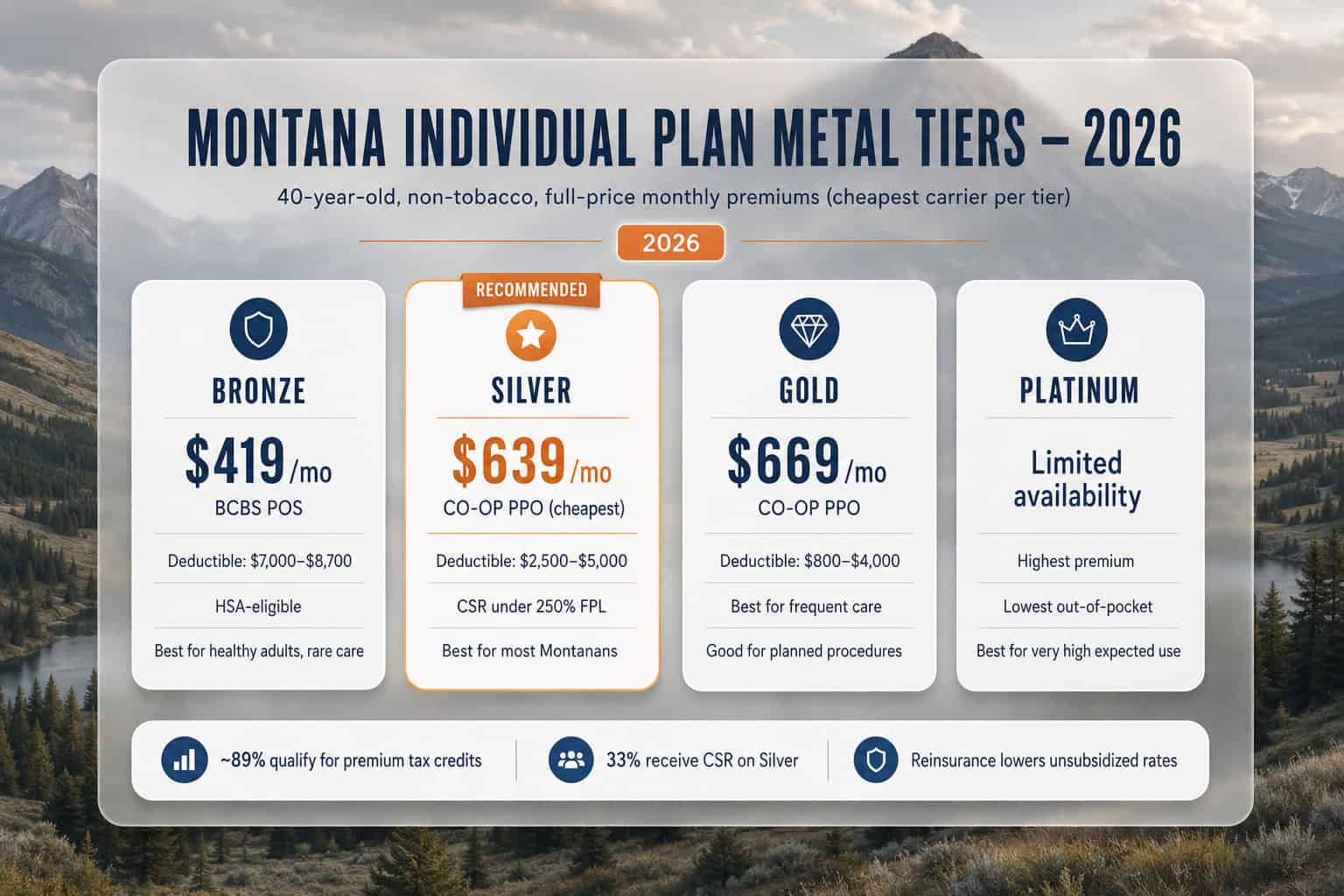
For Montanans under 250% FPL, Silver plans with cost-sharing reductions are the clear winner — a standard Silver deductible of $5,000 can drop to under $1,000 with strong CSRs applied automatically at no additional premium cost. Above 250% FPL with minimal healthcare needs, Bronze plans minimize monthly spend but expose you to $7,000+ deductibles. Gold makes sense for enrollees with frequent doctor visits, chronic conditions, or planned procedures — the CO-OP Gold PPO at $669/month with a $4,000 deductible and free insulin can deliver strong real-world value for diabetic Montanans. Whatever tier fits, individual health insurance in Montana is cheapest when matched to your actual care use; the Montana market overview shows 2026 pricing by city and age across all tiers.
Individual Coverage Questions From Montanans
Who typically buys individual health insurance in Montana?
Self-employed ranchers, outfitters, consultants, and small-business owners. Remote tech and creative workers who’ve relocated to Bozeman and Missoula. Early retirees under 65 bridging to Medicare. Seasonal tourism workers near Glacier and Yellowstone. Part-time employees without benefits. Adult children aging off a parent’s plan at 26. About 73,255 Montanans enrolled in marketplace plans for 2026.
Can self-employed Montanans deduct individual plan premiums?
Yes. The self-employed health insurance deduction allows sole proprietors, LLC members, S-corp shareholders (2%+), and partners to deduct 100% of premiums as an adjustment to gross income. This stacks with marketplace premium tax credits through an iterative IRS calculation in Publication 974. Effective premium costs after all tax benefits typically run 25–40% lower than sticker price for Montana self-employed filers.
What’s the difference between POS, PPO, and EPO in Montana?
POS (BCBS MT, $663/month Silver): in-network Montana care, referrals may be required, lowest BCBS premium. PPO (BCBS MT $789; CO-OP $639): out-of-network covered (nationwide for BCBS, MT/ID for the CO-OP), no referrals, higher premiums for BCBS. EPO (PacificSource, $754): in-network only with no referrals — eliminated all out-of-network for 2026. Most Montanans save with CO-OP PPO or BCBS POS unless they need out-of-state access.
Should I choose the CO-OP or BCBS for individual coverage?
If your healthcare stays within Montana, the CO-OP PPO at $639/month Silver offers the cheapest premium plus free insulin and 250+ preventive drugs — hard to beat on value. If you need out-of-state specialist access (Denver, Seattle, Salt Lake), BCBS MT PPO at $789/month is the only nationwide option. For in-state care at a moderate premium, BCBS MT POS at $663/month provides the broadest Montana hospital network without PPO pricing.
How does Montana’s reinsurance program affect individual premiums?
Montana’s 1332 State Innovation Waiver reinsurance program subsidizes high-cost claims, keeping individual-market premiums an estimated 10–15% lower than they would be without the waiver. The program primarily benefits unsubsidized Montanans (about 11% of enrollees) who pay full premiums. It produced rate decreases in 2020 and kept subsequent years relatively flat — a rare accomplishment in the ACA individual market.
When can I enroll in Montana individual coverage?
Open Enrollment for 2026 ran November 1, 2025 through January 15, 2026. For 2027, the window shortens to November 1 – December 15, 2026. Outside these periods, a Qualifying Life Event triggers a 60-day SEP. Enrolled tribal members can enroll year-round, and HELP Program Medicaid allows year-round enrollment for qualifying adults. Montana has no state individual mandate or penalty for being uninsured.
Related Montana Health Insurance Resources
Individual coverage connects to the rest of the Montana market. Use these guides for the statewide overview, HealthCare.gov enrollment mechanics, affordability pathways, and nationwide PPO options.
The statewide pillar guide to coverage options, costs, carriers, and programs.
Montana Marketplace & EnrollmentHow HealthCare.gov works for Montanans — plans, subsidies, and deadlines.
HELP Medicaid, Subsidies & Low-Cost OptionsEvery affordability pathway — Medicaid, tax credits, and the reinsurance waiver.
PPO Health Insurance PlansNationwide PPO coverage options for individuals and families.
Find Your 2026 Montana Individual Plan
Compare individual plans from BCBS MT (POS + PPO), Mountain Health CO-OP (cheapest Silver + free preventive drugs), and PacificSource (EPO). Subsidy calculations, self-employed tax planning, and rancher income modeling — all at no cost.
Broker Disclosure
ForHealthInsurance.com is an independent health insurance agency serving Montana residents. We are not affiliated with any carrier or government agency. We help you compare plans and enroll in coverage that meets your needs at no extra cost to you.