Ohio Health Insurance 2026: Complete Guide to Plans, Costs, and Carriers
Ohio health insurance for 2026 sits at a turning point. Federal data shows 463,086 Ohioans enrolled through HealthCare.gov for 2026 coverage — about 21% fewer than the nearly 600,000 who enrolled for 2025 — driven primarily by the expiration of enhanced premium tax credits at the end of 2025. Eleven carriers offer marketplace plans for 2026, down from 13 in 2025 after two carriers exited. This Ohio health insurance guide walks through how the marketplace works in Ohio, what subsidies look like under the post-2025 rules, which carriers serve which regions, and how Ohio’s lack of a state reinsurance program affects unsubsidized premiums compared to states like Colorado or Maryland.

What brings you here today?
How Ohio Health Insurance Works in 2026
Ohio health insurance for working-age residents primarily comes through three channels: HealthCare.gov (the federal marketplace, used by 463,086 Ohioans for 2026), employer-sponsored group coverage, and Ohio Medicaid (covering residents at or below 138% of FPL after Medicaid expansion). Ohio uses HealthCare.gov rather than a state-based exchange. The 11 carriers participating in 2026 include Anthem Blue Cross Blue Shield, Medical Mutual of Ohio, Buckeye Health Plan (Ambetter), CareSource, Molina, Oscar, AmeriHealth Caritas, and several others.
The federally facilitated marketplace structure means Ohio shoppers compare and enroll through HealthCare.gov directly, rather than through a state portal. Ohio’s Department of Insurance regulates carrier filings, approves rates, and handles consumer complaints — but plan shopping and enrollment happens at the federal level. This is structurally different from neighboring states like Pennsylvania (which switched to a state-based exchange in 2021) or Kentucky (state-based since 2014).
For 2026, Ohio health insurance enrollment dropped sharply after the enhanced premium tax credits enacted in 2021 expired at the end of 2025. The Centers for Medicare and Medicaid Services reported 463,086 Ohio enrollees as of January 12, 2026 — a 21% decrease from the nearly 600,000 who enrolled for 2025. Households above 400% of the federal poverty level lost subsidy eligibility entirely, and households below that threshold saw smaller subsidies than they received in 2025.
Where to enroll honestly
Ohioans can enroll in marketplace coverage through three legitimate channels: directly at HealthCare.gov (free, government-run), through a certified navigator (free, government-funded help), or through a licensed broker like ForHealthInsurance.com (free to you, paid by carriers regardless of channel). All three channels offer the same plans at the same prices — the difference is how much guidance and ongoing support you receive. Brokers typically help with provider verification, formulary checks, and post-enrollment claims questions; HealthCare.gov is self-service.
Ohio Health Insurance Carriers for 2026
Eleven carriers participate in Ohio’s 2026 marketplace, down from 13 after two exits at year-end 2025. The largest by Ohio market share include Medical Mutual of Ohio (a Cleveland-headquartered carrier), Anthem Blue Cross Blue Shield, Buckeye Health Plan (Ambetter affiliate of Centene), CareSource, and Molina Healthcare. Oscar Health expanded its Ohio footprint in 2026 and offers Cleveland Clinic in-network statewide. Carrier availability varies by county — not every carrier sells in every Ohio county.
Medical Mutual of Ohio
Ohio’s largest health-insurance carrier headquartered in Cleveland, founded in 1934. Strong network depth across all 88 Ohio counties, with particular strength in Northeast Ohio. Long-standing inclusion of Cleveland Clinic and University Hospitals.
- Ohio-headquartered (Cleveland)
- Cleveland Clinic in network
- Strong rural Ohio reach
Anthem Blue Cross Blue Shield
National Blue Cross Blue Shield licensee with the largest national network reciprocity available in Ohio’s marketplace. Strong PPO-style networks within Ohio plus BlueCard reciprocity for Ohio residents who travel for work.
- National network reciprocity
- Multiple plan tiers and structures
- Strong Cincinnati and Columbus presence
Buckeye Health Plan (Ambetter)
Centene Corporation’s Ohio marketplace carrier, branded as Ambetter from Buckeye Health Plan. Competitive pricing on Bronze and Silver tiers, particularly attractive to subsidy-eligible Ohioans seeking lowest monthly premium.
- Centene/Ambetter affiliated
- Competitive Bronze pricing
- Strong Cleveland and Columbus markets
CareSource
Ohio-headquartered nonprofit Medicaid-managed-care company that also offers marketplace plans. Strong primary care network and integrated Medicaid-to-marketplace transitions for Ohioans whose income changes year over year.
- Ohio-headquartered (Dayton)
- Nonprofit structure
- Strong Medicaid-to-marketplace continuity
Oscar Health Insurance
Tech-forward national carrier with rapidly expanding Ohio presence. Particularly strong in Columbus and Cleveland markets. Cleveland Clinic in-network — historically a Medical Mutual exclusive, now also available through Oscar.
- Cleveland Clinic in-network
- Strong app and telehealth offerings
- Concentrated in Columbus and Cleveland
Molina Healthcare and others
Molina Healthcare offers competitively priced HMO plans across Ohio. The 2026 marketplace also includes UnitedHealthcare, AmeriHealth Caritas, Antidote Health Plan of Ohio, and several other carriers depending on county.
- Molina HMO-focused
- UnitedHealthcare in select markets
- Total of 11 carriers across Ohio
Carrier choice in Ohio comes down to three factors: which carriers serve your county, whether your existing primary care doctor and any specialists are in-network with each option, and how each carrier’s prescription formulary handles any drugs you take regularly. The 2026 contraction from 13 to 11 carriers means roughly 1 in 8 Ohio counties saw a carrier exit, forcing affected enrollees to switch plans for 2026 coverage. The remaining 11 carriers cover all 88 Ohio counties with at least 2 carrier options in every county.
Ohio Health Insurance Subsidies After 2025: What Changed
Ohio health insurance subsidies for 2026 changed materially when enhanced premium tax credits expired at the end of 2025. Before 2026: the American Rescue Plan and Inflation Reduction Act had expanded subsidies, eliminated the 400% federal poverty level cliff, and capped premium contributions at 8.5% of income for higher earners. For 2026: those enhancements expired. Households above 400% of FPL no longer receive any subsidy. Households below 400% of FPL still qualify but receive smaller subsidies than in 2025.
The practical impact in Ohio has been steep. The 2025 average net premium for subsidy-eligible Ohio enrollees was about $79 per month — partly because over 90% of Ohio marketplace enrollees received Advance Premium Tax Credits averaging about $500 per month. For 2026, with reduced subsidies, the average net premium has risen materially, contributing to the 21% enrollment decline Ohio experienced going into the 2026 plan year.
The 2026 federal poverty level thresholds that determine Ohio subsidy eligibility: a single Ohioan earning under $15,650 may qualify for Medicaid; between $15,650 and $62,600 (400% FPL) qualifies for marketplace subsidies; above $62,600 no longer qualifies for any premium tax credit. For a family of four, the corresponding thresholds are $32,150 (Medicaid eligibility line) and $128,600 (subsidy ceiling). Ohio Medicaid covered approximately 3 million Ohioans before recent eligibility tightening reduced enrollment.
Repayment caps were eliminated for 2026
HR 1 (the One Big Beautiful Bill Act) eliminated the previous repayment cap on excess premium tax credits effective for the 2026 plan year. Before 2026, even substantial subsidy underestimates were capped at modest amounts at tax-time reconciliation — typically $300 to $2,800 depending on income and household size. For 2026 and beyond, the entire excess subsidy must be repaid if your projected income comes in too low compared to actual income. Ohio shoppers with variable income (self-employed, gig workers, commission-based salespeople) should err toward overestimating slightly rather than under to avoid surprise tax-time bills.
Coverage Paths for Working Ohioans
Ohio health insurance shoppers fall into one of several distinct paths based on employment status, household income, and family situation. The right channel depends on whether you have employer coverage available, whether you qualify for Ohio Medicaid based on income, whether you’re self-employed or 1099, and whether you’ve experienced a recent qualifying life event. About 463,086 Ohioans use the HealthCare.gov marketplace, while millions more rely on employer plans or Ohio Medicaid.
W-2 employees with employer coverage
If your Ohio employer offers a plan, federal “affordability rules” check whether you can also receive marketplace subsidies. For 2026, employer self-only coverage is “affordable” if it costs under 8.39% of your household income — if so, you generally can’t receive marketplace subsidies even if you don’t enroll in the employer plan.
Self-employed and 1099 Ohioans
Self-employed Ohioans, freelancers, gig workers, and 1099 contractors are the largest Ohio marketplace cohort. Schedule C net profit determines MAGI for subsidy calculations. Premium contributions are typically deductible on Schedule 1, Line 17 of the federal 1040.
Ohio Medicaid-eligible residents
Ohio expanded Medicaid in 2014. For 2026, single Ohioans earning under $21,597 (138% FPL) typically qualify for Medicaid, as do families of four earning under $44,367. Medicaid covers the same essential health benefits as marketplace plans at zero or minimal cost-sharing.
Recently between jobs
Job loss is a qualifying life event triggering a 60-day Special Enrollment Period in Ohio’s HealthCare.gov marketplace. Documentation: termination letter or final coverage date. After job loss, household income often drops, which usually qualifies you for substantially larger subsidies than you received during employment.
Early retirees ages 55-64
Ohioans who retired before Medicare eligibility at 65 face the highest individual-market premiums under ACA age-rating rules (3× the under-30 rate). Strategic retirement-account withdrawal sequencing — Roth versus Traditional — can keep MAGI low enough to maintain subsidy eligibility.
Above 400% FPL households
Ohioans whose 2026 household income exceeds 400% of FPL ($62,600 single, $128,600 family of four) no longer qualify for marketplace subsidies. Off-exchange PPO plans through national broker channels may be price-competitive with full-price marketplace plans and offer broader networks.
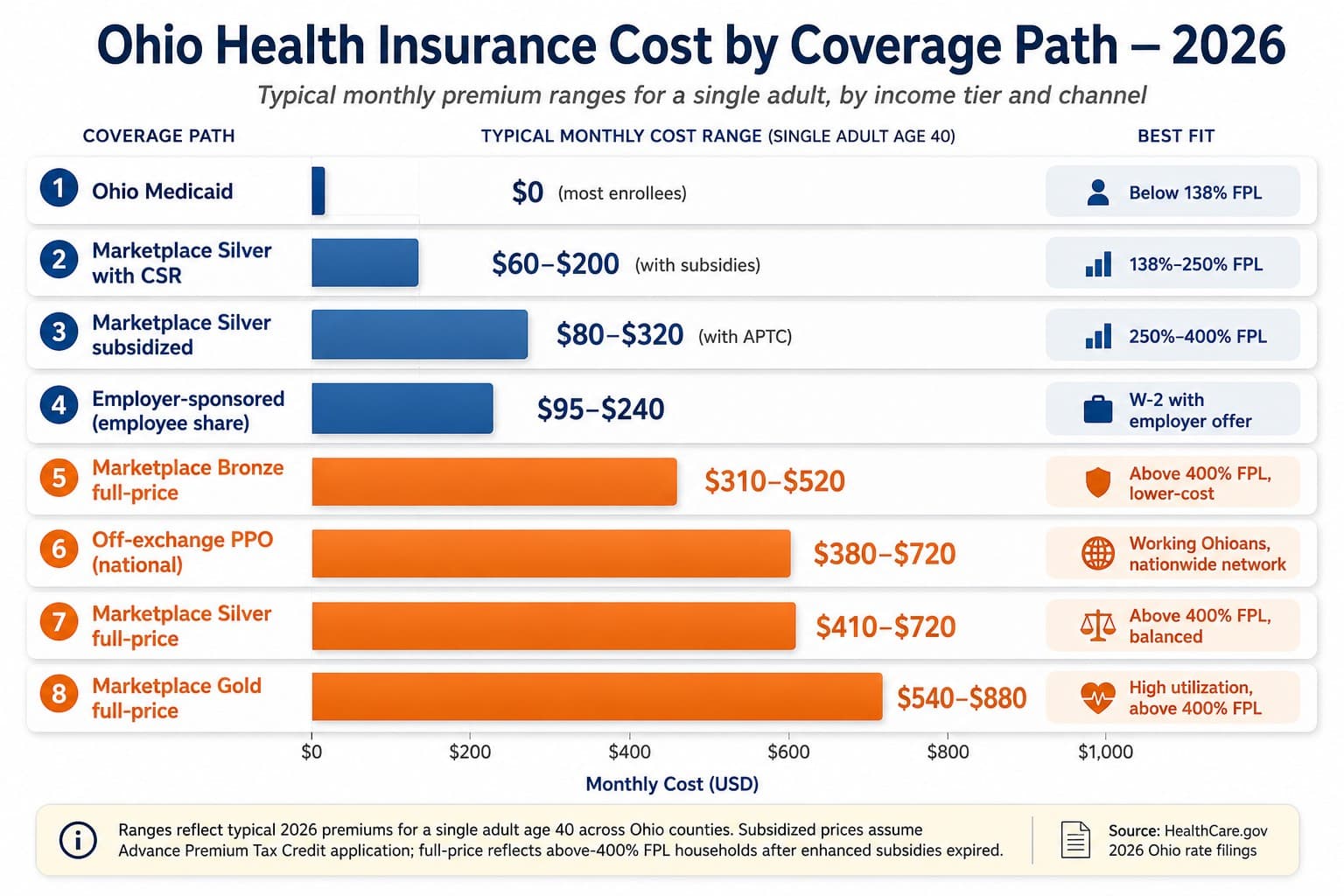
How Much Does Ohio Health Insurance Cost in 2026?
Ohio health insurance costs for 2026 vary significantly based on subsidy eligibility, age, county, plan tier, and tobacco use. The 2025 average net premium for subsidy-eligible Ohio enrollees was about $79 per month after an average $500 monthly Advance Premium Tax Credit. Without subsidies, full-price 2026 Silver-tier premiums in Ohio typically range from $410 to $720 per month for a 40-year-old depending on county, with substantially higher rates for early retirees ages 55-64.
The age-rating curve is the single largest cost driver. Under federal ACA rules, the oldest applicants pay roughly 3× what the youngest adults pay for the same plan. A 21-year-old in Columbus might pay $260 per month full-price for a benchmark Silver plan; a 64-year-old in the same county might pay $780 for the identical plan. This is why early retirees benefit most from any subsidy that reduces premiums and why younger Ohioans often prefer Bronze tiers that minimize monthly premium.
County matters because each Ohio county has a slightly different benchmark Silver plan (the second-lowest-cost Silver plan used to calculate subsidies). A Cuyahoga County (Cleveland) resident and a Warren County resident at the same income may receive different subsidy amounts because their county benchmarks differ. Rural Ohio counties often have higher full-price premiums than the major metros because fewer carriers compete in those markets. Tobacco use can add up to 50% to premiums under federal ACA rules, though Ohio carriers typically apply smaller surcharges than the legal maximum.
| Ohio Coverage Path | Typical Monthly Cost (2026) | Best Fit For |
|---|---|---|
| Ohio Medicaid (income-eligible) | $0 (most enrollees) | Below 138% FPL |
| Marketplace Silver with CSR | $60–$200 (with subsidies) | 138%–250% FPL |
| Marketplace Silver subsidized | $80–$320 (with APTC) | 250%–400% FPL |
| Marketplace Bronze full-price | $310–$520 | Above 400% FPL, lower-cost option |
| Marketplace Silver full-price | $410–$720 | Above 400% FPL, balanced coverage |
| Marketplace Gold full-price | $540–$880 | High utilization, above 400% FPL |
| Off-exchange PPO (national) | $380–$720 | Working Ohioans wanting nationwide network |
| Employer-sponsored (employee share) | $95–$240 | W-2 with employer offer |
Run an Instant Ohio Health Insurance Quote
Enter your zip code to see 2026 Ohio plans available in your county across all 11 marketplace carriers, plus off-exchange PPO options for working Ohioans. A licensed Ohio agent can also walk through subsidy eligibility, network match, and total annual cost comparison by phone — at no cost and no obligation.
Free instant quote — see Ohio plans and prices in 60 seconds.
Why Ohio Premiums Run Higher Than Some Neighbor States
Ohio is one of about 30 states without a 1332 reinsurance waiver — a federal authority that lets states fund a state-level reinsurance program to lower marketplace premiums. Ohio submitted a 1332 application years ago that was deemed incomplete and never modified. As a result, Ohio’s full-price marketplace premiums tend to run higher than premiums in states with operating reinsurance programs, including Maryland (-13.6%), Pennsylvania (-11.7%), and New Jersey (-15.0%) where state reinsurance has demonstrably reduced premiums.
The reinsurance gap matters most for Ohio shoppers above 400% of the federal poverty level — the segment that no longer qualifies for marketplace subsidies as of 2026. In states with reinsurance, full-price premiums are systematically lower because the state pays a portion of high-cost claims, reducing carrier risk and allowing lower rate filings. Ohio shoppers in this income tier generally face higher full-price marketplace costs than peers in reinsurance states with similar demographic profiles.
What Ohio does have: a competitive 11-carrier marketplace that drives some price competition, particularly in Columbus, Cleveland, and Cincinnati where multiple carriers serve the same counties. Rural Ohio counties have less price competition because fewer carriers serve them. Off-exchange PPO plans through national broker channels can offer better unsubsidized pricing in some Ohio markets, particularly for self-employed Ohioans and 1099 contractors who don’t qualify for ACA subsidies but want comprehensive coverage with nationwide networks.
How to Enroll in Ohio Health Insurance
Enrolling in Ohio health insurance for 2026 takes five steps: estimate your projected 2026 modified adjusted gross income (MAGI), run the HealthCare.gov prescreener for subsidy and Medicaid eligibility, compare plans across all 11 Ohio carriers in your county by total annual cost, verify your existing doctors are in-network, and complete enrollment before the deadline. The process typically takes 30 to 60 minutes when documents are ready, with free help available from licensed brokers and certified navigators.
For 2026 coverage, the open enrollment window ran November 1, 2025 through January 15, 2026. The next open enrollment period for 2027 coverage will be shorter due to a federal rule change — running November 1 through December 15, 2026 only — and all coverage will start January 1, 2027 regardless of when during open enrollment you enroll. Outside of open enrollment, Ohioans need a qualifying life event to enroll, such as marriage, divorce, birth, adoption, job loss, or a permanent move to a new area.
The most expensive Ohio enrollment mistake is buying off-exchange directly from a carrier when you qualify for marketplace subsidies. The same plan from the same carrier never qualifies for premium tax credits when sold off-exchange. For the 90%+ of Ohio marketplace enrollees who received APTC, this single mistake costs an average of $500 per month — roughly $6,000 per year — for an identical plan. Always start with the on-exchange prescreener before considering an off-exchange option. The HealthCare.gov enrollment portal is the federally-run platform Ohio uses, and the Ohio Department of Insurance publishes carrier-specific rate filings and consumer resources for Ohio shoppers. For broader context on the post-2025 marketplace, the KFF subsidy explainer walks through the premium tax credit math.
Frequently Asked Questions
Common questions about Ohio health insurance cover the federal exchange (HealthCare.gov), how Ohio compares to neighboring states with state-based exchanges, what changed when enhanced subsidies expired, how Ohio Medicaid works, and how to switch plans if your carrier exited at the end of 2025. Answers below reflect 2026 plan year rules and current Ohio-specific guidance.
Does Ohio have its own health insurance exchange?
No. Ohio uses the federal HealthCare.gov platform rather than running a state-based exchange. Ohio shoppers compare and enroll directly through HealthCare.gov, while the Ohio Department of Insurance regulates carriers and approves rate filings. This is structurally different from neighboring Pennsylvania (Pennie, state-based since 2021) and Kentucky (kynect, state-based since 2014). The federally facilitated structure means Ohio enrollment timelines and rules generally follow federal defaults rather than state-specific variations.
Why did my Ohio health insurance subsidy go down for 2026?
Enhanced premium tax credits enacted under the American Rescue Plan and Inflation Reduction Act expired at the end of 2025. Before 2026, these enhancements eliminated the 400% federal poverty level “subsidy cliff” and capped premium contributions at 8.5% of household income for higher earners. For 2026, those enhancements expired — households above 400% FPL no longer qualify for any subsidy, and households below 400% FPL receive smaller subsidies than they received in 2025. The result: average net premiums rose materially for Ohio enrollees, contributing to the 21% enrollment drop from 2025 to 2026.
What’s the cheapest Ohio health insurance plan in 2026?
For Ohioans below 138% of the federal poverty level (under $21,597 for a single adult), Ohio Medicaid is essentially free and covers all ten essential health benefits. Above that income threshold, the cheapest marketplace option for subsidy-eligible Ohioans is typically a Bronze-tier plan after applying premium tax credits — often under $50 per month for younger Ohioans with moderate incomes. For Ohioans above 400% FPL, the cheapest marketplace option is full-price Bronze ($310-$520 monthly depending on age and county), though off-exchange PPO plans through national broker channels can sometimes beat that price for working Ohioans seeking nationwide networks.
Which Ohio health insurance carriers are best?
“Best” depends on what matters to you. For Cleveland Clinic in-network access: Medical Mutual of Ohio and Oscar Health are the two carriers with consistent statewide Cleveland Clinic inclusion. For lowest premium with subsidy: Ambetter from Buckeye Health Plan and Molina Healthcare typically file the most competitive Bronze and Silver pricing. For national network reciprocity: Anthem Blue Cross Blue Shield offers BlueCard travel coverage. For Ohio-headquartered nonprofit alternatives: CareSource (based in Dayton). The best carrier for any specific Ohioan depends on which doctors they see, which prescriptions they take, and which county they live in.
How does Ohio Medicaid eligibility work in 2026?
Ohio expanded Medicaid in 2014, covering adults at or below 138% of the federal poverty level. For 2026, that’s about $21,597 for a single adult and $44,367 for a family of four. Ohio Medicaid covers all ten essential health benefits including hospital care, prescription drugs, mental health services, and preventive care, typically at zero monthly premium and minimal copays. Enrollment is year-round through Ohio Medicaid directly, separate from HealthCare.gov marketplace enrollment. Ohio Medicaid covered approximately 3 million Ohioans before recent eligibility tightening reduced enrollment.
What happens if my Ohio carrier exited at the end of 2025?
Two carriers exited Ohio’s marketplace at the end of 2025. If your carrier was one of them and you didn’t actively select a new plan during the November 1, 2025 – January 15, 2026 open enrollment window, the Centers for Medicare and Medicaid Services may have automatically enrolled you in a similar plan from a different carrier. Check your January 2026 mail and email for an enrollment confirmation. If you weren’t auto-enrolled or want to switch to a better-fit plan, you’ll need a qualifying life event to enroll mid-year, or wait for the November 1 – December 15, 2026 open enrollment window for 2027 coverage.
Compare 2026 Ohio Health Insurance Plans Now
A licensed Ohio agent can pull subsidy-aware quotes across all 11 Ohio marketplace carriers plus off-exchange PPO alternatives, verify your doctors are in-network with each option, and produce a side-by-side total annual cost comparison — at no cost and no obligation. The full review takes about 20 minutes by phone or video call.
Free Ohio health insurance comparison across all carriers — quote in 60 seconds.
Related Ohio Health Insurance Resources
How HealthCare.gov works for Ohio shoppers — plans, subsidies, and 2026 enrollment.
Best Ohio Health Insurance PlansCompare top Ohio carriers by network, customer satisfaction, and total cost.
Affordable Ohio Health InsuranceLower your monthly cost with subsidies, Medicaid, and lowest-premium plan strategies.
Ohio Individual Health InsuranceCoverage for self-employed Ohioans, freelancers, and individual buyers.
Ohio Health Insurance QuotesFree side-by-side comparison of 2026 Ohio marketplace plans by zip code.
Ohio Small Business Health InsuranceGroup plans, ICHRA, QSEHRA, and SHOP options for Ohio employers with 1-50 employees.
Broker Disclosure
ForHealthInsurance.com is an independent health insurance agency serving Ohio residents. We are not affiliated with any carrier or government agency. We help you compare plans and enroll in coverage that meets your needs at no extra cost to you.