South Carolina Health Insurance Marketplace 2026: HealthCare.gov Enrollment Guide
The South Carolina health insurance marketplace operates entirely through HealthCare.gov — the federal exchange — because South Carolina has never built or operated its own state-based platform. Residents cannot enroll in subsidized coverage through a state platform; HealthCare.gov is the sole legitimate portal for Advance Premium Tax Credits and plan comparison among the five carriers participating in the market. That reliance on the federal platform creates one significant constraint: South Carolina cannot extend its open enrollment window beyond the federal January 15 deadline the way states like California, Rhode Island, or New York can. This guide explains how the South Carolina exchange works, who qualifies for subsidies, what the five carriers offer by metal tier, and how the state’s decision not to expand Medicaid shapes who can and cannot get help through HealthCare.gov.

What brings you to the SC marketplace?
HealthCare.gov and the Non-Expansion Problem: Where SC Sits
HealthCare.gov serves as South Carolina’s marketplace, but the ACA’s architecture creates a hard income floor for eligibility. Residents earning below 100 percent of the federal poverty level — approximately $15,650 for a single adult in 2026 — cannot access marketplace subsidies because the law assumed Medicaid would cover that population. South Carolina’s decision not to expand Medicaid means those residents fall into a coverage gap the federal marketplace was never designed to serve.
The ACA’s two-part structure — Medicaid for those below 100 percent FPL and marketplace subsidies for those above — depends on Medicaid expansion to work without gaps. When the Supreme Court made expansion optional in 2012, the ACA’s architects had not anticipated states declining. South Carolina was among the non-expanding states, leaving the income band below 100 percent FPL unserved. Unlike HealthSource RI, which routes applicants seamlessly between RIte Care and marketplace coverage, HealthCare.gov for South Carolina simply stops at the coverage gap floor — it cannot offer subsidized plans to residents below 100 percent FPL, and there is no state-level equivalent of Medicaid expansion to fill the gap. This income floor is the defining limit of the South Carolina health insurance marketplace.
HealthCare.gov can help — but only above the income floor
A single adult earning $16,000 in 2026 sits just above 100 percent FPL and qualifies for substantial Advance Premium Tax Credits through HealthCare.gov. The same adult earning $14,000 falls into the coverage gap and HealthCare.gov cannot assist. The gap is a hard line, not a sliding scale — a $2,000 income difference determines whether the marketplace is available at all. It is the one hard cutoff built into the South Carolina health insurance marketplace.
For residents who do qualify for the marketplace, the enrollment experience on HealthCare.gov is straightforward. The platform determines subsidy eligibility based on household income and size, displays plans from all carriers available in the enrollee’s county, applies Advance Premium Tax Credits to reduce monthly premiums, and applies Cost-Sharing Reductions for Silver plan enrollees below 250 percent FPL. The full South Carolina plan inventory — Bronze, Silver, Gold, and Catastrophic tiers from five carriers — is accessible through HealthCare.gov without any state-level enrollment system to navigate in between. For eligible residents, the South Carolina health insurance marketplace is a single federal portal end to end.
BCBS of SC, Ambetter, and Molina: What Each Carrier Offers on the Marketplace
Five carriers offer plans on the South Carolina HealthCare.gov marketplace for 2026. BlueCross BlueShield of South Carolina participates in all 46 counties and holds roughly 50 percent of the individual market. Ambetter from Absolute Total Care, Molina Healthcare, Cigna Healthcare, and Aetna CVS Health participate selectively in metro counties. Metal tier availability and pricing vary significantly by county and carrier.
| Carrier | County Coverage | Tiers Available | Network Strength |
|---|---|---|---|
| BlueCross BlueShield of SC | All 46 counties | Bronze, Silver, Gold, Catastrophic | Broadest statewide — virtually all hospitals and most physicians |
| Ambetter (Absolute Total Care) | Metro and suburban counties | Bronze, Silver, Gold | Competitive pricing; narrower rural network |
| Molina Healthcare | Charleston, Columbia, Greenville metros | Bronze, Silver | Low-income focused; limited rural availability |
| Cigna Healthcare | Selected metro counties | Bronze, Silver, Gold | National network; strong for travel or multistate access |
| Aetna CVS Health | Selected metro counties | Bronze, Silver, Gold | National network; growing SC footprint |
Metal tier pricing in South Carolina reflects both carrier competition and county-level cost structure. A 40-year-old non-smoker in Columbia’s Richland County shopping for a Silver plan will find BCBS of SC pricing around $415 per month before subsidy, Ambetter lower at roughly $370 to $390, and Molina (where available) at a similar discount to BCBS of SC. The same shopper in a rural Marlboro County ZIP code may find only BCBS of SC participating at all, removing the competitive pricing pressure that metro residents benefit from. Carrier competition is the biggest variable in what the South Carolina health insurance marketplace costs.
Catastrophic plans are available exclusively through BCBS of SC among South Carolina carriers. These plans are only accessible to residents under 30 years old or those who qualify for a hardship exemption issued by the IRS. They carry the lowest monthly premiums in the SC marketplace — typically $190 to $280 for a 30-year-old — but annual deductibles approach $9,200 in 2026 before coverage begins in most cases. They are not eligible for Advance Premium Tax Credits. They are the lowest-premium option on the South Carolina health insurance marketplace.
Missing the Deadline in SC: What Happens After January 15
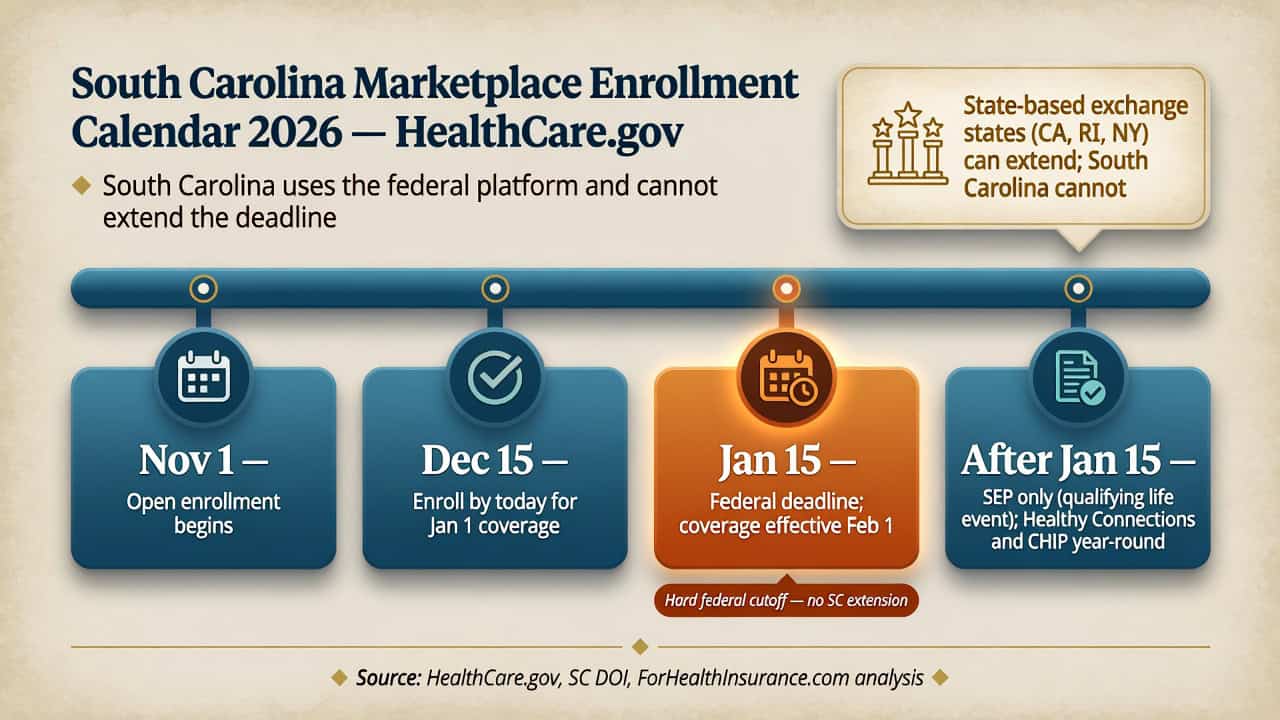
Because South Carolina relies on the federal HealthCare.gov platform rather than a state-based exchange, it cannot extend open enrollment past the January 15 federal deadline — residents who miss it lose access to subsidized marketplace plans until the following November 1, unless a qualifying life event applies. States like California, Rhode Island, and New York set their own windows; South Carolina cannot. There is no state-level grace period.
Open Enrollment — November 1 through January 15
Any South Carolina resident can enroll in or change marketplace plans during the annual open enrollment window. Plans beginning January 1 require enrollment by December 15. Plans enrolled between December 16 and January 15 begin February 1. Subsidy eligibility is determined at enrollment based on projected household income for the coverage year. This window is the main on-ramp to the South Carolina health insurance marketplace.
Special Enrollment Periods — Triggered by Life Events
Qualifying life events open a 60-day enrollment window outside open enrollment. Common SC triggers: loss of employer coverage, marriage or divorce, birth or adoption, permanent move to a new service area, and significant income change affecting subsidy eligibility. Each trigger requires documentation — a letter from a former employer, a marriage certificate, a birth certificate, or equivalent proof. SEPs are the only mid-year entry point to the South Carolina health insurance marketplace.
Healthy Connections and CHIP — Year-Round
South Carolina Medicaid (Healthy Connections) and Partners for Healthy Children (CHIP) enrollment is open year-round for qualifying residents. A resident who becomes newly eligible for Medicaid due to a change in household composition or income can apply at any time through SC DHHS. Children newly qualifying for CHIP can also enroll throughout the year, with no enrollment window restriction.
Missed Enrollment — Limited Options
Residents who miss open enrollment and lack a qualifying life event have few options until the next November. Short-term medical plans are available — these are not ACA-compliant, exclude pre-existing conditions, and have limited coverage — but can bridge gaps for healthy residents between plans. Federally Qualified Health Centers provide sliding-scale primary care and prescription access regardless of insurance status. None of these is a true substitute for the South Carolina health insurance marketplace.
How Subsidies Work When SC Didn’t Expand Medicaid
For South Carolina residents above the coverage-gap floor, Advance Premium Tax Credits reduce monthly marketplace premiums between 100 and 400 percent of the federal poverty level, with enhanced subsidies effectively extending eligibility higher under current law. Cost-Sharing Reductions reduce deductibles and out-of-pocket maximums for Silver enrollees below 250 percent FPL. Both flow through HealthCare.gov — but only above the 100 percent FPL floor that South Carolina’s non-expansion creates.
| Household Income (% FPL) | APTC Eligibility | CSR Eligibility | Typical Net Silver Premium (40-yr-old, Columbia) |
|---|---|---|---|
| Below 100% FPL | None (coverage gap) | None | Not eligible for marketplace subsidy |
| 100%–150% FPL | Full APTC | CSR 94 (Silver) | $0–$40/mo |
| 150%–200% FPL | Full APTC | CSR 87 (Silver) | $20–$90/mo |
| 200%–250% FPL | Full APTC | CSR 73 (Silver) | $60–$170/mo |
| 250%–400% FPL | Partial APTC | None | $120–$350/mo |
| Above 400% FPL | Partial APTC (enhanced subsidy law) | None | $280–$415/mo (capped at 8.5% of income) |
Report income changes during the year — or face repayment at tax time
South Carolina residents receiving Advance Premium Tax Credits must reconcile the amount received against actual annual income when filing their federal tax return. Receiving more APTC than earned income justifies — because projected income was lower than actual income — triggers repayment. Reporting income changes during the year through HealthCare.gov prevents surprises at tax time and keeps subsidy amounts accurate. Accurate income reporting keeps your South Carolina health insurance marketplace subsidy correct.
Compare 2026 South Carolina Marketplace Plans
A licensed South Carolina broker compares all five HealthCare.gov carriers by county, verifies your provider network, calculates your exact APTC and CSR eligibility, and walks through plan trade-offs across metal tiers. Free, no obligation.
What the South Carolina Department of Insurance Requires of Carriers
The South Carolina Department of Insurance (SCDOI) regulates carriers selling marketplace plans in the state. SCDOI oversees carrier rate filing and approval, network adequacy standards, consumer complaint handling, and licensing for insurance agents and brokers. Because South Carolina uses the federal exchange, SCDOI works alongside CMS in overseeing marketplace plan compliance, but rate review and carrier licensing are administered at the state level.
South Carolina’s rate review process requires carriers to file proposed premium changes annually with SCDOI, which reviews for actuarial justification before approvals are granted. The review does not cap premium increases — South Carolina does not have prior approval rate regulation — but it provides a documented review process for significant rate changes. Consumers can access rate filing information through the SCDOI website at doi.sc.gov.
Network adequacy requirements in South Carolina mandate that carriers participating in the marketplace maintain a sufficient provider network to serve enrollees without unreasonable access barriers. SCDOI reviews carrier network submissions for compliance with time and distance standards for primary care, specialist, and hospital access. Enrollees who believe their carrier’s network is inadequate — for example, if no in-network specialist is available within the required distance for their county — can file a complaint with SCDOI directly. The department also maintains a complaint portal for disputes about claims denials, coverage determinations, and billing practices. These protections apply to every plan sold on the South Carolina health insurance marketplace.
Frequently Asked Questions
Five questions SC residents ask most often about HealthCare.gov enrollment — including whether the state runs its own exchange, who qualifies for APTC and CSR subsidies, which carriers participate on exchange, when the enrollment window closes, and how to get free broker assistance navigating plan options.
What is the South Carolina health insurance exchange?
South Carolina does not operate its own state-based exchange. The South Carolina health insurance exchange refers to HealthCare.gov — the federal marketplace — which serves as the enrollment platform for all subsidized and unsubsidized ACA-compliant plans in the state. Residents use HealthCare.gov to compare plans from the five participating carriers, apply for subsidy eligibility, and enroll during open enrollment or qualifying special enrollment periods.
Who qualifies for subsidies on the South Carolina marketplace?
Residents earning at least 100 percent of the federal poverty level (approximately $15,650 for a single adult in 2026) qualify for Advance Premium Tax Credits on HealthCare.gov. Cost-Sharing Reductions, which reduce deductibles and out-of-pocket costs, are available to those earning below 250 percent of FPL who select Silver plans. Residents earning below 100 percent of FPL fall into the Medicaid coverage gap because South Carolina has not expanded Medicaid and cannot access marketplace subsidies. For everyone above that line, subsidy size is the biggest variable on the South Carolina health insurance marketplace.
When does open enrollment end for South Carolina marketplace plans?
South Carolina follows the federal open enrollment calendar. The enrollment window runs from November 1 through January 15. Plans that begin January 1 require enrollment by December 15. Plans enrolled between December 16 and January 15 begin February 1. South Carolina uses the federal platform and does not extend the enrollment window beyond the federal deadline, unlike some state-based exchange states.
Which carriers offer plans on the South Carolina exchange?
Five carriers offer plans on the South Carolina HealthCare.gov marketplace for 2026: BlueCross BlueShield of South Carolina, Ambetter from Absolute Total Care, Molina Healthcare, Cigna Healthcare, and Aetna CVS Health. BlueCross BlueShield of South Carolina is the only carrier available in all 46 counties. The other four carriers participate selectively in metro areas including Charleston, Columbia, and Greenville-Spartanburg.
Can I get help enrolling in the South Carolina marketplace?
Yes. ForHealthInsurance.com brokers provide free enrollment assistance for South Carolina residents. Broker-assisted plans are identical to plans enrolled directly through HealthCare.gov, including the same subsidies and pricing. Brokers also help verify carrier network coverage for your specific providers and calculate subsidy eligibility based on projected household income. There is no additional cost to using a broker — compensation comes from the carrier. A broker can compare every plan on the South Carolina health insurance marketplace for you.
Work With a South Carolina Insurance Broker at No Cost
ForHealthInsurance.com brokers compare all five SC carriers on HealthCare.gov, verify provider networks, calculate APTC and CSR eligibility, and handle enrollment paperwork — all at no cost to South Carolina residents. Plans and subsidies are identical to enrolling directly on HealthCare.gov.
Free South Carolina marketplace enrollment assistance — covers all five carriers in one call.
Related South Carolina Health Insurance Resources
Complete SC overview — all carriers, the coverage gap, costs, and enrollment paths.
South Carolina Plan TypesHMO, PPO, EPO, and POS plans on the SC marketplace — networks and trade-offs explained.
Affordable South Carolina CoverageCoverage gap options, catastrophic plans, and FQHC sliding-scale care for SC residents.
South Carolina Small Business Health InsuranceSHOP marketplace, ICHRA, and group plan options for SC employers and their staff.
HealthCare.gov (Official)South Carolina’s federal marketplace enrollment portal for 2026 plans.
SC Department of InsuranceRate filings, carrier complaints, and agent licensing for South Carolina residents.
Broker Disclosure
ForHealthInsurance.com is an independent health insurance agency serving South Carolina residents. We are not affiliated with any carrier or government agency. We help you compare plans and enroll in coverage that meets your needs at no extra cost to you.