South Carolina Small Business Health Insurance 2026 Guide
South Carolina small business health insurance in 2026 operates without the state-funded premium assistance programs found in states like Oklahoma — there is no SC equivalent to Insure Oklahoma, no state small group reinsurance pool, and no state tax credit layered on top of federal incentives. What South Carolina employers do have access to: the federal Small Business Health Care Tax Credit through SHOP, the full range of traditional group plan products from BCBS of SC and national carriers, and flexible alternatives including ICHRA and QSEHRA that have grown significantly since 2020. This guide covers every option available to South Carolina employers with 1 to 50 employees in 2026.

What’s your SC small business situation?
Group Plans, ICHRA, and Federal SHOP: SC Small Business Coverage Routes
South Carolina small employers in 2026 choose from four coverage approaches: traditional fully insured group plans through carriers like BCBS of SC or Cigna, Individual Coverage HRAs (ICHRA) that reimburse employees for individual marketplace premiums, Qualified Small Employer HRAs (QSEHRA) for the smallest employers, and the federal SHOP marketplace which bundles group enrollment with the Small Business Tax Credit pathway. Each route has different cost structures, administrative burdens, and eligibility requirements.
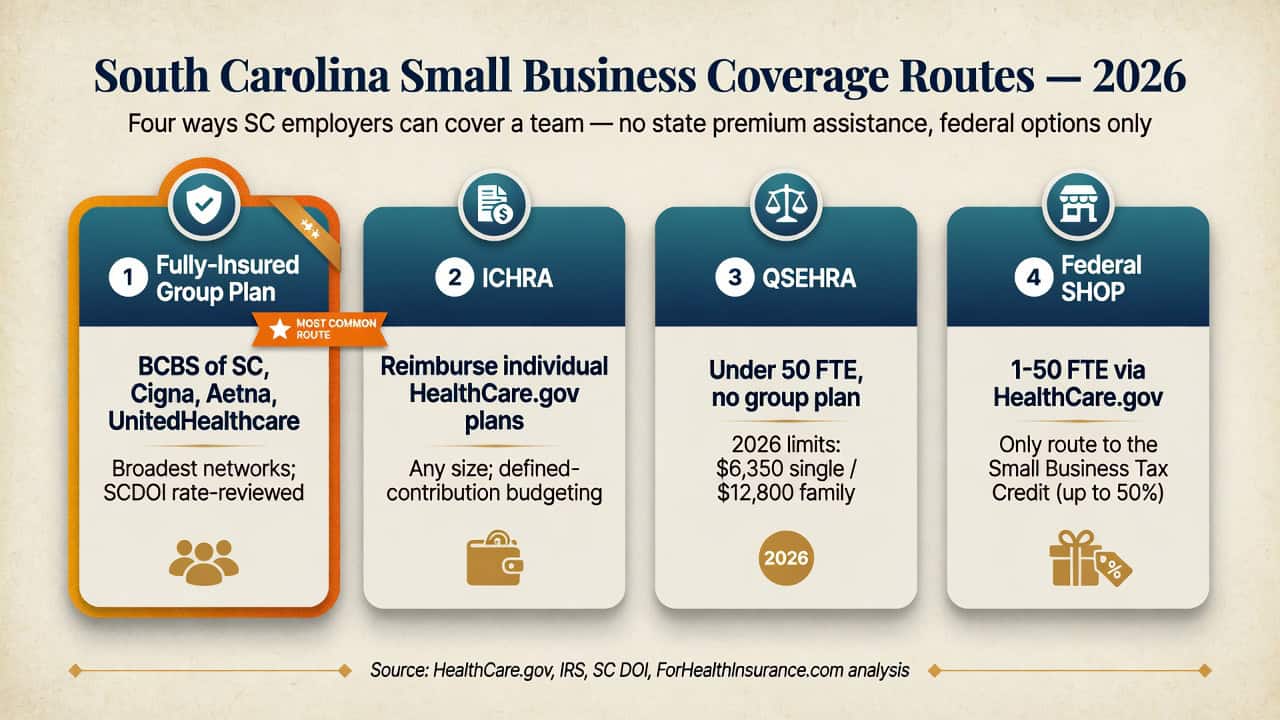
| Coverage Approach | Best For | Key Advantage | Key Limitation |
|---|---|---|---|
| Traditional group plan | 5–50 employees, stable workforce | Broadest BCBS of SC network; familiar to employees | Higher admin complexity; minimum participation requirements |
| ICHRA | Any size, diverse workforce | Defined employer contribution; no group plan admin | Employees manage own enrollment; works best in subsidy-ineligible range |
| QSEHRA | Fewer than 50 employees, no group plan | Simple reimbursement; annual contribution limits set by IRS | Annual caps ($6,350 single / $12,800 family in 2026); no group plan allowed |
| Federal SHOP | Under 25 FTEs seeking tax credit | Only pathway to Small Business Health Care Tax Credit | Limited carrier options in SC; administrative via HealthCare.gov |
Traditional Fully Insured Group Plan
South Carolina small employers with five or more employees and sufficient group participation can purchase fully insured group health plans through BCBS of SC, Cigna, Aetna, or UnitedHealthcare. Premiums are set by the carrier based on group age distribution and plan selection. BCBS of SC dominates SC small group with the broadest statewide provider network. Minimum participation typically requires 70 percent of eligible employees to enroll, excluding those with spousal coverage. This participation rule shapes most South Carolina small business health insurance group decisions.
- BCBS of SC primary small group carrier
- Cigna, Aetna, UHC also available in metros
- HMO and PPO products available
- 70% participation minimum typical
ICHRA — Individual Coverage HRA
ICHRA allows employers to reimburse employees tax-free for individual health insurance premiums purchased on the open market or HealthCare.gov. Employers set a monthly reimbursement amount per employee class (full-time, part-time, seasonal, etc.) and employees choose their own plans. In South Carolina, ICHRA works well for employers with employees spread across multiple counties where group plan networks vary, or for employers who want predictable fixed benefit costs without group plan administration. It is an increasingly common South Carolina small business health insurance approach.
- No group plan administration required
- Defined employer contribution per employee
- Employees choose own carrier and plan
- Works best when employees are subsidy-ineligible
QSEHRA — Qualified Small Employer HRA
QSEHRA is available to employers with fewer than 50 employees who do not offer a group plan. Employers set a reimbursement amount within IRS annual caps ($6,350 single, $12,800 family for 2026) and employees submit qualified premium receipts for reimbursement. Unlike ICHRA, QSEHRA applies uniformly to all employees without employee class distinctions. QSEHRA reduces — but does not eliminate — any marketplace premium tax credit the employee would otherwise receive, so it works best for employees who are subsidy-ineligible. Weighing that trade-off is central to any South Carolina small business health insurance decision.
- Fewer than 50 employees only
- IRS annual contribution caps apply
- No group plan allowed while QSEHRA active
- Reduces employee marketplace APTC
Federal SHOP Marketplace
The federal SHOP marketplace (Small Business Health Options Program) at HealthCare.gov is the only pathway to the Small Business Health Care Tax Credit. In South Carolina, SHOP options are primarily BCBS of SC small group products accessed through HealthCare.gov rather than directly through the carrier. Employers with fewer than 25 FTEs paying average wages below $57,500 and covering at least 50 percent of employee premiums may qualify for the tax credit — up to 50 percent of premiums paid for two consecutive years. It is the single largest federal subsidy available to South Carolina small business health insurance buyers.
- Only route to Small Business Tax Credit
- Under 25 FTEs for full credit
- Average wages under $57,500 required
- Must cover 50%+ of employee premium
No State Premium Assistance: What SC’s Federal Resources Cover Instead
South Carolina has no state-administered small business health insurance premium assistance program. Oklahoma’s Insure Oklahoma subsidizes small employer premiums at the state level; South Carolina has no equivalent. What SC employers do have access to are federal resources — primarily the Small Business Health Care Tax Credit through SHOP and the standard federal tax deduction for employer-paid health insurance premiums, which together meaningfully reduce the after-tax cost of offering coverage.
The Small Business Health Care Tax Credit: SC employers often overlook eligibility
SC employers with fewer than 25 full-time equivalent employees, average annual wages below $57,500 per FTE, and who cover at least 50 percent of employee-only premiums through the federal SHOP marketplace may claim a federal tax credit of up to 50 percent of premiums paid (35 percent for tax-exempt organizations). The credit applies for two consecutive taxable years. An SC employer paying $60,000 in annual group premiums and qualifying for the full 50 percent credit would receive $30,000 back — effectively halving the cost of coverage. The credit phases out as employee count and average wages rise above the thresholds, so the smallest South Carolina small business health insurance buyers gain the most.
Beyond the SHOP tax credit, all South Carolina employers — regardless of size — deduct 100 percent of health insurance premiums paid on behalf of employees as a business expense. Sole proprietors who purchase health insurance may also deduct premiums on Schedule 1 of their personal federal return, reducing adjusted gross income. S-corporation shareholders who own more than 2 percent of the company include employer-paid premiums in W-2 wages but can deduct those premiums on their personal return. These deductions do not substitute for a state assistance program, but they represent meaningful federal cost reduction that SC employers should build into their benefit cost calculations. These deductions quietly lower the real cost of South Carolina small business health insurance.
What SC Small Employers Actually Pay for Group Coverage in 2026
What small business coverage costs in South Carolina for 2026: small group premiums average $650 to $850 per employee per month for single coverage before employer cost-sharing, depending on carrier, plan tier, and the age distribution of the group. A typical SC employer covering 70 percent of the single employee premium pays $455 to $595 per employee monthly, with employees contributing $195 to $255. These figures vary significantly between metro and rural South Carolina counties and between HMO and PPO plan types.
| Coverage Tier | Avg Monthly Premium (2026) | Employer Share (70%) | Employee Share (30%) |
|---|---|---|---|
| Employee only — HMO | $620–$750/mo | $434–$525/mo | $186–$225/mo |
| Employee only — PPO | $720–$890/mo | $504–$623/mo | $216–$267/mo |
| Employee + spouse | $1,350–$1,650/mo | $945–$1,155/mo | $405–$495/mo |
| Employee + children | $1,100–$1,350/mo | $770–$945/mo | $330–$405/mo |
| Employee + family | $1,700–$2,200/mo | $1,190–$1,540/mo | $510–$660/mo |
Get an SC Small Business Health Insurance Quote
A licensed South Carolina broker compares group plans from BCBS of SC, Cigna, Aetna, and UnitedHealthcare, assesses your SHOP tax credit eligibility, and evaluates whether ICHRA or QSEHRA saves you more than a traditional group plan. Free, no obligation.
How the BCBS of SC Group Market Compares to Its Competitors
BlueCross BlueShield of South Carolina controls the majority of the state’s small group health insurance market in 2026, with a statewide provider network that no other carrier matches. Cigna Healthcare, Aetna CVS Health, and UnitedHealthcare participate in South Carolina’s small group market primarily in metro service areas. Ambetter and Molina do not offer traditional small group products in the state.
BlueCross BlueShield of South Carolina (small group)
BCBS of SC offers both HMO and PPO small group products with statewide network access. Its provider network covers virtually all South Carolina hospitals and most physicians in private practice — the only carrier whose network is broad enough to reliably cover employees across all 46 counties. Both fully insured and level-funded small group products are available. BCBS of SC is the dominant carrier on the federal SHOP marketplace for SC employers. Most SC small employers with geographically distributed workforces choose BCBS of SC as the only carrier that covers all employees without network gaps. Network reach is the deciding factor in most South Carolina small business health insurance choices.
Cigna Healthcare (small group)
Cigna participates in South Carolina’s small group market with national network access — a meaningful advantage for SC employers with remote employees or employees who travel extensively. Cigna’s national Open Access Plus network includes in-network facilities in all 50 states without referrals, making it well-suited for professional services firms, logistics companies, and other SC employers with multistate workforce exposure. Cigna’s SC small group footprint is concentrated in the Charleston, Columbia, and Greenville-Spartanburg metros, which shapes where South Carolina small business health insurance competition is strongest.
Aetna CVS Health (small group)
Aetna offers small group products in South Carolina primarily in metro markets. The CVS Health integration provides Aetna members access to MinuteClinic locations within CVS stores — a convenience benefit with meaningful presence in Charleston, Columbia, and Greenville SC markets. Aetna’s SC small group network is narrower than BCBS of SC’s statewide coverage but comparable to Cigna in metro market depth. Level-funded small group products are also available through Aetna for employers seeking more predictable annual costs, rounding out the South Carolina small business health insurance carrier field.
UnitedHealthcare (small group)
UnitedHealthcare participates in South Carolina’s small group market with access to the UnitedHealth national network — the largest provider network in the country by contracted provider count. UHC’s Surest product (formerly Bind) offers a no-deductible small group structure available in some South Carolina markets that some employers find more attractive than traditional deductible-based designs. UHC’s SC small group presence is strongest in the major metro markets; rural SC coverage can be narrower depending on plan type and county.
Frequently Asked Questions
Five questions SC small business owners ask most about group health insurance — covering the state assistance landscape, group versus ICHRA, cost benchmarks, carrier options, and whether SC law requires employers to offer coverage.
Does South Carolina have a small business health insurance assistance program?
South Carolina does not operate a state-funded small business health insurance premium assistance program comparable to Oklahoma’s Insure Oklahoma program. South Carolina small employers rely on federal resources: the Small Business Health Care Tax Credit (available to employers with fewer than 25 FTEs who pay at least 50 percent of employee premiums and purchase coverage through the federal SHOP marketplace), the federal SHOP marketplace itself, and the range of group plan, ICHRA, and QSEHRA options available through licensed brokers and carriers. A broker can map every South Carolina small business health insurance route for your headcount.
What is the difference between a group plan and an ICHRA for SC small businesses?
A traditional group health insurance plan covers all eligible employees under a single employer-sponsored plan with negotiated rates and shared premiums. An Individual Coverage HRA (ICHRA) is an employer-funded health reimbursement arrangement that reimburses employees tax-free for individual marketplace plan premiums they purchase on their own through HealthCare.gov. ICHRA gives SC employers a defined dollar contribution per employee without the administrative complexity of managing a group plan. Employees choose their own plans and carriers. The trade-off is that employees must purchase individual coverage and manage their own enrollment.
How much does small business health insurance cost in South Carolina?
South Carolina small group premiums in 2026 average approximately $650 to $850 per month per employee for single coverage before employer and employee cost-sharing. A typical SC employer covering 70 percent of the premium would pay $455 to $595 per employee per month with the employee contributing $195 to $255. Family coverage runs substantially higher — $1,700 to $2,200 per month — and most South Carolina small employers cap contributions at the employee-only tier, leaving employees to fund dependent premiums. These are averages; actual premiums vary by group size, age distribution, carrier, and plan selection. These benchmarks are a starting point for South Carolina small business health insurance budgeting.
Which carriers offer small group health insurance in South Carolina?
BlueCross BlueShield of South Carolina dominates the state’s small group insurance market, offering fully insured HMO and PPO products with statewide provider network access. Cigna Healthcare and Aetna CVS Health offer small group products in South Carolina, primarily in metro markets with national network access. UnitedHealthcare participates in the South Carolina small group market as well. Ambetter from Absolute Total Care and Molina Healthcare focus on the individual marketplace and do not offer traditional small group products in South Carolina.
Does SC require employers to offer health insurance?
South Carolina has no state law requiring employers to offer health insurance to employees. The federal ACA employer mandate requires applicable large employers — those with 50 or more full-time equivalent employees — to offer minimum essential coverage to full-time employees or face a potential employer shared responsibility payment. Employers with fewer than 50 FTEs are not subject to the federal mandate and are not required by South Carolina law to offer coverage. Offering coverage, however, typically improves recruiting and retention in the competitive SC labor market, particularly in the Charleston, Columbia, and Greenville metro areas.
Compare SC Small Business Health Insurance Options
A licensed South Carolina broker compares group plans from BCBS of SC, Cigna, Aetna, and UnitedHealthcare, evaluates ICHRA and QSEHRA as alternatives, assesses SHOP tax credit eligibility, and presents the lowest total annual cost option for your specific workforce. Free, no obligation.
Free SC small business coverage analysis — all carriers and plan types in one call.
Related South Carolina Health Insurance Resources
Complete SC overview — all carriers, coverage gap, costs, and enrollment paths.
South Carolina MarketplaceHow HealthCare.gov works for SC residents — subsidies, enrollment windows, carrier comparison.
South Carolina Plan TypesBronze, Silver, Gold, HMO, PPO — how metal tiers and network types work in SC.
Affordable SC Health InsuranceCoverage gap options, Healthy Connections, subsidies, and FQHC resources for SC residents.
Federal SHOP MarketplaceSC small employer enrollment portal for group coverage and Small Business Tax Credit access.
SC Department of InsuranceCarrier licensing, rate filings, and consumer complaint resources for South Carolina.
Broker Disclosure
ForHealthInsurance.com is an independent health insurance agency serving South Carolina businesses. We are not affiliated with any carrier or government agency. We help you compare plans and enroll in coverage that meets your needs at no extra cost to you.