Virginia Health Insurance 2026: Marketplace & Cardinal Care
Virginia health insurance in 2026 works through Virginia’s own marketplace at Marketplace.Virginia.gov — not HealthCare.gov, which Virginia stopped using for plan year 2024. The state-based exchange has enrolled more than 573,700 Virginia residents since opening. Virginia also expanded Medicaid in 2019, and Cardinal Care now covers about 1.8 million Virginians, including children enrolled through FAMIS. For 2026, eight carriers compete on the marketplace, premiums rose by an average of 21.6% before subsidies, and the state extended its open enrollment to January 30, 2026 — two weeks longer than the federal deadline. This guide covers every Virginia health insurance path for 2026.

What brings you here today?
Virginia’s Insurance Marketplace: Virginia’s State-Based Exchange
Virginia’s Insurance Marketplace is the state’s official health benefit exchange, operating at Marketplace.Virginia.gov as a fully state-run platform separate from HealthCare.gov. Virginia transitioned to its own state-based exchange for plan year 2024 — making 2026 the third plan year on the new platform. The Marketplace is operated by the Virginia Health Benefit Exchange, a division of the State Corporation Commission, and has enrolled more than 573,700 Virginians since launching in 2023.
Before plan year 2024, Virginia residents enrolled through HealthCare.gov. The transition to a state-based exchange gave Virginia control over its enrollment calendar, plan certification, and integration with Cardinal Care Medicaid. The Marketplace runs a network of more than 4,300 certified assisters and licensed agents statewide and operates its own consumer assistance line at 888-687-1501.
Virginia’s most visible difference from federal-platform states is the open enrollment window itself. The 2026 OEP ran November 1, 2025 through January 30, 2026 — two weeks longer than HealthCare.gov’s January 15 deadline. The state’s Virginia’s Insurance Marketplace is the only place Virginians can apply for advance premium tax credits and cost-sharing reductions, and about 86% of Virginia marketplace enrollees qualified for financial assistance This subsidy reach shapes the health insurance Virginia residents ultimately choose.
Virginia Health Insurance Carriers for 2026
Virginia’s Insurance Marketplace has eight carriers offering individual plans for 2026 — down from ten in 2025 after Aetna and Innovation Health exited at the end of 2025. The 2026 lineup includes Anthem HealthKeepers, Sentara Health Plans, Cigna, Kaiser Mid-Atlantic, CareFirst BlueChoice, Group Hospitalization, Optimum Choice (UnitedHealthcare), and Oscar Insurance Company. Carrier availability varies by Metropolitan Statistical Area — Virginia uses 12 rating regions.
Anthem HealthKeepers (Anthem Blue Cross Blue Shield of Virginia)
Anthem HealthKeepers is the largest individual market carrier in Virginia, with approximately 106,600 covered lives projected for 2026. HealthKeepers is the Virginia-specific brand for Anthem’s HMO products, sold across all 12 Virginia rating regions and on Marketplace.Virginia.gov. Anthem’s approved 2026 rate increase for HealthKeepers averaged 20.9%. The HealthKeepers network covers most major Virginia health systems including HCA Virginia hospitals, Inova in Northern Virginia, Provider networks like these drive the health insurance Virginia families compare.
- About 106,600 covered lives in 2026
- Statewide across 12 rating regions
- 20.9% approved rate increase for 2026
- Largest individual market carrier in Virginia
Sentara Health Plans (formerly Optima Health)
Sentara Health Plans rebranded from Optima Health in 2024 and is tied to Sentara Healthcare, the Norfolk-based hospital system that dominates Hampton Roads. Sentara serves about 89,092 covered lives in Virginia for 2026 — second-largest individual market carrier — and saw a 22.4% approved rate increase. Sentara’s strongest network coverage is in the Hampton Roads, Charlottesville, and Richmond markets, anchored around its own hospital system. Sentara also participates in Cardinal Care Medicaid Medicaid managed care sits beside the health insurance Virginia shoppers buy.
- About 89,092 covered lives in 2026
- Strongest in Hampton Roads / Tidewater
- Tied to Sentara Healthcare hospital system
- Rebranded from Optima Health in 2024
Cigna Health and Life Insurance
Cigna offers individual marketplace plans across several Virginia rating regions — Richmond (MSA 7), Northern Virginia (MSA 10), Winchester (MSA 11), and Lynchburg (MSA 12). Cigna covers about 21,838 lives in Virginia for 2026 with an approved rate increase of 22.8%. Cigna’s broader national network appeals to Virginians who travel for work, have family in other states, or live near state borders. Cigna also offers off-exchange PPO products.
- About 21,838 covered lives in 2026
- Multi-region: Richmond, NoVA, Winchester, Lynchburg
- 22.8% approved rate increase for 2026
- Strong national PPO network reciprocity
Kaiser Foundation Health Plan of the Mid-Atlantic
Kaiser Permanente’s Mid-Atlantic plan covers Northern Virginia (MSA 10), Richmond (MSA 7), and Lynchburg (MSA 12). Kaiser serves about 24,250 Virginia lives for 2026 with the lowest approved rate increase of any major Virginia carrier — 11.8%. Kaiser is an integrated HMO model: members must use Kaiser-employed physicians and Kaiser facilities for in-network care, which limits geographic flexibility but produces typically lower premiums. Strongest fit for NoVA and Richmond residents Plan philosophy is part of the health insurance Virginia households weigh.
- About 24,250 covered lives in 2026
- Northern Virginia, Richmond, Lynchburg
- 11.8% rate increase — lowest among major carriers
- Integrated HMO — Kaiser facilities only
CareFirst BlueChoice
CareFirst BlueChoice is the DC-metro Blue Cross Blue Shield licensee, offering individual marketplace plans in Northern Virginia (MSA 10) only — Arlington, Alexandria, Fairfax, Loudoun, Prince William, and surrounding counties. CareFirst serves about 7,636 NoVA marketplace enrollees for 2026 with an 18.2% approved rate increase. The strongest fit for federal employees, contractors, and DC-metro commuters who need a network that covers DC, Maryland, and Northern Virginia together — the standard regional Blue Cross territory Regional footprints shape the health insurance Virginia consumers can access.
- About 7,636 covered lives in 2026
- Northern Virginia (MSA 10) only
- 18.2% rate increase for 2026
- DC-metro Blue Cross BlueCard network
Optimum Choice (UnitedHealthcare)
Optimum Choice is the UnitedHealthcare HMO brand on Virginia’s Insurance Marketplace, available across MSAs 5, 7, 10, 11, and 12 — covering Bristol, Richmond, Northern Virginia, Winchester, and Lynchburg. Optimum Choice covers about 16,280 Virginia lives for 2026 and saw the largest approved rate increase of any Virginia carrier — 35.4%. The high rate change reflects underwriting and risk pool dynamics specific to Optimum’s plan designs. UnitedHealthcare also operates UnitedHealthcare Community Plan Statewide MCOs round out the health insurance Virginia coverage landscape.
- About 16,280 covered lives in 2026
- 5 MSAs across Virginia
- 35.4% rate increase — largest in Virginia
- UnitedHealthcare HMO brand
Coverage Paths: Cardinal Care, FAMIS, Subsidized Marketplace, and Employer
Virginia health insurance shoppers follow one of four paths in 2026 depending on income and employment. Cardinal Care covers adults at or below 138% of the federal poverty level. FAMIS covers children up to 200% FPL. Marketplace.Virginia.gov serves adults above 138% FPL, with subsidies still available for many enrollees after enhanced ACA credits expired. Employer-sponsored coverage applies for most W-2 workers at Virginia employers, including the large Northern Virginia federal contractor workforce.
Cardinal Care Medicaid (adults below 138% FPL)
Virginia expanded Medicaid in 2019 under Governor Northam, and Cardinal Care now covers about 1.8 million Virginians — including roughly 443,472 expansion adults at or below 138% of the federal poverty level (about $21,597 for a single adult and $44,367 for a family of four in 2026). Coverage is delivered through five managed care organizations: Anthem HealthKeepers Plus, Sentara Community Plan, Aetna Better Health, UnitedHealthcare Community Plan, and Humana Healthy Horizons (which replaced Molina Healthcare in July 2025). Apply through Marketplace.Virginia.gov or Cover Virginia at coverva.dmas.virginia.gov — Cardinal Care enrollment is year-round.
FAMIS — children’s CHIP coverage
FAMIS — Family Access to Medical Insurance Security — is Virginia’s Children’s Health Insurance Program, covering about 183,526 Virginia children for families with incomes typically up to 200% of the federal poverty level. FAMIS provides comprehensive pediatric coverage including dental and vision through the same five Cardinal Care managed care organizations. Children enrolled in FAMIS receive 12 months of protected continuous coverage from enrollment date — coverage cannot be terminated during this period except in narrow circumstances. FAMIS applications are processed through Marketplace.Virginia.gov Eligibility screening precedes the health insurance Virginia enrollees select.
Marketplace.Virginia.gov subsidized plans
Virginia residents above the Cardinal Care eligibility threshold who are not offered affordable employer coverage shop on Virginia’s Insurance Marketplace. Approximately 86% of Virginia marketplace enrollees qualified for advance premium tax credits during the most recent open enrollment, even after enhanced subsidies expired at the end of 2025. The 2026 open enrollment window ran November 1, 2025 through January 30, 2026 — Virginia’s state-based exchange extended the deadline two weeks beyond the federal HealthCare.gov window. Virginians who missed open enrollment can still enroll through a special enrollment period triggered by qualifying life events.
Employer-sponsored coverage
Most working-age Virginians get coverage through an employer. Virginia is the U.S. state with the second-highest concentration of federal civilian employees and federal contractors, particularly in Northern Virginia — meaning a large share of Virginia workers are enrolled in Federal Employees Health Benefits (FEHB) or contractor employer-sponsored plans. Employees offered employer coverage that meets ACA affordability standards (employee-only premium below 9.96% of household income for 2026) are not eligible for Marketplace.Virginia.gov premium tax credits. Virginia employers offering group plans typically use Anthem, Sentara, Cigna, Kaiser, or CareFirst — the same Carrier turnover affects the health insurance Virginia buyers see each year.
How Much Does Virginia Health Insurance Cost in 2026?
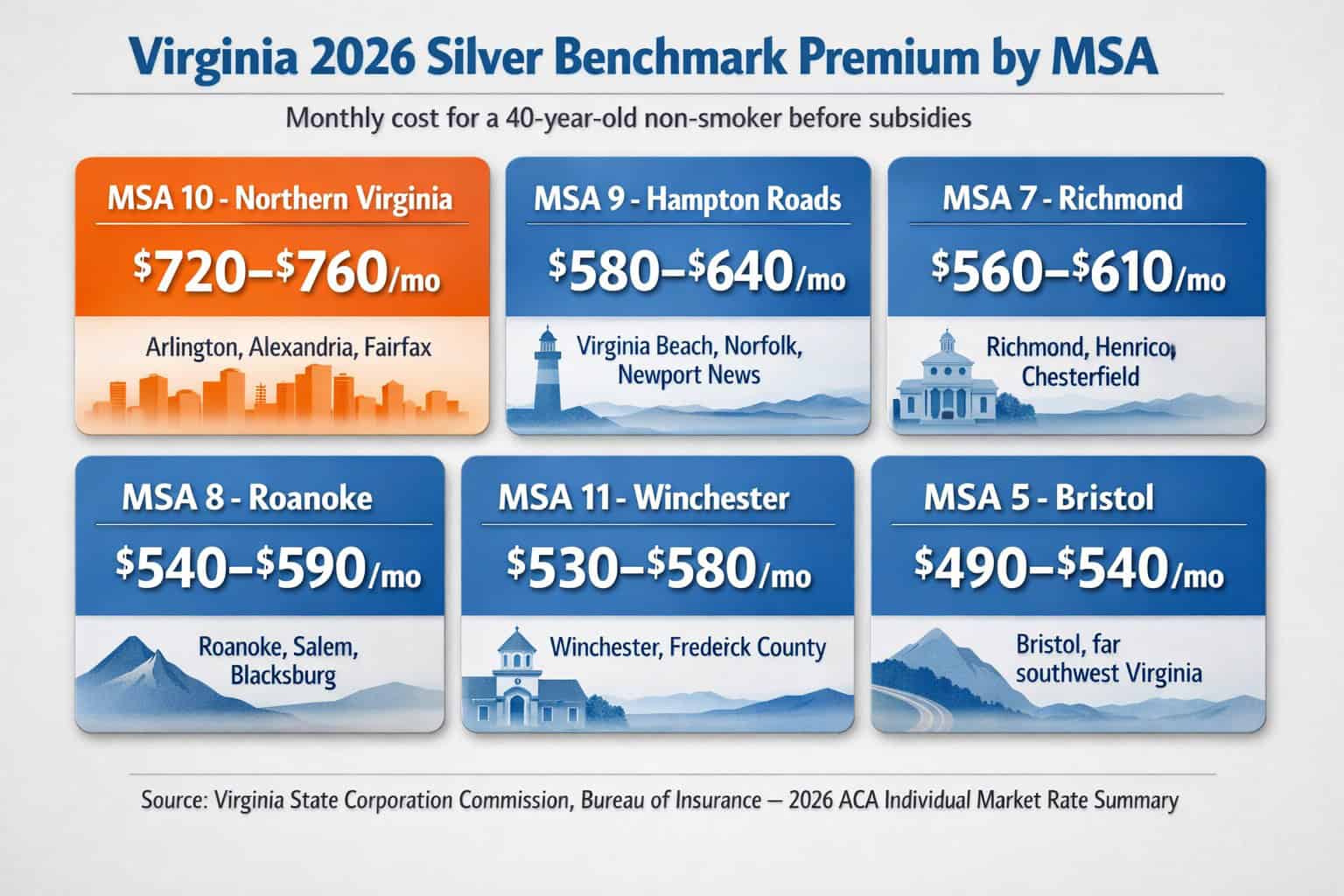
Virginia health insurance costs in 2026 vary substantially by Metropolitan Statistical Area, age, and carrier. Full-price Silver premiums for a 40-year-old run roughly $490–$760 per month before subsidies depending on MSA, with Northern Virginia at the high end and Bristol/southwest Virginia at the low end. After advance premium tax credits — which 86% of Virginia marketplace enrollees still qualify for in 2026 — typical monthly costs drop to $80–$280 per month for subsidized Silver plans.
Virginia’s 12 MSAs produce real pricing differences. A 40-year-old non-smoker shopping the lowest-cost Silver plan in Arlington (MSA 10) sees substantially higher pricing than the same shopper in Bristol (MSA 5) or Roanoke (MSA 8) — Northern Virginia provider networks command higher reimbursement than rural southwest Virginia networks. Virginia’s reinsurance program (in effect since 2023) moderates these increases for non-subsidized enrollees by reimbursing carriers for very high-cost claims.
| Virginia Coverage Path | Typical Monthly Cost (2026) | Best Fit For |
|---|---|---|
| Cardinal Care (Medicaid expansion) | $0 (income-eligible) | Adults below 138% FPL |
| FAMIS (children’s CHIP) | $0 (income-eligible) | Children up to 200% FPL |
| Marketplace Silver + CSR | $50–$200/mo (with APTC + CSR) | 138%–250% FPL |
| Marketplace Silver subsidized | $110–$330/mo (with APTC) | 250%–400% FPL |
| Marketplace Silver full-price | $490–$760/mo (varies by MSA) | Above 400% FPL |
| Off-exchange PPO | $520–$820/mo | Above 400% FPL, national network preference |
| FEHB / Employer-sponsored | $120–$340/mo (employee share) | Federal workers and W-2 employees |
Get a Virginia Health Insurance Quote
Virginia runs its own marketplace, so a licensed Virginia agent starts at Marketplace.Virginia.gov: screening Cardinal Care and FAMIS first, then comparing all eight 2026 carriers with your subsidy math and confirming your Inova, Sentara, HCA Virginia, Bon Secours, or Carilion providers stay in network. Free, no obligation.
Virginia’s 2026 Rate Increase and the Subsidy Story
Virginia’s 2026 ACA marketplace premiums increased by an overall average of 21.6% before subsidies, according to the Virginia State Corporation Commission Bureau of Insurance. The largest driver was the expiration of enhanced federal Advanced Premium Tax Credits at the end of 2025. Most Virginia marketplace enrollees still qualified for substantial subsidies in 2026, but the after-subsidy cost rose for nearly every household.
Approved rate changes by carrier varied widely for plan year 2026: Optimum Choice (UnitedHealthcare) +35.4%, Cigna +22.8%, Sentara Health Plans +22.4%, Anthem HealthKeepers +20.9%, CareFirst BlueChoice +18.2%, and Kaiser Mid-Atlantic +11.8%. The SCC Bureau of Insurance reviews each carrier’s rate filing through SERFF and approves or modifies the request before plans go on the marketplace. Aetna Health Inc. exited Virginia entirely at the end of 2025, leaving approximately 13,721 Virginia Mid-year changes can interrupt the health insurance Virginia members rely on.
The 21.6% rate increase looks worse before subsidies than after
Virginia’s 21.6% statewide average rate increase is calculated before subsidies are applied — and 86% of Virginia marketplace enrollees still qualify for advance premium tax credits in 2026. For most subsidized Virginians, the actual after-subsidy premium increase is much smaller than 21.6%, because the subsidy formula adjusts to keep enrollees’ contribution roughly proportional to their income. Virginia’s reinsurance program (in effect since 2023) further moderates increases for non-subsidized enrollees by reimbursing carriers for very high-cost claims. If you bought a 2026 plan and your premium jumped sharply, log into Marketplace.Virginia.gov and update your income and household information — many enrollees who skip the update miss Accurate income reporting protects the health insurance Virginia residents depend on.
How to Enroll in Virginia Health Insurance
Enrolling in Virginia health insurance in 2026 means going through Marketplace.Virginia.gov — not HealthCare.gov, which Virginia stopped using for plan year 2024. The Marketplace runs its own enrollment portal, its own open enrollment calendar (extended to January 30, 2026), and screens applicants for Cardinal Care and FAMIS eligibility before showing marketplace plan options.
Virginians who missed the January 30, 2026 deadline can still enroll outside open enrollment through a special enrollment period — typical triggers include losing other coverage, getting married, having a baby, or moving to a different Virginia county. Cardinal Care and FAMIS enrollment is open year-round through Marketplace.Virginia.gov or directly through Cover Virginia at coverva.dmas.virginia.gov.
The Marketplace enrollment portal screens applicants for Cardinal Care and FAMIS eligibility before showing marketplace plan options. Applicants below the Medicaid expansion threshold are routed to the Virginia Department of Medical Assistance Services. Those above the threshold see the eight 2026 marketplace carriers with subsidy amounts calculated in real time. Free in-person and phone assistance is available through the Marketplace Help Center at 888-687-1501. The SCC Bureau of Insurance publishes carrier rate filings and the annual ACA Individual Market Public filings document the health insurance Virginia carriers propose.
Frequently Asked Questions
Common questions about Virginia health insurance cover Marketplace.Virginia.gov versus HealthCare.gov, the January 30 open enrollment deadline, Cardinal Care and FAMIS eligibility, the 21.6% statewide rate increase for 2026, and the eight carriers competing on Virginia’s Insurance Marketplace — Anthem HealthKeepers, Sentara, Cigna, Kaiser, CareFirst, Optimum Choice, Group Hospitalization, and Oscar.
Does Virginia use HealthCare.gov for marketplace enrollment?
No. Since plan year 2024, Virginia operates Virginia’s Insurance Marketplace as its own state-based exchange at Marketplace.Virginia.gov, replacing HealthCare.gov entirely for individual and family coverage. Virginia’s Insurance Marketplace is operated by the Virginia Health Benefit Exchange, a division of the State Corporation Commission. Virginia residents shopping for individual marketplace plans, calculating subsidies, or applying for premium tax credits must use Marketplace.Virginia.gov — attempting to enroll through HealthCare.gov will not work for Virginia. Small group plans and SHOP coverage are also The same platform serves the health insurance Virginia small employers use.
When is Virginia’s 2026 open enrollment deadline?
Virginia extended its 2026 open enrollment period to January 30, 2026 — two weeks beyond the federal HealthCare.gov deadline of January 15. Open enrollment for plan year 2026 ran November 1, 2025 through January 30, 2026, with coverage effective February 1, 2026 for enrollments completed by the deadline. Virginia’s Insurance Marketplace, as a state-based exchange, sets its own enrollment calendar independent of the federal window. Outside open enrollment, Virginians can still enroll through a special enrollment period triggered by qualifying life events (job loss, marriage, birth, divorce, move) or year-round through Cardinal Care Medicaid and Cardinal Care backstops the health insurance Virginia low-income families need.
What is Cardinal Care and who qualifies?
Cardinal Care is Virginia’s umbrella brand for Medicaid coverage, rebranded by the Virginia Department of Medical Assistance Services in October 2023. Cardinal Care covers approximately 1.8 million Virginians as of December 2025 — including about 443,472 expansion adults at or below 138% of the federal poverty level (Virginia expanded Medicaid in 2019 under Governor Northam). Coverage is delivered through five managed care organizations: Anthem HealthKeepers Plus, Sentara Community Plan, Aetna Better Health, UnitedHealthcare Community Plan, and Humana Healthy Horizons (which replaced Molina Healthcare in July 2025). Apply through Marketplace.Virginia.gov or Cover Virginia at coverva.dmas.virginia.gov — enrollment is year-round.
What is FAMIS in Virginia?
FAMIS — Family Access to Medical Insurance Security — is Virginia’s Children’s Health Insurance Program (CHIP), covering approximately 183,526 Virginia children as of late 2025. FAMIS provides comprehensive health coverage for children in families with incomes too high to qualify for Medicaid but below program limits, typically up to 200% of the federal poverty level. Children enrolled in FAMIS receive 12 months of protected continuous coverage from enrollment date — coverage cannot be terminated during this period except if the child turns 19, permanently moves out of Virginia, or the parent requests termination. FAMIS is administered as part of the Cardinal Care program through the same five managed care organizations These organizations support the health insurance Virginia safety net provides.
How much did Virginia health insurance premiums increase for 2026?
Virginia’s 2026 ACA marketplace premiums increased by an overall average of approximately 21.6% before subsidies, according to the Virginia State Corporation Commission Bureau of Insurance. Approved increases by carrier ranged widely: Anthem HealthKeepers +20.9%, Sentara Health Plans +22.4%, Cigna Health and Life +22.8%, CareFirst BlueChoice +18.2%, Kaiser Foundation Health Plan of the Mid-Atlantic +11.8%, and Optimum Choice (UnitedHealthcare) +35.4%. The largest driver of these increases was the expiration of enhanced federal Advanced Premium Tax Credits at the end of 2025 — though most subsidy-eligible Virginians still qualify for substantial premium reductions through Marketplace.Virginia.gov. Aetna and Innovation Health exited Virginia’s Those 2025 exits reshaped the health insurance Virginia market overall.
Which carriers offer marketplace plans in Virginia for 2026?
Virginia’s Insurance Marketplace has eight carriers offering individual plans for 2026 — down from ten in 2025 after Aetna Health Inc. and its Innovation Health affiliate exited at the end of 2025. The 2026 carrier lineup includes Anthem HealthKeepers (the largest individual carrier statewide with about 106,600 covered lives), Sentara Health Plans (formerly Optima, with about 89,092 covered lives), Cigna Health and Life Insurance, Kaiser Foundation Health Plan of the Mid-Atlantic, CareFirst BlueChoice (Northern Virginia only), Group Hospitalization and Medical Services, Optimum Choice (UnitedHealthcare), and Oscar Insurance Company. Carrier availability varies by Metropolitan Statistical Area — Virginia is divided into 12 rating regions including Northern Virginia, Richmond, Hampton Roads, Roanoke, and Winchester.
Compare 2026 Virginia Health Insurance Plans
From Northern Virginia to Bristol, premiums swing by rating region, so a licensed Virginia agent prices your MSA specifically across Anthem, Sentara, Cigna, Kaiser, CareFirst, Optimum Choice, Group Hospitalization, and Oscar, applies your tax credit, and checks Cardinal Care eligibility before you enroll. Free, no obligation.
Free Virginia health insurance comparison — covers all programs in one call.
Related Virginia Health Insurance Resources
Marketplace.Virginia.gov enrollment, open enrollment windows, subsidies, and carrier comparison.
Best Health Insurance in VirginiaAnthem HealthKeepers, Sentara, Cigna, Kaiser, and CareFirst compared for 2026.
Affordable Virginia Health InsuranceCardinal Care, FAMIS, subsidies, and the 21.6% rate increase explained.
Individual Health Insurance in VirginiaSelf-employed, freelancer, and family individual marketplace coverage.
Cardinal Care Medicaid (Official)Virginia’s expanded Medicaid and FAMIS eligibility and enrollment for income-qualifying residents.
Virginia Small Business Health InsuranceGroup plans, SHOP, ICHRA, and QSEHRA for Virginia employers.
Virginia’s Insurance Marketplace (Official)Virginia’s official marketplace enrollment portal for 2026 plans.
SCC Bureau of InsuranceCarrier rate filings, consumer complaints, and Virginia DOI resources.
Broker Disclosure
ForHealthInsurance.com is an independent health insurance agency serving Virginia residents. We are not affiliated with any carrier or government agency. We help you compare plans and enroll in coverage that meets your needs at no extra cost to you.