Short-Term Health Insurance in California: What to Know for 2026
Short-term health insurance in California is not available for purchase. The state prohibits the sale of short-term limited duration insurance (STLDI) plans to individual consumers. California passed SB 910 in 2018, banning all sales and renewals of STLDI plans effective January 1, 2019. Residents searching for short-term health insurance California alternatives should instead explore ACA-compliant options: special enrollment through qualifying life events, off-exchange PPO plans from Blue Shield and Anthem, COBRA continuation coverage, and Medi-Cal. California’s individual mandate also means that STLDI plans, even if they were available, would not satisfy the coverage requirement and would still trigger the state tax penalty.

Why California Bans Short-Term Health Insurance
California banned short-term health insurance to protect consumers from coverage gaps these products commonly create. The California Department of Insurance (CDI) enforces the prohibition under Insurance Code section 10123.61, which bars the issuance, sale, or renewal of any STLDI plan within the state.
Short-term plans in states where they remain legal typically exclude coverage for pre-existing conditions, omit essential health benefits like maternity care and mental health services, impose annual and lifetime coverage caps, and can deny claims for conditions that existed before the policy start date. These limitations leave enrollees exposed to large unexpected bills, a risk California regulators determined was not in consumers’ interest.
The ban also supports the stability of California’s ACA-compliant individual market. Short-term plans tend to attract younger, healthier enrollees who would otherwise participate in the broader risk pool. When healthier consumers leave the ACA market, premiums rise for everyone remaining, a dynamic called adverse selection. By keeping all individual market enrollees in ACA-compliant plans, California helps maintain a broader risk pool that keeps premiums more stable for the state’s nearly 2 million Covered California exchange enrollees.
Coverage Gap Situations and ACA Alternatives
Most residents searching for short-term health insurance California has banned are dealing with a specific coverage gap, a period without employer-sponsored or government-provided health insurance. Common gap situations include job transitions, aging off a parent’s plan, freelance work, and missed open enrollment. Each has ACA-compliant alternatives.
Between Jobs
Best alternative: ACA plan via qualifying life event
Losing employer coverage triggers a 60-day special enrollment period for Covered California or off-exchange plans. This is almost always cheaper than COBRA, especially with premium tax credits. An off-exchange Blue Shield or Anthem PPO plan provides flexibility during the transition without network restrictions.
Aging Off Parent’s Plan
Best alternative: ACA plan via qualifying life event
Turning 26 and losing parent plan coverage qualifies as a life event. Young adults can enroll in a Covered California plan, often at the lowest premium tier due to age rating, or choose a Catastrophic plan if under 30 for minimal monthly costs with major medical protection.
Missed Open Enrollment
Best alternative: Off-exchange ACA plan (available anytime)
Residents who missed the enrollment window and do not have a qualifying life event can enroll in an off-exchange ACA plan from Blue Shield or Anthem at any time, with no enrollment window required. These plans satisfy the California mandate and provide full ACA protections.
Freelance or Gig Work
Best alternative: Individual ACA plan
Self-employed Californians can enroll through Covered California during open enrollment or after a qualifying event, often with premium tax credits. Off-exchange PPO plans suit irregular schedules and travel. The self-employed health insurance tax deduction provides additional savings on premiums.
Mandate Penalty Reminder
California’s individual mandate requires all residents to maintain qualifying health coverage. Going without coverage triggers a penalty of $950 per uninsured adult (or 2.5% of income above the filing threshold, whichever is higher) when filing state taxes. Short-term health insurance California banned would not satisfy this requirement even if purchased from an out-of-state carrier.

Qualifying Life Events for Special Enrollment
A qualifying life event (QLE) opens a 60-day special enrollment window outside of open enrollment, making it the most common path to coverage for Californians in a gap period. Understanding which events qualify is essential for residents who cannot find short-term health insurance California permits.
Events That Open Enrollment
- Losing employer or government health coverage
- Turning 26 and aging off a parent’s plan
- Getting married or entering a domestic partnership
- Having or adopting a baby
- Moving to a new California county or ZIP code
- Losing Medi-Cal eligibility due to income change
- Divorce ending spousal coverage
- Gaining U.S. citizenship or lawful presence
Events That Do NOT Qualify
- Voluntarily dropping coverage without a triggering event
- Missing open enrollment without another qualifying change
- Dissatisfaction with current plan or carrier
- Wanting to switch from HMO to PPO mid-year
- Premium increase alone (without qualifying coverage loss)
- Relocating within the same county and rating region
Residents with a qualifying life event can enroll through Covered California for subsidized coverage or directly with a carrier off-exchange. A California health insurance broker can verify eligibility, identify correct documentation, and manage enrollment within the 60-day window at no cost.
Alternatives to Short-Term Health Insurance in California
Because short-term health insurance California residents sometimes seek is banned statewide, several ACA-compliant alternatives serve the same purpose: providing coverage during gap periods while satisfying the individual mandate. The best alternative depends on income level and how long the gap is expected to last.
| Alternative | Enrollment Requirement | Monthly Cost | Mandate Compliant? |
|---|---|---|---|
| Covered California (via QLE) | Qualifying life event within 60 days | $350–$530 (Silver, before subsidies) | Yes |
| Off-exchange ACA plan | Anytime (no enrollment window required) | $370–$600 (varies by tier and carrier) | Yes |
| COBRA continuation | Within 60 days of employer coverage loss | $600–$750+ (full premium + 2%) | Yes |
| Medi-Cal | Income at or below 138% FPL (~$21,597) | Free or very low cost | Yes |
| Catastrophic plan (under 30) | Open enrollment or QLE | $280–$340 | Yes |
Off-Exchange Enrollment Advantage
Off-exchange ACA plans can be purchased at any time in California. There is no enrollment window for direct carrier enrollment. Residents who missed open enrollment and do not have a qualifying life event can still enroll in an ACA-compliant plan from Blue Shield or Anthem, including PPO options, without waiting for the next open enrollment period. These plans satisfy the California mandate and provide full essential health benefit protections. The trade-off is that premium tax credits are not available off-exchange.
COBRA vs. ACA Plans During Coverage Gaps
Californians who lose employer coverage often weigh COBRA against an individual ACA plan as a substitute for short-term health insurance California does not allow. COBRA preserves existing provider relationships but costs significantly more than ACA alternatives in most cases.
| Factor | COBRA | ACA Plan (Exchange or Off-Exchange) |
|---|---|---|
| Monthly cost (typical) | $600–$750+ (full premium + 2% admin) | $350–$530 (before subsidies) |
| Subsidy eligible? | No | Yes (Covered California only) |
| Duration | Up to 18 months | Renewable annually |
| Provider network | Same as employer plan | Carrier-specific (varies) |
| PPO available? | Depends on employer plan | Yes (Blue Shield, Anthem — on + off-exchange) |
| Best for | Mid-treatment provider continuity | Most people — especially subsidy-eligible |
In most cases, an ACA plan through Covered California or off-exchange costs substantially less than COBRA while meeting the same mandate requirements. For detailed cost comparisons by income level, the affordable health insurance California guide provides comprehensive pricing tables.
Real-World Example: Coverage Gap in Long Beach
Michelle, a 29-year-old marketing coordinator in Long Beach, was laid off and initially searched for short-term health insurance California options before learning about the ban. She faced the choice between COBRA at $680 per month and a Covered California Silver plan. With an estimated 2026 income of $42,000, she qualified for roughly $150 per month in premium tax credits, reducing her Silver HMO to $380, less than half the COBRA cost. An off-exchange Blue Shield Silver 2600 PPO at ~$510 per month would cost $170 less than COBRA while providing specialist access without referrals. Annual savings over COBRA: $3,600 on the subsidized HMO or $2,040 on the off-exchange PPO.
Find ACA-Compliant Coverage in California
California residents in a coverage gap can compare ACA-compliant alternatives, including subsidized Covered California plans and off-exchange PPO options, at no cost through a licensed broker.
Compare Plans Call 888-215-4045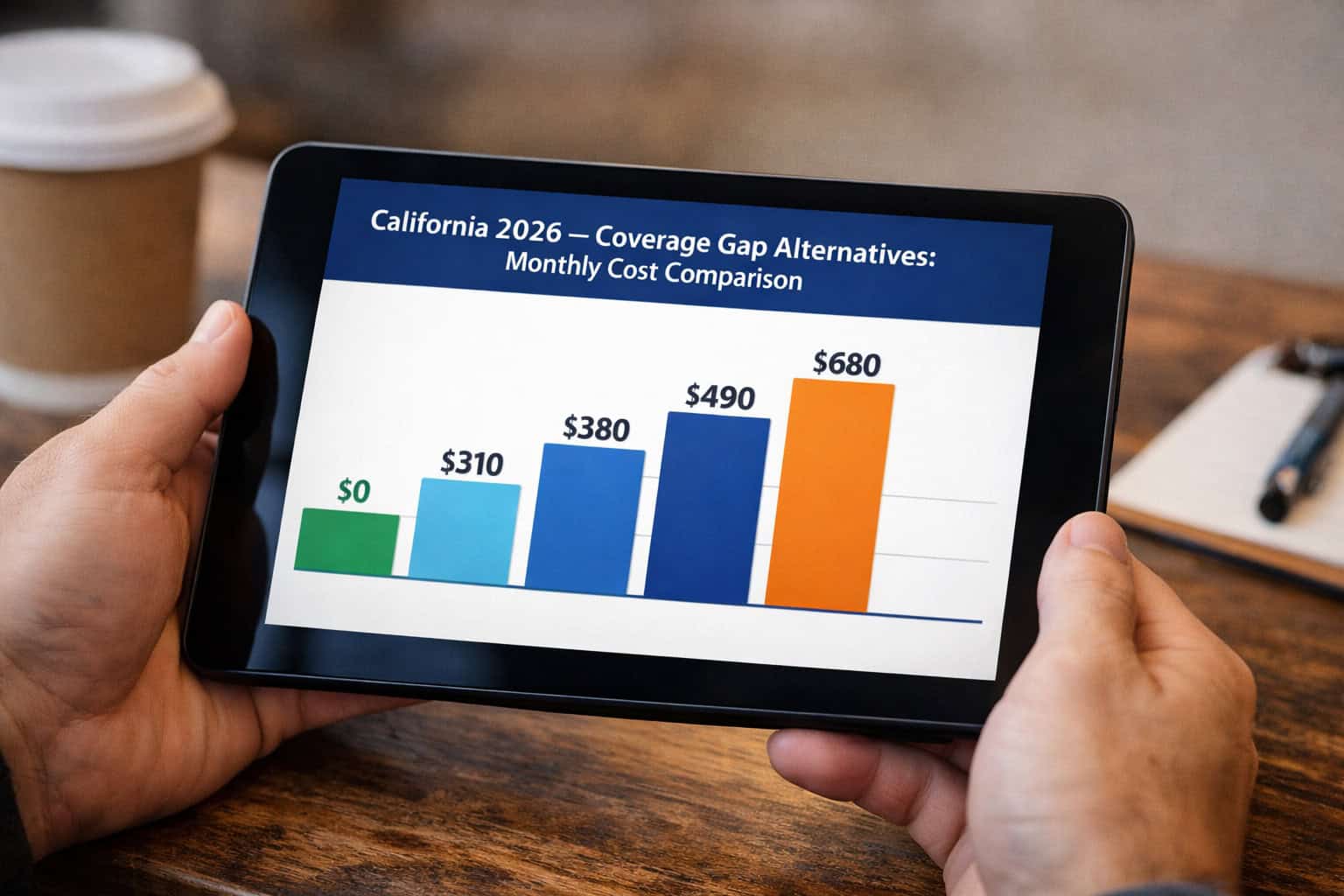
The California Mandate and Coverage Gap Penalties
California’s individual mandate adds financial urgency to resolving coverage gaps quickly. The California Franchise Tax Board (FTB) assesses the penalty when residents file state income taxes, making the cost of going uninsured tangible and immediate.
The penalty for the 2025 tax year (filed in 2026) is the greater of $950 per uninsured adult and $475 per uninsured child, or 2.5% of gross household income above the filing threshold. The penalty is calculated monthly; residents uninsured for three months pay three-twelfths of the annual penalty. Residents who obtain coverage within 60 days of a qualifying life event may avoid penalties for some gap months depending on timing.
Exemptions are available for residents whose lowest-cost Bronze plan exceeds 8.05% of household income, certain hardship situations, and membership in health care sharing ministries. The FTB determines exemption eligibility at tax filing. For residents weighing the penalty against plan costs, the individual health insurance California guide includes mandate penalty calculations alongside plan pricing.
How to Find Coverage Quickly in California
Residents who need coverage now and cannot purchase short-term health insurance California bans can follow a structured process to identify the fastest path to ACA-compliant coverage based on their situation and income level.
Check for a Qualifying Life Event
Review the list of qualifying events to determine if you have a 60-day special enrollment window. Job loss, marriage, having a baby, and moving to a new county all qualify. If yes, proceed with Covered California for subsidy access.
Estimate Your Income
Determine whether you qualify for Medi-Cal (up to 138% FPL), Covered California subsidies (138%–400% FPL), or should focus on off-exchange plans (above 400% FPL). Income level determines the most affordable pathway.
Consider Off-Exchange ACA Plans
If you missed open enrollment and have no qualifying event, off-exchange ACA plans from Blue Shield and Anthem can be purchased at any time. These include PPO options, satisfy the state mandate, and provide full ACA protections.
Contact a Broker
A licensed California health insurance broker can quickly assess your situation, verify qualifying events, compare on-exchange and off-exchange options, and complete enrollment, often in a single consultation at no cost.
Frequently Asked Questions About Short-Term Health Insurance in California
The following questions address the most common concerns California residents have about the short-term insurance ban, ACA-compliant alternative coverage options, mandate penalties, and strategies for closing coverage gaps quickly in 2026.
Can I buy short-term health insurance in California?
No. California prohibits the sale of short-term limited duration insurance (STLDI) plans under SB 910, effective January 1, 2019. The ban applies to all carriers selling to individual consumers within the state. Residents who need temporary coverage should explore ACA-compliant alternatives including Covered California plans through a qualifying life event, off-exchange plans available year-round, COBRA continuation, or Medi-Cal.
What can I get instead of short-term health insurance in California?
The primary alternatives are ACA-compliant individual plans through Covered California (with a qualifying life event or during open enrollment), off-exchange ACA plans from Blue Shield or Anthem (available anytime without an enrollment window), COBRA continuation from a previous employer, and Medi-Cal for residents earning up to 138% of the federal poverty level. Off-exchange plans include PPO options and satisfy the California mandate.
Can I enroll in a health plan outside of open enrollment in California?
Yes, through two paths. A qualifying life event opens a 60-day special enrollment window for Covered California plans. Separately, off-exchange ACA plans can be purchased directly from carriers like Blue Shield and Anthem at any time throughout the year without a qualifying event, though premium tax credits are not available off-exchange.
What is the penalty for being uninsured in California?
The penalty for the 2025 tax year is the greater of $950 per uninsured adult and $475 per child, or 2.5% of household income above the filing threshold. The penalty is prorated monthly; a three-month gap results in one quarter of the annual penalty. Exemptions exist for residents who cannot find affordable coverage and certain hardship situations.
Would an out-of-state short-term plan satisfy the California mandate?
No. Short-term plans do not qualify as minimum essential coverage under California’s individual mandate, regardless of where they are purchased. An out-of-state STLDI plan would not prevent the state tax penalty, and its coverage limitations, including pre-existing condition exclusions, would leave the resident exposed to significant medical costs. Only ACA-compliant coverage satisfies the California mandate.
Is COBRA or an ACA plan better for filling a coverage gap?
For most Californians, an ACA plan costs less than COBRA, especially with premium tax credits. COBRA requires paying the full employer premium plus a 2% administrative fee with no subsidy eligibility. The main advantage of COBRA is maintaining access to the same provider network, which matters most for residents mid-treatment. The California PPO health insurance guide compares off-exchange PPO options that may offer broad network access at lower cost than COBRA.
California Health Insurance Resources
Complete 2026 guide to coverage options, enrollment, and subsidies.
California Marketplace GuideCovered California enrollment, metal tiers, and plan selection.
Individual Health InsuranceSelf-employed coverage, mandate details, and plan selection.
Affordable California CoverageCost breakdowns, subsidy strategies, and savings tips.
Find a California BrokerFree enrollment help from licensed professionals.
California PPO PlansPPO carrier comparisons, on vs. off-exchange options, and costs.
Find ACA-Compliant Coverage in California
See actual plan pricing for your ZIP code, including off-exchange PPO options available year-round. Enter your details below or call for free, personalized help.
Compare Plans Call 888-215-4045Broker Disclosure
ForHealthInsurance.com is an independent health insurance agency serving California residents. We are not affiliated with any carrier or government agency. We help you compare plans and enroll in coverage that meets your needs at no extra cost to you.