Small Business Health Insurance in Missouri: 2026 Group Plans & ICHRA
Small business health insurance in Missouri for 2026 offers employers several pathways — traditional group plans through the state’s five small group carriers, SHOP marketplace coverage on HealthCare.gov with federal tax credits for qualifying small businesses, or Individual Coverage Health Reimbursement Arrangements (ICHRAs) that reimburse employees for individual Missouri marketplace plans. The Missouri small group market features five carriers offering plans off-exchange per the Missouri Department of Commerce and Insurance (DCI). This guide walks through each option for Missouri employers with 1–50 employees, including how Missouri’s nine-carrier individual market makes ICHRA particularly attractive for businesses with employees spread across St. Louis, Kansas City, Springfield, and rural Missouri.

What does your Missouri business need?
Small Business Health Insurance Options in Missouri
Small business health insurance in Missouri for 2026 gives employers with 1–50 employees three primary coverage pathways: traditional small group plans purchased directly from the state’s five small group carriers; the federal SHOP marketplace on HealthCare.gov with access to the Small Business Health Care Tax Credit; or an Individual Coverage Health Reimbursement Arrangement (ICHRA) that reimburses employees for individual Missouri marketplace plans on a tax-free basis.
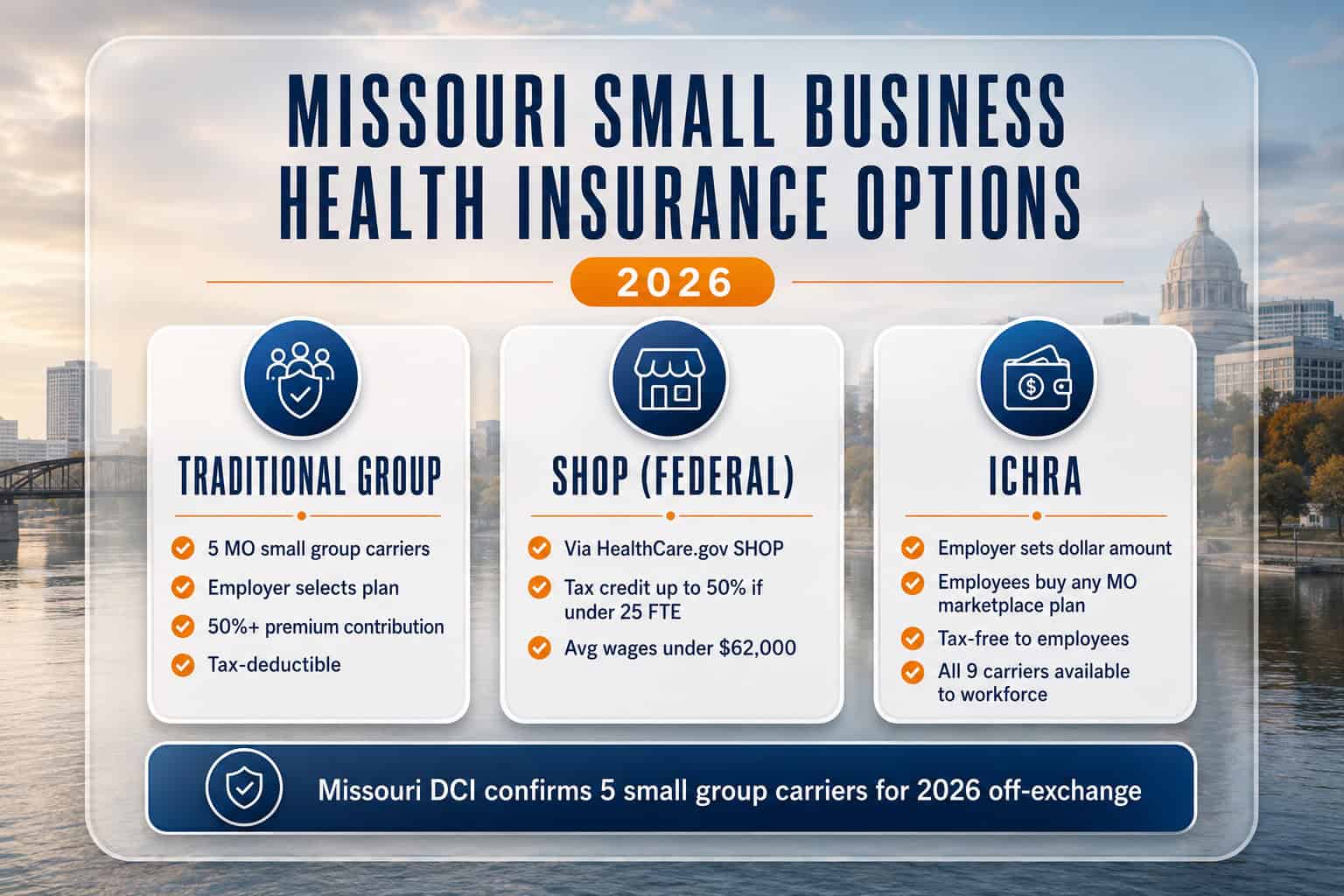
| Option | Eligible Businesses | Carriers in MO | Tax Credit Eligible | Employee Choice |
|---|---|---|---|---|
| Traditional small group | 1–50 FTE | 5 MO small group carriers | No (unless through SHOP) | Employer selects plan; employees enroll |
| SHOP (federal HealthCare.gov) | 1–50 FTE | Same carriers via SHOP | Yes — under 25 FTE + avg wages under $62,000 | Employees may choose from available metal tiers |
| ICHRA | Any size | All 9 MO marketplace carriers available to employees | No (but contributions tax-free) | Full employee choice via HealthCare.gov or off-exchange |
| QSEHRA | Under 50 FTE, no group plan | Any — employees choose own plan | No (but contributions tax-free) | Full employee choice; max $6,350/individual in 2026 |
For many Missouri small businesses — particularly those with employees across multiple regions where marketplace carrier availability differs dramatically — the ICHRA model offers unique advantages. St. Louis metro employees have access to all seven 2026 individual carriers competing for their business. Kansas City employees benefit from BCBS of Kansas City’s 4.1% rate cut. Rural Missouri employees may have only UHC and Ambetter available. Rather than selecting a single group plan with network gaps, the business sets a monthly dollar amount (e.g., $450/employee) and each employee uses it to purchase whichever Missouri marketplace plan fits their county. A Kansas City employee picks BCBS KC while a St. Louis employee selects Anthem BCBS Missouri PPO for BJC HealthCare access.
Small Business Health Care Tax Credit in Missouri
Missouri small businesses purchasing coverage through the federal SHOP marketplace may qualify for the Small Business Health Care Tax Credit — worth up to 50% of the employer’s premium contributions (35% for tax-exempt organizations). To qualify, the business must have fewer than 25 full-time equivalent employees, pay average annual wages under $62,000 (indexed annually), and cover at least 50% of employee-only premium costs. For a qualifying 10-employee Missouri business, this credit can save $4,500–$12,000 per year.
The credit is claimed on the employer’s annual federal tax return using IRS Form 8941. The maximum 50% credit applies to businesses with 10 or fewer FTEs and average wages under $32,000, phasing out as headcount approaches 25 and wages approach $62,000. Tax-exempt Missouri organizations — nonprofits and religious organizations — can claim up to 35% as a refundable credit. The credit is only available for SHOP-purchased plans, not for direct-to-carrier group plans. SHOP enrollment happens through the HealthCare.gov Small Business portal.
Example: Springfield Research Firm, 9 Employees. A Springfield research firm with 9 full-time employees averaging $46,000/year purchases SHOP coverage through HealthCare.gov, contributing $520/month per employee toward a Silver plan. Annual employer contribution: $56,160. The Small Business Health Care Tax Credit at approximately 32% (phased based on wages) returns roughly $17,971 — reducing effective employer cost to $38,189, or about $354/month per employee. Total contributions decrease significantly after the credit applies at tax time.
Does Missouri Require Employers to Offer Health Insurance?
Missouri has no state employer mandate requiring businesses to offer health insurance. The federal ACA employer mandate applies only to Applicable Large Employers with 50 or more full-time equivalent employees — Missouri businesses with fewer than 50 FTEs face no federal penalty for not offering coverage. Approximately 89% of Missouri businesses have fewer than 20 employees, making the vast majority exempt from any employer mandate.
For Missouri businesses at or near the 50-FTE threshold, the federal penalty for not offering affordable, minimum-value coverage is $2,970 per full-time employee (minus the first 30) for 2026. A 55-FTE Missouri business not offering coverage would face a potential penalty of approximately $74,250/year. Businesses approaching this threshold should evaluate whether small business health insurance in Missouri through a group plan or ICHRA is more cost-effective than absorbing the penalty. Missouri small group rates for 2026 are regulated by the Missouri Department of Commerce and Insurance.
Missouri Small Group Carriers for 2026
Five carriers offer small group health insurance in Missouri for 2026 off-exchange, per the Missouri DCI preliminary rate release. These include Anthem Blue Cross Blue Shield of Missouri (statewide PPO), Blue Cross Blue Shield of Kansas City (30 western counties, same 4.1% rate-cut posture as individual market), UnitedHealthcare (small group statewide), Humana, and Cigna. Small group rate filings are approved by the Missouri Department of Commerce and Insurance.
Missouri small group plans are community-rated — premiums are based on employee ages, tobacco use, and county, not on the group’s health history. A 10-person group in Jackson County (Kansas City) with an average employee age of 38 can expect Silver small group premiums of approximately $520–$620/month per employee before employer contributions, typical for small business health insurance in Missouri at that group size. Anthem BCBS of Missouri offers the broadest PPO network for St. Louis metro employers, reaching BJC HealthCare, SSM Health, and Mercy Hospital. BCBS of Kansas City integrates tightly with Saint Luke’s Health System in the KC metro — ideal for Kansas City employer groups. For businesses exploring ICHRA, the Missouri carrier comparison guide details the nine individual-market carriers employees would choose from under an ICHRA arrangement.
Compare Missouri Small Business Health Plans
See group plan options from Missouri’s five small group carriers — Anthem BCBS Missouri, BCBS of Kansas City, UnitedHealthcare, Humana, and Cigna. Check SHOP tax credit eligibility and explore ICHRA alternatives with access to all nine Missouri marketplace carriers for your business.
ICHRA — An Alternative to Traditional Group Plans in Missouri
An Individual Coverage Health Reimbursement Arrangement lets Missouri employers set a fixed monthly dollar amount per employee — typically $400–$600 — which employees use to purchase individual plans through HealthCare.gov or off-exchange. Employer contributions are tax-deductible to the business and tax-free to the employee. Employees buying through HealthCare.gov with ICHRA funds may also qualify for premium tax credits if the employer contribution is below ACA affordability thresholds. Approximately 90% of Missouri individual market enrollees qualify for subsidies.
ICHRAs work particularly well for small business health insurance in Missouri because of the state’s geographic carrier variation. A traditional group plan locks all employees into one carrier and network — suboptimal when a St. Louis metro employee has access to seven 2026 marketplace carriers while an employee in rural northeastern Missouri has access to only UHC. With an ICHRA, each employee selects the Missouri marketplace plan that works best for their county and provider preferences, and the employer’s per-employee cost stays fixed regardless of location or carrier selection. Because most employees buy individual coverage and many qualify for premium tax credits, it helps to understand how subsidies and low-cost plans work in the guide to affordable health insurance in Missouri.
ICHRA works well when
Missouri employees are spread across multiple regions with different carrier availability — particularly businesses with St. Louis, Kansas City, Springfield, and rural Missouri locations. The business wants predictable, fixed monthly costs. Employees have diverse healthcare needs and prefer choosing their own plan type and metal tier.
Traditional group works well when
All Missouri employees are in the same metro area with similar carrier options. The business qualifies for SHOP tax credits (under 25 FTE, wages under $62,000). Employees prefer having the employer handle plan selection and administration. The business wants to offer Anthem BCBS Missouri or BCBS KC PPO network as a recruitment advantage.
How to Set Up Small Business Health Insurance in Missouri
Setting up small business health insurance in Missouri involves four decisions: coverage type (group plan, SHOP, or ICHRA), carrier selection for group plans, contribution level (minimum 50% of employee-only premiums for SHOP tax credit eligibility), and enrollment timing (group plans can start any month, not restricted to Open Enrollment). A licensed Missouri enrollment assistant can walk through all options at no cost to the business.
Determine employee count and budget
Count full-time equivalent employees (30+ hours/week). Missouri businesses under 25 FTE with average wages under $62,000 should evaluate SHOP for the tax credit. Businesses with 1–5 employees often find ICHRA or QSEHRA more cost-effective than traditional group rates.
Choose a coverage approach
Traditional group (employer selects carrier and plan), SHOP (employees may choose metal tier, tax credit available), or ICHRA (employer sets dollar amount, employees buy on HealthCare.gov). Each has different cost and administrative implications for Missouri employers.
Get quotes from Missouri carriers
For group plans: Anthem BCBS Missouri, BCBS of Kansas City, UnitedHealthcare, Humana, and Cigna serve the Missouri small group market. Provide employee census data (ages, ZIPs, tobacco status) for accurate quotes. For ICHRA: set the monthly allowance and let employees quote individual HealthCare.gov plans themselves.
Enroll and communicate to employees
Group plans can start the first of any month — no Open Enrollment restriction. SHOP enrollment goes through the federal HealthCare.gov Small Business portal. Provide Missouri employees with plan details, contribution amounts, and network information. Coverage activates once the first premium payment clears.
Frequently Asked Questions About Missouri Small Business Coverage
Do Missouri businesses under 50 employees have to offer coverage at all?
Missouri layers no state employer mandate on top of federal law, so only the ACA rule applies: a coverage requirement attaches solely to employers averaging 50 or more full-time-equivalent workers. The Missouri Department of Commerce and Insurance adds nothing beyond that federal line. Because close to 89% of employers across Jackson, St. Louis, and Greene counties sit below the threshold, the typical Missouri shop offers group coverage as a hiring advantage rather than a legal duty.
Which Missouri employers actually qualify for the federal SHOP tax credit?
Qualification turns on four tests: fewer than 25 full-time-equivalent workers, average annual wages below $62,000, at least half of each employee-only premium paid by the business, and enrollment through the SHOP marketplace on HealthCare.gov. The credit returns up to 50% of premium contributions, or 35% for a tax-exempt Missouri nonprofit, and is claimed on IRS Form 8941. Springfield and Cape Girardeau firms with lower regional wage bases tend to clear the wage test most comfortably.
Which carriers sell small group plans in Missouri for 2026, and where do they reach?
Five carriers file small group business, and the map splits east to west. Anthem Blue Cross Blue Shield of Missouri runs statewide PPO coverage tied to BJC HealthCare and SSM Health around St. Louis. Blue Cross Blue Shield of Kansas City anchors the 30 western counties through Saint Luke’s Health System. UnitedHealthcare, Humana, and Cigna fill out the field, while Mercy and CoxHealth networks carry the most weight around Springfield. The Missouri Department of Commerce and Insurance rate release confirms all five.
How does an ICHRA work for a Missouri team spread across different metros?
When staff sit across Kansas City, St. Louis, and the Ozarks, one group plan rarely fits every network. An Individual Coverage Health Reimbursement Arrangement fixes that: the business sets a monthly allowance and each worker buys an individual plan matched to their own county on HealthCare.gov. Contributions stay deductible to the employer and tax-free to the worker. The arrangement suits Missouri especially well because carrier counts swing from two in rural counties to nine in the metro markets.
Will accepting an ICHRA cost a Missouri worker their HealthCare.gov subsidy?
That depends on whether the allowance clears the ACA affordability bar for each worker. When the contribution counts as affordable, the employee takes the ICHRA and gives up premium tax credits; when it falls short, the worker may decline the arrangement and claim subsidies instead. With roughly 90% of Missouri individual-market enrollees receiving subsidies, the calculation carries real weight — a licensed enrollment assistant can run the affordability test person by person before open enrollment closes.
What do small group premiums really run in Kansas City versus St. Louis?
Premiums track the metro. A Jackson County group in Kansas City averaging age 38 runs about $520–$620 per employee monthly for Silver coverage in 2026, with St. Louis rates sitting modestly higher on the strength of the BJC and SSM hospital systems. Greene County groups near Springfield frequently land lower. Worker ages, metal tier, and carrier all move the number, and a qualifying employer can cut effective cost by up to 50% through the SHOP credit. An ICHRA, by contrast, costs whatever fixed allowance the business sets.
Related Missouri Health Insurance Resources
Explore related guides for Missouri’s overall coverage landscape, marketplace enrollment for individuals, comparing top-rated carriers, and PPO plan flexibility to help navigate small business coverage decisions in the Show-Me State.
Plans, costs, carriers, and how coverage works statewide.
Marketplace EnrollmentHealthCare.gov enrollment, deadlines, and qualifying life events.
Best Carriers & PPO PlansHow Missouri’s top carriers rank by network and quality.
PPO PlansReferral-free specialist access and out-of-network coverage nationwide.
Find Coverage for Your Missouri Team
Compare group plans from Anthem BCBS Missouri, BCBS of Kansas City, UnitedHealthcare, Humana, and Cigna. Check SHOP tax credit eligibility through HealthCare.gov and explore ICHRA options with access to all nine Missouri marketplace carriers. Licensed enrollment assistance at no cost.
Broker Disclosure
ForHealthInsurance.com is an independent health insurance agency serving Missouri businesses. We are not affiliated with any carrier or government agency. We help you compare plans and enroll in coverage that meets your needs at no extra cost to you.