Affordable Health Insurance in Nevada 2026: How to Save on Coverage
Affordable health insurance in Nevada looks different in 2026 than it did a year ago. Federal enhanced subsidies expired at the end of 2025, raising sticker prices across every Nevada Health Link plan — but Nevada also launched two new programs that pull premiums in the other direction: state-approved Battle Born State Plans and a market-wide reinsurance program. This guide on affordable health insurance Nevada residents can actually buy in 2026 shows where the savings are, how subsidies still work for most Nevadans, and how to find the lowest total annual cost based on your specific situation.

What brings you here today?
How Much Does Affordable Health Insurance in Nevada Cost?
Affordable health insurance Nevada residents enrolled in for 2026 cost an average of $148 per month after subsidies. Of the 104,286 Nevadans who enrolled for 2026, 82% received premium tax credits averaging $516 per month. Without subsidies, full-price benchmark Silver premiums in Nevada rose by an approved average of 22.3% for 2026 — but Nevada’s reinsurance program kept that increase below what most states experienced.
“Affordable” depends entirely on whether you qualify for a subsidy. For the 82% of Nevada Health Link enrollees who do, the average net premium is roughly the cost of a monthly cell phone bill. For the 18% who don’t qualify for a premium tax credit, full-price affordable health insurance Nevada plans range from roughly $510 to $680 per month for a benchmark Silver plan in Clark County, depending on the carrier. For the lowest-income Nevadans, Medicaid through Nevada’s program (operated by the Department of Health and Human Services) provides free or near-free coverage outside the marketplace entirely.
The single biggest 2026 change: enhanced subsidies that had been in place since 2021 (under the American Rescue Plan and Inflation Reduction Act) expired at the end of 2025. That reduced the size of every subsidized Nevadan’s tax credit and eliminated subsidies entirely for households above 400% of the federal poverty level. The shift moved the average net premium for subsidized Silver enrollees in Nevada from $89 in 2025 to $202 in 2026 — a 34% jump for the most popular metal tier, according to a ValuePenguin analysis.
Who Qualifies for Nevada Health Link Subsidies in 2026?
Nevadans qualify for premium tax credits through Nevada Health Link if their household income falls between 100% and 400% of the federal poverty level, they don’t have access to affordable employer coverage, and they aren’t eligible for Medicare or Medicaid. Below 138% of the federal poverty level, most Nevadans qualify for Medicaid instead. Cost-sharing reductions (which lower deductibles and copays) are available up to 250% of the federal poverty level on Silver-tier plans only.
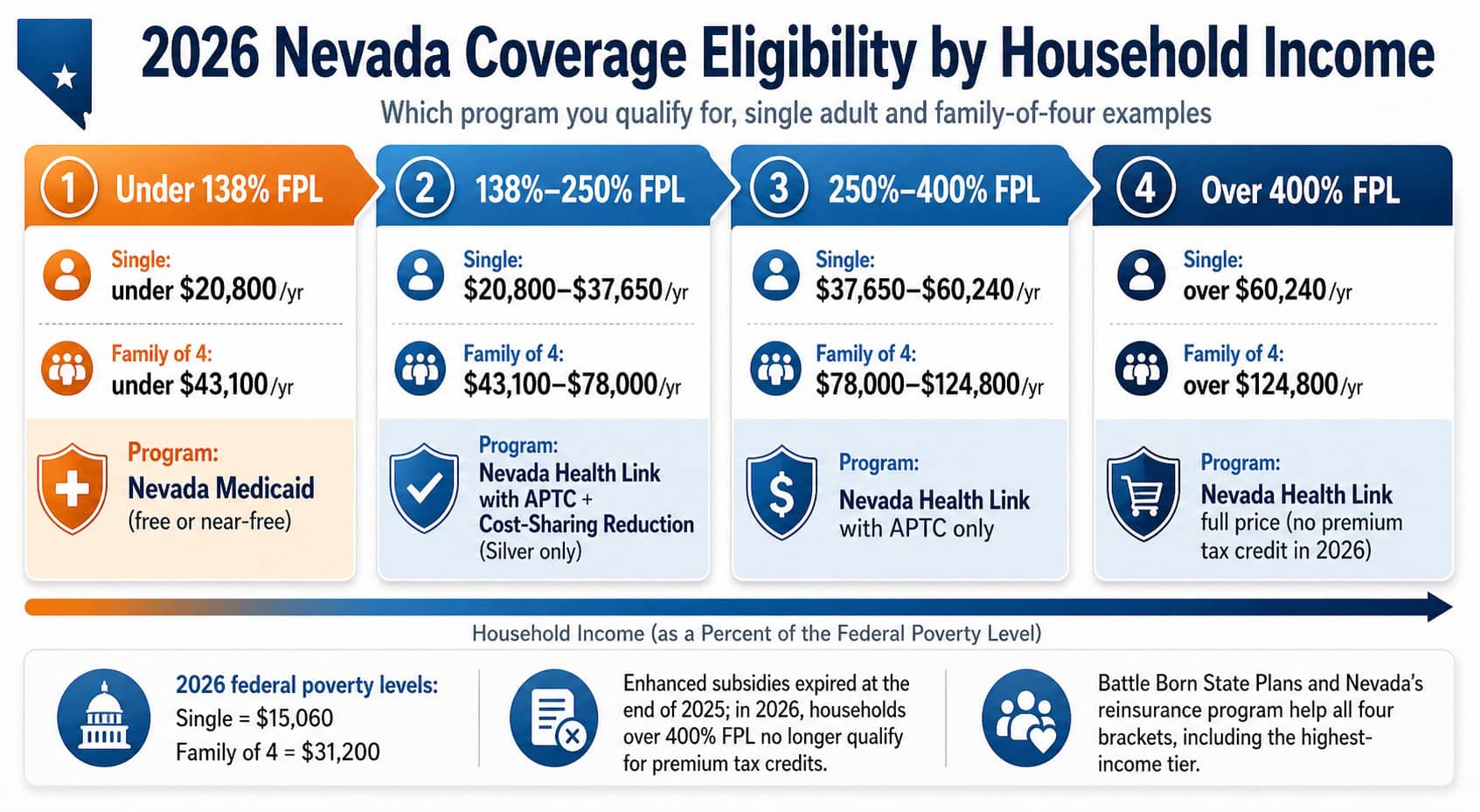
Two pieces of help are stacked together. The Advance Premium Tax Credit (APTC) lowers your monthly premium directly. Cost-Sharing Reductions (CSRs) lower your deductible, copays, and out-of-pocket maximum — but only if you choose a Silver-level plan and earn between 138% and 250% of the federal poverty level. For 2026, 46% of Nevada Health Link enrollees received CSR benefits in addition to premium tax credits, meaning nearly half of subsidized Nevadans were paying both lower premiums and lower out-of-pocket costs.
The income calculation uses Modified Adjusted Gross Income (MAGI), not gross pay. This matters for self-employed Nevadans who can deduct business expenses to arrive at a lower MAGI, potentially qualifying for a larger subsidy. Underestimating income risks a tax-time reconciliation under HR 1’s eliminated repayment caps; overestimating means a smaller monthly subsidy than you should be getting. The most accurate way to check eligibility is to enter your projected 2026 income directly into the Nevada Health Link prescreener.
What Makes Nevada Premiums Lower Than They Otherwise Would Be?
Two state-level programs reduce 2026 Nevada premiums beyond what federal subsidies do. Battle Born State Plans, authorized by a federal 1332 waiver, are state-approved plans with state-mandated premium reduction targets. The Market Stabilization Program — Governor Lombardo’s reinsurance fund — covers high-cost claims so carriers don’t pass those costs into premiums. Together, these are the reason Nevada’s full-price rates rose less than they would have under federal rules alone.
Battle Born State Plans launched for the 2026 plan year and are sold exclusively through Nevada Health Link. They cover the same ten essential health benefits as every other marketplace plan, but they’re subject to specific premium reduction targets that the standard marketplace plans aren’t. Carriers offering Battle Born State Plans agreed to lower-cost arrangements with providers and reduced broker commissions in exchange for predictable enrollment volume — the trade-off that makes the lower premium possible. Roughly 10,000 Nevadans selected a Battle Born State Plan during the first open enrollment, less than a third of what the state had projected.
The reinsurance program is structurally separate but works in parallel. When a Nevada Health Link enrollee has a very expensive medical year — major surgery, cancer treatment, premature birth — the state-funded reinsurance pool absorbs a portion of those claims so carriers don’t have to recover the cost across all customers’ premiums. This particularly benefits the 18% of Nevada enrollees who earn above 400% of the federal poverty level and no longer qualify for tax credits in 2026. Without reinsurance, full-price Silver premiums in Nevada would have risen even more than the approved 22.3% average.
Nevada is the third state with a public option
Nevada joined Colorado and Washington as the third state to launch a public-option-style marketplace program when Battle Born State Plans went live in 2026. Washington’s Cascade Select plans and Colorado’s Colorado Option followed similar structures — state-mandated premium reduction targets in exchange for market access. Both states saw enrollment grow substantially after their second or third year, suggesting Nevada’s modest first-year uptake may not be the steady state.
Affordable Nevada Plans by Metal Tier
For affordable health insurance Nevada shoppers can sustain over a full year, metal tier choice matters more than carrier choice. Bronze plans have the lowest premiums but highest out-of-pocket costs. Silver plans are nearly always the right pick for Nevadans under 250% of the federal poverty level because cost-sharing reductions make them behave like Gold or Platinum plans. Gold and Platinum plans cost more monthly but produce lower total annual costs for Nevadans with chronic conditions or expected major care.
Bronze
$0–$120/moLowest premiums after subsidies for Nevadans under 250% FPL. Best for healthy Nevadans who rarely use care and want catastrophic protection at the lowest monthly cost.
- Plan covers ~60% of average costs
- Highest deductibles ($7,000+ typical)
- Best annual cost if you don’t hit the deductible
- Not CSR-eligible
Silver (with CSR)
$45–$185/moThe best value for Nevadans between 138% and 250% of the federal poverty level. CSRs make Silver plans behave like Gold or Platinum on out-of-pocket costs without the premium markup.
- Plan covers up to ~94% of costs with CSR
- Deductibles can drop to ~$700
- 46% of NV enrollees got CSR in 2026
- Only available on-exchange
Silver (without CSR)
$135–$540/moFor Nevadans above 250% FPL, Silver plans behave like standard 70/30 plans. Still the most-purchased tier, but the gap between Silver and Gold narrows once CSRs aren’t in play.
- Plan covers ~70% of average costs
- Deductibles $4,500–$5,500 typical
- Most popular tier nationwide
- 2026 average net premium: $148
Gold and Platinum
$220–$680/moHigher monthly premiums but lowest out-of-pocket costs when you actually use care. Best for Nevadans with chronic conditions, expected surgery, or ongoing prescriptions.
- Plan covers ~80–90% of costs
- Deductibles often under $2,000
- Lower copays for office visits
- Best total cost for high care users
The choice between Bronze and Silver-with-CSR is the most consequential decision for low-income Nevadans seeking affordable health insurance Nevada Health Link offers. A subsidized Bronze plan often has a $0 monthly premium but a $7,500 deductible — meaning you pay nothing each month but everything out-of-pocket if anything goes wrong. A subsidized Silver plan with CSR might cost $80 per month but reduce that deductible to $1,200. For anyone who might use care, Silver-with-CSR almost always produces a lower total annual cost despite the higher premium.
See Your Personalized Affordable Nevada Plan Options
A licensed Nevada agent can calculate your exact subsidy, check Battle Born State Plan and Medicaid eligibility, and compare total annual cost across all 2026 Nevada Health Link options — at no cost to you.
Strategies for Lowering Your Nevada Health Insurance Cost
Five strategies materially reduce affordable health insurance Nevada costs: enroll on-exchange through Nevada Health Link to access subsidies, choose a Silver-tier plan if you qualify for cost-sharing reductions, evaluate Battle Born State Plans against standard plans, accurately estimate your modified adjusted gross income, and compare total annual cost (not just premium) across at least three carriers.
One option that does not lower real costs: short-term policies are not ACA-compliant, exclude pre-existing conditions, and forfeit subsidy eligibility entirely — the Nevada short-term health insurance guide covers when they do and do not make sense.
Strategy 1: Enroll on-exchange, not directly with carriers
Nevada Health Link is the only place premium tax credits apply. The same plan from the same carrier sold off-exchange charges full price. For the 82% of Nevadans who qualify for a subsidy, this single decision is worth thousands per year — it is the biggest lever on keeping affordable health insurance Nevada coverage genuinely within reach.
Strategy 2: Pick Silver if you qualify for CSRs
Cost-sharing reductions only apply to Silver-tier plans and only for households between 138% and 250% of the federal poverty level. If you qualify, a CSR-enhanced Silver plan often produces lower total cost than a Bronze plan with $0 premium.
Strategy 3: Compare Battle Born State Plans
Battle Born State Plans are required to be sold statewide and have built-in premium reduction targets. They’re particularly valuable for rural Nevadans and for households above 400% FPL who lost subsidy eligibility in 2026.
Strategy 4: Estimate MAGI accurately
Self-employed Nevadans can deduct business expenses to arrive at a lower MAGI. Underestimating risks tax-time reconciliation under HR 1’s eliminated caps. Overestimating means a smaller monthly subsidy than you should receive.
Strategy 5: Calculate total annual cost
Premium × 12 + expected out-of-pocket spending = total annual cost. Always compare this number, not the monthly premium. The cheapest premium plan often produces the highest total cost for anyone who uses care.
Strategy 6: Check Medicaid first
Nevada Medicaid covers households under 138% of the federal poverty level — about $21,597/year for a single adult or $44,367/year for a family of four. If you qualify, Medicaid is free or near-free and replaces marketplace coverage entirely.
Real-world example: Single self-employed designer in Henderson, age 32
A self-employed graphic designer in Henderson earning $42,000 in MAGI (about 280% of the 2026 federal poverty level for a single adult) qualifies for a premium tax credit through Nevada Health Link but not for cost-sharing reductions. A benchmark Silver plan after subsidy might run roughly $185–$220 per month with a $4,800 deductible. A Battle Born State Bronze plan might cost $95 per month after subsidy with a $7,500 deductible. For someone who rarely uses care, the BBSP Bronze choice saves about $1,200 per year. For someone with even one expected procedure, the Silver plan typically wins on total annual cost.
Affordable Nevada Plans by County and Situation
The most affordable health insurance Nevada plan varies by county. In Clark County, SilverSummit (Ambetter), Molina, and CareSource Nevada compete for lowest sticker price. In Washoe County, SilverSummit and Hometown Health alternate as the lowest-cost options. In rural counties (Elko, Humboldt, White Pine), Battle Born State Plans and Select Health are usually the only competitively priced options.
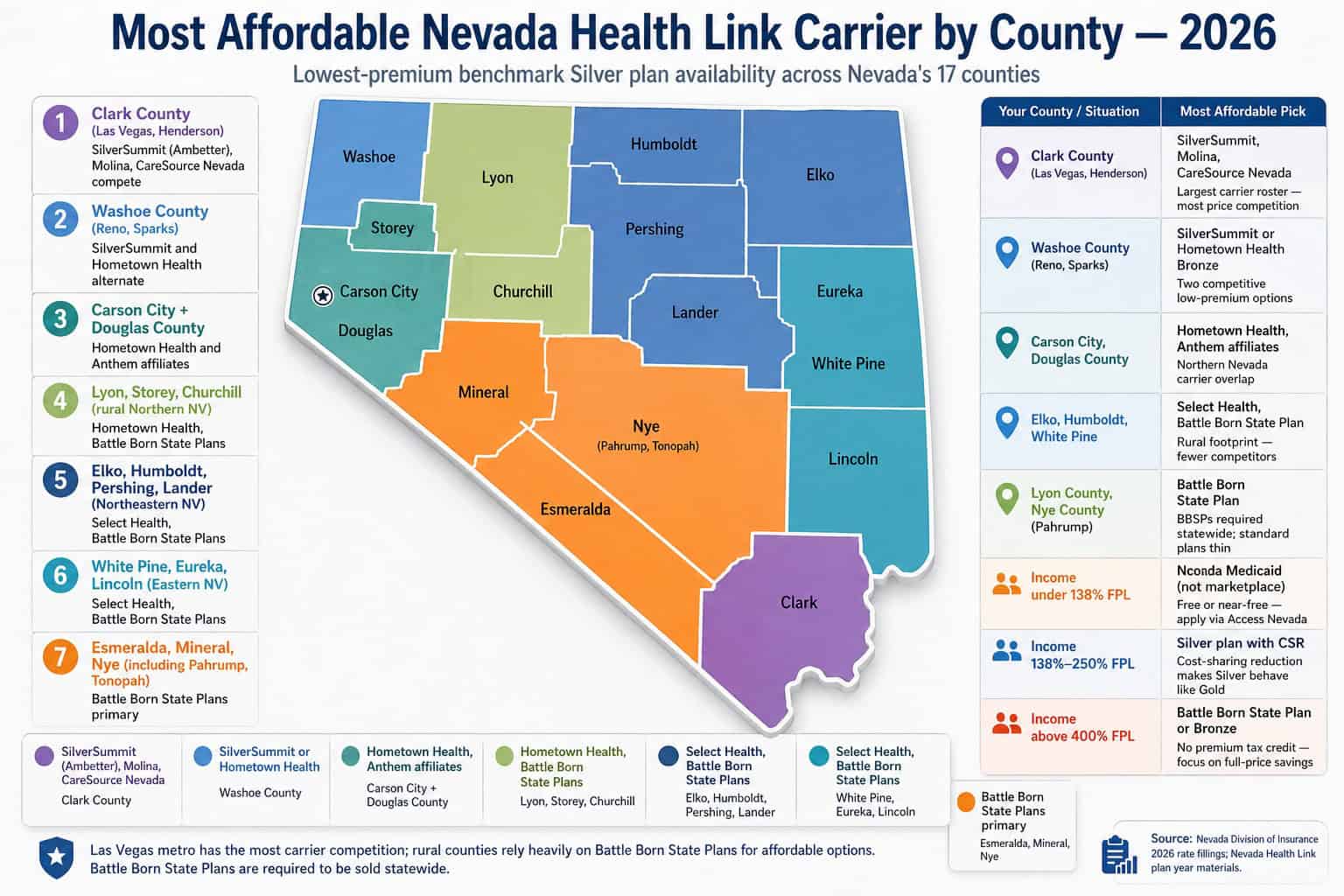
| Your County / Situation | Most Affordable Pick | Why |
|---|---|---|
| Clark County (Las Vegas, Henderson) | SilverSummit, Molina, CareSource Nevada | Largest carrier roster — most price competition |
| Washoe County (Reno, Sparks) | SilverSummit or Hometown Health Bronze | Two competitive low-premium options |
| Carson City, Douglas County | Hometown Health, Anthem affiliates | Northern Nevada carrier overlap |
| Elko, Humboldt, White Pine | Select Health, Battle Born State Plan | Rural footprint — fewer competitors |
| Lyon County, Nye County (Pahrump) | Battle Born State Plan | BBSPs required statewide; standard plans thin |
| Income under 138% FPL | Nevada Medicaid (not marketplace) | Free or near-free — apply via Access Nevada |
| Income 138%–250% FPL | Silver plan with CSR | Cost-sharing reduction makes Silver behave like Gold |
| Income above 400% FPL | Battle Born State Plan or Bronze | No premium tax credit — focus on full-price savings |
For Nevadans below 138% of the federal poverty level, Nevada Medicaid (administered through the state Department of Health and Human Services) is the affordable choice — not a marketplace plan. Eligibility is income-based and runs year-round, not just during open enrollment. The federal Medicaid Nevada page has the current eligibility brackets and enrollment information. Nevada also operates Nevada Check Up, the state’s Children’s Health Insurance Program (CHIP), for children in households earning slightly above Medicaid limits.
How to Find Affordable Health Insurance in Nevada
Finding affordable health insurance Nevada residents can actually afford starts with the Nevada Health Link prescreener at NevadaHealthLink.com, which calculates your subsidy and Medicaid eligibility before you apply. Free help is available statewide from licensed agents and certified navigators. The four-step process — gather income info, run the prescreener, compare plans by total annual cost, and submit before January 15 — typically takes under an hour.
Gather your income information
Collect pay stubs, last year’s tax return, and any 1099s. Nevada Health Link needs an estimated 2026 household income, not last year’s actual figure — so factor in raises, job changes, or variable self-employment earnings before you start.
Run the Nevada Health Link prescreener
The prescreener at NevadaHealthLink.com calculates your subsidy amount and Medicaid eligibility before you formally apply. This tells you which programs you qualify for and roughly what you will pay, so you can shop with real numbers rather than sticker prices.
Compare plans by total annual cost
Multiply each monthly premium by 12, then add expected out-of-pocket spending — deductible if you are likely to hit it, plus copays for routine care. The lowest premium frequently produces the highest total cost for anyone who uses care during the year.
Submit before January 15
Open Enrollment for 2026 closed January 15. Outside that window a qualifying life event is required, so submitting on time is what protects both your coverage and your subsidy eligibility for the full plan year.
The single most expensive mistake first-time marketplace shoppers make is buying off-exchange directly from a carrier. The same plan from the same carrier never qualifies for a federal premium tax credit when sold off-exchange. For the 82% of Nevadans who qualify for a subsidy, this mistake costs an average of $516 per month — roughly $6,200 per year — for an identical plan. Enrolling on-exchange is the foundation of affordable health insurance Nevada shoppers should build from.
The second most expensive mistake is comparing plans by monthly premium alone. The cheapest premium plan almost always has the highest deductible, and for anyone who uses care during the year, the total annual cost on a Bronze plan can exceed the total annual cost on a CSR-enhanced Silver plan. Always run the math on total cost — premium × 12 plus expected medical spending — before picking the lowest sticker price. The KFF state-by-state benchmark premium tracker is a useful reference for full-price comparisons.
2026 income estimates carry more risk
HR 1 (the One Big Beautiful Bill Act) eliminated the caps on tax-credit repayment if you underestimate your income. In prior years, even substantial income underestimates resulted in capped repayments at tax time. For 2026 and beyond, the entire excess subsidy must be repaid. Self-employed Nevadans and those with variable income should err toward overestimating slightly rather than under.
Frequently Asked Questions
Common questions about affordable health insurance in Nevada cover subsidy thresholds, Medicaid versus marketplace, Battle Born State Plans, what happened to enhanced subsidies in 2026, and how to estimate income accurately for self-employed Nevadans. Answers below reflect 2026 plan year rules and the federal poverty level brackets in effect for the 2026 enrollment period.
What’s the cheapest health insurance in Nevada?
The cheapest sticker price for affordable health insurance Nevada residents can buy comes from a Bronze-tier plan from SilverSummit, Molina, or CareSource Nevada — premiums after subsidy can run as low as $0 per month for low-income enrollees. But “cheapest” is rarely the best value. For Nevadans between 138% and 250% of the federal poverty level, a CSR-enhanced Silver plan typically produces a lower total annual cost despite the higher premium because of the dramatically lower deductibles and copays. For Nevadans below 138% FPL, Nevada Medicaid is free or near-free and replaces marketplace coverage entirely.
What income makes me eligible for a subsidy in Nevada?
For 2026, household income between 100% and 400% of the federal poverty level qualifies for affordable health insurance Nevada Health Link enrollees access through premium tax credits. The 2026 federal poverty level is $15,650 for a single adult and $32,150 for a family of four — meaning the subsidy bracket runs from roughly $15,650 to $62,600 for a single adult, or $32,150 to $128,600 for a family of four. Below those amounts, Medicaid usually applies. Above 400% FPL, no premium tax credit is available in 2026 (this changed when enhanced subsidies expired at the end of 2025).
Are Battle Born State Plans cheaper than regular Nevada plans?
Battle Born State Plans are designed to have lower premiums than equivalent standard marketplace plans, with state-mandated reduction targets. The actual savings vary by carrier, county, and metal tier. The clearest savings tend to appear at Bronze and Silver tiers and in rural counties where standard plan competition is thin. For Nevadans above 400% of the federal poverty level — who lost subsidy eligibility in 2026 — Battle Born State Plans often produce the largest dollar savings because the lower premium isn’t reduced further by a tax credit.
What happened to the enhanced subsidies that expired in 2025?
The American Rescue Plan and Inflation Reduction Act expanded ACA premium tax credits beginning in 2021, allowing subsidies for households above 400% of the federal poverty level and increasing the size of subsidies for everyone below that threshold. Those enhancements expired at the end of 2025. For 2026, subsidies returned to the original ACA formula: smaller credits for everyone, and no tax credit at all for households above 400% FPL. This is the primary reason Nevada Health Link enrollees saw their net premiums rise from $89 to $202 on average for the most popular Silver tier.
How do I qualify for Medicaid in Nevada?
Nevada Medicaid covers households under 138% of the federal poverty level — about $21,597 per year for a single adult or $44,367 for a family of four in 2026. Eligibility is determined by current monthly income (not annual estimated income, the way marketplace subsidies work). Medicaid is administered by the Nevada Department of Health and Human Services and enrollment is open year-round through Access Nevada. The federal Medicaid Nevada overview page has current eligibility brackets and the application portal.
I’m self-employed in Nevada — how do I estimate income for subsidies?
Use Modified Adjusted Gross Income (MAGI), not gross revenue. Self-employed Nevadans can deduct business expenses (home office, mileage, equipment, health insurance premium itself, retirement contributions) to arrive at a lower MAGI. The Schedule C net profit, plus any retirement contributions you’ll make, is the most accurate starting point. Estimate conservatively for 2026 because HR 1 eliminated repayment caps — if you underestimate, the entire excess subsidy must be repaid at tax time. Nevada Health Link’s prescreener at NevadaHealthLink.com walks through the income estimation step before you commit to a plan.
Related Nevada Health Insurance Resources
Explore the rest of the Nevada coverage library — the statewide overview, the Nevada Health Link marketplace, carrier comparisons, and small business options.
Complete 2026 overview of coverage options, carriers, and enrollment.
Nevada Health Link MarketplaceEnrollment windows, subsidies, and how to apply through the state exchange.
Best Nevada Health Insurance PlansAll ten 2026 carriers compared on network, cost, and coverage area.
Nevada Small Business CoverageGroup plans, SHOP options, and employer requirements for 2026.
Find the Most Affordable Nevada Plan for Your Situation
Subsidies, reinsurance savings, and Battle Born pricing combine differently for every Nevada household. A licensed Nevada agent runs the full affordability comparison across all 2026 options for you — free, and with no obligation to enroll.
Broker Disclosure
ForHealthInsurance.com is an independent health insurance agency serving Nevada residents. We are not affiliated with any carrier or government agency. We help you compare plans and enroll in coverage that meets your needs at no extra cost to you.