Nevada Small Business Health Insurance 2026: Group Plans, ICHRA, and the SHOP Gap
Nevada small business health insurance options for 2026 differ from what many other states offer in one important way: Nevada Health Link does not run a SHOP marketplace. Nevada’s insurance carriers stopped offering SHOP plans, so small businesses with 1 to 50 employees can’t buy through the exchange the way employers in California or New York can. The practical alternatives are direct-from-carrier group plans (Anthem, Health Plan of Nevada, Sierra Health & Life, UnitedHealthcare, and Aetna all participate in the Nevada small group market), QSEHRAs, ICHRAs, and a few related structures. Nevada small business health insurance shopping in 2026 is still possible — it just bypasses the exchange entirely.

What brings you here today?
What Is Nevada Small Business Health Insurance?
Nevada small business health insurance is group health coverage purchased by an employer with 1 to 50 full-time equivalent (FTE) employees. Plans must follow Affordable Care Act rules including community rating, guaranteed issue, and ten essential health benefits. Unlike many states, Nevada Health Link does not run a SHOP marketplace — Nevada small businesses buy directly from carriers or work with licensed agents. Small group premiums in Nevada typically run $450 to $900 per employee per month.
The federal definition of a “small employer” sets the boundary at 1 to 50 FTE employees. A business with one W-2 employee (other than the owner or family members) qualifies for small group coverage in Nevada. The 50-FTE ceiling is calculated by combining all full-time employees plus the part-time equivalent of part-time employees averaged over the year. Crossing the 50-FTE threshold moves a business into the “Applicable Large Employer” (ALE) category with materially different obligations under the federal employer mandate.
Nevada’s small group market follows ACA rules that protect employers and employees. Carriers can’t deny applications based on the medical history of any employee or family member. Premium rates are based on the group’s combined risk pool — adjusted only by age, county of residence, tobacco use, family size, and plan tier. The combination of guaranteed issue and community rating makes the small group market structurally more accessible than the historical pre-ACA group market, where carriers could decline groups outright based on a single employee’s preexisting condition.
The Nevada SHOP situation matters for tax planning
Many small business resources reference the federal Small Business Health Care Tax Credit, which historically applied only to coverage purchased through the SHOP marketplace. Because Nevada Health Link no longer offers SHOP plans, Nevadan small businesses generally cannot access this credit through the exchange. Some employers in other states qualify for up to 50% of premium costs back as a tax credit; Nevadan small business owners need to look at alternative tax structures including the Modified Business Tax health insurance deduction at the state level. Confirm tax strategy with a CPA familiar with Nevada small business filings before assuming SHOP-tied federal credits apply.
Carriers in the Nevada Small Group Market
Five primary carriers compete in the Nevada small business health insurance market for 2026: Anthem Blue Cross Blue Shield, Health Plan of Nevada (HPN), Sierra Health & Life, UnitedHealthcare, and Aetna. Note that Aetna exited the Nevada individual market at the end of 2025 but continues offering small group plans. Each carrier offers PPO, HMO, EPO, and HDHP/HSA-compatible structures, with networks varying significantly between Clark County, Washoe County, and rural Nevada counties.
Anthem Blue Cross Blue Shield
StatewideLargest Nevada small group network statewide. Strong PPO options with national BlueCard reciprocity for employees who travel for work. Network covers most major Nevada hospitals and physician groups.
- PPO, HMO, EPO, HDHP options
- National BlueCard travel reciprocity
- Strong rural Nevada coverage
Health Plan of Nevada (HPN)
Clark CountyUnitedHealth subsidiary with deep Las Vegas Valley presence. Network is concentrated in Clark County and weaker in Northern Nevada. Strong choice for businesses with employees primarily in the Las Vegas metro.
- HMO and EPO emphasis
- Owns Smart Choice Network for Clark County
- Limited network in Reno or Carson City
Sierra Health & Life
Washoe CountyUnitedHealth subsidiary historically strong in Northern Nevada. Network depth in Reno, Sparks, and Carson City regions. Often the right choice for businesses with employees primarily in Washoe County.
- Renown Health network anchor
- Strong Northern Nevada specialist coverage
- Limited Las Vegas presence
UnitedHealthcare
NationalDirect UnitedHealthcare-branded small group plans separate from HPN and Sierra subsidiaries. National network strength makes UHC competitive for Nevada businesses with multi-state operations or remote employees outside Nevada.
- National provider network
- Multiple plan tiers and structures
- Strong for multi-state employers
Aetna
Group onlyAetna exited the Nevada individual marketplace at the end of 2025 but continues offering small group plans for 2026. Network strength varies by region; PPO and HMO options available for small employers.
- Group market only (no individual)
- National network access
- Member services tied to CVS/Aetna integration
Hometown Health and others
StatewideSeveral other Nevada-licensed carriers participate in the small group market including Hometown Health (Northern Nevada-focused) and Imperial Insurance. Carrier availability varies by employer size and region.
- Regional specialists serve local markets
- Sometimes competitive on price for niche groups
- Network depth varies significantly
Choosing a carrier for Nevada small business health insurance comes down to where your employees live and work. A Las Vegas-based business with all employees in Clark County will weigh HPN, Anthem, and UnitedHealthcare differently than a Reno business with employees across Washoe County. Multi-region Nevada employers — particularly those with employees in both Clark and Washoe Counties — often default to Anthem or UnitedHealthcare because of broader cross-county network reach. Always verify your employees’ existing primary care physicians by NPI before committing to any carrier.
How Much Does Nevada Small Business Health Insurance Cost?
Nevada small business health insurance premiums for 2026 typically run $450 to $900 per employee per month depending on plan design, employee ages, and county. A typical Las Vegas-based small business with 10 employees and average age 38 might pay $5,500 to $7,500 per month total for a Bronze-equivalent group plan, or $7,500 to $11,000 per month for a Gold-equivalent plan with broader networks and lower deductibles.
Worked Example: Las Vegas Employer, 10 Employees
A Las Vegas contractor with 10 employees at an average age of 38 is quoted $6,400 per month for a Bronze-equivalent group plan — roughly $640 per employee, inside the typical $450 to $900 Nevada range. Moving to a Gold-equivalent plan with broader networks would push the total near $9,000 per month. Because the business sits under 50 FTE, it faces no employer mandate, so an ICHRA reimbursing employees for individual Nevada Health Link coverage is a genuine alternative worth pricing alongside the group quote.
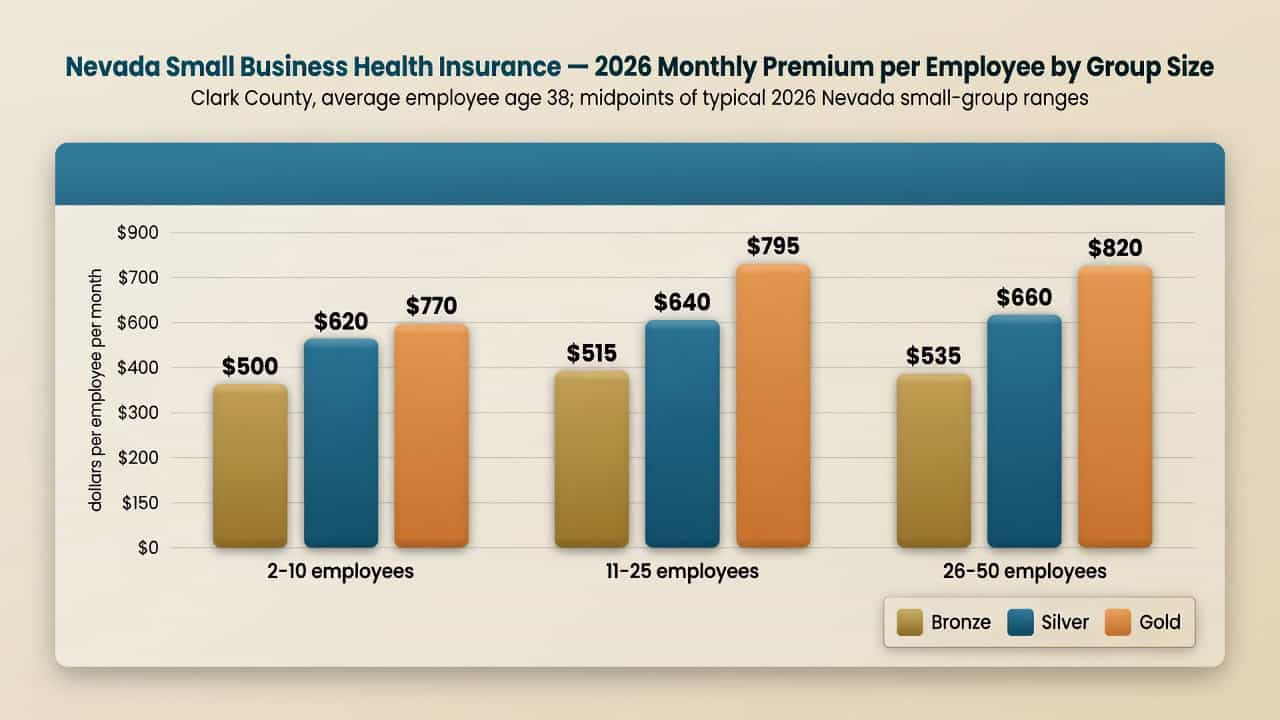
Six factors drive the per-employee premium on Nevada small business health insurance: the average age of the employee group (older groups cost more under ACA rating rules), county distribution (rural Nevada generally costs more than Clark or Washoe), tobacco use rates, plan metal tier (Bronze through Platinum), network depth (HMO narrower than PPO), and any additional rider benefits such as dental, vision, or accident coverage. Family enrollments cost roughly 2.4 to 3.0 times single coverage, depending on age structure.
Employer contribution rules for Nevada small group plans typically require the employer to pay at least 50% of the employee-only premium. Carrier-specific participation rules also require that at least 70% to 75% of eligible employees enroll (or have other qualifying coverage) — preventing the employer from offering a plan that only the highest-utilization employees would buy. These structural rules keep the small group risk pool stable but create a coordination challenge: not enough employees enroll, the plan can’t be issued.
| Group Size | Bronze (per employee/mo) | Silver (per employee/mo) | Gold (per employee/mo) |
|---|---|---|---|
| 2–10 employees | $420–$580 | $520–$720 | $650–$890 |
| 11–25 employees | $430–$600 | $540–$740 | $680–$910 |
| 26–50 employees | $450–$620 | $560–$760 | $710–$930 |
| Family coverage multiplier | 2.4×–3.0× | 2.4×–3.0× | 2.4×–3.0× |
The numbers above reflect typical 2026 Nevada small group ranges for a 38-year-old average employee in Clark County. Actual premiums for any specific group can run materially higher or lower depending on the age curve of the employee population, tobacco use, county distribution, and rider benefits. Nevada small business health insurance quotes are typically valid for 30 to 60 days, and rates can be locked in for the plan year once the group enrolls.
QSEHRA and ICHRA Alternatives to Group Plans
Because Nevada Health Link runs no SHOP marketplace, reimbursement-based HRAs have become a common route for the state’s small employers. Two structures let Nevada small businesses fund employees’ individual coverage instead of buying a group plan: QSEHRAs (Qualified Small Employer HRAs, under 50 FTE) and ICHRAs (Individual Coverage HRAs, no size limit). With either, the employer reimburses employees tax-free for individual premiums and qualified medical expenses, and employees keep their Nevada Health Link plans through job changes.
Employees offered an ICHRA shop the individual market themselves, so it helps to know what does and does not qualify — short-term policies are not ACA-compliant and cannot be reimbursed, as the Nevada short-term health insurance guide explains.
QSEHRA — Qualified Small Employer HRA
For Nevada employers with under 50 FTE who don’t offer a group plan. Reimburses employees tax-free for individual market premiums and qualified medical expenses. 2026 federal maximum reimbursement: $6,150 single, $12,450 family per year.
- Employer must not offer group coverage
- Same terms must apply to all eligible employees
- Reimbursements reduce ACA subsidy eligibility
- Simple to administer; no participation rules
ICHRA — Individual Coverage HRA
For Nevada employers of any size. Reimburses employees tax-free for individual market premiums. Can be offered alongside a traditional group plan to different employee classes (full-time vs part-time, etc.). No federal maximum on reimbursement amount.
- No employer size limit
- Can vary by employee class
- Employees use Nevada Health Link plans
- Counts toward employer mandate for ALEs
Health Reimbursement Arrangement (traditional)
Group-plan-integrated HRA that reimburses qualified medical expenses not covered by the group plan. Used as a benefit enhancer alongside traditional group coverage, particularly to offset high-deductible plan costs.
- Pairs with existing group plan
- Employer-funded; no employee contribution
- Common with HDHP/HSA structures
- Reduces employee out-of-pocket exposure
HSA — Health Savings Account contributions
Employer contributions to employee HSAs alongside an HSA-eligible high-deductible group plan. Triple tax advantage (deductible going in, tax-free growth, tax-free for qualified expenses). 2026 limits: $4,400 single, $8,750 family.
- Requires HSA-eligible HDHP
- Employer contributions are tax-deductible
- Funds belong to employee permanently
- Nevada deducts on state income tax (none for individuals; relevant for MBT)
The decisive question between traditional group plans and ICHRA for Nevada small businesses is administrative simplicity versus customization. Traditional group plans require coordinating one plan across all employees with shared deductibles, networks, and copays — straightforward to administer but constrained for businesses with diverse employee needs. ICHRAs let each employee buy the Nevada Health Link plan that fits their family, doctor relationships, and prescription needs — more administrative work to track reimbursements, but better individual fit for diverse workforces. Many growing Nevada small businesses are migrating from traditional group plans to ICHRA structures as the regulatory framework matures.
Compare Nevada Small Business Plans Across All Carriers
A licensed Nevada agent can pull quotes from every small group carrier, run a side-by-side cost comparison against ICHRA and QSEHRA alternatives, and model all three structures against your actual employee data — at no cost to your business.
The 50-FTE Employer Mandate Threshold
In Nevada’s gaming- and hospitality-driven economy, plenty of employers staff well past 50 workers — and any Nevada business crossing the 50 full-time-equivalent (FTE) threshold becomes an Applicable Large Employer (ALE) under the federal employer mandate. ALEs must offer affordable, minimum-value coverage to at least 95% of full-time employees and their dependents or face penalties. The 2026 affordability threshold is 8.39% of household income for self-only coverage.
Calculating your FTE count is the first step in determining whether your Nevada business is approaching the threshold. Full-time employees (30+ hours per week) count as 1.0 FTE each. Part-time employees count by dividing their total monthly hours by 120. Seasonal employees working fewer than 120 days per year are excluded. The annual FTE count is the average of the 12 monthly FTE numbers. A Nevada business with 45 full-time employees and 12 part-time employees averaging 60 hours per month has about 51 FTE — making it an ALE.
The two penalty types matter to know about in advance. The “A” penalty ($2,970 per full-time employee annually for 2026) applies when an ALE fails to offer coverage to at least 95% of full-time employees and at least one full-time employee receives a marketplace subsidy. The “B” penalty ($4,460 per full-time employee receiving a subsidy for 2026) applies when an ALE offers coverage that is unaffordable or doesn’t meet minimum value. The B penalty caps at the A penalty amount, so the total exposure is bounded by the A calculation.
The 50-FTE crossing year — get planning right
Nevada small businesses approaching 50 FTE benefit from advance planning a full year before crossing the threshold. The IRS look-back period typically uses prior calendar year data to determine ALE status. A business that reaches 51 FTE during 2026 becomes an ALE for 2027, with full mandate obligations starting January 1, 2027. Setting up compliant group coverage or an ICHRA structure during the lead-up year — when you’re not yet legally required — is materially easier and less expensive than scrambling to comply after crossing the threshold.
Nevada Small Business Health Insurance for Under-50 Employers
For the overwhelming majority of Nevada employers — those under 50 FTE — offering health coverage is voluntary, with no federal employer mandate. In Nevada’s tight hospitality and service labor market, small employers offer it mainly for recruitment and retention. The decision usually comes down to cost-of-coverage versus cost-of-talent-loss, and the average Nevada small-group contribution runs roughly 60% to 75% of employee-only premium and 50% to 60% of family premium.
Decide between group plan and ICHRA/QSEHRA
Group plan: best for businesses with similar employee demographics and willingness to manage one plan across the group. ICHRA: best for diverse workforces where employees benefit from picking their own Nevada Health Link plans. QSEHRA: best for very small Nevada businesses (typically under 25 employees) wanting administrative simplicity.
Set the employer contribution level
Carriers typically require minimum 50% employer contribution to employee-only premium. Many Nevada small businesses set 70% to 80% on employee-only and 50% on family. The contribution level affects both employee take-up and the perceived value of the benefit. Total annual cost can be modeled before committing.
Choose carrier and metal tier
Pull quotes from each Nevada small group carrier through a licensed agent. Compare networks against your employees’ existing primary care doctors. Choose Bronze for lowest premium and HSA compatibility, Silver for balance, or Gold for richest benefits. Most Nevada small employers settle on Silver as the standard offering.
Enroll employees and meet participation rules
Carriers typically require 70% to 75% employee participation (counting employees with other qualifying coverage). Run open enrollment within the carrier’s specified window. Collect employee elections, dependent enrollments, and waiver documentation for those declining coverage due to spouse’s plan or other qualifying alternatives.
Annual renewal and compliance check
Nevada small group plans renew annually with new rates effective on the plan anniversary. Compare renewal rates against fresh quotes from competing carriers each year — renewal cost increases of 8% to 15% are typical for 2026 and competing carriers may offer better terms. Track FTE count to anticipate any 50-FTE threshold crossing.
Mid-Size Nevada Employers (11–49 FTE): Approaching the Threshold
Nevada employers in the 11-to-49-FTE band — common among Reno tech firms, Las Vegas professional practices, and Henderson service businesses — occupy a strategic middle zone: large enough for real buying power, small enough to keep flexibility on plan structure. The common pattern is a traditional group plan paired with an HSA or supplementary HRA. These employers should track their FTE trajectory closely, since crossing 50 FTE triggers the federal employer mandate.
The 11-49 FTE range is also where Nevada small businesses typically gain access to better carrier rates. Carriers price small group plans on a sliding scale, and groups of 25+ employees typically qualify for slightly more favorable rates than groups of 5. The negotiation leverage isn’t large in absolute terms, but combined with the option to threaten to switch carriers at renewal, mid-size Nevada employers can realize 5% to 10% savings versus the standard small group rate card.
Level-funded plans become an option starting in this size range. Level-funded plans are technically self-insured but operate similarly to fully insured group plans from the employee perspective — predictable monthly cost, comprehensive coverage, ACA-compliant. The advantage is that healthier-than-average groups can receive a refund of unused claims dollars at year-end. The disadvantage is that worse-than-average claim years can result in a true-up cost. Level-funded structures generally require minimum 10 to 15 employees and are increasingly popular for Nevada employers in the 15-49 FTE range.
The independent KFF Employer Health Benefits Survey publishes annual data on small group plan structures and contribution patterns nationally — useful benchmarks for Nevada small business health insurance decisions. The Nevada Division of Insurance regulates the state’s small group market and publishes carrier-specific filings that inform plan availability. The HealthCare.gov small business employer guide covers the federal rules that apply nationally including in Nevada.
Nevada Modified Business Tax: Health Insurance Deduction
Nevada’s Modified Business Tax (MBT) allows employers to deduct health insurance premiums paid for employees from their MBT liability. This is a Nevada-specific tax benefit not available in states without an MBT. Eligible health insurance premium contributions reduce the employer’s MBT taxable wages, which directly lowers the MBT bill. The benefit applies to all qualifying group health insurance premiums plus HSA and HRA contributions paid by the employer.
The Nevada Modified Business Tax applies to most employers operating in Nevada with quarterly wages above $50,000. The tax rate is 1.378% on financial institutions and 1.475% on most other businesses applied to taxable wages. Health insurance premium contributions are subtracted from the taxable wage base, effectively making each dollar of employer premium contribution worth roughly $0.01 to $0.015 in MBT savings depending on the employer category.
For a Nevada small business with $2 million in annual quarterly wages and $200,000 in employer-paid health insurance premiums, the MBT health insurance deduction reduces the tax bill by roughly $2,950 per year (1.475% × $200,000). This isn’t a major component of the overall economics of offering coverage, but it stacks favorably with the federal corporate income tax deduction for health insurance contributions and reduces the net cost of providing benefits. Confirm the specific MBT treatment of your benefit structure with a Nevada-licensed CPA before committing.
Frequently Asked Questions
Common questions about Nevada small business health insurance cover the SHOP situation, the employer mandate threshold, the difference between group plans and ICHRAs, how QSEHRAs work for very small Nevada employers, and what counts as a full-time equivalent employee. Answers below reflect 2026 federal rules including HR 1 changes and current Nevada-specific guidance.
Why doesn’t Nevada Health Link offer SHOP plans?
Nevada Health Link previously offered SHOP coverage to small employers, but Nevada’s insurance carriers stopped participating in SHOP. The exchange’s official guidance now directs small businesses to enter direct relationships with carriers or work with licensed agents. This is similar to several other states (Washington, Minnesota, New Mexico) that previously offered SHOP and discontinued it. The practical impact for Nevada small business health insurance shoppers: skip the exchange and work directly with carriers or licensed agents for group coverage.
What’s the smallest Nevada business that can buy group health insurance?
Under ACA rules, a Nevada business with at least one W-2 employee (other than the owner, partners, or family members) can qualify for small group health insurance. A solo entrepreneur with no employees other than themselves typically buys individual coverage through Nevada Health Link rather than a group plan. Once the business has even one non-family W-2 employee, the small group market becomes available. A common pattern: a business adds its first employee, the owner moves their personal coverage into the new group plan along with the employee.
What’s the difference between group health insurance and ICHRA in Nevada?
Group health insurance is a single plan the employer purchases that covers all participating employees with shared deductibles, networks, and copays. ICHRA (Individual Coverage HRA) is a reimbursement structure where the employer gives each employee a tax-free monthly stipend to purchase their own Nevada Health Link plan. Group plans are simpler to administer; ICHRAs offer more individual flexibility for diverse workforces. Both meet ACA employer mandate requirements for Applicable Large Employers when structured correctly. Most Nevada small businesses use traditional group plans, but ICHRA adoption is growing rapidly.
How do I count full-time equivalent employees for the 50-FTE threshold?
Full-time employees (30+ hours per week) count as 1.0 FTE each. Part-time employees count by dividing their total monthly hours by 120. Seasonal employees working fewer than 120 days per year are excluded. The annual FTE count is the average of all 12 monthly FTE numbers. A Nevada business with 35 full-time employees and 18 part-time employees averaging 80 hours per month has 35 + (18 × 80 ÷ 120) = 47 FTE — still below the 50 threshold. The IRS provides a worksheet for the calculation in the Form 1095-C instructions.
Can my Nevada small business get the federal Small Business Health Care Tax Credit?
The federal Small Business Health Care Tax Credit historically required SHOP marketplace enrollment to qualify. Because Nevada Health Link no longer offers SHOP plans, most Nevada small businesses cannot access this credit through the traditional path. There are limited circumstances where the credit may still apply, but they’re narrow enough that most Nevadan small business owners should plan around alternative tax structures including the federal corporate income tax deduction for premium contributions and the Nevada Modified Business Tax health insurance deduction. Confirm specific eligibility with a Nevada CPA familiar with current federal SHOP guidance.
What’s the cheapest Nevada small business health insurance option for a 5-employee business?
For a Nevada business with 5 employees, the lowest-cost compliant options typically rank: (1) QSEHRA reimbursement of employees’ individual Nevada Health Link plans — often the lowest total cost when employees qualify for marketplace subsidies, (2) Bronze-tier traditional group plan with HSA contribution — lowest premium with high-deductible structure, (3) ICHRA reimbursement — flexible but more administrative work. Total annual cost depends heavily on employee ages and family enrollments. A licensed Nevada agent can model all three structures against your specific employee data in roughly 30 minutes.
Related Nevada Health Insurance Resources
Explore the rest of the Nevada coverage library — the statewide overview, the Nevada Health Link marketplace, carrier comparisons, and affordability programs.
Complete 2026 overview of coverage options, carriers, and enrollment.
Nevada Health Link MarketplaceEnrollment windows, subsidies, and how to apply through the state exchange.
Best Nevada Health Insurance PlansAll ten 2026 carriers compared on network, cost, and coverage area.
Affordable Nevada CoveragePremium costs by county, subsidy eligibility, and ways to lower your rate.
Get Nevada Small Business Health Insurance Quotes
A licensed Nevada agent can compare quotes across all small group carriers, run an ICHRA versus group plan analysis for your specific employee roster, and confirm your Modified Business Tax deduction — free, with no obligation.
Broker Disclosure
ForHealthInsurance.com is an independent health insurance agency serving Nevada businesses. We are not affiliated with any carrier or government agency. We help you compare plans and enroll in coverage that meets your needs at no extra cost to you.