Nevada Health Insurance Marketplace 2026: Plans, Subsidies, and Enrollment
Finding health insurance in Nevada doesn’t have to be complicated. The Nevada health insurance marketplace — known as Nevada Health Link — is the state’s official enrollment platform, and it’s the only place where Nevadans can use federal tax credits to lower the monthly cost of a plan. New for the 2026 plan year, residents shopping the Nevada health insurance marketplace can also choose state-approved Battle Born State Plans designed to bring premiums down. This guide walks through how the marketplace works, who qualifies for help paying, and how to compare your options before the January 15 enrollment deadline.

What brings you here today?
What Is the Nevada Health Insurance Marketplace?
The Nevada health insurance marketplace is Nevada Health Link, the state-run exchange operated by the Silver State Health Insurance Exchange. For the 2026 plan year, the Nevada health insurance marketplace offers 140 qualified health plans from eight private carriers, and it is the only place Nevada residents can apply federal premium tax credits to lower their monthly costs.
The Nevada health insurance marketplace runs at NevadaHealthLink.com. It is a state-based exchange — meaning Nevada handles its own enrollment platform rather than using HealthCare.gov. The state ran its own marketplace from 2014, switched to HealthCare.gov from 2015 through 2019, then moved back to a state-based platform in 2020. As of 2025, oversight of the Nevada health insurance marketplace moved to the Nevada Health Authority under Senate Bill 494, a state agency created to coordinate health programs and reduce healthcare costs.
The marketplace serves a specific group of Nevadans: people who do not get qualifying health insurance through a job, do not yet qualify for Medicare (age 65+), and earn too much for Medicaid. For everyone in that gap — self-employed Nevadans, gig workers, early retirees, freelancers, and families whose employer plans are unaffordable — Nevada Health Link is the single doorway to subsidized coverage in the state.
Two ways to buy a plan in Nevada
You can buy a private health plan inside the Nevada Health Link marketplace (eligible for subsidies) or outside it (full price, often through a carrier directly or through a licensed agent). Off-exchange plans never qualify for federal tax credits, even if the plan itself is identical. If you might qualify for a subsidy, only an on-exchange plan will give it to you.
Who Offers Nevada Health Link Plans in 2026?
Eight private carriers offer 140 qualified health plans through Nevada Health Link for 2026: SilverSummit Health Plan (Ambetter), Anthem Blue Cross Blue Shield, Health Plan of Nevada, Hometown Health, Imperial Insurance Companies, Molina Healthcare of Nevada, CareSource Nevada (new for 2026), and Select Health. Plan availability varies by county, and carrier choice matters because each one has a different provider network.
CareSource Nevada is the notable addition for the 2026 plan year, expanding marketplace competition. Aetna exited the Nevada marketplace at the end of 2025 — part of Aetna’s nationwide withdrawal from ACA marketplaces — so anyone enrolled in an Aetna plan had to pick a new carrier for 2026. Three of the eight carriers are Anthem affiliates, which means Anthem-network providers in Las Vegas, Reno, and Carson City have multiple plan paths into the same network.
Hometown Health is the local Nevada carrier of note, owned by the Renown Health system in Northern Nevada. Hometown’s network is strongest in Washoe County and surrounding areas — for Reno-area residents who use Renown providers, a Hometown Health plan often produces the lowest in-network out-of-pocket cost. Health Plan of Nevada (HPN), a UnitedHealthcare subsidiary, has the deepest footprint in Clark County and has been Nevada’s oldest HMO since 1982.
| 2026 Nevada Health Link Carrier | Plan Type Focus | Strongest Service Area |
|---|---|---|
| Anthem Blue Cross Blue Shield | HMO, EPO, PPO | Statewide |
| Health Plan of Nevada (HPN) | HMO | Clark County (Las Vegas) |
| Hometown Health | HMO, PPO | Washoe County (Reno) |
| SilverSummit Health Plan (Ambetter) | HMO | Clark and Washoe Counties |
| Molina Healthcare of Nevada | HMO | Clark County |
| Imperial Insurance Companies | HMO | Selected Nevada counties |
| CareSource Nevada (new 2026) | HMO | Clark County initially |
| Select Health | HMO | Rural and Northern Nevada |
Carrier counts and service areas are based on Nevada Division of Insurance rate filings and Nevada Health Link 2026 plan year materials. Coverage in your specific zip code may vary; checking plan availability against your zip is the first step in any Nevada plan search. For the official rate filing record and carrier participation data, see the Nevada Division of Insurance rate filings page.

What Are Battle Born State Plans?
Battle Born State Plans are state-approved health plans available exclusively through Nevada Health Link starting with the 2026 plan year. Authorized by a federal 1332 waiver, they are required to be offered statewide and must meet specific premium reduction targets — making Nevada the third state in the country with a public-option-style program after Colorado and Washington.
The plans cover the same ten essential health benefits as every other marketplace plan: hospitalization, doctor visits, emergency care, lab work, prescription drugs, maternity care, mental health services, preventive care, pediatric services, and rehabilitative services. The difference is structural — Battle Born State Plans are subject to state-set price reduction targets, and carriers offering them have agreed to lower-cost arrangements with providers in exchange for predictable enrollment volume.
For the first open enrollment, just over 10,000 Nevadans selected a Battle Born State Plan — below the state’s initial projection. The slower-than-expected uptake is partly explained by the broader 2026 premium environment: federal enhanced subsidies expired at the end of 2025, raising the visible price of every marketplace plan, which made the BBSP price advantage harder to spot for shoppers comparing on sticker price alone. For people earning above 400% of the federal poverty level (who lost subsidy eligibility in 2026), Battle Born State Plans can produce meaningful savings.
How the price reduction works
Carriers meet the state’s lower-premium requirement primarily by reducing broker commissions and provider payment rates. Federal savings generated by Battle Born State Plans also fund a market-wide reinsurance program — Governor Lombardo’s Market Stabilization Program — which started in 2026 and helps lower premiums for all Nevadans, not just BBSP enrollees. This is the reason unsubsidized rates in Nevada are not rising as steeply as in states without reinsurance.
Who Qualifies for Financial Help in Nevada?
For 2026 coverage, 82% of Nevada Health Link enrollees received premium tax credits averaging $516 per month. After subsidies, the average enrollee paid about $148 per month for a marketplace plan. Subsidies are based on household income and size, and are available only when you enroll on-exchange through Nevada Health Link.
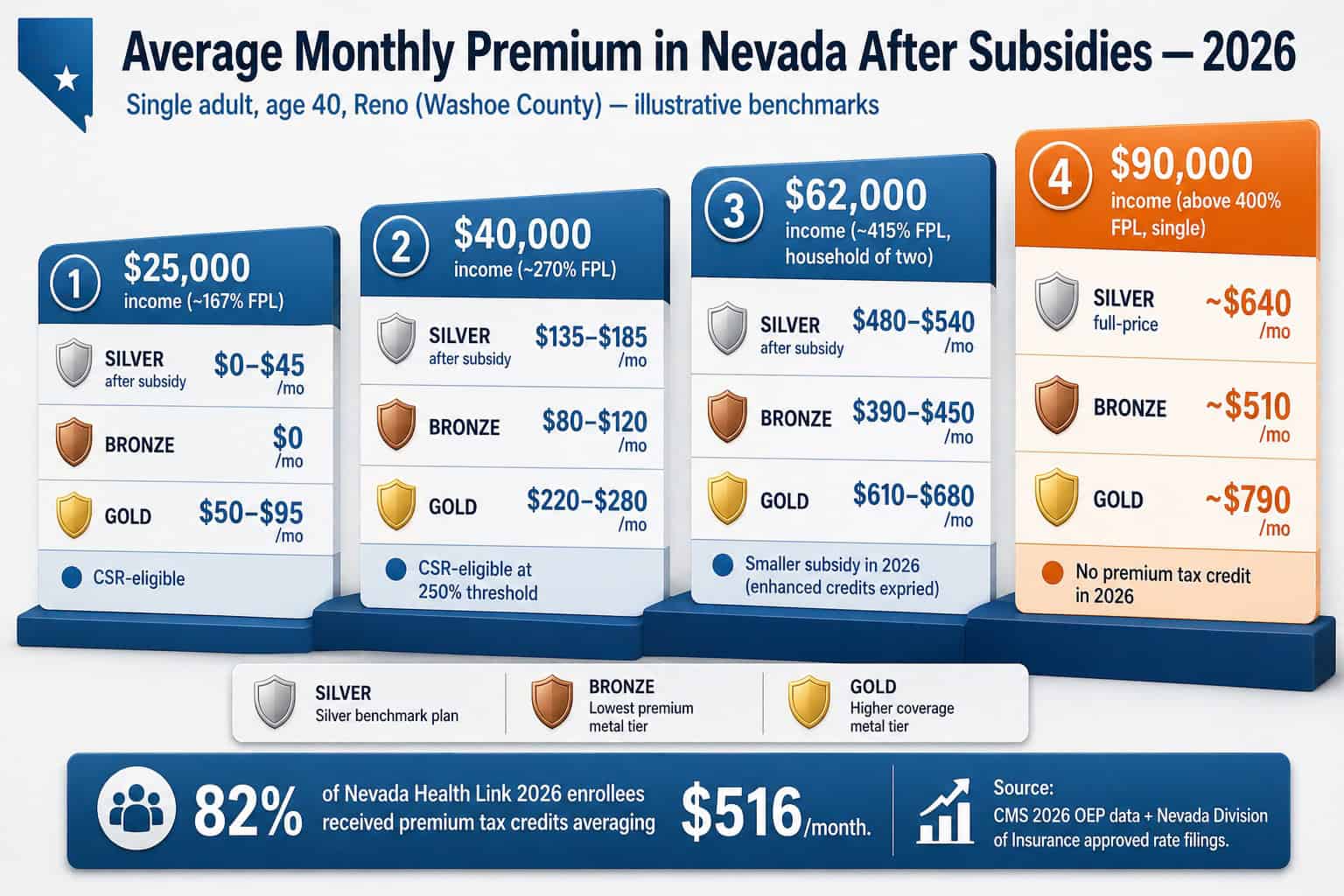
There are two distinct kinds of help. The Advance Premium Tax Credit (APTC) lowers your monthly premium directly — the credit goes to the insurer and you pay the difference. The second is a Cost-Sharing Reduction (CSR), which lowers your deductible, copays, and out-of-pocket maximum, but only if you choose a Silver-level plan. For the 2026 plan year, 46% of Nevada Health Link enrollees received CSR benefits — meaning nearly half of subsidized Nevadans are paying significantly less out of pocket when they actually use their plan, on top of the lower premium.
The federal income brackets are the same nationally, but the dollar amount of your subsidy depends on the second-lowest-cost Silver plan available in your county — which means a Las Vegas resident and a Tonopah resident at the same income can qualify for very different subsidy amounts. The most accurate way to check is to enter your income and zip code directly into the Nevada Health Link prescreener at NevadaHealthLink.com.
2026 subsidies are smaller than 2024–2025
The American Rescue Plan and Inflation Reduction Act enhanced subsidies expired at the end of 2025. For 2026, subsidies returned to the original ACA formula — covering a smaller portion of premiums — and people earning above 400% of the federal poverty level no longer automatically qualify. This is the main reason Nevadans are seeing higher monthly bills in 2026 even when their income hasn’t changed. For details, the KFF analysis of the 2026 subsidy environment walks through the math by income bracket.
Real-world example: Reno couple, age 45, household income $62,000
A married couple in Washoe County earning $62,000 (about 308% of the 2026 federal poverty level for a household of two) would have qualified for a meaningful tax credit under the enhanced subsidies. Under the 2026 rules, they still qualify for an APTC — but a smaller one — and are likely to pay closer to $480–$540 per month combined for a benchmark Silver plan after the credit, depending on which carrier they pick. If they choose a Silver plan and earn under 250% of FPL, they would also pick up cost-sharing reductions; at 308% FPL, they don’t qualify for CSRs but still get the premium tax credit.
How to Enroll in a Nevada Health Link Plan
Enrolling in a Nevada Health Link plan takes four steps: gather income and household information, create an account on NevadaHealthLink.com, compare plans by total cost (premium plus expected out-of-pocket), and submit your application before the January 15 deadline. Free help is available from licensed agents and certified navigators in multiple languages.
Most Nevadans complete enrollment in 30 to 60 minutes once they have their documents ready. The hardest part isn’t the application itself — it’s deciding between similar plans. The Nevada Health Link prescreener shows your subsidy and a side-by-side plan view before you complete the formal application, which lets you see real prices instead of sticker prices.
Gather your information
Social Security numbers (or document numbers for legal residents) for everyone applying, estimated 2026 household income, current employer coverage information if applicable, and your home zip code. Income estimate accuracy matters more than ever — under HR 1, the tax credit cap for income underestimates was eliminated, so an inaccurate estimate can mean a much larger reconciliation bill at tax time.
Run the Nevada Health Link prescreener
At NevadaHealthLink.com, the prescreener tells you your estimated subsidy, eligibility for cost-sharing reductions, and Medicaid eligibility (if any) before you create an account. This step takes about five minutes and gives you the real net premium for plans in your county.
Compare plans by total annual cost
Total annual cost = monthly premium × 12 + your expected use of services + the deductible if you hit it. A Bronze plan with a $0 premium can cost more in a year than a Silver plan at $200 per month if you use a lot of care. Filter by network — verify your doctors are in-network before you commit.
Submit before January 15 (or December 15 for January 1 coverage)
Enrollments completed by December 31, 2025 took effect January 1, 2026. Enrollments submitted between January 1 and January 15, 2026 took effect February 1, 2026. The same timing rule applies for the 2027 open enrollment period beginning November 1, 2026. Don’t autopilot — confirm your plan and net premium each year, especially with the changing subsidy environment.
See Your 2026 Nevada Health Link Options
A licensed Nevada agent can run your subsidy estimate, check Battle Born State Plan and Medicaid eligibility, and compare all 140 plans from the eight 2026 carriers side by side — at no cost to you.
When Is Open Enrollment in Nevada?
Open enrollment for the Nevada health insurance marketplace runs annually from November 1 through January 15. For 2026 coverage, the enrollment window was November 1, 2025 through January 15, 2026. The next open enrollment (for 2027 coverage) opens November 1, 2026 and closes January 15, 2027.
Outside open enrollment, Nevadans can only sign up for an on-exchange plan during a Special Enrollment Period — triggered by a qualifying life event. Without one, the wait is until the next November 1. This is the single most expensive mistake first-time marketplace shoppers make: missing the window and going uninsured for a calendar year while waiting.
| Enrollment Window | Coverage Effective | Notes |
|---|---|---|
| November 1 – December 31 | January 1 of the new year | Standard window — most enrollees pick this |
| January 1 – January 15 | February 1 | Final 15 days of OEP — coverage starts a month later |
| January 16 – October 31 | Only via SEP | Closed window unless you qualify for special enrollment |
For the most current dates and any state-specific enrollment extensions, the HealthCare.gov dates and deadlines page reflects federal rules that Nevada Health Link follows.
What If You Missed Open Enrollment?
Nevadans who missed the January 15 open enrollment deadline may still qualify for a Special Enrollment Period if a qualifying life event happened in the past 60 days. Common qualifying events in Nevada include losing job-based coverage, moving to Nevada from another state, getting married or divorced, having a baby, or aging off a parent’s plan at 26.
Short-term policies are the one option many Nevadans reach for here, and usually the wrong one — they are medically underwritten, exclude pre-existing conditions, and forfeit subsidies entirely. The Nevada short-term health insurance guide compares them honestly against SEP and catastrophic alternatives.
The 60-day window starts on the date of the qualifying event, not the date you find out about the SEP. Wait too long and the window closes — even if the event itself clearly qualifies. Documentation is required: a termination letter from a former employer, a marriage certificate, a birth certificate, or a Nevada driver’s license dated after the move, depending on which event applies.
If no qualifying event applies, three options remain. Medicaid enrollment is open year-round through Nevada’s Medicaid agency for people under 138% of the federal poverty level. Short-term health insurance plans are sold off-exchange and can fill a gap of a few months — though they don’t cover pre-existing conditions or all essential health benefits. Free clinics and community health centers across Nevada offer sliding-scale care for the uninsured.
Moving to Nevada from another state?
Moving to Nevada is its own qualifying life event. New residents have 60 days from the move date to enroll in Nevada Health Link. If you arrived from a state with a different exchange (most states use HealthCare.gov), your old plan does not transfer — you have to start fresh with a Nevada plan. The state’s network of certified enrollment professionals can help with the documentation and timing.
How Do You Compare Nevada Health Link Plans?
All plans on the Nevada health insurance marketplace are organized into four metal tiers — Bronze, Silver, Gold, and Platinum — based on what share of average healthcare costs the plan covers. Comparing plans means weighing four numbers together: monthly premium, deductible (the amount you pay before insurance kicks in), out-of-pocket maximum, and copays for the services you actually use.
Metal tiers describe how costs are split between you and the plan when you use care. Bronze covers about 60% of average healthcare costs and you pay 40%. Silver is roughly 70/30. Gold is 80/20. Platinum is 90/10. A higher metal tier generally means higher monthly premiums but lower costs when you actually go to the doctor or pick up a prescription.
For most Nevadans who qualify for cost-sharing reductions, Silver is the right answer almost automatically — the CSR makes a Silver plan behave like a Gold or Platinum plan for deductibles and copays without a Gold-level premium. For Nevadans who don’t qualify for CSRs and rarely use care, Bronze keeps monthly costs lowest. For Nevadans with chronic conditions or expected major care, Gold or Platinum often produce the lowest total annual cost despite higher monthly premiums.
| Metal Tier | Plan Pays (Avg.) | You Pay (Avg.) | Best For |
|---|---|---|---|
| Bronze | ~60% | ~40% | Healthy, low expected use, no CSR eligibility |
| Silver | ~70% | ~30% | Anyone eligible for CSRs (under 250% FPL) |
| Gold | ~80% | ~20% | Regular care, ongoing prescriptions |
| Platinum | ~90% | ~10% | Chronic conditions, expected major care |
For a deeper walkthrough of how metal tiers and cost-sharing reductions interact, the HealthCare.gov plan categories explainer covers the cost-share math in more detail.
Frequently Asked Questions
Common questions about Nevada Health Link cover enrollment timing, subsidy eligibility, qualifying life events, the difference between on-exchange and off-exchange plans, and how Battle Born State Plans compare to standard marketplace plans. Answers below reflect 2026 plan year rules.
Is Nevada Health Link the same as HealthCare.gov?
No. Nevada Health Link is the Nevada health insurance marketplace — Nevada’s state-based exchange, operated by the Silver State Health Insurance Exchange under the Nevada Health Authority. It uses its own enrollment platform at NevadaHealthLink.com. Nevada used HealthCare.gov from 2015 through 2019, but moved back to a state-based platform in 2020. Subsidy rules are federal and identical to HealthCare.gov, but the website, customer support, and certified assister network are all Nevada-run.
Can I get a Nevada Health Link plan if I don’t qualify for a subsidy?
Yes. Anyone who is a Nevada resident, a U.S. citizen or lawfully present immigrant, and not currently incarcerated can enroll in a Nevada Health Link plan, regardless of income. Subsidies are not required to enroll — they only kick in if your income falls within the eligibility range. People earning above 400% of the federal poverty level no longer qualify for premium tax credits in 2026, but can still buy on-exchange and benefit from Nevada’s reinsurance program lowering full-price premiums.
How much does Nevada Health Link coverage cost on average in 2026?
The average enrollee pays about $148 per month after subsidies, based on 2026 open enrollment data showing 82% of Nevadans receiving premium tax credits averaging $516 per month. Without subsidies, full-price premiums in Nevada rose by an approved average of 22.3% for 2026 (some Division of Insurance reports cite 26%). Costs vary by age, county, plan type, tobacco use, and whether you choose a Battle Born State Plan or a standard marketplace plan.
What’s the difference between Battle Born State Plans and regular marketplace plans?
Battle Born State Plans cover the same ten essential health benefits as every other marketplace plan and use the same metal tier structure. The difference is that Battle Born State Plans are subject to state-set premium reduction targets — carriers offering them have agreed to lower-cost arrangements. They are required to be available statewide, including in rural counties where carrier choice is otherwise limited. They are sold only through Nevada Health Link.
Do I have to enroll through a broker, or can I do it myself?
You can enroll directly at NevadaHealthLink.com on your own. You can also use a certified navigator (free, state-funded), a licensed agent (free to you, paid by the carrier), or call the Nevada Health Link customer support line at 1-800-547-2927. There is no extra cost to use one — commissions are built into the plan pricing whether you use an agent or not — and licensed agents provide ongoing support after enrollment for things like claims questions and SEP changes.
What if I’m self-employed or a gig worker in Nevada?
Self-employed Nevadans, freelancers, and gig workers are some of the largest Nevada Health Link enrollee groups. The marketplace was designed for exactly this group — people without employer-sponsored coverage. Income for subsidy purposes is based on your modified adjusted gross income (MAGI), so estimating self-employment income for the year ahead is the most important pre-application step. Underestimating risks a tax-time reconciliation; overestimating means a smaller monthly subsidy than you should be getting.
Related Nevada Health Insurance Resources
Explore the rest of the Nevada coverage library — the statewide overview, carrier comparisons, affordability programs, and small business options.
Complete 2026 overview of coverage options, carriers, and enrollment.
Best Nevada Health Insurance PlansAll ten 2026 carriers compared on network, cost, and coverage area.
Affordable Nevada CoveragePremium costs by county, subsidy eligibility, and ways to lower your rate.
Nevada Small Business CoverageGroup plans, SHOP options, and employer requirements for 2026.
Get Personal Help With Your Nevada Plan
Choosing among 140 Nevada Health Link plans is easier with help. A licensed Nevada agent will confirm which carriers cover your doctors, calculate your exact subsidy, and complete enrollment before the January 15 deadline — free of charge.
Broker Disclosure
ForHealthInsurance.com is an independent health insurance agency serving Nevada residents. We are not affiliated with any carrier or government agency. We help you compare plans and enroll in coverage that meets your needs at no extra cost to you.