North Carolina Health Insurance Marketplace: 2026 HealthCare.gov Enrollment
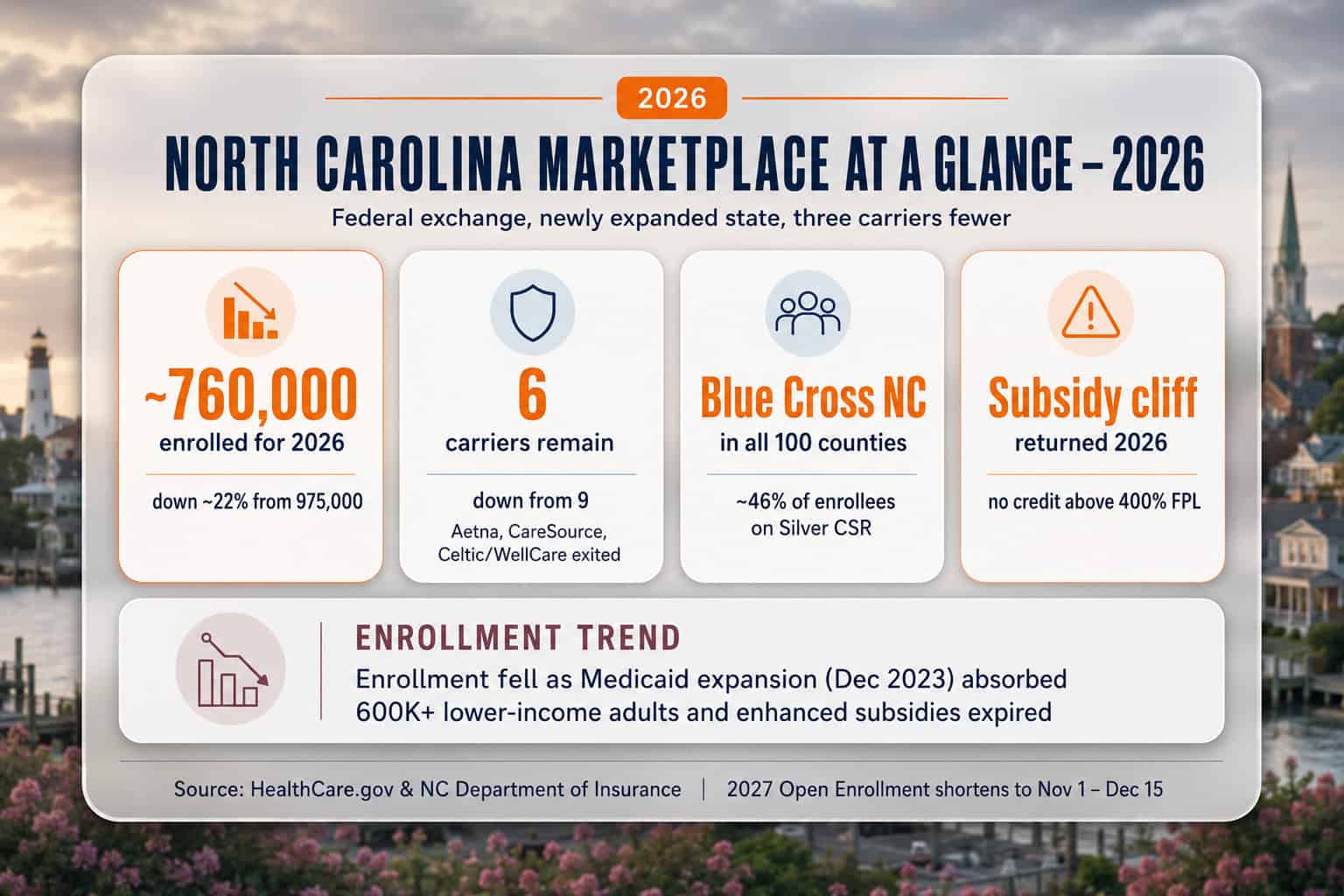
The North Carolina health insurance marketplace runs on HealthCare.gov — the federal exchange where about 760,000 North Carolinians enrolled for 2026, down roughly 22% from 975,000 the prior year. The drop reflects both Medicaid expansion absorbing lower-income enrollees and the expiration of enhanced federal subsidies pushing healthier residents off the exchange. Six carriers remain for 2026 after Aetna, CareSource, and Celtic/WellCare exited — with Blue Cross NC the only insurer available in all 100 counties. Carrier availability ranges from one option in many rural counties to six in parts of Charlotte and the Triangle. This guide walks through how the NC marketplace works, which carriers serve your county, how to enroll step by step, key 2027 dates, and where to get help navigating a market that lost a third of its carriers in one year.

Where are you in the enrollment process?
NC on HealthCare.gov: Federal Exchange, Six Remaining Carriers
The North Carolina health insurance marketplace operates through HealthCare.gov — the federal exchange, since North Carolina has not built a state-based platform. Six carriers offer plans for 2026, down from nine in 2025 after Aetna, CareSource, and Celtic/WellCare exited. Blue Cross and Blue Shield of North Carolina is the only carrier available in all 100 counties. Insurance Commissioner Mike Causey oversees rate approvals and consumer protections through the NC Department of Insurance.
Carrier availability in North Carolina varies more than in most states. Charlotte and the Research Triangle may have five or six carriers competing — with Ambetter, Oscar, UHC, and Cigna all present alongside Blue Cross NC. Asheville has Oscar as a cost-competitive alternative. But many rural counties — particularly across eastern North Carolina and parts of the western mountains — have only Blue Cross NC. The HealthCare.gov window-shopping tool shows exactly which carriers are available in your ZIP code before you create an account. NC Medicaid expansion (effective December 2023) has shifted about 600,000 lower-income North Carolinians from marketplace plans to Medicaid — reducing marketplace enrollment but improving coverage quality for those who qualify. The NC individual plan guide covers who remains in the individual market.
Three Carriers Gone: What Aetna, CareSource & WellCare Enrollees Must Know
Three carriers exited the North Carolina health insurance marketplace for 2026: Aetna CVS Health (leaving ACA exchanges nationwide, previously covering 70 NC counties), CareSource (exiting the NC individual market), and Celtic/WellCare of North Carolina (withdrawing). If you were enrolled with any of these carriers and did not actively select a new plan during Open Enrollment, HealthCare.gov auto-mapped you to a default replacement — which may not cover your doctors, hospitals, or prescriptions.
Auto-mapping is HealthCare.gov’s fallback, not a personalized recommendation. A former Aetna enrollee in Mecklenburg County may have been placed with Blue Cross NC or Ambetter — carriers with fundamentally different provider networks. A CareSource enrollee in eastern NC may have been mapped to the sole remaining carrier, Blue Cross NC, in a network tier that excludes their primary care doctor. If you were auto-mapped, verify your provider network immediately and consider requesting a Special Enrollment Period if a qualifying change occurred. The NC carrier comparison guide details network differences among the six remaining carriers.
Action required for auto-mapped NC enrollees: Call the carrier you were mapped to and confirm your doctors, hospitals, and prescriptions are in-network. If they are not, you may qualify for a Special Enrollment Period to switch plans. A licensed agent can check network compatibility across all carriers available in your county at no cost. Do not assume the auto-mapped plan matches your previous coverage — it often does not.
How to Enroll in NC Marketplace Coverage Step by Step
With three carriers gone for 2026, getting enrollment right matters more than ever in North Carolina. Enrolling in the North Carolina health insurance marketplace takes four HealthCare.gov steps: create an account, enter household and income details, browse plans by carrier and metal tier, and confirm your selection. The NC Navigator Consortium and licensed agents help at no cost — though navigator capacity has been cut by federal funding reductions heading into the shorter 2027 window.
Create or sign in to your HealthCare.gov account
Go to HealthCare.gov and set up an account with your email. Returning NC enrollees must sign in and actively confirm their plan — subsidy amounts recalculate each year based on updated benchmark premiums and income. Even if you keep the same carrier, updating your information ensures accurate credits.
Enter household and income details
Provide names, birthdates, tobacco status, and projected 2026 household MAGI. Use expected 2026 income — not last year’s tax return. HealthCare.gov automatically screens for NC Medicaid eligibility: adults under 138% FPL ($20,782 single) are referred to NC DHHS for Medicaid enrollment instead of marketplace coverage.
Browse plans from carriers available in your county
HealthCare.gov displays only the carriers that serve your ZIP code — anywhere from one (Blue Cross NC in many rural counties) to six in Charlotte or the Triangle. Filter by metal tier (Bronze, Silver, Gold, Platinum) and carrier. Silver plans unlock cost-sharing reductions for enrollees under 250% FPL — about 46% of NC marketplace enrollees received CSR benefits in 2025.
Confirm plan selection and pay the first premium
Select your plan with the premium tax credit applied. Coverage activates once the first premium clears. Verify your doctors are in-network before confirming — phone the carrier directly, as online directories are not always current. Report income changes during the year through HealthCare.gov to keep subsidy amounts accurate.
Key Dates: The 2027 Window Drops to Six Weeks
North Carolina’s loss of three carriers makes the shorter 2027 window especially high-stakes. Open Enrollment for the 2026 North Carolina health insurance marketplace ran November 1, 2025 through January 15, 2026; for 2027, federal rules shorten it to November 1 – December 15, 2026 — six weeks instead of ten. Missing December 15 means no marketplace coverage for 2027 unless a Qualifying Life Event triggers a Special Enrollment Period, though NC Medicaid and NC Health Choice accept applications year-round.
| Enrollment Window | Dates | Coverage Starts |
|---|---|---|
| 2026 Open Enrollment (past) | Nov 1, 2025 – Jan 15, 2026 | Jan 1 or Feb 1, 2026 |
| 2027 Open Enrollment (upcoming) | Nov 1 – Dec 15, 2026 | Jan 1, 2027 |
| Special Enrollment Period | 60 days after QLE | First of next month typically |
| NC Medicaid / NC Health Choice | Year-round | Month of approval |
The compressed 2027 window is especially high-stakes given that NC lost three carriers for 2026. Enrollees who were auto-mapped this year and didn’t verify their plans will face the same risk again if additional carriers adjust their NC footprints. Setting a calendar reminder for November 1, 2026 and beginning carrier comparison in the first week prevents last-minute scrambles. Licensed agents and the NC Navigator Consortium provide free enrollment assistance — contact the NC Department of Insurance consumer line at 855-408-1212 with questions about your coverage options.
Get Help Enrolling in NC Marketplace Coverage
Compare all carriers available in your county, verify your doctors are in-network, and calculate after-subsidy costs. Licensed enrollment assistance serves Charlotte, the Triangle, the Triad, Asheville, Fayetteville, Wilmington, and rural NC at no cost.
How NC Marketplace Subsidies Work After the Enhanced Credit Expiration
Premium tax credits still exist for North Carolina health insurance marketplace enrollees below 400% FPL, but the enhanced subsidies in place since 2021 expired at the end of 2025. The subsidy cliff returned — North Carolinians above 400% FPL receive no tax credit at all. Below 400% FPL, credits cap the benchmark Silver premium as a percentage of income, and about 46% of NC marketplace enrollees received cost-sharing reductions on Silver plans in 2025.
The practical impact is substantial. In 2025, about 70% of NC enrollees paid less than $50/month after subsidies. For 2026, NC marketplace rates rose by a weighted average of about 28%, and with the enhanced credits gone the average net premium enrollees actually pay jumped roughly 85%.
Worked example — Wake County 40-year-old at the subsidy cliff
A 40-year-old in Wake County earning $63,000 — just over the 2026 cliff of $62,600 (400% FPL for a single adult) — pays the full Blue Cross NC Silver premium of about $584/month, roughly $7,000/year with no tax credit. At $62,000, just under the cliff, the same person qualifies for credits that cap the benchmark premium near 8.5% of income — about $440/month. A $1,000 difference in income swings annual cost by roughly $1,700.
Managing MAGI through HSA contributions, traditional IRA contributions, or business-expense timing can keep income below the cliff, and the NC affordable coverage guide details those strategies. Credits reconcile at tax time via IRS Form 8962.
Carrier Availability Across NC: Metro vs Rural Reality
Carrier availability on the North Carolina health insurance marketplace ranges from six options in Charlotte and parts of the Triangle to just one (Blue Cross NC) in many rural eastern and mountain counties. Ambetter covers the most counties after Blue Cross NC and is cheapest in about 41% of the state. Oscar has the lowest 2026 rate increase at +16.9% but serves only select metro areas. Checking your ZIP code on HealthCare.gov is the essential first step.
Charlotte / Mecklenburg County
Up to 6 carriers competing. Oscar cheapest Silver at $575/month. Blue Cross NC, Ambetter, UHC, and Cigna also available. Atrium Health (Advocate Health) is the dominant hospital system — verify which carriers include Atrium in-network.
Raleigh-Durham / Research Triangle
4–6 carriers in most Triangle counties. Blue Cross NC cheapest Silver in Raleigh at $584/month. Ambetter competitive in Durham and Wake. Duke Health, UNC Health, and WakeMed contract with different carriers — network verification is critical.
Greensboro-Winston-Salem / Triad
3–4 carriers typically. Blue Cross NC and Ambetter are the primary options. Cone Health and Novant Health anchor the region — both are in Blue Cross NC networks. Ambetter networks are narrower in the Triad than in Charlotte.
Rural Eastern NC & Mountain Counties
Often Blue Cross NC only. ECU Health (formerly Vidant) serves eastern NC — confirm your Blue Cross NC network tier includes ECU facilities. In western mountain counties, Asheville-area residents may have Oscar as a second option with competitive pricing.
Enrollment Questions From North Carolina Residents
Does North Carolina have its own health insurance exchange?
No. North Carolina uses HealthCare.gov, the federally-facilitated marketplace. All enrollment, subsidies, plan changes, and renewals route through the federal portal. Insurance Commissioner Mike Causey and the NC Department of Insurance oversee rate approvals and consumer protections. Six carriers offer plans for 2026, with Blue Cross NC available in all 100 counties.
Which carriers left North Carolina for 2026?
Three carriers exited: Aetna CVS Health (leaving ACA exchanges nationwide, previously in 70 NC counties), CareSource (exiting the NC individual market), and Celtic/WellCare (withdrawing from NC). If you were enrolled with any of these carriers, HealthCare.gov auto-mapped you to a replacement. Verify your doctors and prescriptions are covered by calling the new carrier directly.
When does 2027 Open Enrollment start and end?
November 1, 2026 through December 15, 2026 — six weeks instead of the ten weeks used for 2026 (which ran through January 15). Plans selected by December 15 take effect January 1, 2027. Missing December 15 means no marketplace coverage for 2027 unless a Qualifying Life Event triggers a Special Enrollment Period. NC Medicaid allows year-round enrollment.
How many carriers are available in my NC county?
It varies from one to six. Charlotte and parts of the Triangle have up to six carriers. Rural eastern NC and many mountain counties have only Blue Cross NC. The HealthCare.gov window-shopping tool shows exactly which carriers serve your ZIP code without requiring an account. A licensed agent can compare all available carriers in your county and verify provider networks.
Did the enhanced subsidies expire for NC?
Yes. Enhanced premium tax credits — in place since 2021 — expired at the end of 2025. The subsidy cliff returned, eliminating help for North Carolinians above 400% FPL. Below 400% FPL, credits still cap premiums as a percentage of income but at less generous levels than 2025. In 2025, about 70% of NC enrollees paid less than $50/month after subsidies. For 2026, NC marketplace rates rose by a weighted average of about 28%, and the average net premium enrollees pay rose roughly 85%.
Can I enroll outside Open Enrollment in North Carolina?
Only with a Qualifying Life Event: job loss, marriage, birth, divorce, moving, aging off a parent’s plan at 26, or loss of other coverage. Each QLE triggers a 60-day Special Enrollment Period. NC Medicaid and NC Health Choice accept applications year-round. People earning at or below 150% FPL may also qualify for a low-income SEP allowing year-round marketplace access.
Related North Carolina Health Insurance Resources
The marketplace is one piece of North Carolina coverage. Compare carriers, costs, and every enrollment path across the state.
The statewide pillar — 2026 carriers, costs, Medicaid expansion, and how coverage works in NC.
Best Health Insurance in NCBlue Cross NC, Ambetter, and Oscar compared on networks, PPO access, and value.
Individual Health Insurance in NCPrivate ACA plans for Triangle, Charlotte, and self-employed North Carolinians.
Affordable Coverage in NCNC Medicaid expansion, subsidies, and the lowest-cost routes to full ACA coverage.
Short-Term Coverage in NCTemporary plans for gaps between jobs — and why subsidized ACA or Medicaid usually wins.
PPO Health Insurance PlansNationwide PPO coverage options for individuals who want broad provider networks.
Start Your NC Marketplace Enrollment
Compare all carriers available in your county, verify provider networks, and calculate after-subsidy costs. Licensed enrollment assistance at no cost — serving Charlotte, the Triangle, the Triad, Asheville, and every NC county.
Broker Disclosure
ForHealthInsurance.com is an independent health insurance agency serving North Carolina residents. We are not affiliated with any carrier or government agency. We help you compare plans and enroll in coverage that meets your needs at no extra cost to you.