Short-Term Health Insurance in North Carolina: 2026 Temporary Coverage
Short-term health insurance in North Carolina provides temporary coverage for residents between jobs, waiting for employer benefits, or bridging a gap outside Open Enrollment. Federal rules allow plans up to 364 days with renewals up to 36 months total. These plans cost less than ACA marketplace coverage but exclude pre-existing conditions, cap benefits, and skip preventive care. Because North Carolina expanded Medicaid in December 2023 and has no coverage gap, many NC residents considering short-term plans actually qualify for either NC Medicaid (adults under 138% FPL, year-round enrollment) or a subsidized marketplace plan through a Special Enrollment Period — making full ACA coverage the better path in most situations. With three carriers exiting the NC marketplace for 2026, confusion about coverage options is running higher than usual.

What’s causing your coverage gap?
Before Short-Term: Check for a Qualifying Life Event
Most North Carolinians considering short-term health insurance in North Carolina actually qualify for a Special Enrollment Period on HealthCare.gov — unlocking a full ACA plan within days. Job loss, moving, marriage, birth, divorce, aging off a parent’s plan at 26, and loss of other coverage all trigger 60-day SEPs. NC Medicaid is available year-round for adults under 138% FPL. A Qualifying Life Event gives access to all carriers in your county with subsidy eligibility.
The most common scenario in 2026: an NC resident whose carrier (Aetna, CareSource, or Celtic/WellCare) exited the marketplace assumes they need short-term health insurance in North Carolina until the next Open Enrollment. In reality, loss of minimum essential coverage — including being auto-mapped to an unaffordable replacement plan — can trigger a Special Enrollment Period. A Charlotte worker whose Aetna plan ended December 31 has 60 days to enroll in Oscar, Ambetter, Blue Cross NC, or any carrier available in Mecklenburg County with premium tax credits applied. The NC marketplace enrollment guide walks through SEP qualification step by step.
When Short-Term Coverage Actually Fits in NC
In North Carolina the short-term niche keeps shrinking — Medicaid expansion absorbed the lower-income gap, and 2026 carrier exits are pushing displaced enrollees into Special Enrollment Periods instead. Short-term health insurance in North Carolina now fits one profile: a healthy resident with no Qualifying Life Event, income above the NC Medicaid line, and a defined 30-to-90-day bridge — say, a Cary tech contractor between employer benefits. Federal rules permit 364 days, but each renewal compounds the exposure.
A realistic NC fit
An RTP or Cary contractor between W-2 roles with a firm start date roughly 60 days out, no chronic conditions, and income above NC’s $20,782 Medicaid line. Or a Wilmington seasonal hospitality worker bridging the off-season who has already used their Special Enrollment Period. The need is purely catastrophic — ER and hospital cover for an unexpected injury, not ongoing care.
Where full ACA wins in NC
Your Aetna, CareSource, or Celtic/WellCare plan ended — which can itself open a 60-day SEP into Oscar, Ambetter, or Blue Cross NC with credits applied. Income lands under 138% FPL (NC Medicaid, year-round) or below 400% FPL for subsidies. You expect preventive care, prescriptions, or maternity, or carry any pre-existing condition. Children can enroll in NC Health Choice year-round regardless.
Even in these cases, weigh short-term health insurance in North Carolina against a subsidized Bronze plan before committing — and remember the protections short-term drops. With the enhanced subsidies gone for 2026, compare the actual after-credit price for your income rather than assuming either option is cheaper.
What Short-Term Plans Don’t Cover in North Carolina
Short-term health insurance in North Carolina is not ACA-compliant. Pre-existing conditions are excluded — carriers deny claims for anything documented before policy start. Benefit caps apply (typically $250,000–$1,000,000 lifetime). Preventive care, maternity, mental health, substance-abuse treatment, and prescription drugs are usually excluded or severely limited. Short-term plans do not count as minimum essential coverage, so they don’t satisfy proof-of-coverage requirements that some employers or visa programs impose.
| Coverage Element | Short-Term Plan | ACA Marketplace Plan |
|---|---|---|
| Pre-existing conditions | Excluded | Fully covered |
| Preventive care | Usually excluded | Free (no cost-sharing) |
| Maternity | Excluded | Covered (essential benefit) |
| Mental health | Excluded or limited | Covered (essential benefit) |
| Prescription drugs | Limited or excluded | Covered |
| Benefit cap | $250K–$1M typical | No annual or lifetime cap |
| Subsidy eligible | No | Yes (below 400% FPL) |
For these reasons, short-term health insurance in North Carolina works only as a true stopgap — never as a year-over-year substitute for ACA coverage.
NC carrier-exit confusion warning: Three carriers left North Carolina’s marketplace for 2026 (Aetna, CareSource, Celtic/WellCare). Some affected enrollees may have been approached by agents selling short-term or “health care sharing ministry” plans as alternatives to ACA coverage. These are not equivalent. Verify any plan through HealthCare.gov and confirm it is ACA-compliant before enrolling. The NC Department of Insurance consumer line (855-408-1212) can answer questions about plan legitimacy.
See What an SEP Unlocks in Your NC County
If your Aetna, CareSource, or Celtic/WellCare plan ended for 2026, a Special Enrollment Period may put Oscar, Ambetter, or Blue Cross NC within reach today — frequently below the price of a short-term plan and with the full ACA protections it skips. A licensed North Carolina enrollment assistant checks your SEP eligibility, the carriers in your county, and your subsidy amount at no cost.
NC’s Expansion Advantage: Check Medicaid Before Short-Term
North Carolina was one of the last states to expand Medicaid, going live December 1, 2023 — and enrollment topped 600,000 in the first year. That timing reshapes the short-term health insurance in North Carolina calculation: adults 19–64 under 138% FPL ($20,782 single, $42,780 for a family of four) can enroll any day of the year through ePASS or 1-888-245-0179 — no Open Enrollment wait, no Qualifying Life Event. Short-term is rarely the right answer here.
What makes the choice decisive in North Carolina specifically is how fast and how deep the rollout ran. On day one, nearly 300,000 residents already receiving Medicaid Family Planning benefits were converted to full coverage automatically, and rural counties such as Edgecombe, Robeson, and Swain now have more than 12% of their adult populations enrolled — exactly the places where a short-term plan’s narrow network and benefit caps would leave people most exposed. The benefits short-term plans most often carve out — maternity, behavioral health, prescriptions, and the preventive screenings that catch problems early — are exactly what NC Medicaid pays in full, with no monthly premium and nothing above a $4 copay. NC Health Choice extends the same coverage to children up to 211% FPL through NC DHHS. No short-term health insurance in North Carolina matches that for a qualifying household, and the NC affordable coverage guide maps every low-cost route.
Cost Reality: Short-Term vs Subsidized NC Marketplace
Short-term plans in North Carolina typically cost $100–$250/month for a 40-year-old — less than the $540 full-price Ambetter Silver. After premium tax credits, subsidy-eligible NC residents still pay less than sticker price, but the enhanced subsidies expired at the end of 2025, so 2026 costs are sharply higher than recent years. A 40-year-old in Durham earning $40,000 now pays about $287/month for a benchmark Silver — more than a short-term plan, but with pre-existing-condition coverage, no benefit cap, and free preventive care that short-term excludes. At lower incomes and on Medicaid the value gap widens further in ACA’s favor.
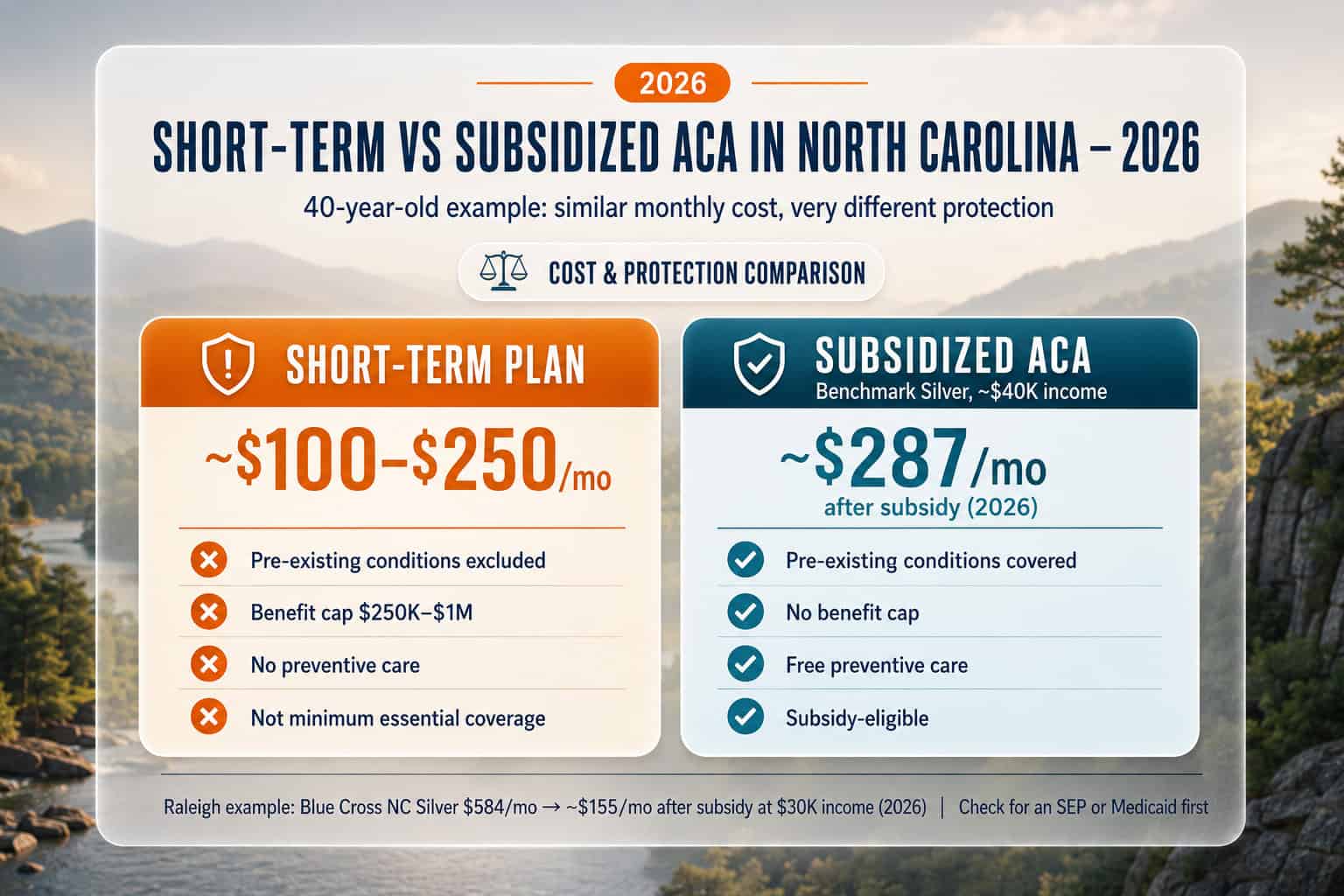
Worked example — Raleigh restaurant manager, $30,000/year
A Raleigh restaurant manager earning $30,000/year who loses employer coverage in April has a 60-day SEP to enroll in a marketplace plan. Blue Cross NC Silver at $584/month drops to about $155/month after subsidies at that income level in 2026 — with Duke Health and UNC Health in-network, free preventive care, cost-sharing reductions on a Silver plan, and no pre-existing-condition exclusions. A short-term plan at $180/month actually costs more here and provides none of those protections.
Since the enhanced subsidies expired, a subsidized plan no longer always undercuts short-term on monthly price — but it delivers far more for the money, and at lower incomes or on NC Medicaid it remains both cheaper and more complete. You can model both paths against your own income using the KFF subsidy calculator before deciding.
Temporary Coverage Questions From NC Residents
Does North Carolina allow short-term health insurance plans?
Yes. North Carolina permits short-term plans under federal rules allowing coverage up to 364 days with renewals to 36 months total. These plans are not ACA-compliant — they can exclude pre-existing conditions, cap benefits, and omit essential health benefits like maternity and mental health. North Carolina has no state individual mandate or penalty for being uninsured.
Is short-term cheaper than ACA marketplace coverage in NC?
Not always. The enhanced premium tax credits expired at the end of 2025, so 2026 marketplace costs are higher than recent years. A subsidy-eligible 40-year-old earning about $40,000 now pays roughly $287/month for a benchmark Silver — often more than a short-term plan, but with pre-existing-condition coverage, no benefit cap, and free preventive care that short-term cannot provide at any price. At lower incomes and on NC Medicaid, ACA coverage is both cheaper and more complete.
Should I check for a Special Enrollment Period first?
Always. Job loss, moving, marriage, birth, divorce, aging off a parent’s plan, loss of other coverage, and carrier exits can all trigger 60-day SEPs on HealthCare.gov. NC Medicaid is available year-round for adults under 138% FPL. NC Health Choice covers children year-round. A QLE unlocks all carriers in your county with subsidy eligibility — making short-term unnecessary in most situations.
What does short-term health insurance exclude in NC?
Pre-existing conditions (claims denied for anything documented before the policy), maternity, mental health and substance-abuse treatment, and many prescription drugs. Benefit caps of $250,000–$1,000,000 are typical. Preventive care is usually not covered. Short-term plans do not count as minimum essential coverage under the ACA.
How does NC Medicaid expansion affect short-term decisions?
NC expanded Medicaid in December 2023 — adults under 138% FPL ($20,782 single) now qualify for comprehensive year-round coverage with no monthly fee and copays capped at $4. More than 600,000 North Carolinians enrolled in the first year. Before choosing short-term, any lower-income NC resident should check Medicaid eligibility first. The coverage gap that existed before December 2023 is now closed.
My carrier left NC — do I need short-term coverage?
Probably not. If your carrier (Aetna, CareSource, or Celtic/WellCare) exited the NC marketplace for 2026, loss of minimum essential coverage can trigger a Special Enrollment Period. You may have 60 days to enroll in a new ACA plan from the remaining six carriers with subsidy eligibility. A licensed agent can determine whether your situation qualifies for an SEP before you buy short-term.
Related North Carolina Health Insurance Resources
Short-term is rarely the best fit in North Carolina. Compare it against the state’s full ACA, Medicaid, and carrier options before you decide.
The statewide pillar — 2026 carriers, costs, Medicaid expansion, and how coverage works in NC.
Best Health Insurance in NCBlue Cross NC, Ambetter, and Oscar compared on networks, PPO access, and value.
Individual Health Insurance in NCPrivate ACA plans for Triangle, Charlotte, and self-employed North Carolinians.
NC Marketplace & HealthCare.govHow to enroll, qualify for an SEP, and claim premium tax credits in North Carolina.
Affordable Coverage in NCNC Medicaid expansion, subsidies, and the lowest-cost routes to full ACA coverage.
PPO Health Insurance PlansNationwide PPO coverage options for individuals who want broad provider networks.
Don’t Settle for Less Coverage Than NC Offers
Before buying short-term, check whether a QLE, NC Medicaid, or NC Health Choice gives access to full ACA coverage from North Carolina’s marketplace carriers. Licensed enrollment assistance at no cost.
Broker Disclosure
ForHealthInsurance.com is an independent health insurance agency serving North Carolina residents. We are not affiliated with any carrier or government agency. We help you compare plans and enroll in coverage that meets your needs at no extra cost to you.