Individual Health Insurance in North Carolina: 2026 Private Plans
Individual health insurance in North Carolina covers the roughly 760,000 residents who buy their own coverage through HealthCare.gov plus those purchasing off-exchange private plans — tech consultants and biotech founders in the Research Triangle, finance professionals between firms in Charlotte, freelancers across the Triad, Asheville’s tourism and creative workforce, early retirees bridging to Medicare, and anyone between employer-sponsored jobs. North Carolina’s Medicaid expansion in December 2023 shifted 600,000+ lower-income adults to Medicaid, concentrating the individual marketplace among middle-income and higher-income buyers who depend on carrier choice and subsidy eligibility. Six carriers serve the exchange for 2026 — but carrier availability varies dramatically by county, from six options in Charlotte to one (Blue Cross NC) in much of rural eastern North Carolina. This guide covers who buys individual and private health insurance in North Carolina, how to navigate the county-level carrier map, self-employed tax strategies, and metal-tier selection.

What’s your individual coverage situation?
Self-employed or freelance
Triangle consultant, Charlotte independent, Asheville creative
See self-employed options ↓Who Buys Individual Plans in the Tar Heel State
Individual health insurance in North Carolina covers residents without employer-sponsored benefits — the roughly 760,000 marketplace enrollees for 2026 plus off-exchange purchasers. The Research Triangle drives a large self-employed segment: biotech consultants, startup founders, and Duke/UNC-affiliated researchers. Charlotte’s finance sector generates between-jobs buyers and early retirees, and Asheville’s tourism and creative economy adds seasonal and freelance demand. NC Medicaid expansion shifted 600,000+ lower-income adults off the exchange.
North Carolina’s individual market has contracted sharply — from a record 1,027,930 enrollees in 2024 to about 760,000 for 2026, a 26% decline driven by Medicaid expansion absorbing lower-income enrollees and enhanced-subsidy expiration pushing healthier residents off the exchange. The remaining marketplace population is older and sicker on average, which partly explains the 28% weighted average rate increase. Individual plans purchased through HealthCare.gov are ACA-compliant: pre-existing conditions are covered, all 10 essential health benefits are included, and no benefit caps apply. Off-exchange private health insurance in North Carolina from Blue Cross NC and UnitedHealthcare offers PPO access without subsidy eligibility.
Your County Determines Your Carrier Options
Individual health insurance in North Carolina varies by county more than almost any state. Charlotte has up to six carriers, the Triangle has four to six, the Triad has three or four, and rural eastern NC and many mountain counties have Blue Cross NC as the sole option. This geographic reality means the best individual health insurance in North Carolina depends first on where you live, then on your doctors, then on premium and subsidy math.
| Region | Carriers Available | Cheapest Silver (40yo) | Key Health Systems |
|---|---|---|---|
| Charlotte / Mecklenburg | Up to 6 | Oscar $575/mo | Atrium Health (Advocate Health) |
| Raleigh-Durham / Triangle | 4–6 | Blue Cross NC $584/mo | Duke Health, UNC Health, WakeMed |
| Greensboro / Triad | 3–4 | Ambetter or Blue Cross NC | Cone Health, Novant Health |
| Asheville / Mountains | 2–3 | Oscar competitive | Mission Health (HCA) |
| Eastern NC / Rural | 1 (Blue Cross NC only) | Blue Cross NC only | ECU Health (formerly Vidant) |
Triangle Consultants, Charlotte Independents & Asheville Creatives
Self-employed North Carolinians are the largest individual health insurance in North Carolina buyer segment. The Research Triangle Park ecosystem generates biotech consultants, SaaS founders, and university-affiliated researchers who buy their own coverage, while Charlotte’s banking and finance corridor produces independent advisors and between-firms professionals. The self-employed health insurance deduction lets sole proprietors deduct 100% of premiums as an adjustment to gross income — stacking with marketplace credits.
The premium tax credit and self-employed deduction interact through an iterative IRS calculation in IRS Publication 974. For many NC self-employed filers, effective premium costs after all tax benefits run 25–40% lower than sticker price. A Durham biotech consultant earning $85,000 might pay $440/month after subsidy for a Blue Cross NC Blue Home Silver and deduct the $5,280 annual premium — saving an additional $1,267 in federal taxes at the 24% bracket.
Example: Charlotte Freelance Financial Analyst, Age 38, $68,000 Income
A self-employed financial analyst in Charlotte earning $68,000/year (about 109% of the 2026 cliff, roughly 434% FPL) sits above the subsidy cliff after enhanced credits expired. Without subsidies, Oscar Silver runs $575/month ($6,900/year). The self-employed deduction saves about $1,656 at the 24% bracket, bringing effective cost to $5,244/year. If the analyst reduces MAGI below the $62,600 cliff through an HSA contribution ($4,400) and a traditional IRA ($7,500) — bringing MAGI to about $56,100 — marketplace subsidies unlock, potentially cutting net premium to about $350/month plus the deduction benefit.
Asheville and mountain NC freelancers: Asheville’s tourism, craft, and creative economy generates significant individual-market demand. Oscar offers competitive pricing in the Asheville area with the lowest statewide rate increase (+16.9%). For seasonal workers whose income swings between tourism peaks and off-season lulls, projecting annual MAGI conservatively protects against subsidy clawback. Mission Health (HCA Healthcare) is the dominant Asheville-area hospital system — verify its network status with your carrier.
Compare NC Individual Plans for Your County
See individual plans from all carriers available in your area — Blue Cross NC, Ambetter, Oscar, UHC, Cigna, and AmeriHealth. Subsidy calculations and self-employed deduction modeling from a licensed enrollment assistant at no cost.
Pre-Medicare Coverage for NC Early Retirees
North Carolina early retirees between 55 and 64 face the highest individual premiums by age — a 60-year-old pays about 3x a 21-year-old — but benefit most from premium tax credits when they manage retirement income strategically. The subsidy cliff at 400% FPL ($62,600 for a single adult in 2026) means a Raleigh retiree keeping MAGI at $62,000 qualifies for substantial credits, while one at $63,000 may pay full price. Blue Cross NC Blue Home provides the broadest access for retirees needing Duke or UNC specialists.
Retirees from North Carolina’s banking, pharmaceutical, and university sectors often have complex income from pensions, investment accounts, and consulting. The key is managing which income counts as MAGI — Roth IRA distributions do not, while traditional IRA withdrawals do. A 62-year-old Charlotte bank retiree drawing $4,000/month from a pension plus $2,000/month from investments needs the full $72,000 counted as MAGI — well above the cliff. Shifting income to Roth conversions in lower-income years before retirement creates a MAGI-free withdrawal source during the marketplace years. The NC affordable coverage guide covers income-optimization strategies for pre-Medicare North Carolinians.
On-Exchange vs Off-Exchange: When HealthCare.gov Isn’t the Only Path
Most North Carolinians buying individual health insurance in North Carolina should start with HealthCare.gov because premium tax credits are only available on-exchange. But for higher-income residents above 400% FPL who receive no subsidy, off-exchange private health insurance in North Carolina from Blue Cross NC and UnitedHealthcare may offer broader PPO networks or different plan designs not available through the marketplace. Off-exchange plans are ACA-compliant but do not qualify for credits or cost-sharing reductions.
The off-exchange path makes sense in a narrow scenario: a healthy 40-year-old Durham tech executive earning $150,000 receives no marketplace subsidy. Blue Cross NC’s off-exchange PPO may offer a network configuration or deductible structure not available on HealthCare.gov — sometimes at a comparable premium. UnitedHealthcare also offers off-exchange individual plans in select NC areas. Rate filings for both on-exchange and off-exchange plans are reviewed by the NC Department of Insurance. For anyone below 400% FPL, on-exchange is almost always the better deal because credits reduce net costs substantially. The NC carrier comparison details Blue Cross NC’s on-exchange versus off-exchange product differences.
Choosing the Right Metal Tier for Your NC Plan
North Carolina marketplace plans come in five tiers: Catastrophic (under 30 or hardship), Bronze (lowest premium), Silver (CSR-eligible under 250% FPL), Gold (lowest deductibles), and Platinum (limited availability). For subsidized NC residents under 250% FPL, Silver with cost-sharing reductions is the clear winner — deductibles can drop from $5,000+ to under $1,000 at no additional premium. About 46% of NC marketplace enrollees received CSR benefits in 2025.
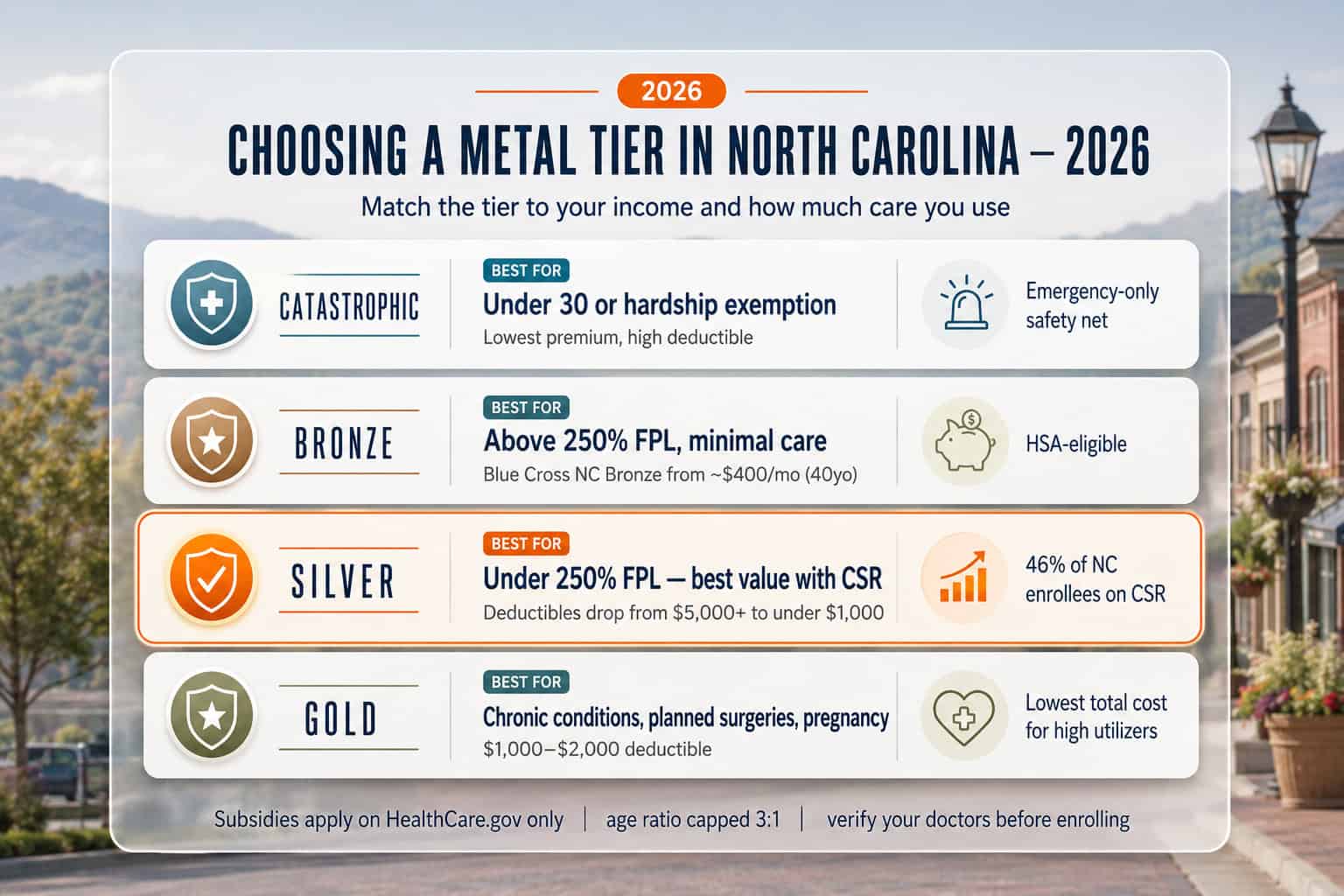
Above 250% FPL with minimal healthcare needs, Bronze plans minimize monthly spend — Blue Cross NC Bronze starts at about $400/month for a 40-year-old. Gold makes sense for NC residents with chronic conditions, planned surgeries, or pregnancies: Ambetter and Blue Cross NC Gold plans with $1,000–$2,000 deductibles can save thousands in out-of-pocket costs when utilization is high. Bronze plans are now eligible for HSA contributions, making them effective for healthy savers who want tax-advantaged medical savings alongside catastrophic protection. The NC market overview shows tier-by-tier and age-based pricing across the state.
Individual Coverage Questions From North Carolinians
Who typically buys individual health insurance in North Carolina?
Self-employed professionals (Research Triangle biotech consultants, Charlotte financial advisors, Asheville creatives), startup founders, freelancers, early retirees under 65, seasonal tourism workers, part-time employees without benefits, and adult children aging off a parent’s plan at 26. NC Medicaid expansion shifted 600,000+ lower-income adults to Medicaid, concentrating the marketplace among middle-income and higher-income buyers.
Can self-employed North Carolinians deduct individual plan premiums?
Yes. The self-employed health insurance deduction allows sole proprietors, LLC members, S-corp shareholders (2%+), and partners to deduct 100% of premiums as an adjustment to gross income. This stacks with marketplace premium tax credits through an iterative IRS calculation in Publication 974. Effective costs after all tax benefits typically run 25–40% lower than sticker price for NC self-employed filers.
Should I buy on-exchange or off-exchange in North Carolina?
Start on-exchange (HealthCare.gov) because premium tax credits are only available there. Off-exchange plans from Blue Cross NC and UnitedHealthcare may offer different PPO network configurations, but at the same or higher price without subsidies. Off-exchange makes sense only for higher-income NC residents above 400% FPL who receive no marketplace subsidy and want a specific network or plan design not available on HealthCare.gov.
Why does carrier availability vary so much across NC?
North Carolina’s 100 counties span dense metros (Charlotte, the Triangle) with 4–6 carriers down to rural eastern and mountain counties where Blue Cross NC is the only option. Carrier participation depends on enrollment density and profitability — larger metro markets attract more carriers, while Blue Cross NC maintains statewide presence as a not-for-profit insurer. Always check your ZIP code on HealthCare.gov before comparing plans.
Which metal tier should I choose for my NC individual plan?
Under 250% FPL: Silver with cost-sharing reductions (deductibles drop dramatically at no extra cost). Above 250% FPL with minimal care: Bronze (lowest premium, HSA-eligible). Frequent care or chronic conditions: Gold (lowest deductibles, best total-cost value for high utilizers). About 46% of NC marketplace enrollees chose Silver with CSR in 2025.
How did Medicaid expansion affect the NC individual market?
NC Medicaid expansion (December 2023) shifted 600,000+ lower-income adults from marketplace plans to Medicaid. Marketplace enrollment fell from a record 1,027,930 in 2024 to about 760,000 for 2026. The remaining marketplace population skews older and higher-income, which partially drove the 28% average rate increase. Expansion eliminated the coverage gap — adults under 138% FPL now qualify for Medicaid instead of going uninsured.
Related North Carolina Health Insurance Resources
Individual coverage connects to every other North Carolina pathway. Compare carriers, costs, and enrollment routes across the state.
The statewide pillar — 2026 carriers, costs, Medicaid expansion, and how coverage works in NC.
Best Health Insurance in NCBlue Cross NC, Ambetter, and Oscar compared on networks, PPO access, and value.
NC Marketplace & HealthCare.govHow to enroll, qualify for subsidies, and claim premium tax credits in North Carolina.
Affordable Coverage in NCNC Medicaid expansion, subsidies, and the lowest-cost routes to full ACA coverage.
Short-Term Coverage in NCTemporary plans for gaps between jobs — and why subsidized ACA or Medicaid usually wins.
PPO Health Insurance PlansNationwide PPO coverage options for individuals who want broad provider networks.
Find Your 2026 NC Individual Plan
Compare individual plans from all carriers in your county. Subsidy calculations, self-employed deduction modeling, and network verification for Duke, UNC, Atrium, and Novant — all at no cost.
Broker Disclosure
ForHealthInsurance.com is an independent health insurance agency serving North Carolina residents. We are not affiliated with any carrier or government agency. We help you compare plans and enroll in coverage that meets your needs at no extra cost to you.