Small Business Health Insurance in California: A Complete Guide for 2026
Small business health insurance in California is available through the open group market, the Covered California for Small Business (SHOP) marketplace, and alternative arrangements like ICHRA and QSEHRA. California businesses with 1 to 100 employees seeking small business health insurance California fall into the small group market, where carriers must offer coverage regardless of employee health status and cannot charge different premiums based on medical history. With 11 carriers and both HMO and PPO options available, small business health insurance California employers offer ranges from Bronze coverage to group PPO plans that help attract and retain employees.

Small Business Health Insurance Options in California
California small business owners have several pathways to provide small business health insurance California employees can benefit from. The right option depends on the number of employees, budget, how much control the employer wants over plan selection, and whether the business qualifies for tax credits.
Covered California for Small Business (SHOP)
Businesses: 1–100 employees
The state SHOP marketplace allows employers to offer employees a choice of plans from participating carriers within a selected metal tier. Businesses with fewer than 25 employees may qualify for the Small Business Health Care Tax Credit. Three carriers participate in the 2026 SHOP marketplace, offering HMO and some PPO options.
Open Group Market (Off-SHOP)
Businesses: 1–100 employees
Employers can purchase group plans directly from carriers outside the SHOP marketplace. The open market offers access to all carriers operating in the small group segment, including group PPO plans from Blue Shield and Anthem, with more plan design flexibility than SHOP. No tax credit eligibility through this pathway.
ICHRA (Individual Coverage HRA)
Any business size
Instead of selecting a group plan, employers fund a defined-contribution health reimbursement arrangement. Employees use the funds to purchase their own individual ACA-compliant plan on Covered California or off-exchange. ICHRA gives employees plan choice while giving employers predictable monthly costs.
QSEHRA (Qualified Small Employer HRA)
Businesses: Fewer than 50 employees
A simpler alternative to ICHRA for businesses that do not offer a group plan. Employers set a monthly reimbursement allowance (up to $6,150/individual or $12,450/family for 2026) that employees use toward individual health insurance premiums and qualified medical expenses.
Group Plan Types: HMO vs. PPO for California Businesses
The choice between HMO and PPO group plans is one of the most important decisions for small business health insurance California employers make. Plan structure affects employee satisfaction, provider access, and total costs. In California’s competitive job market, offering a PPO option can be a meaningful recruitment and retention advantage.
| Feature | Group HMO | Group PPO |
|---|---|---|
| Specialist referrals required? | Yes | No |
| Out-of-network coverage? | No (except emergencies) | Yes (at higher cost share) |
| Employee provider flexibility | Limited to network | Any provider (in-network preferred) |
| Monthly employer cost (typical per employee) | $450–$650 | $550–$800 |
| CA carriers offering group plans | Kaiser, Blue Shield, Anthem, Health Net, others | Blue Shield, Anthem |
| Employee retention impact | Standard benefit | Premium benefit — competitive advantage |
Blue Shield of California and Anthem Blue Cross are the primary carriers offering group PPO plans in the California small group market. Kaiser Permanente’s integrated HMO model remains the most popular group plan choice by enrollment volume due to lower premiums and coordinated care, but does not offer a PPO option. For a deeper comparison of PPO plan structures, the California PPO health insurance covers both individual and group PPO options from these carriers.
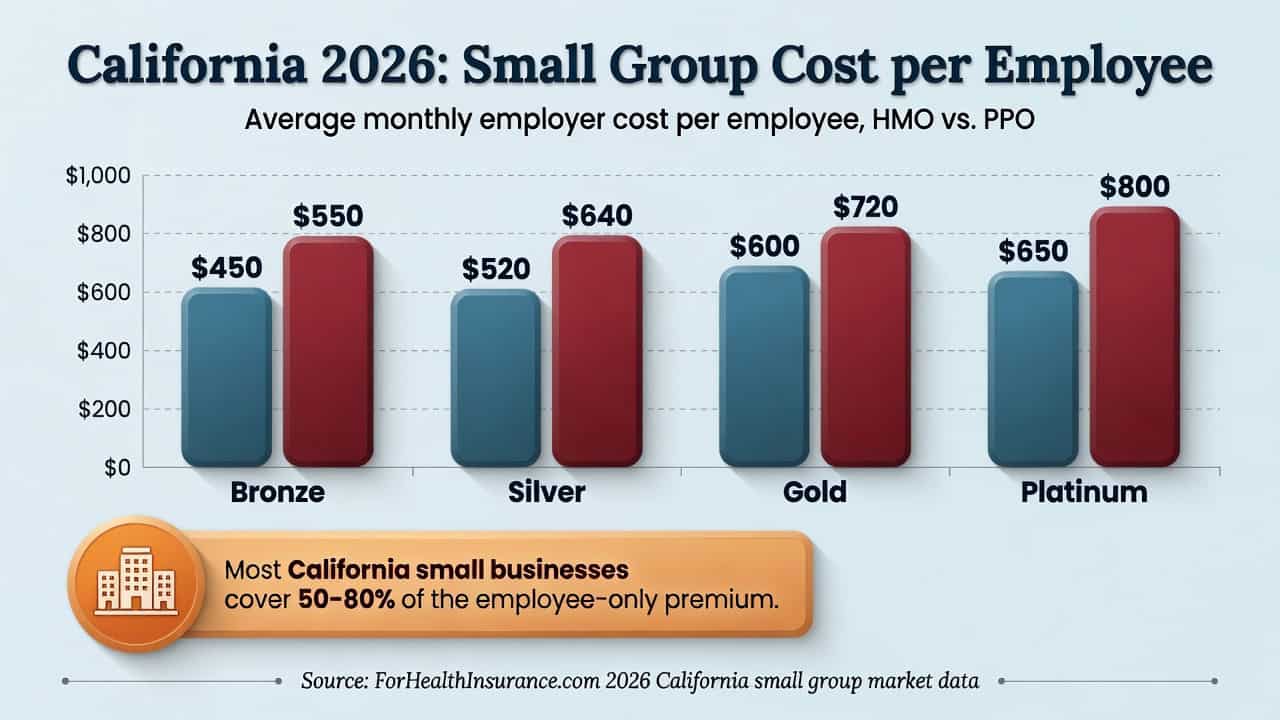
Small Business Health Insurance Costs in California
Group health insurance costs for small business health insurance California employers purchase vary by the plan type, metal tier, employee ages, business location (rating region), and how much the employer contributes toward premiums. California requires small group carriers to use community rating with limited age adjustment, meaning costs are more predictable than in some other states.
Average Employer Costs
Per employee per month (2026)
HMO plans typically range from $450 to $650 per employee depending on metal tier and carrier. PPO plans run $550 to $800. Most California small businesses contribute 50%–80% of the employee-only premium, with employees covering the remainder and any dependent costs through payroll deduction.
Minimum Contribution Requirements
California small group market
Most carriers require employers to contribute at least 50% of the employee-only premium for the selected plan. Some carriers set higher minimums for certain plan tiers. Participation requirements typically mandate that at least 70% of eligible employees enroll in the plan to activate the group policy.
Tax Deductions for Employers
Federal tax benefit
Employer contributions to employee health insurance premiums are tax-deductible as a business expense on federal returns, reducing taxable business income. This applies to all group plan types and to employer contributions toward ICHRA and QSEHRA reimbursements. Premiums are also exempt from payroll taxes.
Small Business Health Care Tax Credit
SHOP marketplace only
Businesses with fewer than 25 full-time equivalent employees, average wages below $58,000, and that pay at least 50% of employee premiums through SHOP may qualify for a tax credit worth up to 50% of the employer’s premium contribution. The IRS Small Business Health Care Tax Credit page details eligibility and calculation requirements.
For cost comparisons and strategies to keep premiums affordable, the affordable health insurance California guide covers pricing by metal tier, age bracket, and income level across the individual and small group markets.
California Employer Mandate and Requirements
California does not have a state-level employer health insurance mandate, but federal rules under the Affordable Care Act require businesses with 50 or more full-time equivalent (FTE) employees to offer qualifying coverage or face a penalty. Small businesses with fewer than 50 FTE employees are not required to offer health insurance under federal or state law, though many do to attract talent in California’s competitive labor market.
| Business Size | Federal Mandate? | Coverage Requirement | Penalty for Non-Compliance |
|---|---|---|---|
| 1–49 FTE employees | No | Voluntary | None |
| 50+ FTE employees | Yes (ACA employer mandate) | Must offer affordable coverage to 95% of full-time employees | $2,900 per FTE (minus first 30) if no coverage offered; $4,350 per employee receiving exchange subsidy if coverage is unaffordable |
The HealthCare.gov small business guide explains federal requirements in detail. For businesses near the 50-employee threshold, employee classification (full-time vs. part-time) and FTE calculation methodology affect mandate applicability; a licensed California agent can help determine exact compliance requirements.
ACA Affordability Standard
For businesses subject to the employer mandate, coverage is considered “affordable” if the employee’s share of the lowest-cost self-only plan does not exceed 9.02% of household income for 2026. Employers typically use the federal poverty line safe harbor or W-2 safe harbor to determine affordability without requiring employees to disclose household income.
ICHRA and QSEHRA: Alternative Approaches
Small business health insurance California employers can provide does not have to follow the traditional group plan model. Individual Coverage Health Reimbursement Arrangements (ICHRA) and Qualified Small Employer Health Reimbursement Arrangements (QSEHRA) allow employers to fund employee health insurance without selecting and administering a group plan.
Under ICHRA, the employer sets a monthly reimbursement per employee class. Employees buy their own ACA-compliant plan on Covered California or off-exchange and submit receipts. Employer contributions are tax-deductible; employee reimbursements are tax-free. ICHRA has no size limit or cap on reimbursement amounts.
QSEHRA is for businesses under 50 employees with no group plan. The 2026 limits are $6,150/year (self-only) and $12,450/year (family). Contributions are tax-deductible and reimbursements are generally tax-free. The U.S. Department of Labor provides regulatory guidance on HRA setup and compliance requirements.
ICHRA vs. Group Plan — When Each Makes Sense
ICHRA works well for businesses that want cost predictability (fixed monthly contribution) and employee choice, or those with employees spread across multiple California rating regions where a single group plan may not serve everyone well. Traditional group plans are typically better for businesses that want to standardize benefits, negotiate group rates with a specific carrier, or offer PPO coverage as a competitive employee benefit.
How to Set Up Small Business Health Insurance in California
Setting up small business health insurance California employers offer for the first time involves choosing a plan structure, selecting carriers and plans, meeting contribution and participation requirements, and completing enrollment. The process typically takes two to four weeks with licensed enrollment assistance.
Choose a Plan Structure
Decide between a traditional group plan (SHOP or open market), ICHRA, or QSEHRA based on business size, budget, and how much plan choice employees should have. Businesses under 25 employees should evaluate the SHOP tax credit eligibility.
Compare Carriers and Plans
A licensed California agent can present group plan options from all available carriers, including PPO plans from Blue Shield and Anthem and HMO options from Kaiser and Health Net, with side-by-side cost and benefit comparisons at no cost to the business.
Determine Contribution Level
Set the employer contribution percentage (minimum 50% of employee-only premium for most carriers). Decide whether to contribute toward dependent coverage. Factor in payroll tax savings and business expense deductions when calculating net cost.
Enroll and Administer
Complete carrier applications, collect employee enrollment forms, and set up payroll deductions. The agent manages paperwork and serves as the ongoing point of contact for plan questions, renewals, and employee coverage changes throughout the year.
Real-World Example: 12-Employee Marketing Agency in Los Angeles
A 12-employee Los Angeles marketing agency sought enrollment assistance to compare SHOP and open-market options. SHOP was ruled out (average salary exceeded $58,000). The licensed agent recommended a dual-plan offering: Kaiser Gold HMO at $580/employee/month and Blue Shield Gold PPO at $720. The employer contributes 70% of the HMO rate for all employees; PPO-preferring employees cover the difference. Eight chose HMO, four chose PPO. Total annual employer cost: $58,464 — fully deductible.
Compare Small Business Group Plans in California
Compare small business group plan options across every California carrier, HMO and PPO, at no cost to your company. A licensed agent can present pricing built around your specific business size, rating region, and employee demographics.
Frequently Asked Questions About Small Business Health Insurance in California
The following questions address the most common concerns about small business health insurance California owners face, including group coverage, tax credits, employer mandate rules, ICHRA alternatives, and the process of setting up health insurance for employees.
Is small business health insurance required in California?
California has no state employer mandate. Federal ACA rules require coverage only for businesses with 50 or more FTEs. Smaller employers offer it voluntarily — typically to compete for talent in California’s tight labor market.
What is the Small Business Health Care Tax Credit?
Businesses with fewer than 25 full-time equivalent employees, average annual wages below $58,000, and that pay at least 50% of employee premiums through the SHOP marketplace may qualify for a federal tax credit worth up to 50% of the employer’s premium contribution. The credit is available for two consecutive tax years and requires enrollment through Covered California for Small Business.
How much does small business health insurance cost in California?
Group HMO plans run $450 to $650 per employee per month; PPO plans range from $550 to $800. Most employers contribute 50% to 80% of employee-only premiums. Contributions are tax-deductible and exempt from payroll taxes.
What is the difference between ICHRA and a traditional group plan?
A group plan has the employer selecting a single carrier and plan. ICHRA gives employees a monthly reimbursement to buy their own individual plan, giving employers cost predictability. Group plans allow standardized benefits and access to group PPO rates from Blue Shield and Anthem.
Can a small business offer PPO plans to employees in California?
Yes. Blue Shield and Anthem offer group PPO plans in California’s small group market. PPOs allow specialist access without referrals and out-of-network coverage — a meaningful recruitment advantage over HMO-only competitors.
Can a broker help set up small business health insurance at no cost?
Yes. Licensed agents are compensated by carriers, not employers. An agent can compare group plans across all carriers, evaluate SHOP tax credit eligibility, assist with ICHRA and QSEHRA setup, and manage enrollment — at no cost to the business. See the best health insurance in California guide for carrier comparisons.
Related California Health Insurance Resources
Explore the rest of the California coverage library for carrier comparisons, cost breakdowns, and free help enrolling in a 2026 plan.
Complete 2026 guide to coverage options, enrollment, and subsidies.
Best Health Insurance in CaliforniaCarrier comparisons, quality ratings, and network details.
Find a California AgentFree enrollment help from licensed professionals.
Affordable Coverage OptionsCost breakdowns, subsidy strategies, and savings tips.
Compare Small Business Health Insurance in California
Get 2026 group plan pricing for your business, including HMO and PPO options from every California carrier as well as your SHOP tax credit eligibility. Free consultation with a licensed agent, and no obligation to enroll.
Broker Disclosure
ForHealthInsurance.com is an independent health insurance agency serving California residents. We are not affiliated with any carrier or government agency. We help you compare plans and enroll in coverage that meets your needs at no extra cost to you.