Affordable Health Insurance South Carolina 2026 Guide
Affordable health insurance in South Carolina in 2026 means different things at different income levels. At the bottom of the income scale, South Carolina’s Healthy Connections Medicaid program covers qualifying residents for free — but its eligibility rules are narrower than most states because the state has not expanded Medicaid. In the middle, marketplace subsidies through HealthCare.gov reduce premiums sharply for working households earning between 100 and 400 percent of the federal poverty level, with Cost-Sharing Reductions making Silver plans particularly strong for lower earners. At the margins, residents in the coverage gap — earning too much for Medicaid but too little for marketplace subsidies — have limited options and must piece together care from Federally Qualified Health Centers, catastrophic plans, and hospital charity programs. This guide maps every affordable coverage path available to South Carolina residents based on household income, so the cheapest route to affordable health insurance in South Carolina depends entirely on where you land on that scale.
What is your income level?
What Healthy Connections Covers — and Its Hard Income Cutoffs
Healthy Connections is South Carolina’s Medicaid program, providing free health coverage to qualifying residents. Because the state has not expanded Medicaid, eligibility is limited to specific categories — pregnant women, children, very low-income parents with dependent children, people with disabilities, and seniors needing long-term care. Childless adults below the poverty line do not qualify regardless of income, and income limits for parents are restrictive compared to expansion states.
South Carolina’s Medicaid eligibility rules have not changed substantially since before the ACA. A parent of two qualifies for Healthy Connections at income up to approximately $5,800 per year — an income ceiling so low that most working parents earning even part-time retail wages exceed it. A pregnant woman qualifies at higher income levels: up to approximately 194 percent of the federal poverty level during pregnancy, with continued coverage for 12 months postpartum. Children qualify for either Healthy Connections or Partners for Healthy Children (CHIP) based on income, with CHIP extending coverage to children in households up to 213 percent FPL. For families just above those limits, affordable health insurance in South Carolina shifts from Medicaid to subsidized marketplace coverage.
Partners for Healthy Children: SC’s CHIP program covers kids regardless of parent eligibility
A working parent in the coverage gap — earning too much for Healthy Connections, too little for marketplace subsidies — may still have children who qualify for Partners for Healthy Children at low or no cost. CHIP eligibility for children is separate from parent eligibility for Medicaid. A household with two parents earning $38,000 combined (about 230 percent FPL for a family of four) would not qualify for adult Healthy Connections but would qualify their children for Partners for Healthy Children with minimal monthly premiums. Splitting coverage this way is one of the most common affordable health insurance South Carolina strategies for mixed-eligibility families.
Healthy Connections and Partners for Healthy Children enrollment is open year-round — unlike marketplace plans, there is no open enrollment window. Residents can apply through the South Carolina Department of Health and Human Services (SC DHHS) at any time, and HealthCare.gov also screens for Medicaid eligibility during the marketplace enrollment process. Changes in household income or composition trigger re-evaluation of eligibility, and DHHS conducts annual renewal reviews. Year-round Medicaid enrollment is what keeps affordable health insurance in South Carolina reachable after a mid-year income drop.
Trapped in the Gap: What SC Residents Below 100% FPL Can Do
South Carolina residents who earn too much for Healthy Connections but too little for marketplace subsidies — the income range roughly between $6,000 and $15,650 for a single adult in 2026 — are in the coverage gap. Marketplace subsidies start at 100 percent of the federal poverty level, and Medicaid eligibility for non-disabled childless adults does not exist in non-expansion states. There is no clean solution for this population, but several partial options help.
The coverage gap is not a smooth continuum — it is a hard wall created by the intersection of SC’s Medicaid eligibility rules and the ACA’s subsidy floor. A single adult earning $15,000 per year sits in the gap with no affordable insurance options. The same adult earning $15,651 — just $1 above the 100 percent FPL floor — qualifies for a heavily subsidized Silver plan through HealthCare.gov, often at $0 to $20 per month. That $651 income difference can represent the difference between no coverage and near-free coverage. The ACA’s architects assumed every state would expand Medicaid to close this gap; when South Carolina and other states opted out, the gap became permanent absent new legislation. Until that changes, the gap remains the hardest problem in affordable health insurance in South Carolina.
Practical options for residents in the gap include: Federally Qualified Health Centers for primary and preventive care at sliding-scale fees; catastrophic plans for residents under 30 or with a hardship exemption (low premium, $9,200 deductible); hospital charity care for high-cost events; and pharmaceutical patient assistance programs for prescription medications. None substitutes for comprehensive coverage, but together these resources provide partial protection for residents the system was not designed to serve. They are the practical floor of affordable health insurance in South Carolina for gap residents.
How a $35,000 SC Income Unlocks a Near-Zero-Premium Silver Plan
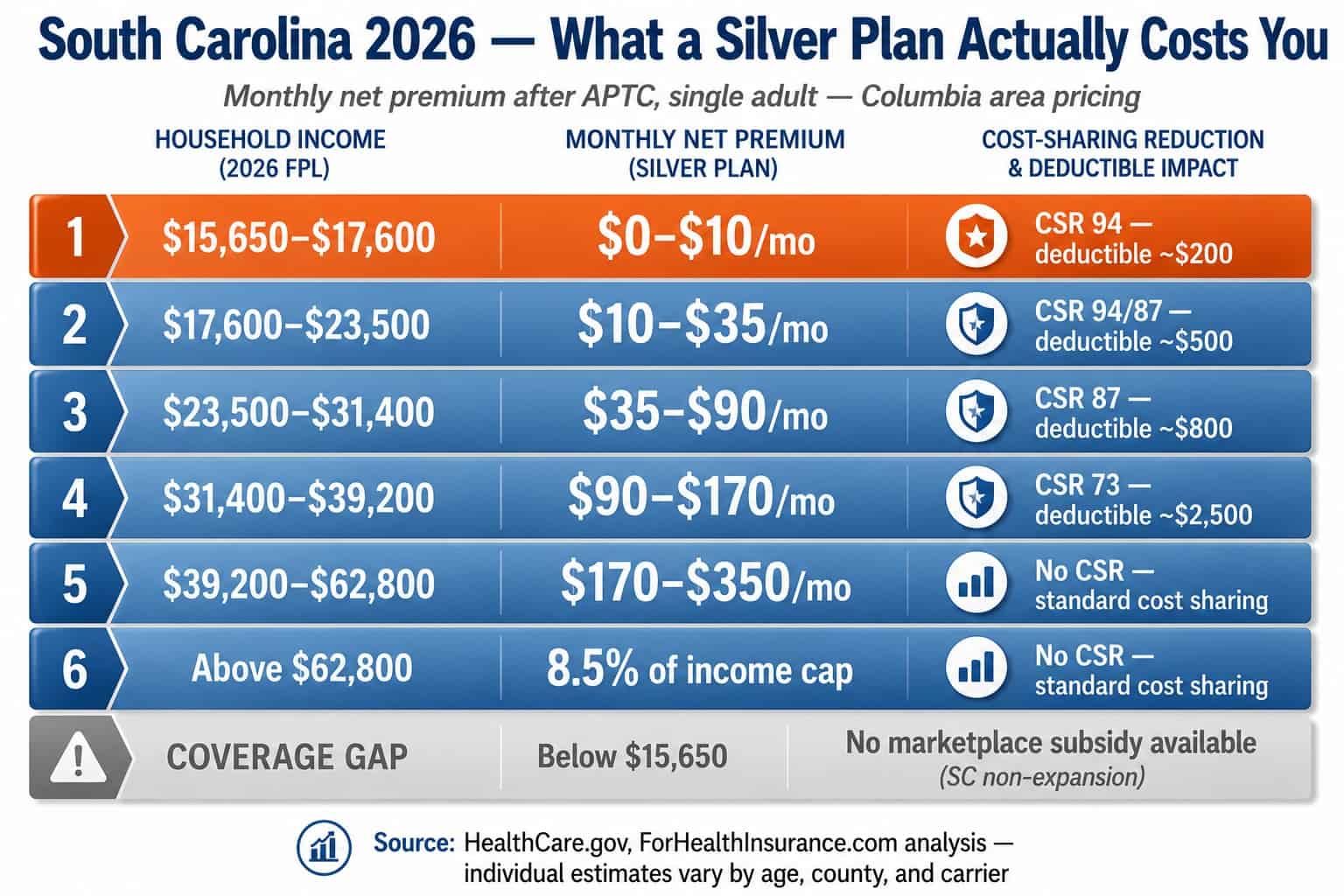
A South Carolina household earning $35,000 per year sits at approximately 220 percent of the federal poverty level for a single adult — in the range where Advance Premium Tax Credits reduce marketplace Silver plan premiums dramatically and Cost-Sharing Reductions lower the deductible from a standard $3,000 to $5,000 down to approximately $2,500. At incomes closer to 100 to 150 percent FPL, CSR Silver plans often run $0 to $20 per month with deductibles under $500.
| Annual Income (Single Adult) | % FPL (2026) | Est. Monthly Net Silver Premium | Silver Deductible with CSR |
|---|---|---|---|
| $15,650–$17,600 | 100%–112% FPL | $0–$10/mo | ~$100–$200 (CSR 94) |
| $17,600–$23,500 | 112%–150% FPL | $10–$35/mo | ~$200–$500 (CSR 94/87) |
| $23,500–$31,400 | 150%–200% FPL | $35–$90/mo | ~$500–$800 (CSR 87) |
| $31,400–$39,200 | 200%–250% FPL | $90–$170/mo | ~$2,500 (CSR 73) |
| $39,200–$62,800 | 250%–400% FPL | $170–$350/mo | ~$4,500 (no CSR) |
| Above $62,800 | Above 400% FPL | Capped at 8.5% of income | Standard Silver, no CSR |
Find Affordable Health Insurance South Carolina Options
A licensed South Carolina broker calculates your exact subsidy eligibility, screens for Healthy Connections and Partners for Healthy Children eligibility, and identifies whether a CSR Silver plan delivers stronger coverage than Bronze at your income level. Free, no obligation.
The SC No-Mandate Reality: Bronze Buys Real Protection Without Penalty
South Carolina imposes no state individual mandate penalty for going uninsured, and the federal mandate penalty has been zero since 2019. That means going without coverage carries no tax consequence — only medical risk. For SC residents who are healthy and cash-constrained, a Bronze plan with a high deductible provides real protection against catastrophic medical events at the lowest marketplace premium available, without the incentive-penalty dynamic that exists in states like Massachusetts or New Jersey.
Below 138% FPL — Apply for Healthy Connections or check CHIP for children
Residents in this income range who fit Medicaid eligibility categories (pregnant women, children, low-income parents, disabled) should apply for Healthy Connections or Partners for Healthy Children. Those who do not fit any eligibility category are in the coverage gap — Federally Qualified Health Centers and hospital charity care are the primary affordable options. Do not enroll in a marketplace plan at this income level without confirming Medicaid ineligibility first.
100%–200% FPL — CSR Silver almost always beats Bronze
At 100 to 200 percent FPL, Cost-Sharing Reductions make Silver plans the overwhelmingly stronger value. A CSR 87 or CSR 94 Silver plan delivers deductibles as low as $200 to $800 at monthly premiums often under $50 after subsidy. A Bronze plan at the same income level may cost less per month but attaches a $7,000 to $9,200 deductible. One emergency visit or unexpected diagnosis can cost tens of thousands — Bronze’s lower premium rarely compensates for that exposure at these income levels.
200%–400% FPL — Bronze with APTC for healthy households
Households at 200 to 400 percent FPL no longer qualify for Cost-Sharing Reductions, removing Silver’s primary advantage over Bronze. At this income range, a healthy household that rarely uses care — no chronic conditions, no regular prescriptions, no planned surgeries — often finds Bronze provides the lowest total annual cost: lower premiums all year, with the high deductible only activated if something significant happens. Verify that at least preventive care is covered at no cost before the deductible under the specific Bronze plan selected.
Under 30 or hardship exemption — Catastrophic plans available
Residents under 30 years old or those who have received a hardship exemption from the IRS can enroll in Catastrophic plans — the lowest-premium tier on the SC marketplace, available exclusively through BCBS of SC. Catastrophic plans carry a deductible near the out-of-pocket maximum (approximately $9,200 in 2026) but cover three primary care visits per year before the deductible and all preventive services at no cost. Catastrophic plans do not qualify for Advance Premium Tax Credits.
Palmetto Health Centers and FQHCs: Sliding-Scale Care Without Insurance
South Carolina has more than 70 Federally Qualified Health Center sites across the state — community health centers that receive federal funding and are required to serve all patients regardless of insurance status or ability to pay. Fees are charged on a sliding scale based on household income. For residents in the coverage gap or temporarily uninsured, FQHCs provide primary care, dental services, behavioral health, and prescription access without requiring insurance.
Major FQHC networks in South Carolina include Cooperative Health (Columbia, Richland County), Fetter Health Care Network (Charleston, North Charleston, and surrounding Lowcountry), Pendleton Community Care (Upstate SC — Anderson, Pickens, Oconee counties), and Carolina Health Centers (Greenwood, Abbeville, Edgefield, and Saluda counties). The federal Health Resources and Services Administration maintains a locator at findahealthcenter.hrsa.gov that finds the nearest federally qualified site by ZIP code.
At very low incomes — below 100 percent of the federal poverty level — patients at most SC FQHCs pay $20 to $40 per visit for primary care, with no visit cost for those below approximately 20 percent FPL. Dental visits typically run $30 to $90 sliding-scale. Prescription access through 340B drug pricing programs at FQHC-affiliated pharmacies can significantly reduce medication costs. FQHCs do not cover emergency or inpatient hospital care — for high-cost medical events, uninsured patients must negotiate directly with the hospital’s charity care or financial assistance program. For the uninsured, FQHCs are the closest thing to affordable health insurance in South Carolina.
Frequently Asked Questions
Five questions SC residents ask most about finding free or low-cost coverage — covering Medicaid eligibility, the coverage gap, free care options, Bronze versus Silver, and what options exist below the marketplace subsidy floor.
Who qualifies for free or low-cost health insurance in South Carolina?
Free coverage through Healthy Connections (SC Medicaid) is available to pregnant women, children, very low-income parents, people with disabilities, and seniors needing long-term care. Children in households up to 213 percent of the federal poverty level qualify for Partners for Healthy Children at low or no cost. Residents earning between 100 and 150 percent of the federal poverty level qualify for marketplace Silver plans with Cost-Sharing Reductions that reduce premiums to near zero after subsidies. Adults below the poverty line who do not fit Medicaid eligibility categories fall into the coverage gap with limited affordable options. That gap is the central limit on affordable health insurance in South Carolina.
What is the SC coverage gap and can anything help?
The coverage gap in South Carolina refers to residents earning below 100 percent of the federal poverty level who do not qualify for Healthy Connections under existing Medicaid eligibility rules and cannot access marketplace subsidies because those subsidies start at 100 percent FPL. Roughly 100,000 to 200,000 South Carolinians fall into this gap. Practical options for gap residents include Federally Qualified Health Centers offering sliding-scale primary care, catastrophic plans if under 30 or with a hardship exemption, and hospital charity care programs for high-cost events. These partial resources are the fallback when affordable health insurance in South Carolina is out of reach.
Is free health insurance available in South Carolina?
Yes, for qualifying residents. Healthy Connections provides free Medicaid coverage to eligible South Carolinians — primarily children, pregnant women, very low-income parents, people with disabilities, and seniors. Partners for Healthy Children (CHIP) provides free or near-free coverage for children in households up to 213 percent FPL. Marketplace Silver plans with CSR 94 (for enrollees at 100 to 150 percent FPL) often reduce premiums to $0 to $20 per month after subsidies. Federally Qualified Health Centers provide free or sliding-scale primary care regardless of insurance status.
How much does a Bronze plan cost in South Carolina with subsidies?
A 40-year-old South Carolina resident earning $35,000 per year (approximately 220 percent of the federal poverty level) might pay $60 to $120 per month for a Bronze plan after Advance Premium Tax Credits in 2026. A resident at $25,000 per year (roughly 160 percent FPL) might pay $0 to $40 per month for a Bronze plan — though at that income level, a CSR Silver plan often provides stronger coverage at a similar or lower after-subsidy cost. Exact amounts depend on county, carrier, age, and household size. A broker can pin down your exact affordable health insurance South Carolina cost in a few minutes.
Where can uninsured SC residents get primary care without insurance?
Federally Qualified Health Centers (FQHCs) across South Carolina provide primary care, dental, mental health, and prescription services on a sliding-scale fee basis tied to household income. SC residents at very low incomes often pay $20 to $40 per visit. Major FQHC networks in SC include Cooperative Health (Columbia), Fetter Health Care Network (Charleston), and Pendleton Community Care (Upstate). The HRSA health center finder at findahealthcenter.hrsa.gov locates the nearest FQHC by ZIP code. Hospital charity care programs are available for uninsured residents facing high-cost emergency or inpatient care.
Find Affordable SC Health Insurance Today
A licensed South Carolina broker screens for Healthy Connections and CHIP eligibility, calculates your exact APTC and CSR amounts, and compares Bronze and Silver plans across all five SC carriers. Most consultations take under 15 minutes. Free, no obligation.
Free South Carolina coverage consultation — all income levels, all programs.
Related South Carolina Health Insurance Resources
Complete SC overview — all carriers, the coverage gap, costs, and every coverage path.
South Carolina MarketplaceHow HealthCare.gov works for SC residents — subsidies, open enrollment, carrier comparison.
South Carolina Plan TypesBronze, Silver, Gold, HMO, PPO — how metal tiers and network types affect SC costs.
South Carolina Small Business Health InsuranceGroup plans, ICHRA, and SHOP marketplace options for SC employers and employees.
HRSA Health Center FinderLocate Federally Qualified Health Centers near your SC ZIP code for sliding-scale care.
SC DHHS — Healthy ConnectionsApply for South Carolina Medicaid, check eligibility, and manage existing coverage.
Broker Disclosure
ForHealthInsurance.com is an independent health insurance agency serving South Carolina residents. We are not affiliated with any carrier or government agency. We help you compare plans and enroll in coverage that meets your needs at no extra cost to you.