Health Insurance South Carolina 2026: Plans, Costs, and the Coverage Gap
South Carolina health insurance in 2026 sits at the intersection of three forces that shape every resident’s options. HealthCare.gov — the federal marketplace — handles all subsidized and unsubsidized plan enrollment because the state never built its own exchange. The Medicaid coverage gap, created by the state’s decision not to expand Medicaid under the Affordable Care Act, leaves an estimated 100,000 to 200,000 working adults earning too much for Healthy Connections but too little for marketplace subsidies. And the absence of a state individual mandate means no tax penalty for going without coverage — only the financial exposure of paying full retail for medical care. Five carriers participate in the marketplace, led by BlueCross BlueShield of South Carolina with roughly 50 percent of the individual market. This guide covers every path to health insurance in South Carolina for 2026, and what each one actually costs.

What brings you here today?
The Medicaid Coverage Gap and Why It Matters in South Carolina
South Carolina chose not to expand Medicaid under the Affordable Care Act, creating a financial trap for low-income working residents. Adults earning between roughly 50 and 100 percent of the federal poverty level fall into a coverage gap with no affordable options — too much income for Healthy Connections (the state Medicaid program), too little for marketplace subsidies on HealthCare.gov. Roughly 100,000 to 200,000 South Carolinians sit in this gap as of 2026.
The Affordable Care Act was originally written assuming every state would expand Medicaid to cover adults up to 138 percent of the federal poverty level. When the Supreme Court ruled in 2012 that states could opt out, South Carolina chose not to expand. Healthy Connections — the state’s existing Medicaid program — remained restricted to its pre-ACA eligibility categories: pregnant women, children, parents of dependent children with very low incomes, people with disabilities, and seniors needing long-term care. Childless adults below the poverty line, working low-wage jobs without employer coverage, do not qualify regardless of how little they earn. It is the single biggest reason health insurance in South Carolina looks different from coverage in Medicaid-expansion states.
The income-based subsidies on HealthCare.gov begin at 100 percent of the federal poverty level. For 2026 enrollment, that is roughly $15,650 in annual income for a single adult and $26,650 for a family of three. Below those thresholds, ACA subsidies do not apply because the law assumed Medicaid would handle that population. Above those thresholds and up to 400 percent of poverty (and effectively higher under current enhanced subsidies), marketplace plans become affordable through Advance Premium Tax Credits and Cost-Sharing Reductions. The gap sits in the narrow band between zero income and the subsidy threshold.
Practical alternatives for those trapped in the gap are limited. Catastrophic plans on the marketplace cover residents under 30 years old or those granted a hardship exemption, with low monthly premiums but high deductibles approaching $9,200 in 2026. Federally Qualified Health Centers provide sliding-scale primary care across the state. Hospital charity care and patient assistance programs cover specific high-cost medications. None substitutes for comprehensive insurance, but for residents in the gap, these form the practical safety net. The Kaiser Family Foundation’s national coverage gap analysis tracks the population affected and ongoing legislative debate over expansion in the South Carolina General Assembly. For residents above the gap, health insurance in South Carolina is bought through the federal marketplace with income-based subsidies.
Five Carriers, One Dominant: South Carolina’s 2026 Insurance Market
South Carolina’s 2026 marketplace has five carriers — BlueCross BlueShield of South Carolina, Ambetter from Absolute Total Care, Molina Healthcare, Cigna Healthcare, and Aetna CVS Health. BCBS of SC dominates with roughly 50 percent of the individual market and is the only carrier with statewide coverage in all 46 counties. Ambetter, Molina, Cigna, and Aetna compete primarily in metro areas. Carrier availability varies sharply by county.
The practical result is that shopping for health insurance in South Carolina means weighing one statewide carrier against four metro-focused challengers.
BlueCross BlueShield of South Carolina
Columbia-headquartered nonprofit mutual insurance company, independently owned by its policyholders. Part of the Blue Cross Blue Shield Association but separately incorporated. BCBS of SC contracts with virtually every hospital and the majority of physicians in private practice. The only marketplace carrier with statewide presence in all 46 counties. BlueCard national reciprocity provides in-network access in all 50 states.
- Columbia-based nonprofit mutual
- ~50% individual market share
- All 46 SC counties covered
- BlueCard national reciprocity
Ambetter from Absolute Total Care
Operated by Absolute Total Care under parent company Centene. Ambetter has grown its South Carolina footprint significantly since 2018 by pricing Bronze and Silver plans below BCBS of SC equivalents. The trade-off is a narrower provider network — many physicians who accept BCBS of SC are out-of-network for Ambetter, and rural hospitals may have limited or no Ambetter agreements. Strongest in metro Charleston, Columbia, and Greenville-Spartanburg.
- Centene-owned (Absolute Total Care)
- ~22% market share
- Lower Bronze/Silver pricing
- Narrower network than BCBS of SC
Molina, Cigna, and Aetna
Three additional carriers participate selectively. Molina Healthcare focuses on Medicaid managed care and concentrates marketplace plans in Charleston, Columbia, and Greenville metros, with limited rural availability. Cigna Healthcare brings a national provider network and serves selected metro counties. Aetna CVS Health is the smallest of the five by market share but has been expanding service area year over year. All three offer competitive pricing in metro counties where they participate.
- Molina ~13% market share, metro-focused
- Cigna ~9% market share, national network
- Aetna ~6% market share, growing footprint
- Selected metro counties only
Where SC Residents Find Coverage: Four Routes by Income
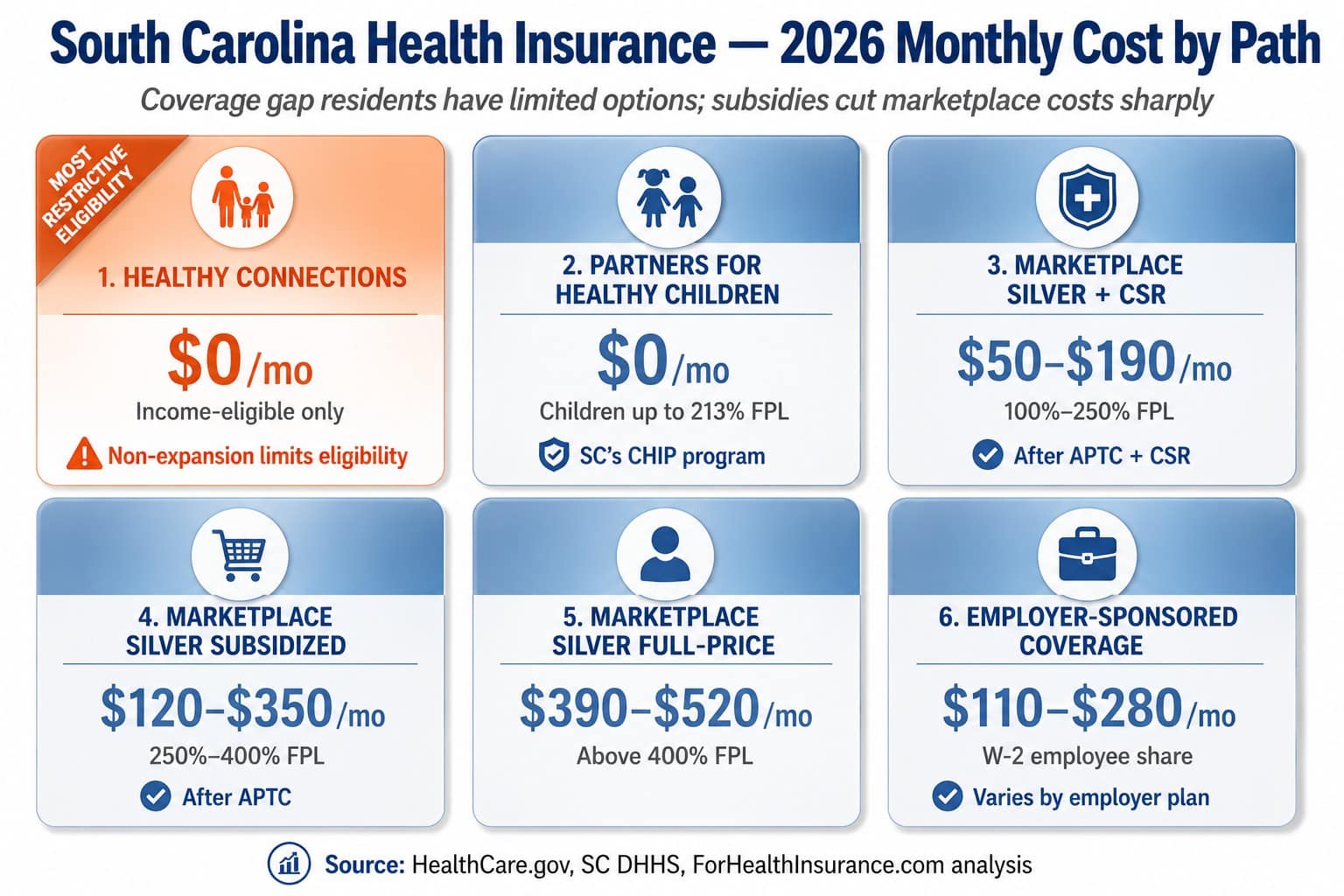
SC residents follow one of four coverage paths depending on income, employment status, and family situation. Healthy Connections (Medicaid) covers eligible pregnant women, children, very low-income parents, and people with disabilities; HealthCare.gov marketplace plans with subsidies serve those at 100% to 400% of FPL; full-price marketplace or employer-sponsored coverage applies above that. Partners for Healthy Children covers kids in households up to 213% FPL.
Healthy Connections Medicaid (eligible categories only)
South Carolina Medicaid covers pregnant women, children, very low-income parents, people with disabilities, and seniors needing long-term care. Childless adults below the poverty line do NOT qualify due to non-expansion. Income limits are restrictive: a parent of two earning more than approximately $5,800 per year typically loses eligibility. Apply through the SC Department of Health and Human Services. Healthy Connections enrollment is year-round.
Partners for Healthy Children (CHIP, kids only)
Children in households up to 213 percent of the federal poverty level (about $56,800 for a family of four in 2026) qualify for free or low-cost coverage through Partners for Healthy Children. Coverage includes preventive care, dental, vision, and behavioral health. A common South Carolina pattern: kids on Partners for Healthy Children while a parent who earns slightly more enrolls in a marketplace plan with subsidy.
HealthCare.gov marketplace (100%–400% FPL with subsidy)
South Carolinians between 100% and 400% of FPL ($15,650–$128,600 for a family of four in 2026) enroll through HealthCare.gov for subsidized marketplace plans. Advance Premium Tax Credits cap premium contributions on a sliding scale based on income. Cost-Sharing Reductions further reduce out-of-pocket costs for enrollees under 250% FPL who choose Silver plans. Open enrollment runs November 1 through January 15 each year. This is where most working-age residents get health insurance in South Carolina.
Employer-sponsored coverage
Roughly 49 percent of insured South Carolinians under 65 receive coverage through their employer. The ACA employer mandate applies at 50+ FTEs. BCBS of SC dominates the state’s group insurance market. Employees offered employer-sponsored coverage that meets ACA affordability standards (below 9.12% of household income for employee-only premium in 2026) are not eligible for HealthCare.gov premium tax credits, even if they decline the employer plan. For everyone else, health insurance in South Carolina flows through HealthCare.gov.
South Carolina Premium Reality: 2026 Costs by Tier and County
Premium pricing in 2026 varies by metal tier, age, county, tobacco use, and carrier. For a 40-year-old non-smoker in Columbia, average monthly premiums before subsidy run approximately $315 for Bronze, $415 for Silver, $510 for Gold, and $625 for Platinum where available. Subsidies routinely cut these by 50 to 80 percent for residents below 250 percent of the federal poverty level — many enrollees pay under $100 per month for Silver coverage after subsidy.
South Carolina has multiple geographic rating areas — premiums vary between Columbia, Charleston, Greenville, and rural counties. The same 40-year-old non-smoker quoted at $415 for Silver in Columbia might pay $485 in a rural Pee Dee county and $445 in Charleston County, driven by local provider costs and carrier participation patterns. Tobacco users face a federal-allowed surcharge of up to 50 percent on premiums in South Carolina, which is not subsidized; an enrollee who smokes pays the surcharge in full regardless of income. Subsidies still make health insurance in South Carolina far cheaper for eligible residents than the unsubsidized figures imply.
| South Carolina Coverage Path | Typical Monthly Cost (2026) | Best Fit For |
|---|---|---|
| Healthy Connections (Medicaid) | $0 (income-eligible) | Pregnant women, children, low-income parents, disabled |
| Partners for Healthy Children (CHIP) | $0–small monthly fee | Children up to 213% FPL |
| Marketplace Bronze + APTC | $30–$140/mo (with subsidy) | 100%–250% FPL, healthy enrollees |
| Marketplace Silver + CSR | $50–$190/mo (with APTC + CSR) | 100%–250% FPL, best value tier |
| Marketplace Silver subsidized | $120–$350/mo (with APTC) | 250%–400% FPL |
| Marketplace Silver full-price | $390–$520/mo | Above 400% FPL |
| Catastrophic plan | $190–$280/mo | Under 30 or hardship exemption |
| Employer-sponsored (employee share) | $110–$280/mo | W-2 with employer offer |
Run an Instant South Carolina Health Insurance Quote
A licensed South Carolina agent screens for Healthy Connections and Partners for Healthy Children eligibility, then compares HealthCare.gov plans from BCBS of SC, Ambetter, Molina, Cigna, and Aetna — with subsidy calculations and provider verification included. Free, no obligation.
Going Uninsured in SC: No State Penalty, But Real Financial Risk
South Carolina has not enacted a state-level individual mandate penalty for going without health insurance. The federal mandate penalty was reduced to zero in 2019, and unlike Massachusetts, New Jersey, California, Rhode Island, and the District of Columbia, South Carolina did not pass its own state replacement. Residents face no state tax penalty for being uninsured — only the financial risk of paying full price for medical care.
Massachusetts pioneered state-level mandate penalties with its 2006 health reform law, predating the ACA. After the federal mandate penalty zeroed out, New Jersey, California, Rhode Island, and the District of Columbia enacted their own state mandates between 2019 and 2021. Vermont enacted a mandate without a financial penalty. The remaining 44 states, including South Carolina, have not. State and federal income tax filings for South Carolina residents include no question about insurance coverage status that triggers a penalty. In practice, carrying health insurance in South Carolina is a personal financial decision, not a legal requirement.
The absence of a mandate doesn’t reduce uninsured financial risk — it amplifies it
South Carolina hospitals charge full retail rates to uninsured patients, often two to four times what an insurer would have negotiated. Emergency department visits routinely exceed $3,500 even for moderate conditions. Unexpected diagnoses for cancer, heart disease, or major injuries produce six-figure bills that have driven medical bankruptcies in the state. The absence of a mandate penalty does not change the underlying actuarial logic that uninsured Americans face the highest health-related financial risk.
For residents who feel they cannot afford coverage, the path forward typically involves examining subsidy eligibility (most underestimate what they qualify for), Healthy Connections eligibility for children if not parents, catastrophic plans for those under 30 or with hardship exemptions, and Federally Qualified Health Center sliding-scale primary care to manage routine needs. A broker conversation often surfaces affordability options the consumer was not aware of. Most who believe they cannot afford health insurance in South Carolina have simply not checked their subsidy eligibility.
Open Enrollment in South Carolina: Dates, Steps, and Deadlines
Because South Carolina runs entirely on HealthCare.gov rather than a state-based exchange, its open enrollment follows the federal calendar exactly: November 1, 2025 through January 15, 2026. Coverage starting January 1, 2026 requires enrollment by December 15, 2025; enrollments completed December 16 through January 15 typically begin February 1. Outside this window, SC residents need a qualifying life event to access a Special Enrollment Period.
The federal open enrollment calendar applies uniformly to South Carolina because the state uses HealthCare.gov rather than running its own exchange. Some state-based exchange states (California, Rhode Island, New York) extend their enrollment windows beyond the federal calendar; South Carolina does not have that flexibility. The enrollment process itself is straightforward: gather income projections and household details, get a quote from a broker or visit HealthCare.gov directly, compare at least three plans across metal tiers and carriers, complete the application with subsidy eligibility verification, and pay the first premium to activate coverage. Those steps are the same whether you buy health insurance in South Carolina through a broker or directly on HealthCare.gov.
Special Enrollment Periods extend access outside the standard window for residents experiencing qualifying life events. Common triggers include loss of employer coverage, change in household size (marriage, divorce, birth, adoption), permanent move to South Carolina from another state, and significant change in income that affects subsidy eligibility. Each trigger has documentation requirements and a 60-day window from the event to enroll. Residents who miss open enrollment without a qualifying event have limited options until the next November — Healthy Connections and Partners for Healthy Children remain open year-round for those who qualify, and Federally Qualified Health Centers provide sliding-scale primary care regardless of insurance status. Missing the window is the most common reason eligible residents go a year without health insurance in South Carolina.
Frequently Asked Questions
Five quick answers to the questions South Carolina residents ask most often about 2026 health insurance — covering whether the state runs its own exchange, the Medicaid coverage gap, mandate penalties, the carrier landscape, and open enrollment dates and deadlines for the year.
Does South Carolina use HealthCare.gov or its own state exchange?
South Carolina uses HealthCare.gov, the federal health insurance marketplace. Unlike states such as Rhode Island, California, or New York, South Carolina has not built or operated its own state-based exchange. Residents shopping for marketplace coverage enroll through HealthCare.gov for both subsidized and unsubsidized plans, and the federal call center handles support questions for South Carolina enrollees.
What is the Medicaid coverage gap in South Carolina?
The coverage gap refers to South Carolina residents who earn too much to qualify for Healthy Connections (the state Medicaid program) but too little to qualify for marketplace subsidies on HealthCare.gov. This gap exists because South Carolina has not expanded Medicaid under the Affordable Care Act. An estimated 100,000 to 200,000 working adults fall into this gap statewide. People in this range are typically eligible for catastrophic plans or hardship exemptions but face limited affordable options.
Does South Carolina have a state individual mandate penalty?
No. South Carolina does not impose a state-level individual mandate penalty for going without health insurance. The federal mandate penalty was reduced to zero in 2019, and unlike Massachusetts, New Jersey, California, Rhode Island, and the District of Columbia, South Carolina has not enacted its own replacement penalty. Residents face no state tax penalty for being uninsured, though they remain financially exposed to medical bills without coverage.
Which health insurance carriers operate in South Carolina for 2026?
Five carriers offer plans on the South Carolina marketplace for 2026: BlueCross BlueShield of South Carolina, Ambetter from Absolute Total Care, Molina Healthcare, Cigna Healthcare, and Aetna CVS Health. BlueCross BlueShield of South Carolina holds the largest market share at roughly 50 percent, with statewide network coverage. Ambetter and Molina compete primarily on lower-cost Bronze and Silver tiers in metro areas. Carrier availability varies by county, and rural counties may have only two or three options.
When is open enrollment for South Carolina health insurance?
South Carolina follows the federal open enrollment calendar for plans purchased through HealthCare.gov. The annual enrollment window runs from November 1 through January 15. Coverage that begins January 1 requires enrollment by December 15 of the prior year. Coverage selected between December 16 and January 15 typically begins February 1. Outside these dates, residents need a qualifying life event to enroll through a Special Enrollment Period.
Compare 2026 South Carolina Health Insurance Plans
A licensed South Carolina agent screens for Healthy Connections and Partners for Healthy Children eligibility, compares HealthCare.gov plans from all five carriers with subsidy calculations, and verifies your specific providers across BCBS of SC, Ambetter, Molina, Cigna, and Aetna networks. Free, no obligation.
Free comparison of all SC coverage programs — handled in one call.
Related South Carolina Health Insurance Resources
HealthCare.gov enrollment for SC residents — open enrollment, subsidies, carriers compared.
South Carolina Plan TypesHMO, PPO, EPO, and POS plans available in South Carolina — networks and trade-offs.
Affordable South Carolina Health InsuranceCoverage gap options, subsidies, catastrophic plans, and FQHC sliding-scale care.
South Carolina Small Business Health InsuranceGroup plans, ICHRA, SHOP, and BCBS of SC small group options for SC employers.
HealthCare.gov (Official)Federal marketplace enrollment portal for South Carolina 2026 plans.
SC Healthy Connections (Official)South Carolina Medicaid and Partners for Healthy Children eligibility and applications.
Broker Disclosure
ForHealthInsurance.com is an independent health insurance agency serving South Carolina residents. We are not affiliated with any carrier or government agency. We help you compare plans and enroll in coverage that meets your needs at no extra cost to you.