Affordable Health Insurance Tennessee 2026: Cost Guide
Affordable health insurance in Tennessee for 2026 means navigating the largest single-year premium increase the state has seen in eight years. Tennessee’s marketplace carriers received a weighted average rate increase of 37.5% — driven primarily by the December 2025 expiration of enhanced American Rescue Plan subsidies. Full-price benchmark Silver plans now run approximately $670 to $747 per month for a 40-year-old, varying by carrier. The good news: about 77% of Tennessee marketplace enrollees still qualify for Advance Premium Tax Credits, which averaged around $455 per month in 2026 — and subsidy-eligible Tennesseans pay substantially less than the headline numbers suggest. The harder news: the 400% FPL cliff returned for 2026, meaning above-subsidy households face the full impact of the rate increase with no federal assistance. This guide covers actual 2026 costs across all six Tennessee carriers, subsidy maximization strategies for households between 100% and 400% of FPL, when each metal tier is the right call, and when off-exchange BlueCross BlueShield of Tennessee PPO produces better value than the marketplace for above-cliff households.

What brings you here today?
What Tennessee Coverage Actually Costs in 2026
Affordable health insurance Tennessee pricing in 2026 starts at about $508 per month for a Bronze plan and runs to about $880 per month for Gold for a 40-year-old non-tobacco user before subsidies. After Advance Premium Tax Credits, the average subsidy-eligible Tennessean paid substantially less — subsidies averaged $455 per month and reduced costs for 77% of marketplace enrollees. Costs vary by carrier, age, county, plan tier, and tobacco use.
Bronze plans
$508–$582/moFull-price benchmark for a 40-year-old non-tobacco user. Lowest premium, highest deductible ($5,000–$8,000 typical). All BCBSTN Bronze plans are HSA-eligible for 2026. Best for households above 250% of FPL who don’t expect heavy medical use.
Silver plans (full price)
$670–$747/moFull-price benchmark for a 40-year-old non-tobacco user. The benchmark tier — APTC is calculated against the second-cheapest Silver plan in your county. Eligible for Cost-Sharing Reductions up to 250% of FPL. Oscar runs the lowest average Silver premium statewide.
Gold and Platinum plans
$690–$880/moFull-price benchmark for a 40-year-old non-tobacco user. Higher premium, lower deductible ($1,300–$3,200 typical). Alliant Health Plans is the only Tennessee carrier offering Platinum tier for 2026 — about $859 per month with no deductible.
Subsidy-eligible average
~$455/mo subsidyAverage APTC for the 77% of Tennessee marketplace enrollees who qualified for premium tax credits in 2026. After subsidy, many subsidy-eligible Tennesseans pay between $50 and $300 per month depending on income, age, and plan choice.
The Tennessee 2026 cost story is dominated by the 37.5% weighted average rate increase approved by CMS — the largest in eight years and the central challenge for marketplace shoppers this year. The increase was uneven across carriers: BlueCross BlueShield of Tennessee approved approximately +41%, Celtic/Ambetter approximately +38%, Oscar approximately +28%, and Alliant Health Plans just +0.3%. This carrier variation creates a meaningful affordability arbitrage for Tennesseans whose providers are flexible — Alliant in Southeast Tennessee, Oscar in Nashville and Memphis, and Cigna in major metros are often substantially cheaper than BCBSTN even before subsidies, particularly for healthy under-40 enrollees. Premiums also vary by age (a 60-year-old pays roughly 3× what a 21-year-old pays under federal age-rating rules), tobacco use (carriers can charge tobacco users up to 50% more in Tennessee), and household composition on family policies.
What’s not visible in the headline numbers: the 2025 expiration of enhanced American Rescue Plan subsidies meaningfully changed the affordability picture for many Tennesseans. From 2021 through 2025, ARP enhancements capped marketplace premiums at 8.5% of household income for everyone — meaning even households above 400% of FPL received some federal assistance. That enhancement expired December 31, 2025. For 2026, the 400% FPL subsidy cliff returned to its pre-ARP form: above the threshold, no federal subsidy applies, and full-price premiums (now 37.5% higher than in 2025) kick in. This combination — the cliff returning at the same time premiums jumped 37.5% — was the single biggest reason Tennessee saw enrollment shifts and coverage drops between 2025 and 2026.
How Tennessee Marketplace Subsidies Work
Tennessee marketplace enrollees rely on two federal subsidies — Advance Premium Tax Credits and Cost-Sharing Reductions — calculated against your projected 2027 household income. APTC reduces your monthly premium directly. CSR is available only on Silver plans for households up to 250% of FPL and reduces deductibles and out-of-pocket costs. Both are calculated automatically by HealthCare.gov when you apply. Tennessee’s 100% FPL lower bound differs from expansion states’ 138% threshold because Tennessee did not adopt Medicaid expansion.
APTC is structured around an “applicable percentage” of your household income that you’re expected to contribute toward the second-cheapest Silver plan in your county — the foundation of how affordable health insurance Tennessee marketplace shoppers can access at subsidized rates. Below 150% of FPL, that contribution is essentially zero. At 200% of FPL, it’s about 2% of income. At 300% of FPL, it’s about 6%. At 400% of FPL, it’s about 8.5%. Above 400% of FPL in 2026, no APTC applies — the subsidy cliff returned with the ARP expiration. The dollar amount of your APTC is the difference between the benchmark Silver premium in your county and your applicable contribution, which means after Tennessee’s 37.5% rate increase, the dollar value of APTC for subsidy-eligible Tennesseans actually grew (because the benchmark Silver got more expensive). You can apply your APTC to any plan from any of the six Tennessee carriers — not just Silver — but the APTC dollar amount is fixed regardless of which plan you choose.
CSR works differently. It’s only available on Silver plans, and only for Tennesseans below 250% of FPL — making CSR-Silver the structural answer to affordable health insurance Tennessee subsidy-eligible buyers most often qualify for. CSR effectively transforms the Silver plan’s actuarial value: at 100%–150% of FPL, Silver becomes a 94% AV plan (better than standard Gold). At 150%–200% of FPL, Silver becomes 87% AV. At 200%–250% of FPL, Silver becomes 73% AV. The carrier absorbs the cost-sharing reduction; the federal government reimburses carriers for it. For Tennesseans in these income bands, Silver almost always produces the lowest total annual cost — premium plus expected out-of-pocket — and Bronze is frequently a worse total deal even though the monthly premium looks lower.
| 2026 Income Range | Single Adult | Family of 4 | What You Get |
|---|---|---|---|
| Below 100% FPL | < $15,650 | < $32,150 | Tennessee coverage gap (TennCare not expanded) |
| 100%–150% FPL | $15,650–$23,475 | $32,150–$48,225 | APTC + 94% AV Silver (CSR maximum) |
| 150%–200% FPL | $23,475–$31,300 | $48,225–$64,300 | APTC + 87% AV Silver (CSR strong) |
| 200%–250% FPL | $31,300–$39,125 | $64,300–$80,375 | APTC + 73% AV Silver (CSR limited) |
| 250%–400% FPL | $39,125–$62,600 | $80,375–$128,600 | APTC only (no CSR) |
| Above 400% FPL | > $62,600 | > $128,600 | No subsidy — cliff returned in 2026 |
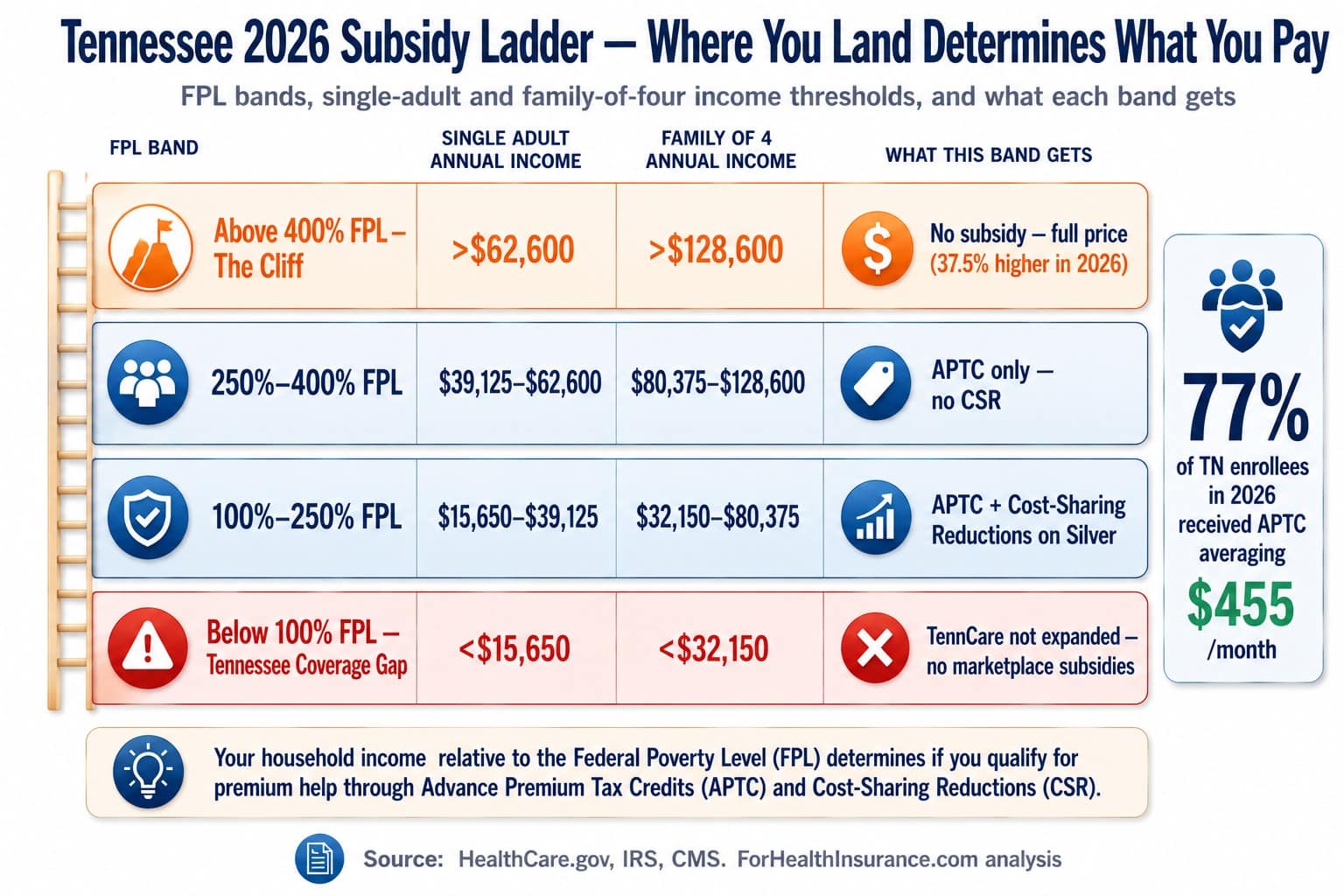
Tennessee’s coverage gap is unique among non-expansion states for its size
Because Tennessee did not adopt the ACA Medicaid expansion, residents below 100% of FPL who don’t qualify for TennCare under the state’s limited eligibility categories (pregnant women, children, certain disabled adults) are typically left without affordable coverage options — they fall below the marketplace subsidy threshold and don’t have a TennCare pathway. This is in contrast to expansion states where residents below 138% of FPL are covered by Medicaid. Approximately 100,000 to 150,000 Tennesseans are estimated to fall into the coverage gap depending on the year. Tennesseans in this band may qualify for community health center sliding-scale care, hospital charity care programs, or limited federally qualified health center (FQHC) services — but standard health insurance coverage is generally unavailable to them. Federal community health centers in Memphis, Nashville, Knoxville, and Chattanooga serve as the primary care safety net for this population.
Five Strategies to Lower Your Tennessee Premium
Five strategies typically lower the cost of affordable health insurance Tennessee residents pay: maximize APTC by accurately projecting income, pick Silver if you qualify for CSR, choose Bronze for low expected medical use above 250% FPL, contribute to an HSA through an HSA-eligible plan, and shop off-exchange BCBSTN PPO if above the 400% FPL cliff. The 37.5% rate increase makes accurate matching consequential.
Finding affordable health insurance Tennessee residents can actually use comes down to matching the right strategy to the right income band — and Tennessee’s specific market structure shapes which strategy applies. Unlike expansion states that route below-138%-FPL residents to Medicaid, Tennessee’s TennCare gap means the marketplace is the only path between 100% and 138% of FPL — making CSR-eligible Silver dramatically more valuable in Tennessee than in expansion-state Affordable Care Act markets. Unlike states with effective rate review, Tennessee’s CMS-reviewed-only filings produced the 37.5% increase that hit BCBSTN at +41% while leaving Alliant at +0.3% — meaning Southeast Tennessee residents have a carrier-arbitrage option most other states lack. Unlike states with state income tax, Tennessee’s no-state-tax structure means HSA contributions deliver federal-only tax benefits, but those federal benefits remain meaningful for households in 22%–32% marginal brackets. The five strategies below reflect these Tennessee-specific dynamics.
Project your 2027 income accurately
APTC is calculated against your projected 2027 household Modified Adjusted Gross Income, and accurate projection is the foundation of affordable health insurance Tennessee shoppers can actually afford. Under-projecting income means HealthCare.gov gives you a larger monthly subsidy than you actually qualify for — the IRS reconciles at tax time and you owe back the overpayment. After Tennessee’s 37.5% rate increase, the dollar amount of APTC overpayment recovery for above-cliff households is substantially larger than in prior years. Over-projecting means you pay more in monthly premium than necessary and get a refund only when you file your 2027 taxes. For Tennesseans whose income fluctuates — country music industry freelancers, healthcare consultants, sales commission workers, real estate agents — estimate annual MAGI realistically rather than picking a number that maximizes upfront subsidy.
Pick Silver if you qualify for CSR (100%–250% FPL)
Cost-Sharing Reductions are the most undervalued benefit in the Tennessee marketplace and the single highest-leverage pathway to affordable health insurance Tennessee subsidy-eligible buyers can access. A Silver plan with CSR at 94% AV (for households at 100%–150% FPL) outperforms a standard Gold plan on actuarial value while costing less per month after APTC. Tennesseans in this income band who pick Bronze instead — chasing the lowest monthly premium — almost always come out worse on total annual cost when medical events occur. CSR is automatic on Silver plans and only on Silver plans. Switching from Bronze to Silver with CSR is the single highest-leverage adjustment most subsidized Tennesseans can make.
Choose Bronze if above 250% FPL with low expected use
Above 250% of FPL, CSR no longer applies, and Silver loses its primary advantage over Bronze. For Tennesseans in their 30s and 40s with no chronic conditions, no anticipated procedures, and a strong cash position to absorb the higher Bronze deductible, Bronze produces real annual savings. The premium gap between Silver and Bronze for a 40-year-old in Tennessee is typically $160–$260 per month — about $1,920–$3,120 per year. Oscar Insurance and Alliant Health Plans typically post the lowest Bronze premiums in covered counties.
Use an HSA-eligible plan to reduce taxable income
All BlueCross BlueShield of Tennessee Bronze plans are HSA-eligible for 2026, and many other carriers offer HSA-compatible options — turning an HSA strategy into another path toward affordable health insurance Tennessee high-deductible plan buyers can leverage at tax time. HSA contributions are tax-deductible (federal — Tennessee has no state income tax on wages, so no state benefit, but federal deduction applies), grow tax-free, and are tax-free when used for qualified medical expenses. The 2026 HSA contribution limit is $4,300 for self-only coverage and $8,550 for family. For Tennesseans in the 22%–32% federal marginal tax bracket, an HSA contribution of $4,300 reduces federal tax by $946–$1,376 — effectively making the high-deductible plan cheaper than the headline premium suggests.
Shop off-exchange BCBSTN PPO if above 400% FPL
Above the 400% FPL subsidy cliff, on-exchange and off-exchange compete on full-price terms — and after Tennessee’s 37.5% on-exchange rate increase, off-exchange BCBSTN PPO often wins on both price and network, becoming the practical answer to affordable health insurance Tennessee above-cliff buyers should evaluate first. BlueCross BlueShield of Tennessee off-exchange PPO plans frequently offer broader provider networks, BlueCard national reciprocity, and more flexible plan designs — and price competitively against on-exchange Silver and Gold for above-cliff households. Off-exchange BCBSTN PPO premiums for a 40-year-old in 2026 typically run $640 to $820 per month, comparable to or slightly below full-price on-exchange Silver. For above-cliff households, shopping both on-exchange and off-exchange before deciding is essential.
Calculate Your Tennessee Subsidy
Where your projected 2027 income lands on Tennessee’s subsidy ladder decides everything. A licensed Tennessee agent maps your number against the APTC and CSR bands, then finds the lowest total-cost plan across BlueCross BlueShield of Tennessee, Cigna, Oscar, Ambetter, UnitedHealthcare, and Alliant, on-exchange and off. You get your real after-subsidy figure in one call.
Real-World Tennessee Cost Scenarios
Tennessee households experience the 2026 marketplace very differently depending on which of the state’s six carriers serve their county and where income falls relative to the returned 400% FPL cliff. The four scenarios below span a 28-year-old in Nashville, a Knoxville family of four, a 55-year-old in Chattanooga, and a self-employed Nashville couple above the cliff, showing why affordable health insurance Tennessee residents find depends on metro and carrier mix as much as income.
The scenarios below are anchored in actual Tennessee carrier rates, the state’s specific FPL thresholds (Tennessee’s 100% lower bound, not the expansion-state 138%), and Tennessee-anchored geography — Nashville’s music industry economy, Knoxville’s UT-Vols-anchored healthcare market, Chattanooga’s Alliant pricing advantage with its +0.3% rate increase, and the Memphis-Nashville professional corridor. They demonstrate why affordable health insurance Tennessee shoppers find differs meaningfully from neighboring states like Kentucky (which expanded Medicaid through Kynect), Georgia (which now operates a state-based exchange with different rate review), or Mississippi (which uses HealthCare.gov but with only two on-exchange carriers compared to Tennessee’s six).
Each scenario assumes 2026 plan year pricing — full-price benchmark Silver $670–$747 per month for a 40-year-old, +37.5% statewide weighted increase from 2025, and the post-ARP cliff at 400% FPL. The scenarios use BCBSTN, Cigna, Oscar, Ambetter, UnitedHealthcare, and Alliant as the available carrier mix. Geographic context matters: Alliant operates only in Southeast Tennessee, Oscar concentrates in Nashville and Memphis metros, UnitedHealthcare covers Rating Area 8, and BCBSTN is universally available across all 95 counties — so finding affordable health insurance in Tennessee differs by metro in ways that don’t apply in single-rating-area states like Rhode Island or Vermont.
Scenario 1: Single 28-year-old in Nashville, $34,000 income (215% FPL)
Eligibility: APTC + Silver CSR at 87% AV.
Best plan: Oscar Silver with CSR or Cigna Silver with CSR. Full-price Silver runs about $560–$640 per month for a 28-year-old; APTC reduces premium to roughly $50–$110 per month; CSR drops the deductible from ~$5,500 to ~$2,200. Total expected annual cost (premium + average OOP) is around $2,100–$2,800.
Why not Bronze: Bronze at 28 might run $30–$70 per month after APTC — but the deductible jumps to $7,500+ and there’s no CSR. If a single hospitalization or surgery occurs, Bronze costs $5,000+ more than Silver for this income band.
Scenario 2: Family of four in Knoxville, $95,000 income (295% FPL)
Eligibility: APTC only — above the CSR threshold.
Best plan: Depends on care-use pattern. If the family expects routine care only, Bronze runs about $900–$1,100 per month after APTC for a family of four after the 37.5% rate increase. If anyone in the family has a chronic condition or expects significant care, Gold from BCBSTN, Cigna, or UnitedHealthcare produces lower total annual cost despite the higher monthly premium. BCBSTN Silver PPO is the right call if the family travels or has providers across systems.
Key trade-off: $200–$400 per month premium difference between Bronze and Gold compounds to $2,400–$4,800 per year. Whether that pays for itself depends entirely on actual medical use.
Scenario 3: Single 55-year-old in Chattanooga, $52,000 income (332% FPL)
Eligibility: APTC only — above CSR.
Best plan: Alliant Health Plans Silver or Gold, or BCBSTN Silver PPO. At 55, full-price Silver runs about $1,200–$1,450 per month in Tennessee after the rate increase; APTC reduces this to roughly $300–$440 per month. Alliant is uniquely positioned in Chattanooga — its +0.3% rate increase for 2026 produced the lowest premiums in Southeast Tennessee, plus Alliant offers Platinum tier for households expecting heavy use.
Special consideration: Pre-Medicare bridge coverage. At 55, this household is 10 years from Medicare. Choosing a plan with reasonable provider continuity to Medicare-aged providers reduces friction at age 65.
Scenario 4: Self-employed couple in Nashville, $145,000 combined income (above 400% FPL cliff)
Eligibility: No APTC — above the cliff facing the full 37.5% rate increase.
Best plan: Off-exchange BCBSTN PPO. Full-price on-exchange Silver for two 50-year-olds runs about $2,000–$2,400 per month combined after the rate increase. Off-exchange BCBSTN PPO at the same age runs $1,600–$1,900 per month combined and offers BlueCard national reciprocity, broader networks, and HSA-eligible plan design options. For a self-employed couple at this income level, the HSA contribution alone (up to $8,550 in 2026 for family coverage) reduces federal taxes by $1,800–$2,700.
Why not on-exchange: No APTC means on-exchange offers nothing structural that off-exchange doesn’t. Off-exchange BCBSTN PPO often produces broader networks and better tax-advantaged plan design at lower premiums after the rate increase.
Above the 400% FPL Cliff: When Off-Exchange BCBSTN PPO Wins
Tennesseans above 400% of FPL — single adults earning more than $62,600 or families of four earning more than $128,600 in 2026 — get zero APTC with the return of the subsidy cliff and face the full impact of Tennessee’s 37.5% rate increase. For these above-cliff households, on-exchange and off-exchange compete on full-price terms, and off-exchange BCBSTN PPO often produces better total value than on-exchange Silver or Gold.
This is where the path to affordable health insurance in Tennessee diverges most sharply from the standard marketplace shopping pattern. The above-cliff math is more pronounced in Tennessee than in most states for two reasons. First, the 37.5% rate increase Tennessee absorbed for 2026 was among the largest nationally — meaning above-cliff households here face a steeper full-price premium than their counterparts in states like North Carolina or Georgia. Second, BCBSTN’s BlueCard national reciprocity is structurally more valuable in Tennessee than in single-state markets because Tennessee’s metro economy includes a meaningful population that travels — Nashville’s music industry artists splitting time with Los Angeles or Austin, Memphis-headquartered FedEx executives, healthcare consultants servicing regional systems, and pre-Medicare retirees with seasonal residences in Florida. For these above-cliff Tennesseans, off-exchange BCBSTN PPO solves both the price and network problem in a way no on-exchange plan can.
The 400% FPL cliff is the single biggest affordability change in Tennessee’s marketplace for 2026 — combined with the 37.5% rate increase, the impact on above-cliff households is the largest in eight years. From 2021 through 2025, the American Rescue Plan and the Inflation Reduction Act capped marketplace premiums at 8.5% of household income for everyone — including above-cliff households. A 60-year-old couple in Nashville earning $110,000 (about 660% of FPL) received roughly $400–$700 per month in APTC during those years. For 2026, that subsidy is zero. The same couple’s monthly premium jumped by the full APTC amount plus the 37.5% rate increase on top — and many such Tennessee households dropped marketplace coverage between November 2025 and January 2026.
For above-cliff Tennesseans, the right strategy is shopping both channels — and on-exchange-vs-off-exchange-comparison is the single highest-leverage check for affordable health insurance Tennessee residents above the cliff need to run before enrolling. On-exchange marketplace plans through HealthCare.gov sell at full price with no subsidy applied — Silver for a 40-year-old runs $670–$747 per month, Gold runs $690–$880. Off-exchange BCBSTN PPO products at the same age typically run $640 to $820 per month with broader provider networks, BlueCard national reciprocity (in-network access in all 50 states), and access to HSA-eligible plan designs that aren’t always available on-exchange. For households that don’t need APTC anyway, off-exchange often produces better network value at competitive cost — and after the 37.5% rate increase, off-exchange BCBSTN PPO frequently undercuts on-exchange Silver on price.
For Tennesseans evaluating off-exchange PPO options nationwide — particularly those who want to compare plans by ZIP code, network footprint, and HSA-eligible designs — off-exchange PPO health insurance plans are available nationwide with quotes by ZIP code and no referral requirements. Compare designs on the Tennessee health insurance plans page or the full Tennessee health insurance guide. Above-cliff Tennesseans frequently come out ahead off-exchange when they account for network breadth and HSA tax savings on top of premium, making off-exchange BCBSTN PPO the practical answer to affordable health insurance Tennessee buyers above the cliff most often need. Ambetter Health Solutions also offers off-exchange ICHRA-compatible plans for Tennesseans whose employers reimburse individual coverage.
The cliff is asymmetric — under-projecting income matters more above 400% FPL after 2026’s rate increase
For Tennesseans whose income hovers near the 400% FPL line, accurate income projection matters more than at any point since the ACA started. Under-projecting (estimating 380% of FPL when actual ends up at 410%) means HealthCare.gov gives APTC during the year — and then the IRS recovers the entire annual subsidy at tax time when actual income exceeds the cliff threshold. With Tennessee’s full-price 2026 premiums up 37.5% versus 2025, the dollar value of recovered APTC is correspondingly larger. Above-cliff households are not protected by the same APTC repayment caps that apply to subsidized households. For self-employed Tennesseans, music industry workers with variable annual income, those who might receive year-end bonuses, or freelancers in Nashville’s healthcare consulting industry, projecting conservatively above the cliff and shopping off-exchange BCBSTN PPO eliminates this tax-time recovery risk entirely.
Frequently Asked Questions
Common questions about affordable health insurance Tennessee residents shop for in 2026 cover actual costs after the 37.5% rate increase, premium-lowering strategies, the cheapest available plans, off-exchange BCBSTN PPO economics, and subsidy income thresholds.
How much does health insurance cost in Tennessee for 2026?
Full-price benchmark Silver plans in Tennessee run approximately $670 to $747 per month for a 40-year-old before subsidies in 2026, varying by carrier — reflecting the 37.5% weighted average rate increase approved by CMS. After Advance Premium Tax Credits, the average subsidy-eligible Tennessean paid substantially less in 2026 — federal subsidies averaged around $455 per month for the roughly 77% of marketplace enrollees who qualified. A Bronze plan at the same age runs $508 to $582 full price; Gold runs $690 to $880; the Alliant Platinum plan runs around $859 per month with no deductible. Costs vary by age, county, plan tier, tobacco use, and household size.
How can I lower my Tennessee health insurance premium?
Five strategies typically lower premiums: maximize Advance Premium Tax Credits by accurately projecting your 2027 income (especially important after the 400% FPL cliff returned for 2026), pick Silver if you qualify for Cost-Sharing Reductions (100%–250% of FPL — note Tennessee’s 100% threshold differs from expansion states’ 138%), reduce premiums in exchange for higher deductibles by choosing Bronze if you don’t expect heavy medical use and don’t qualify for CSR, contribute to a Health Savings Account through an HSA-eligible plan (all BCBSTN Bronze plans are HSA-compatible for 2026), and shop off-exchange BCBSTN PPO designs if you’re above the 400% FPL subsidy cliff facing the full 37.5% rate increase.
What is the cheapest health insurance plan in Tennessee?
The cheapest on-exchange plan in Tennessee for a 40-year-old non-tobacco user is typically a Bronze plan from Oscar Insurance, BlueCross BlueShield of Tennessee, or Alliant Health Plans, with full-price premiums starting around $508 per month before subsidies. With APTC, that same Bronze plan often runs $0 to $200 per month for households at 100%–250% of FPL. However, the cheapest premium is rarely the cheapest total annual cost. For households eligible for Cost-Sharing Reductions (up to 250% of FPL), a Silver plan with CSR almost always produces the lowest combined annual cost (premium plus expected out-of-pocket) despite the higher monthly premium. Oscar typically posts the lowest average premiums statewide on average.
Are off-exchange PPO plans more affordable in Tennessee?
Off-exchange BlueCross BlueShield of Tennessee PPO plans are not eligible for premium tax credits and are not the affordable choice for Tennesseans below 400% of FPL who would qualify for substantial subsidies on-exchange. Above the 400% FPL subsidy cliff, however, off-exchange PPO becomes more competitive — full-price on-exchange Silver runs about $670 to $747 per month for a 40-year-old after the 37.5% rate increase, while off-exchange BCBSTN PPO runs $640 to $820 per month with broader networks and BlueCard national reciprocity. For above-cliff households who don’t get APTC anyway, off-exchange BCBSTN PPO often produces better network value at comparable or lower cost.
What income qualifies for marketplace subsidies in Tennessee?
Tennesseans with household incomes between 100% and 400% of the federal poverty level qualify for Advance Premium Tax Credits in 2026. For 2026 marketplace coverage, that range is approximately $15,650 to $62,600 for a single adult and $32,150 to $128,600 for a family of four. About 77% of Tennessee marketplace enrollees received APTC in 2026, with subsidies averaging $455 per month. Cost-Sharing Reductions on Silver plans are available up to 250% of FPL ($39,125 single, $80,375 family of four). Below 100% of FPL, Tennesseans fall into the coverage gap because Tennessee did not expand Medicaid — TennCare does not cover non-disabled, non-pregnant adults below 100% of FPL.
Get Your Real After-Subsidy TN Quote
The sticker premium is never the number that matters in Tennessee. A licensed Tennessee agent reconciles your APTC and CSR against the 400% cliff, weighs subsidized HealthCare.gov plans versus off-exchange BCBSTN PPO, and hands you the figure your household will actually pay after the 37.5% increase.
Free TN subsidy calculation — covers all six carriers and on-exchange/off-exchange comparison.
Related Tennessee Health Insurance Resources
Complete TN coverage guide — six carriers, TennCare, costs, and the 37.5% rate increase.
TN Health Insurance MarketplaceHealthCare.gov enrollment, the shorter 2027 OEP, and the application walkthrough.
TN Health Insurance PlansCarrier comparison, plan tiers, and HMO vs PPO vs EPO designs.
Individual Health Insurance TennesseeSelf-employed, freelance, and individual coverage paths — on-exchange and off-exchange.
KFF Tennessee Health FactsIndependent state-level data on coverage, the uninsured rate, and the marketplace.
HealthCare.gov (Official)Tennessee’s official federal marketplace enrollment portal.
KFF Subsidy CalculatorEstimate your 2026 APTC amount before applying through HealthCare.gov.
IRS Premium Tax Credit BasicsFederal rules for APTC eligibility, calculation, and tax-time reconciliation.
Broker Disclosure
ForHealthInsurance.com is an independent health insurance agency serving Tennessee residents. We are not affiliated with any carrier or government agency. We help you compare plans and enroll in coverage that meets your needs at no extra cost to you.