Tennessee Health Insurance 2026: BCBSTN, Cigna & Oscar Guide
Tennessee health insurance in 2026 is shaped by three structural features that distinguish it from neighboring states: a competitive six-carrier marketplace anchored by BlueCross BlueShield of Tennessee with five additional national and regional carriers, a non-expanded Medicaid program (TennCare) that creates a coverage gap for working-age adults below 100% of the federal poverty level, and a 37.5% weighted average rate increase for 2026 — among the largest single-year hikes in eight years. About 555,000 Tennesseans selected marketplace plans for 2026 coverage through HealthCare.gov, the federally-facilitated platform Tennessee uses (the state never built its own exchange). The 2025 expiration of enhanced American Rescue Plan subsidies, combined with rising medical costs and shifting risk pools, produced the largest premium increase Tennessee has seen since 2018. This guide covers every Tennessee coverage path for 2026 — BlueCross BlueShield of Tennessee, Cigna Healthcare, Oscar Insurance, Celtic/Ambetter, UnitedHealthcare, and Alliant Health Plans on the marketplace, the TennCare coverage gap, off-exchange PPO options for above-subsidy households, and how Nashville, Memphis, Knoxville, and Chattanooga markets differ on carrier availability.

What brings you here today?
Tennessee Health Insurance Carriers for 2026
Tennessee’s 2026 marketplace has six carriers — BlueCross BlueShield of Tennessee, Cigna Healthcare, Oscar Insurance, Celtic/Ambetter, UnitedHealthcare, and Alliant Health Plans. BCBSTN is the dominant statewide carrier with the broadest network and the only PPO designs sold widely on the marketplace. The other five primarily offer EPO designs anchored on regional networks. Roughly 555,000 Tennesseans selected plans across these carriers for 2026.
BlueCross BlueShield of Tennessee
Tennessee-headquartered nonprofit and the dominant carrier across individual, small group, and large group markets. BCBSTN contracts with virtually every major Tennessee hospital and provider — Vanderbilt University Medical Center, Methodist Le Bonheur Healthcare, Erlanger Health System, University of Tennessee Medical Center. BlueCard national reciprocity gives BCBSTN members in-network access in all 50 states. Twelve marketplace plan options for 2026 across Bronze, Silver, and Gold; Network E expanded to all regions for 2026.
- Tennessee-headquartered nonprofit (Chattanooga)
- Broadest statewide provider network
- BlueCard national reciprocity
- 12 marketplace plans for 2026
- +41% approved rate increase for 2026
Cigna Healthcare
National managed care carrier with strong Tennessee marketplace presence in Chattanooga, Knoxville, Nashville, Memphis, Jackson, and the Tri-Cities. Cigna offers EPO designs across Bronze, Silver, and Gold tiers. Strongest on primary care and specialist office visit cost-sharing — many Cigna plans cover those visits before the deductible. Lower-than-average deductibles compared to other Tennessee carriers, with somewhat higher out-of-pocket maximums. No adult dental coverage embedded in plans. Dental is the most common Tennessee health insurance add-on Tennesseans buy separately.
- National carrier, Tennessee metro focus
- EPO Bronze, Silver, and Gold tiers
- Low primary care and specialist copays
- Below-average deductibles
Oscar Insurance
Tech-enabled marketplace carrier with Tennessee presence concentrated in Nashville and Memphis. Oscar ranks as the most affordable statewide carrier on average premium, though availability varies by county. Strong digital member experience, virtual primary care included, and the most competitive premiums for healthy under-40 Tennesseans in covered counties. +28% approved rate increase for 2026.
- Lowest average TN premium
- Nashville and Memphis primary footprint
- Strong telehealth and digital tools
- +28% approved rate increase for 2026
Celtic/Ambetter of Tennessee
Subsidiary of Centene Corporation, underwritten by Celtic Insurance Company. Ambetter of Tennessee covers all 95 Tennessee counties — the broadest geographic footprint among non-BCBSTN carriers. EPO design with three-tier structure focused on lower deductibles and predictable cost-sharing. My Health Pays rewards program offers up to $500 in 2026 for completing health activities. Ambetter Health Solutions also provides off-exchange ICHRA-compatible plans, widening the Tennessee health insurance options for reimbursed employees.
- All 95 Tennessee counties
- EPO design, three-tier cost structure
- $500 My Health Pays rewards in 2026
- ICHRA-compatible off-exchange plans
UnitedHealthcare
Re-entered the Tennessee marketplace in 2021 after a multi-year absence. UnitedHealthcare offers coverage in Chattanooga, Jackson, Memphis, Nashville, and West Middle Tennessee including Columbia, Dickson, and Lawrenceburg in Rating Area 8. Broader-network options than other EPO carriers in covered metros. Strongest fit for Tennesseans who already have a UnitedHealthcare relationship through prior employer coverage or who prefer national-carrier servicing. National networks are a deciding factor in many Tennessee health insurance choices.
- National carrier, TN metros + Rating Area 8
- Broader networks in covered counties
- Re-entered TN market in 2021
- Strongest national-carrier servicing
Alliant Health Plans
Regional carrier headquartered in Dalton, Georgia, serving Southeast Tennessee and North Georgia. Alliant offers competitive EPO premiums across Bronze, Silver, Gold, and Platinum tiers. The only Tennessee marketplace carrier with Platinum tier availability for 2026. Alliant approved only a 0.3% rate increase for 2026 — by far the smallest among Tennessee carriers. Best fit for Southeast Tennessee residents in Chattanooga and surrounding counties whose providers are in the Alliant network.
- Southeast TN / North GA regional
- Bronze, Silver, Gold, Platinum tiers
- +0.3% approved rate increase for 2026
- Only carrier offering Platinum in TN
The six-carrier structure produces a clear set of buying patterns. Statewide buyers and those needing national network access typically choose BlueCross BlueShield of Tennessee — the only Tennessee carrier with broad PPO availability and BlueCard reciprocity. Major-metro residents in Nashville, Memphis, Knoxville, and Chattanooga have access to all six carriers and often optimize on price and provider network match. Rural Tennesseans frequently have only BCBSTN, Ambetter, and one or two additional carriers available depending on county. The Tennessee Department of Commerce and Insurance regulates carrier compliance, with the Centers for Medicare and Medicaid Services (CMS) reviewing rate filings annually since Tennessee no longer operates an effective state rate review program.
Tennessee Health Insurance Coverage Paths
Most Tennesseans access coverage through one of four paths in 2026: TennCare (Tennessee’s non-expanded Medicaid program) for limited eligibility groups, the HealthCare.gov marketplace for incomes between 100% and 400% of FPL with subsidies, off-exchange plans for above-subsidy households or those wanting plan designs not on-exchange, or employer-sponsored coverage. Tennessee does not have a state individual mandate, so there is no penalty for going uninsured.
TennCare (Tennessee Medicaid — limited eligibility)
Tennessee did not adopt the ACA Medicaid expansion. TennCare covers pregnant women, children (CoverKids extends to higher incomes for children), certain people with disabilities, and other limited eligibility groups — but does not cover non-disabled, non-pregnant adults below 100% of FPL. This produces Tennessee’s coverage gap: residents in this band are typically ineligible for both TennCare and marketplace premium tax credits. The Tennessee Division of TennCare administers the program; CoverKids provides children’s coverage up to 250% of FPL, a key piece of Tennessee health insurance for Tennessee families.
HealthCare.gov marketplace (100%–400% FPL)
Tennesseans between 100% and 400% of FPL ($15,650–$62,600 for a single adult and $32,150–$128,600 for a family of four in 2026) enroll through HealthCare.gov for subsidized marketplace plans. Advance Premium Tax Credits are available across this income range. The 2027 open enrollment window runs November 1 through December 15, 2026 — Tennessee follows the federal calendar, which is shorter for 2027 than in prior years due to a federal rule change.
Off-exchange plans (above 400% FPL or specific designs)
Tennesseans above the subsidy threshold often shop off-exchange where BlueCross BlueShield of Tennessee offers PPO designs with national BlueCard reciprocity, and Ambetter Health Solutions offers ICHRA-compatible plans for employer reimbursement programs. Off-exchange plans are not eligible for Premium Tax Credits but offer plan designs not always available on-exchange. Off-exchange premiums for a 40-year-old in 2026 typically run $640 to $820 per month before any HSA tax savings.
Employer-sponsored coverage
Most insured Tennesseans below age 65 are covered through employer plans — Tennessee’s largest employers include FedEx in Memphis, HCA Healthcare in Nashville, Vanderbilt University and Vanderbilt University Medical Center, Eastman Chemical in Kingsport, and the State of Tennessee. Tennessee employers below 50 FTE are not required to offer insurance under the ACA. Employees offered employer coverage that meets ACA affordability standards (below 9.02% of household income for employee-only premium in 2026) are not eligible for marketplace premium tax credits. This is the one income band where Tennessee health insurance carries no subsidy.
The 37.5% Tennessee Rate Increase: What Happened and Why
Tennessee marketplace premiums increased an average of 37.5% (weighted) for 2026 — among the largest single-year increases nationally and the largest in Tennessee in eight years. Three factors drove the spike: the December 2025 expiration of enhanced American Rescue Plan subsidies, accelerating medical costs across hospitals and prescriptions throughout 2024–2025, and carrier projections of a sicker risk pool as healthier enrollees drop coverage at higher prices.
The American Rescue Plan and Inflation Reduction Act enhanced premium subsidies from 2021 through 2025 by capping marketplace premiums at 8.5% of household income for everyone — including households above 400% of FPL who had previously faced a hard subsidy cliff. That enhancement expired December 31, 2025, returning Tennessee to its pre-ARP subsidy structure for 2026. The 400% FPL cliff is back: above the threshold, no federal subsidy applies and full-price premiums kick in. For Tennessee carriers projecting their 2026 risk pools, this expiration was the single largest variable — they assumed healthier enrollees above 400% of FPL would drop coverage rather than absorb full-price increases, leaving a sicker remaining pool that requires higher premiums to underwrite, the core reason Tennessee health insurance rose so sharply for 2026.
| Tennessee Carrier | Approved 2026 Rate Change | Geographic Footprint |
|---|---|---|
| BlueCross BlueShield of Tennessee | +41% | Statewide (all 95 counties) |
| Celtic/Ambetter of Tennessee | +38% | All 95 counties |
| Oscar Insurance | +28% | Nashville, Memphis primary |
| Cigna Healthcare | Within range | Major metros + Tri-Cities |
| UnitedHealthcare | Within range | Metros + Rating Area 8 |
| Alliant Health Plans | +0.3% | Southeast TN / North GA |
The carrier-by-carrier picture shows substantial variation. BlueCross BlueShield of Tennessee proposed and received approval for the largest increase at approximately 41%, reflecting BCBSTN’s statewide risk pool and its position as the carrier of last resort in many rural Tennessee counties. Celtic/Ambetter approved 38%. Oscar 28%. Alliant Health Plans, with its smaller Southeast Tennessee and North Georgia footprint and different risk pool dynamics, approved just 0.3% — making Alliant by far the most stable Tennessee carrier on rate. Tennessee no longer operates an effective state rate review program, so CMS conducts the federal review of all Tennessee carrier rate filings annually.
The 2026 rate spike makes accurate income projection more important than ever
For Tennesseans whose household income is near key FPL thresholds — particularly the 400% cliff at $62,600 single and $128,600 family of four in 2026 — accurate income projection has higher stakes than in prior years. Under-projecting income (estimating 380% of FPL when actual ends up 410%) means HealthCare.gov gives APTC during the year and the IRS recovers the entire annual subsidy at tax time when actual income exceeds the cliff. With 2026 full-price premiums up 37.5%, the dollar value of recovered APTC is correspondingly larger. Tennesseans with variable income — sales, real estate, music industry, freelance, agricultural — should project conservatively or shop off-exchange to eliminate cliff exposure. Managing the cliff is central to affordable Tennessee health insurance.
How Much Does Tennessee Health Insurance Cost in 2026?
Full-price benchmark Silver plans in Tennessee run approximately $670 to $747 per month for a 40-year-old before subsidies in 2026, varying by carrier. After subsidies, the average subsidy-eligible Tennessean paid substantially less — federal premium tax credits averaged around $455 per month for the roughly 77% of marketplace enrollees who qualified. Tennessee’s full-price costs run higher than the national average, reflecting the +37.5% weighted rate increase and the state’s non-expanded Medicaid environment.
Tennessee’s 2026 cost structure reflects the largest premium increase the state has seen since 2018. Sample 40-year-old Silver premiums by carrier: Oscar averages around $747 per month statewide; Cigna runs about $766 for Silver; BlueCross BlueShield of Tennessee around $700–$750 depending on plan; Alliant about $730 in Southeast Tennessee. Bronze tier premiums for the same 40-year-old run roughly $508–$582 across carriers; Gold runs $690–$859; the Alliant Platinum plan runs around $859 per month with no deductible and a $3,900 OOP max. Costs vary by age (60-year-olds pay roughly 3× what 21-year-olds pay), tobacco use (carriers can charge tobacco users up to 50% more in Tennessee), and county.
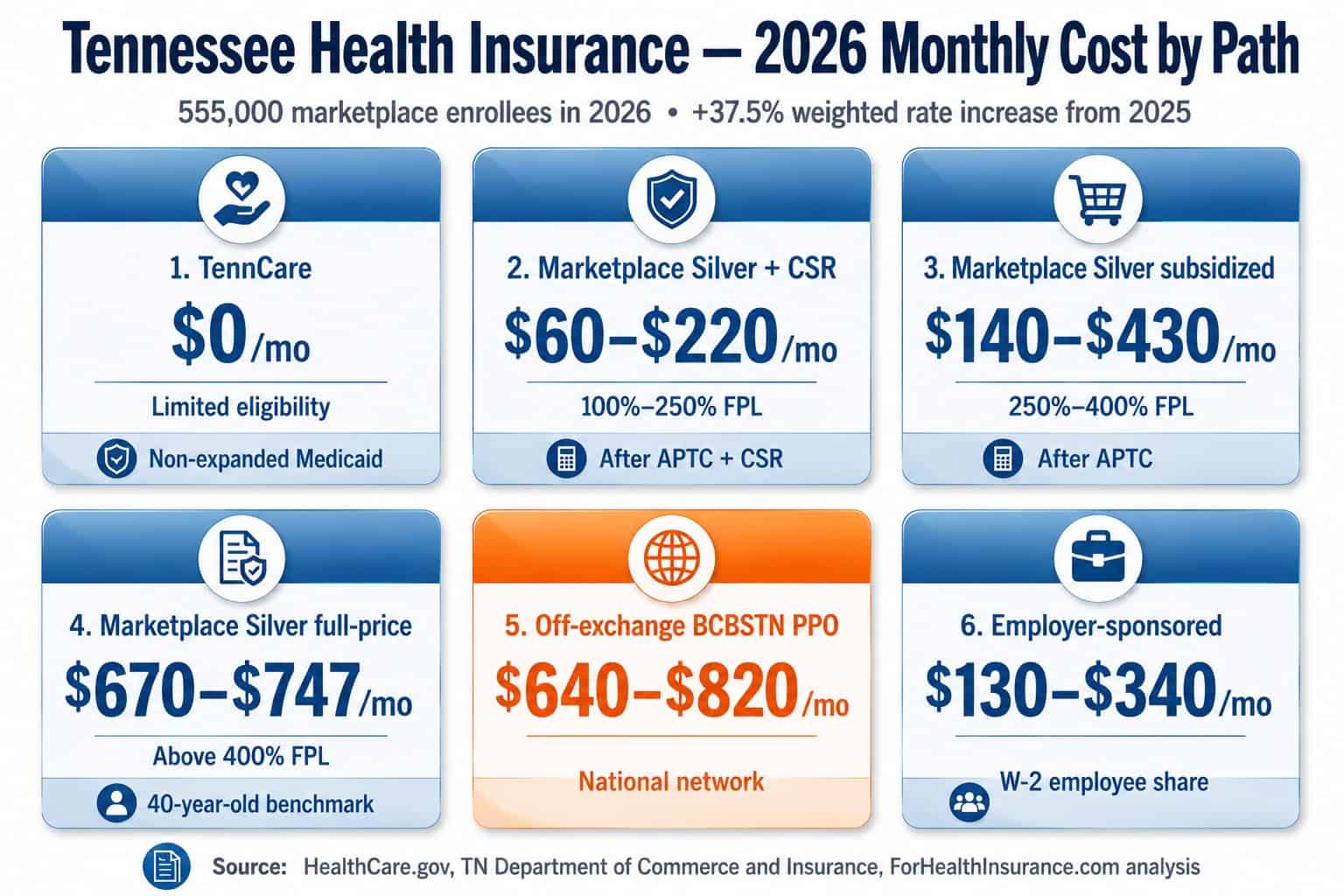
| Tennessee Coverage Path | Typical Monthly Cost (2026) | Best Fit For |
|---|---|---|
| TennCare (non-expanded Medicaid) | $0 (income-eligible) | Pregnant women, kids, disabled, limited adult groups |
| CoverKids (children only) | $0–small premium | Children up to 250% FPL |
| Marketplace Silver + CSR | $60–$220/mo (with APTC + CSR) | 100%–250% FPL |
| Marketplace Silver subsidized | $140–$430/mo (with APTC) | 250%–400% FPL |
| Marketplace Silver full-price | $670–$747/mo | 40-year-old, above 400% FPL |
| Off-exchange BCBSTN PPO | $640–$820/mo | Above 400% FPL, national network preference |
| Employer-sponsored (employee share) | $130–$340/mo | W-2 with employer offer |
Get Your Tennessee Coverage Quote
A licensed Tennessee agent screens for TennCare and CoverKids eligibility, compares marketplace plans from BlueCross BlueShield of Tennessee, Cigna, Oscar, Ambetter, UnitedHealthcare, and Alliant with subsidy calculations, and verifies your providers at Vanderbilt, Methodist Le Bonheur, Erlanger, or your local clinic. Free, no obligation.
PPO Health Insurance Options in Tennessee
PPO plans in Tennessee are dominated by BlueCross BlueShield of Tennessee, both on the marketplace and off-exchange. Most other Tennessee marketplace carriers — Cigna, Oscar, Ambetter, UnitedHealthcare, Alliant — primarily offer EPO designs that don’t cover out-of-network care outside emergencies. Tennesseans who need true PPO flexibility, broader networks, or BlueCard national reciprocity typically choose BCBSTN — and above the 400% FPL cliff, off-exchange BCBSTN PPO often produces better value than on-exchange alternatives.
Tennessee’s marketplace structure is unusual in that EPO is the dominant network design across five of the six participating carriers. Cigna, Oscar, Ambetter, UnitedHealthcare, and Alliant primarily sell EPO plans that cover in-network providers only with no out-of-network coverage outside emergencies. This works for Tennesseans whose providers are concentrated in the carrier’s network and who don’t travel — but it’s a poor fit for the substantial Tennessee population that splits time between Nashville and a second metro, travels for work in the music or healthcare industries, or has providers across multiple systems. BlueCross BlueShield of Tennessee fills the PPO gap with broad statewide networks, BlueCard reciprocity giving in-network access in all 50 states, and 12 plan options for 2026 across Bronze, Silver, and Gold.
For Tennesseans above the 400% FPL subsidy cliff, off-exchange shopping becomes more attractive because off-exchange plans (which never qualified for APTC) compete on full-price terms anyway. BCBSTN off-exchange PPO products often offer broader provider networks and BlueCard reciprocity at premium points comparable to or below on-exchange Silver — particularly after the 37.5% on-exchange rate increase for 2026. Ambetter Health Solutions also offers off-exchange ICHRA-compatible plans for Tennesseans whose employers reimburse individual coverage. For Tennesseans evaluating off-exchange PPO options statewide, off-exchange PPO health insurance plans are available by ZIP code with no referrals required. Compare every plan type on the Tennessee health insurance plans page, or start with the Tennessee health insurance marketplace guide for subsidies and enrollment.
Tennessee’s Four Major Metros: Nashville, Memphis, Knoxville, Chattanooga
Tennessee’s coverage market splits across four major metropolitan regions with distinct carrier mixes and provider networks. Nashville (Davidson County) is anchored by Vanderbilt University Medical Center and HCA TriStar; Memphis (Shelby County) by Methodist Le Bonheur and Regional One; Knoxville (Knox County) by University of Tennessee Medical Center and Covenant Health; Chattanooga (Hamilton County) by Erlanger Health System and BlueCross BlueShield of Tennessee’s headquarters. Carrier participation and plan availability vary substantially by metro.
Nashville is Tennessee’s largest market with about 715,000 residents in Davidson County and over 2 million in the metropolitan area. The healthcare anchor is Vanderbilt University Medical Center, one of the Southeast’s largest academic medical centers, plus HCA TriStar’s network of community hospitals across the metro. Nashville Tennesseans have access to all six marketplace carriers — BCBSTN, Cigna, Oscar, Ambetter, UnitedHealthcare, and Alliant — making Nashville the most competitive marketplace market in the state. The music and entertainment industry concentration in Nashville produces a substantial self-employed and freelance population that buys individual coverage rather than employer plans, with significant year-over-year network shopping.
Memphis (Shelby County, ~620,000 residents) is anchored by Methodist Le Bonheur Healthcare and Regional One Health, plus the major presence of Baptist Memorial Health Care across the metro. Memphis carrier mix includes BCBSTN, Cigna, Oscar, Ambetter, and UnitedHealthcare; Alliant does not operate in West Tennessee. FedEx headquarters in Memphis produces a large employer-sponsored coverage market, but the surrounding Mid-South region also has substantial individual marketplace enrollment. Knoxville (Knox County, ~190,000 residents) is anchored by University of Tennessee Medical Center, Tennova Healthcare, and Covenant Health, with full carrier mix availability except Alliant. Chattanooga (Hamilton County, ~365,000 residents) is BCBSTN’s home metro and the strongest market for both BCBSTN and Alliant Health Plans, plus Cigna, Ambetter, and selective UnitedHealthcare and Oscar coverage.
Rural Tennessee carrier availability is more limited than the metros
Tennessee’s 95 counties include substantial rural geography in West Tennessee, the Cumberland Plateau, the Tri-Cities region, and the Smoky Mountains. Rural Tennesseans frequently have only two to four carriers available compared to all six in major metros — typically BCBSTN (universally available), Ambetter (all 95 counties), and one or two additional carriers depending on county. For rural Tennesseans whose nearest specialist or major hospital may be in a different county or state, BCBSTN PPO with BlueCard reciprocity is often the practical choice regardless of premium considerations. Verifying carrier county availability through HealthCare.gov before enrolling is essential — plan availability is not uniform statewide.
How to Enroll in Tennessee Health Insurance
Because Tennessee does not operate a state-based exchange, enrolling for 2027 coverage runs through HealthCare.gov — the federal platform. The 2027 open enrollment window runs November 1, 2026 through December 15, 2026 — shorter than prior years due to a federal rule change. Outside open enrollment, a qualifying life event (job loss, marriage, divorce, birth, move) is required to enroll. TennCare and CoverKids are year-round programs.
HealthCare.gov automatically screens applicants for TennCare and CoverKids eligibility before displaying marketplace plan options. Tennesseans who qualify for TennCare are routed to the Tennessee Division of TennCare; those above marketplace eligibility thresholds see plans from all six Tennessee carriers — BCBSTN, Cigna, Oscar, Ambetter, UnitedHealthcare, and Alliant — with subsidy amounts calculated in real time. The 2027 open enrollment is shorter than the 2026 cycle: it ends December 15, 2026 with no extension. Tennesseans who miss the December 15 deadline must qualify for a special enrollment period to enroll for 2027.
Tennessee residents who want help with the application can work with a free Navigator through Tennessee’s network of HealthCare.gov-certified navigators, listed through the Tennessee Department of Commerce and Insurance. The federal HealthCare.gov call center (1-800-318-2596) is also available 24/7. Tennesseans who prefer a licensed broker rather than a navigator — particularly those evaluating off-exchange BCBSTN PPO alongside marketplace plans — can work with ForHealthInsurance.com at 888-215-4045. For the Tennessee Department of Commerce and Insurance’s official consumer guide and rate filing information, see Tennessee Department of Commerce and Insurance.
Frequently Asked Questions
Common questions about coverage in the state cover whether Tennessee has its own exchange (it doesn’t — federal HealthCare.gov), whether TennCare was expanded (no — coverage gap exists), why premiums spiked 37.5% for 2026, which carrier offers the broadest network, and whether PPO plans are available.
Does Tennessee have a state-based health insurance exchange?
No. Tennessee uses the federally-facilitated marketplace at HealthCare.gov rather than operating a state-based exchange. Tennessee residents enroll, compare plans, and apply for premium tax credits through HealthCare.gov — the same federal platform used by 30 states for the 2026 plan year. Six carriers participated in the Tennessee marketplace for 2026: BlueCross BlueShield of Tennessee, Cigna Healthcare, Oscar Insurance, Celtic/Ambetter, UnitedHealthcare, and Alliant Health Plans. About 555,000 Tennesseans selected marketplace plans for 2026 coverage, making the marketplace the backbone of individual Tennessee health insurance.
Did Tennessee expand Medicaid?
No. Tennessee is one of the 10 states that have not adopted the Affordable Care Act’s Medicaid expansion. TennCare — Tennessee’s Medicaid program — covers pregnant women, children, certain people with disabilities, and other limited eligibility groups, but does not provide a coverage pathway for non-disabled, non-pregnant adults below 100% of the federal poverty level. This creates Tennessee’s well-documented coverage gap: residents below 100% of FPL are typically ineligible for both TennCare and marketplace premium tax credits, while those between 100% and 400% of FPL qualify for marketplace subsidies on HealthCare.gov, the engine that keeps Tennessee health insurance affordable for most enrollees.
Why did Tennessee health insurance premiums increase 37.5% for 2026?
Tennessee marketplace premiums increased an average of 37.5% (weighted) for 2026 — among the largest single-year increases in eight years nationally. Three factors drove the increase: the December 31, 2025 expiration of the American Rescue Plan and Inflation Reduction Act enhanced subsidies, which removed federal premium support above 400% of FPL and reduced subsidies for many lower-income enrollees; rising medical costs across hospitals, prescriptions, and procedures throughout 2024 and 2025; and carrier projections of a sicker risk pool as healthier enrollees drop coverage at higher prices. Approved 2026 increases by carrier: BlueCross BlueShield of Tennessee about 41%, Celtic/Ambetter about 38%, Oscar about 28%, and Alliant Health Plans about 0.3%.
Which is the best health insurance carrier in Tennessee?
The best Tennessee carrier depends on your providers, region, and care-use pattern. BlueCross BlueShield of Tennessee is the dominant statewide carrier with the broadest provider network, BlueCard national reciprocity, and 12 plan options across Bronze, Silver, and Gold tiers for 2026 — the strongest fit for Tennesseans who travel or have providers across multiple systems. Cigna Healthcare offers low-deductible options with strong primary care and specialist coverage in Nashville, Knoxville, Chattanooga, and Memphis. Oscar Insurance offers the lowest average premiums statewide. Ambetter (Celtic) covers all 95 Tennessee counties with predictable cost-sharing. Alliant Health Plans serves North Georgia and Southeast Tennessee with competitive EPO pricing. UnitedHealthcare offers broader networks in major metros. Verify your specific physicians and preferred hospitals against each carrier’s provider directory before enrolling.
Can I get a PPO health insurance plan in Tennessee?
Yes. PPO plans are available in Tennessee through both on-exchange and off-exchange channels. BlueCross BlueShield of Tennessee is the dominant PPO carrier statewide, offering broad provider networks and BlueCard national reciprocity that gives Tennesseans in-network access in all 50 states. Most other Tennessee marketplace carriers — Cigna, Oscar, Ambetter, Alliant — primarily offer EPO designs, which provide in-network coverage statewide but no out-of-network coverage outside emergencies. Tennesseans who need true PPO flexibility, broader networks, or national reciprocity often choose BlueCross BlueShield off-exchange or evaluate off-exchange PPO products from carriers including Ambetter Health Solutions for ICHRA-compatible plans.
Compare 2026 TN Marketplace Plans
A licensed agent compares all six Tennessee carriers — BlueCross BlueShield of Tennessee, Cigna, Oscar, Ambetter, UnitedHealthcare, and Alliant — calculates your APTC and CSR amounts, screens for TennCare and CoverKids eligibility, and verifies your providers at Vanderbilt, Methodist Le Bonheur, Erlanger, UT Medical Center, or your local clinic. Free, no obligation.
Free TN coverage comparison — covers all carriers and programs in one call.
Related Tennessee Health Insurance Resources
HealthCare.gov enrollment, 2027 open enrollment window, subsidies, and the application walkthrough.
TN Health Insurance PlansBCBSTN, Cigna, Oscar, Ambetter, UHC, Alliant compared by tier, network, and design.
Affordable Coverage in Tennessee2026 subsidies, average costs, and strategies to lower your premium after the 37.5% increase.
Individual Health Insurance TennesseeSelf-employed, freelance, and individual coverage paths — on-exchange and off-exchange.
KFF Tennessee Health FactsIndependent state-level data on coverage, the uninsured rate, and the marketplace.
HealthCare.gov (Official)Tennessee’s official federal marketplace enrollment portal for 2027 plans.
Tennessee Division of TennCareTennCare and CoverKids applications and eligibility information.
TN Department of Commerce & InsuranceCarrier rate filings, consumer complaints, and licensed agent verification.
Broker Disclosure
ForHealthInsurance.com is an independent health insurance agency serving Tennessee residents. We are not affiliated with any carrier or government agency. We help you compare plans and enroll in coverage that meets your needs at no extra cost to you.