Best Health Insurance in Vermont 2026: BCBSVT vs MVP
This guide compares Vermont’s two health insurance carriers for 2026 — Blue Cross Blue Shield of Vermont and MVP Health Care — to help you decide which plan fits your situation. Vermont’s individual market has no PPO plans, no third carrier, and a single statewide price zone. The comparison here is narrower than most states, which makes the decision cleaner.

What brings you here today?
Two Carriers, Two Network Types — The Vermont Decision
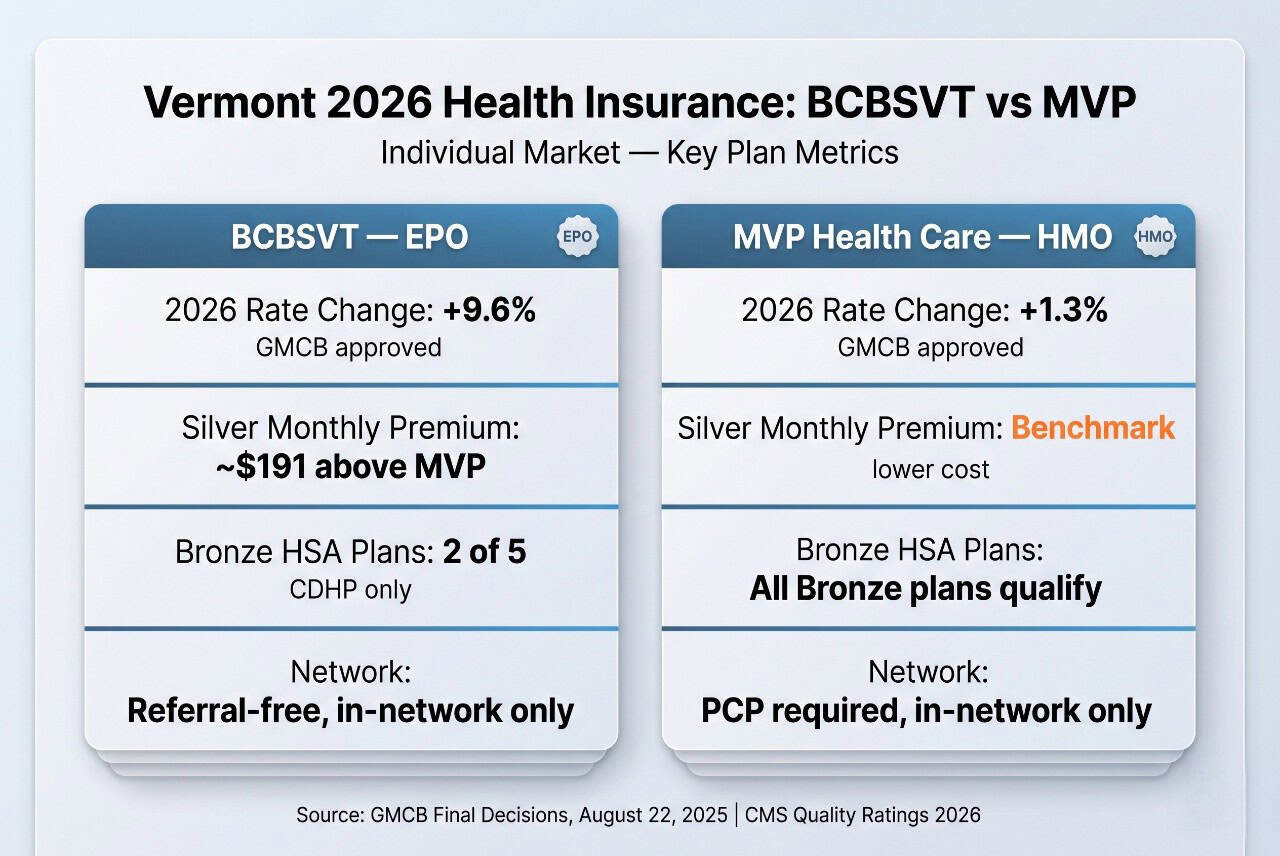
Vermont’s individual market offers exactly two choices for 2026: Blue Cross Blue Shield of Vermont (BCBSVT), the state’s only EPO carrier, and MVP Health Care, which sells HMO plans statewide. Both received perfect CMS quality scores of 5 out of 5. The Green Mountain Care Board approved a 9.6% increase for BCBSVT individual plans and 1.3% for MVP — widening an already significant premium gap between the two carriers.
In most ACA states, “choosing the best plan” means filtering through dozens of carriers across multiple counties with different prices. Vermont removed almost all of that complexity. There is no Aetna, no Ambetter, no Oscar, no Cigna in Vermont’s individual market. The choice is structural: do you want an EPO that removes the referral requirement but costs more, or an HMO that costs less but requires a primary care physician gatekeeper?
Because Vermont prohibits age rating — one of only two states that do, alongside New York — the premium difference between BCBSVT and MVP is consistent across all ages. A 30-year-old and a 60-year-old face the same $191/month average gap between BCBSVT Silver and MVP Silver. That consistency makes the financial comparison straightforward regardless of your age.
BCBSVT vs MVP: A Direct 2026 Comparison
MVP Health Care’s Silver HMO averages roughly $191 less per month than BCBSVT’s Silver EPO — a $2,292 annual difference. Both carriers earned identical CMS quality scores of 5 out of 5. The GMCB approved a 1.3% MVP rate increase and 9.6% for BCBSVT for 2026, continuing a multi-year trend of BCBSVT premiums outpacing MVP. For most Vermont enrollees, the decision is whether the EPO’s referral-free structure justifies $191/month.
Blue Cross Blue Shield of Vermont
- Network type: EPO (no referrals needed)
- 2026 individual rate: +9.6% (GMCB approved)
- Silver tier avg: ~$191/mo above MVP Silver
- HSA-eligible Bronze: 2 of 5 plans (CDHPs)
- Platinum: $1,580/mo, $500 deductible, $1,600 OOP max
- CMS quality score: 5 of 5
- Financial status: Under enhanced DFR supervision (Aug 2025)
MVP Health Care
- Network type: HMO (PCP referrals required)
- 2026 individual rate: +1.3% (GMCB approved)
- Silver tier avg: Benchmark (lower-cost carrier)
- HSA-eligible Bronze: All Bronze plans qualify
- Platinum: $1,366/mo, $500 deductible, $1,500 OOP max
- CMS quality score: 5 of 5
- Enrollees (Feb 2025): 9,312 policyholders, 12,790 effectuated
| Factor | BCBSVT (EPO) | MVP Health Care (HMO) |
|---|---|---|
| Network type | EPO — no referrals, in-network only | HMO — PCP required, referrals for specialists |
| 2026 GMCB-approved rate change | +9.6% | +1.3% |
| Silver monthly premium gap | ~$191/mo higher than MVP | Benchmark Silver plan |
| Bronze deductible (typical Silver equiv.) | Higher on non-CDHP plans | $3,050 Silver deductible |
| HSA-eligible plans | 2 Bronze CDHPs | All Bronze plans |
| Platinum monthly cost | $1,580/mo | $1,366/mo |
| Out-of-state BlueCard access | Yes — BlueCard PPO network | No — emergencies only |
| CMS quality score (2026) | 5 of 5 | 5 of 5 |
| NCQA accreditation | Accredited | Accredited |
Rate source: GMCB final decisions issued August 22, 2025. Full rate decision documents are published at gmcboard.vermont.gov. BCBSVT was placed under enhanced supervision by the Department of Financial Regulation in August 2025 due to solvency concerns — enrollees should verify network and billing stability before enrolling.
Is There a PPO Option in Vermont?
Vermont has no individual PPO plans in 2026. BCBSVT sells EPO plans and MVP sells HMO plans — both restrict coverage to in-network providers except for emergencies. BCBSVT’s EPO removes the referral requirement (no gatekeeper before seeing a specialist) but still limits coverage to its in-network EPO roster. No Vermont individual plan provides out-of-network coverage as a standard benefit.
The distinction matters most for Vermonters who see providers across state lines regularly. MVP’s HMO restricts you to in-network care with no out-of-network reimbursement outside emergencies. BCBSVT’s EPO gives access to the BlueCard PPO network when traveling out of state, which means out-of-state BlueCard providers bill at in-network rates — a meaningful advantage for Vermonters who receive regular care at Dartmouth-Hitchcock Medical Center in Lebanon, New Hampshire, or other New England institutions.
Vermonters who need a true PPO network — no referrals and genuine out-of-network reimbursement — can explore PPO health insurance plans available through employer-sponsored coverage or off-exchange options in neighboring states if they have dual-state residency situations. For most individual market buyers in Vermont, the choice is EPO or HMO, and the premium difference of roughly $191 per month is the primary decision factor.
BCBSVT BlueCard advantage: BCBSVT EPO enrollees traveling or living near state borders can access the BlueCard PPO network — a national network of providers who agree to Blue Cross rates. This is particularly relevant for Vermonters in the Upper Connecticut River Valley who use Dartmouth-Hitchcock Medical Center or White River Junction VA Medical Center in New Hampshire.
How to Choose: MVP HMO or BCBSVT EPO
Choose MVP if your current doctors are in-network, you are comfortable with a primary care gatekeeper, and the $191/month premium savings is more valuable than referral-free specialist access. Choose BCBSVT if you regularly see specialists without referrals, use Dartmouth-Hitchcock or out-of-state providers, or your conditions require frequent cross-specialty coordination.
Choose MVP Health Care if…
Your primary care doctor and specialists are already in MVP’s HMO network. You see a doctor once or twice a year for routine care. The $191/month premium savings matters more than flexibility. You primarily use University of Vermont Medical Center or Rutland Regional facilities. You want all Bronze plans to be HSA-eligible.
Choose BCBSVT EPO if…
You see multiple specialists and want no referral friction. You receive regular care at Dartmouth-Hitchcock in Lebanon, NH, or other out-of-Vermont BlueCard providers. You have ongoing conditions requiring frequent specialist coordination. You want the Platinum plan’s very low $500 deductible and $1,600 out-of-pocket max.
Scenario: Rutland couple, ages 52 and 54
A married couple in Rutland — both in their early 50s — earns $78,000 combined in 2026. Under Vermont’s no-age-rating rule, both pay the same premiums regardless of their ages. They shop Vermont Health Connect together. MVP Silver HMO sticker price: approximately $1,700/month for both before subsidies. BCBSVT Silver EPO sticker price: approximately $2,082/month for both. After federal APTC and Vermont Premium Assistance, MVP Silver nets to roughly $490/month and BCBSVT Silver to about $872/month. The woman sees a cardiologist in Burlington quarterly — already in MVP’s network — so they choose MVP and bank $382/month.
2026 Plan Highlights by Metal Tier
All Bronze and Catastrophic plans on Vermont’s exchange are HSA-eligible for 2026 — an expansion from prior years. MVP’s entire Bronze lineup qualifies for an HSA, while BCBSVT’s two HSA-eligible Bronze CDHPs start at around $945/month. The Platinum tier offers Vermont’s most comprehensive out-of-pocket protection: MVP Platinum at $1,366/month and a $500 deductible, BCBSVT Platinum at $1,580/month and a $1,600 out-of-pocket maximum.
| Tier | BCBSVT Highlights | MVP Highlights |
|---|---|---|
| Bronze | 5 plans; 2 HSA-eligible CDHPs; non-HSA Bronze from ~$933/mo | All plans HSA-eligible; lowest-cost Bronze in VT market |
| Silver | Referral-free EPO; higher premium; CSR-eligible for subsidy enrollees | $3,050 deductible; benchmark Silver plan; CSR-eligible |
| Gold | Lower deductible EPO option; strong for frequent care | Lower premium than BCBSVT Gold; HMO gatekeeper applies |
| Platinum | $1,580/mo; $500 deductible; $1,600 OOP max; EPO referral-free | $1,366/mo; $500 deductible; $1,500 OOP max; HMO referral required |
| Catastrophic | Under 30 or hardship exemption; HSA-eligible | Under 30 or hardship exemption; HSA-eligible |
2026 HSA opportunity: Vermont’s decision to make all Bronze and Catastrophic plans HSA-eligible for 2026 opens a tax-advantaged savings window for healthy adults who rarely use insurance. A 40-year-old Vermonter on an MVP Bronze HMO who contributes the 2026 HSA limit of $4,300 (individual) effectively reduces their net health care cost by that amount in pre-tax dollars, lowering the real cost of the plan further beyond the sticker premium.
Not sure which Vermont carrier is right for you?
A licensed agent compares BCBSVT and MVP across your providers, budget, and 2026 subsidy eligibility — at no cost to you.
Provider Networks: UVM Medical Center and Dartmouth-Hitchcock
University of Vermont Medical Center in Burlington is Vermont’s largest academic medical center and the primary tertiary care hospital for most of the state. Dartmouth-Hitchcock Medical Center in Lebanon, New Hampshire, is the dominant provider for southeastern Vermont and the Upper Connecticut River Valley. Both carriers generally include UVM Medical Center in-network; BCBSVT’s BlueCard access gives EPO enrollees a significant advantage for Dartmouth-Hitchcock access.
Vermont’s hospital landscape is shaped by two major systems. The University of Vermont Health Network encompasses UVM Medical Center plus affiliate hospitals in Burlington, Montpelier, Berlin, St. Albans, and Plattsburgh, NY. Rutland Regional Medical Center operates independently in central Vermont. MVP’s HMO network is well established at UVM Health Network facilities. BCBSVT’s EPO network historically covered southern Vermont hospitals more deeply, including Brattleboro Memorial Hospital and Springfield Medical Care.
Before enrolling in either plan, check the carrier’s online provider directory at Vermont Health Connect to confirm that your primary care physician and any current specialists are in-network. If you are switching carriers — for example, from BCBSVT to MVP to capture the lower premium — verify that your doctors accept MVP’s HMO before completing enrollment. Plan changes take effect at the start of the next coverage period and cannot be reversed mid-month. The NCQA plan ratings tool provides independent quality assessments for both carriers.
Related Vermont Health Insurance Resources
Frequently Asked Questions
Which is better — BCBSVT or MVP Health Care in Vermont?
For most Vermonters with established in-network care, MVP Health Care’s Silver HMO is the better value: roughly $191 less per month than BCBSVT Silver, a $3,050 deductible, and identical CMS quality scores. BCBSVT EPO is better for people who see specialists regularly and want to skip PCP referrals, or who use Dartmouth-Hitchcock as a primary institution.
Is there a PPO health insurance plan available in Vermont?
No. Vermont’s individual market has no PPO plans in 2026. BCBSVT sells EPO plans and MVP sells HMO plans — both require in-network care except for emergencies. BCBSVT’s EPO eliminates the referral requirement but still restricts coverage to in-network providers. Vermonters who need out-of-network access typically rely on employer-sponsored PPO coverage or move off-exchange.
Do both Vermont carriers have the same quality ratings?
Yes. Both BCBSVT and MVP Health Care received perfect CMS quality ratings of 5 out of 5 for the 2026 plan year. Neither carrier separates itself on quality metrics, so the choice between them comes down to network type, premium, and provider relationships.
What was the approved rate change for Vermont carriers in 2026?
The Green Mountain Care Board approved a 9.6% individual market increase for BCBSVT (down from 23.5% requested) and 1.3% for MVP (down from 6.2% requested), effective January 1, 2026. These were among the lowest approved increases in the country.
Does my doctor take Vermont Health Connect plans?
You need to check each carrier’s provider directory before enrolling. MVP’s HMO network requires all care to be in-network, and switching from BCBSVT to MVP means confirming your primary care doctor and specialists participate in MVP’s network. Both carriers generally cover care at the University of Vermont Medical Center and most Vermont hospitals, but network specifics vary.
Are HSA-eligible plans available in Vermont for 2026?
Yes. All Bronze and Catastrophic plans on Vermont’s exchange are HSA-eligible for 2026. MVP offers HSA-eligible CDHPs across its entire Bronze lineup. BCBSVT offers 2 HSA-eligible Bronze CDHPs. A Health Savings Account lets you set aside pre-tax dollars for qualified medical expenses, lowering your effective annual cost.
Get a free Vermont health insurance quote
Compare BCBSVT and MVP with a licensed agent who knows Vermont’s two-carrier market and your local provider networks.
Broker Disclosure
ForHealthInsurance.com is an independent health insurance agency serving Vermont residents. We are not affiliated with any carrier or government agency. We help you compare plans and enroll in coverage that meets your needs at no extra cost to you.