Affordable Health Insurance in North Carolina: 2026 Medicaid, Subsidies & Low-Cost Plans
Affordable health insurance in North Carolina for 2026 rests on two pillars that didn’t exist three years ago: a Medicaid expansion that brought 600,000+ residents into comprehensive coverage since December 2023, and a marketplace where premium tax credits — though reduced from their enhanced levels — still cap premiums as a percentage of income for households below 400% FPL. The coverage gap that once trapped hundreds of thousands of North Carolinians between Medicaid and marketplace eligibility is closed. NC Health Choice covers children up to 211% FPL, and total Medicaid and CHIP enrollment exceeds 2.9 million — roughly one in four residents. But the expiration of enhanced subsidies at the end of 2025 created a new affordability challenge: the return of the subsidy cliff and a weighted-average 2026 rate increase of about 28% statewide. This guide covers every pathway to affordable health insurance in North Carolina — and where to find genuinely cheap health insurance in the state at each income level.

Where does your household fall?
NC Medicaid Expansion: From Coverage Gap to 600,000 Enrolled
North Carolina expanded Medicaid on December 1, 2023 — closing a coverage gap that had trapped hundreds of thousands of residents. Adults ages 19–64 with income up to 138% FPL (about $20,782 single or $42,780 for a family of four) now qualify. More than 600,000 North Carolinians enrolled in the first year. NC Medicaid covers doctor visits, dental, vision, prescriptions, and behavioral health with no monthly fee and copays capped at $4.
The expansion transformed affordable health insurance in North Carolina, especially in rural areas. Before December 2023, a single adult in Robeson County earning $15,000/year — too much for pre-expansion Medicaid, too little for marketplace subsidies — had no affordable coverage path. That gap is now closed. Rural counties including Edgecombe, Robeson, and Swain saw over 12% of their adult populations enroll in Medicaid, and on launch day nearly 300,000 residents who had been receiving Medicaid Family Planning benefits were auto-enrolled into full comprehensive coverage. Medicaid covered more than 1,000,000 prescriptions for new enrollees in the first five months and $17.9 million in dental claims — services many expansion enrollees had gone without for years. The NC market overview shows where Medicaid fits among all 2026 coverage options.
Enrollment is year-round through NC DHHS via ePASS, by phone at 1-888-245-0179, or through local Department of Social Services offices. HealthCare.gov applications automatically screen for Medicaid eligibility — adults under 138% FPL are transferred to NC DHHS rather than being offered marketplace plans. Processing takes up to 45 days, but online applications are generally faster.
Marketplace Subsidies After the Enhanced Credit Expiration
Premium tax credits still make affordable health insurance in North Carolina possible for households between 138% and 400% FPL, but the enhanced subsidies in place since 2021 expired at the end of 2025. The subsidy cliff returned — NC residents above 400% FPL receive no credit. Below 400% FPL, credits cap the benchmark Silver as a percentage of income, and about 46% of NC marketplace enrollees received cost-sharing reductions in 2025.
The practical impact is severe. In 2025, about 70% of NC enrollees paid less than $50/month after subsidies. North Carolina’s 2026 marketplace rates rose by a weighted average of about 28% — and with the enhanced credits gone, the average net premium NC enrollees actually pay jumped roughly 85% for 2026, even though many downgraded to lower-premium Bronze plans. Credits reconcile at tax time via IRS Form 8962, and cost-sharing reductions apply automatically to Silver plans under 250% FPL — dramatically reducing deductibles at no additional premium — the backbone of affordable health insurance in North Carolina below 250% FPL. The NC marketplace guide walks through after-subsidy enrollment across all available carriers by county.
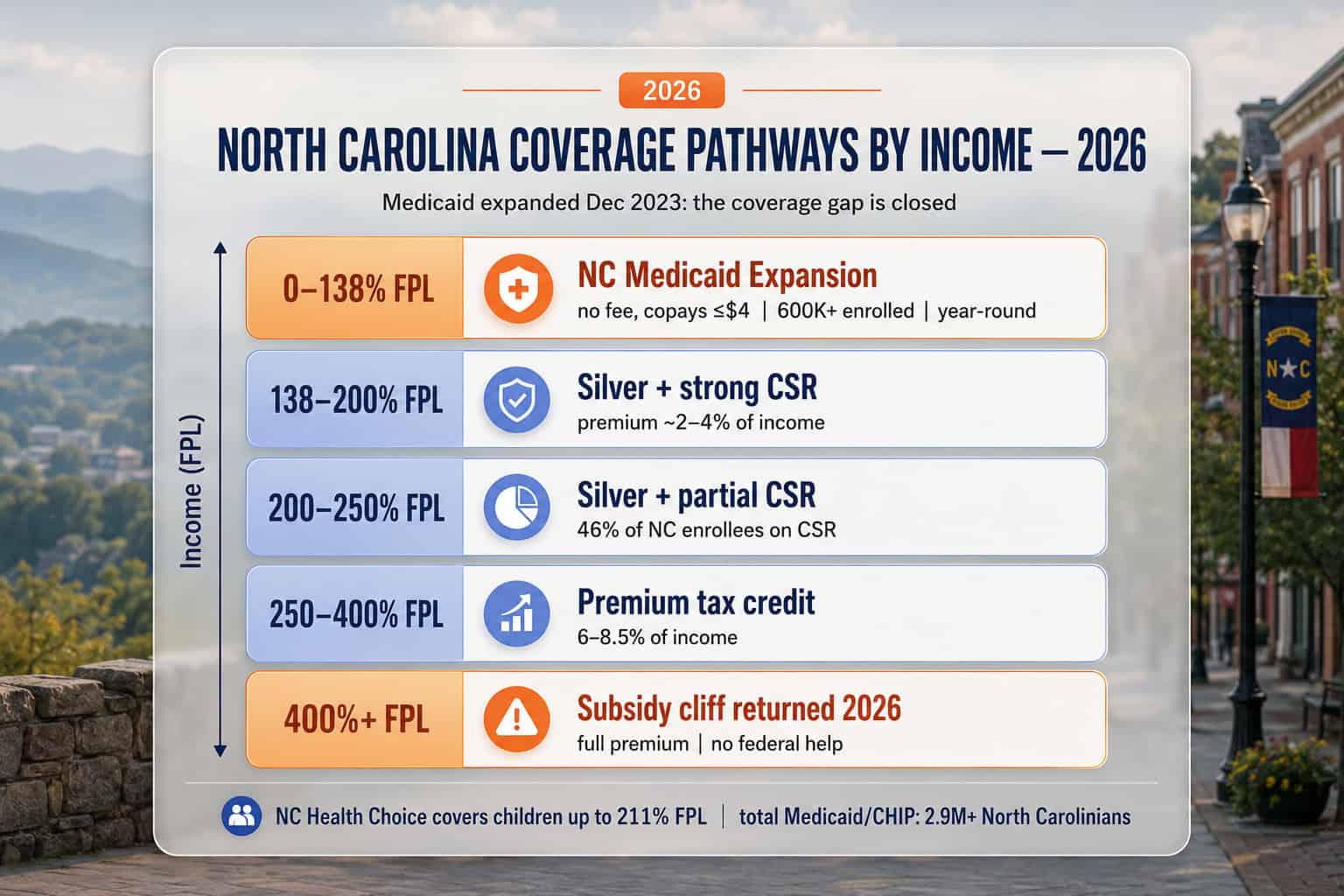
| Household Income (% FPL) | Best NC Coverage Path | Typical Net Cost |
|---|---|---|
| Under 138% FPL | NC Medicaid expansion | $0/month (copays ≤$4) |
| 138%–150% FPL | Silver + strong CSR | ~$0–$40/month |
| 150%–200% FPL | Silver + CSR | ~$40–$150/month |
| 200%–250% FPL | Silver + limited CSR | ~$150–$280/month |
| 250%–400% FPL | Silver or Bronze + subsidy | ~$280–$500/month |
| 400%+ FPL | Full-price marketplace or off-exchange | $540+/month (cheapest Silver) |
NC Health Choice: Children’s Coverage Up to 211% FPL
NC Health Choice — North Carolina’s CHIP program — covers children with household income up to 211% FPL (about $64,400 for a family of four). The program was folded into NC Medicaid in April 2023, simplifying enrollment into a single ePASS application. NC Health Choice provides comprehensive coverage including preventive care, dental, vision, and mental health services, and the provider network is the same as Medicaid. Total NC Medicaid and CHIP enrollment exceeds 2.9 million.
Many NC families where parents purchase marketplace plans can enroll children in NC Health Choice at lower cost than adding them to the parents’ marketplace Silver plan. A Fayetteville family earning $55,000 with two children may qualify for NC Health Choice for the kids (no premium) while the parents buy an Ambetter Silver plan with subsidies — one of the most reliable routes to cheap health insurance in North Carolina for whole families. The ePASS application screens for both Medicaid and Health Choice eligibility simultaneously. Apply year-round through NC DHHS or your local DSS office — no Open Enrollment restriction applies to children’s coverage.
Find the Most Affordable NC Coverage for 2026
Check NC Medicaid eligibility, marketplace subsidy qualification, and NC Health Choice for children. Licensed enrollment assistance walks through every affordable North Carolina coverage pathway at no cost — serving Charlotte, the Triangle, the Triad, Asheville, Fayetteville, Wilmington, and rural NC.
The Subsidy Cliff Is Back: What NC Residents Above 400% FPL Face
The return of the subsidy cliff in 2026 hits North Carolina hard. Under enhanced subsidies (2021–2025), NC residents above 400% FPL had premiums capped at 8.5% of income. Now, a single 50-year-old in Wake County earning $63,000 — just over the 2026 cliff of $62,600 (400% FPL for a single adult) — pays the full Silver premium of about $1,000/month ($12,000/year) with no tax credit. At $62,000, just under the cliff, the same person’s benchmark premium is capped near 8.5% of income — roughly $440/month. That $1,000 income difference creates about a $6,700/year cost swing.
Managing the cliff requires MAGI strategy. HSA contributions ($4,400 for 2026), traditional IRA contributions ($7,500, or $8,600 if 50+), and business-expense timing can lower MAGI below 400% FPL for self-employed and variable-income North Carolinians.
Worked example — Charlotte financial advisor, $68,000/year
A Charlotte independent financial advisor earning $68,000 who maximizes both HSA ($4,400) and traditional IRA ($7,500) contributions brings MAGI to about $56,100 — well below the 2026 cliff of $62,600, unlocking affordable health insurance in North Carolina through subsidized marketplace coverage instead of paying the full Silver premium.
The NC individual plan guide covers self-employed deduction strategies alongside cliff management.
NC cliff warning for dual-income households: A couple in the Triangle both earning $32,000 ($64,000 combined, about 310% FPL) qualifies for substantial subsidies. If one partner picks up a side consulting contract pushing household income to $65,000, the subsidy amount adjusts — and if it crosses 400% FPL, the cliff eliminates all help. Tracking projected MAGI quarterly and updating HealthCare.gov mid-year prevents a painful tax-time surprise.
Five Strategies for the Cheapest NC Coverage
Finding cheap health insurance in North Carolina requires matching your income band to the right coverage path. Under 138% FPL: NC Medicaid at $0. Under 250% FPL: Silver with cost-sharing reductions (deductibles drop from $5,000+ to under $1,000). Above 250% FPL with minimal care: Bronze saves monthly spend. Above 400% FPL: MAGI-reduction strategies to get below the cliff. In multi-carrier counties: shop Ambetter and Oscar against Blue Cross NC — Ambetter is cheapest in 41% of NC.
County-level carrier comparison is the most underused tool for affordable health insurance in North Carolina. A Mecklenburg County resident with access to six carriers should not default to Blue Cross NC without checking Oscar ($575 Silver, +16.9% rate increase) and Ambetter ($540 Silver) — the kind of comparison the NC carrier comparison guide lays out side by side. A rural Bertie County resident with only Blue Cross NC should evaluate network tiers — Blue Local is significantly cheaper than Blue Home, though the network is narrower. NC’s HealthCare.gov window-shopping tool shows every available option by ZIP code with subsidy calculations applied.
Affordability Questions From North Carolina Residents
Who qualifies for NC Medicaid expansion?
Adults ages 19–64 with household income up to 138% FPL — about $20,782 for a single adult or $42,780 for a family of four. No asset test applies. Coverage includes doctor visits, dental, vision, prescriptions, behavioral health, and hospital care with no monthly fee and copays capped at $4. Apply year-round at ePASS, by calling 1-888-245-0179, or at your local DSS office. More than 600,000 have enrolled since December 2023.
What is NC Health Choice?
NC Health Choice is North Carolina’s CHIP program covering children with household income up to 211% FPL (about $64,400 for a family of four). It was folded into NC Medicaid in April 2023, simplifying enrollment through the same ePASS application, and the provider network is the same as Medicaid. Benefits include preventive care, dental, vision, and mental health. Enrollment is year-round.
How do marketplace subsidies work in NC after the enhanced credits expired?
Premium tax credits still exist for NC residents under 400% FPL — they cap the benchmark Silver premium as a percentage of income. But the enhanced subsidies that extended help above 400% FPL and made premiums even cheaper below 400% expired at the end of 2025. The subsidy cliff returned: no help above 400% FPL. In 2025, about 70% of NC enrollees paid less than $50/month after subsidies. For 2026, NC marketplace rates rose by a weighted average of about 28%, and the average net premium enrollees pay rose roughly 85%.
What is the subsidy cliff and how do I avoid it?
The subsidy cliff is the income threshold at 400% FPL — for 2026 coverage, $62,600 single / $128,600 family of four — where marketplace premium tax credits drop to zero. A single person earning $62,000 still gets help; at $63,000, none. HSA contributions ($4,400), traditional IRA contributions ($7,500, or $8,600 if 50+), and business-expense timing can lower MAGI below the cliff. Track projected MAGI quarterly.
Is there still a coverage gap in North Carolina?
No. North Carolina closed the coverage gap when Medicaid expansion took effect December 1, 2023. Before expansion, adults above pre-expansion Medicaid thresholds but below 100% FPL had no subsidized coverage path. That gap no longer exists — every income level has a pathway to coverage through either NC Medicaid, subsidized marketplace plans, or full-price marketplace enrollment.
Which carrier has the cheapest Silver in North Carolina?
It depends on county. Ambetter from Centene offers the cheapest Silver in about 41% of NC (around $540/month for a 40-year-old). Oscar Health has the cheapest Silver in Charlotte at $575/month, and Blue Cross NC runs $584/month in Raleigh. In rural counties where Blue Cross NC is the only carrier, compare its Blue Local (cheapest, narrowest) and Blue Home (broader, pricier) tiers. After subsidies, most pay significantly less than sticker price.
Related North Carolina Health Insurance Resources
Affordability depends on matching your income to the right pathway. Compare every North Carolina coverage option side by side.
The statewide pillar — 2026 carriers, costs, Medicaid expansion, and how coverage works in NC.
Best Health Insurance in NCBlue Cross NC, Ambetter, and Oscar compared on networks, PPO access, and value.
Individual Health Insurance in NCPrivate ACA plans and self-employed deduction strategies for Triangle and Charlotte workers.
NC Marketplace & HealthCare.govHow to enroll, qualify for subsidies, and claim premium tax credits in North Carolina.
Short-Term Coverage in NCTemporary plans for gaps between jobs — and why subsidized ACA or Medicaid usually wins.
PPO Health Insurance PlansNationwide PPO coverage options for individuals who want broad provider networks.
Explore Every NC Affordability Pathway
Check NC Medicaid eligibility, marketplace subsidies, NC Health Choice, and cliff-management strategies. Licensed enrollment assistance at no cost — serving every North Carolina county.
Broker Disclosure
ForHealthInsurance.com is an independent health insurance agency serving North Carolina residents. We are not affiliated with any carrier or government agency. We help you compare plans and enroll in coverage that meets your needs at no extra cost to you.