Short Term Health Insurance in Nevada 2026: Rules, Limits, and Better Alternatives
Short term health insurance Nevada residents can buy in 2026 looks attractive on the surface — low monthly premiums, fast approval, coverage that starts the next day. The reality is more complicated. Federal rules effective September 1, 2024 cap short-term limited duration insurance (STLDI) at four months total including renewals, and Nevada Administrative Code separately limits these plans to 185 days. STLDI plans can deny coverage for preexisting conditions, exclude maternity care, prescriptions, and mental health, and aren’t required to cover the ten essential health benefits that ACA-compliant plans must include. For most Nevadans facing a coverage gap, a Special Enrollment Period through Nevada Health Link is a better answer than short term health insurance in Nevada — and that’s the comparison this page walks through honestly.

What brings you here today?
What Is Short Term Health Insurance in Nevada?
Nevada Administrative Code caps short-term limited duration insurance (STLDI) at 185 days, and Nevada Health Link openly warns consumers against relying on it — but the binding limit is the federal rule effective September 1, 2024: a three-month initial term and four-month total maximum. STLDI is the off-exchange, medically underwritten coverage sold to fill brief gaps between jobs; it isn’t subject to Affordable Care Act consumer protections.
Short term health insurance in Nevada is fundamentally different from a Nevada Health Link plan. STLDI is medically underwritten, meaning the insurance company can ask about your medical history and decline applications based on preexisting conditions. STLDI is not required to cover the ten essential health benefits — including maternity care, mental health services, prescription drugs outside hospital settings, and preventive care that ACA-compliant plans must include. Annual and lifetime benefit caps are allowed on STLDI plans, which are prohibited on ACA-compliant plans.
The federal rule change in 2024 was a significant tightening. Before September 1, 2024, STLDI plans could last up to 364 days with renewal terms extending coverage to 36 months. The new rules cap initial terms at three months and total duration including renewals at four months. The rule also bans “stacking” — buying consecutive STLDI policies from the same insurer (or affiliated insurers) within 12 months — to prevent the practice of using STLDI as a long-term substitute for comprehensive coverage.
Nevada Health Link’s official position on STLDI
The state of Nevada has issued explicit consumer warnings about short-term plans. Nevada Health Link’s STLDI fact sheet states that these plans “may think they have coverage but with little benefit,” noting that STLDI plans are allowed to deny coverage based on preexisting conditions, charge higher premiums based on age or gender, and drop enrollees if they’re diagnosed with a medical condition after enrolling. The state’s recommendation is to exhaust ACA-compliant alternatives — including Special Enrollment Periods, Medicaid eligibility checks, and catastrophic plans — before considering STLDI.
What Short Term Health Insurance Nevada Plans Actually Cover
For a healthy under-35 Nevadan, STLDI premiums run $80 to $250 a month — but the coverage behind that price is thin. Short-term plans in Nevada typically cover hospitalization, ER visits, and some doctor visits while capping benefits at $1 million to $2 million lifetime and excluding preventive care, maternity, retail prescriptions, and mental health and substance use treatment. They also decline applicants with preexisting conditions, and exposure during a serious event can top $20,000 out-of-pocket.
The benefit structure of an STLDI plan in Nevada looks superficially similar to a high-deductible ACA plan but operates very differently in practice. Deductibles on STLDI plans typically run $5,000 to $10,000 — comparable to or slightly higher than ACA Bronze plans. Out-of-pocket maximums are typically $20,000 — versus the 2026 ACA legal maximum of $10,600. The combination means a serious medical event under STLDI can cost roughly twice as much out-of-pocket as the same event under an ACA-compliant plan.
What’s not covered is often more important than what is. STLDI plans typically exclude: maternity and newborn care, prescription drugs filled at retail pharmacies, mental health and substance use disorder treatment beyond crisis services, preventive care including annual physicals and screenings, rehabilitative care, and pediatric dental and vision. Many STLDI plans also exclude any condition that existed before the policy effective date — interpreted broadly to include conditions you may not have known you had if symptoms appeared before enrollment.
| Coverage Element | Short Term (STLDI) | Nevada Health Link Plan |
|---|---|---|
| Preexisting conditions covered | No (can deny applicant) | Yes (federal protection) |
| Ten essential health benefits | No (excluded) | Yes (federal mandate) |
| Maternity care | No (typical exclusion) | Yes (essential benefit) |
| Prescription drugs (retail pharmacy) | No (typical exclusion) | Yes (formulary) |
| Mental health and substance use | No (typical exclusion) | Yes (essential benefit) |
| Preventive care (no cost-sharing) | No | Yes (ACA mandate) |
| Annual benefit caps | Yes (typically $1M–$2M) | No (prohibited) |
| Out-of-pocket maximum (2026) | ~$20,000 | $10,600 maximum |
| Subsidies available | No (off-exchange) | Yes (most enrollees) |
| Maximum duration | 4 months total (federal) | 12-month plan year |
The Better Answer for Most: A Special Enrollment Period
For most Nevadans considering short term health insurance in Nevada, a Special Enrollment Period (SEP) through Nevada Health Link is a better answer. Job loss, marriage, divorce, birth, adoption, moving to Nevada, aging off a parent’s plan at 26, and several other life events trigger a 60-day SEP — allowing enrollment in a fully ACA-compliant Nevada Health Link plan with subsidies, preexisting condition protection, and the ten essential benefits.
Lost job-based coverage
Most commonLoss of employer health insurance triggers a 60-day SEP starting on the coverage-loss date. Documentation is a termination letter or final coverage date from the former employer.
Nevada business owners looking at the other side of that equation — offering coverage rather than replacing it — can review the Nevada small business health insurance guide for group plan and SHOP options.
- SEP runs 60 days from coverage loss
- Subsidies typically apply (lower income now)
- Coverage starts first of next month
Marriage, divorce, birth, adoption
Family changeEach of these qualifying life events triggers a 60-day SEP. Birth and adoption can backdate coverage to the birth or adoption date.
- Marriage certificate, divorce decree, birth certificate accepted
- Newborns enrollable for 60 days from birth
- Adopted children enrollable for 60 days from placement
Permanent relocation
Move to NevadaMoving to Nevada from another state triggers a 60-day SEP. Documentation: lease, utility bill, or driver’s license update showing the new Nevada address.
- Must be permanent move, not vacation
- Prior coverage proof required
- SEP runs 60 days from move date
Turning 26 (parent’s plan ends)
Aging offCoverage on a parent’s plan ends at the end of the birthday month for Nevadans turning 26. The 60-day SEP starts on that date.
- Often pairs with first job’s HR transition
- Most qualify for substantial subsidies
- Preventive care now fully covered
Income drops below subsidy threshold
Income changeA significant decrease in projected MAGI can newly qualify a Nevadan for marketplace subsidies, triggering an SEP.
- Documentation: new income proof
- SEP runs 60 days from income change
- Often relevant for self-employed Nevadans
Native American tribal members
Year-roundMembers of federally recognized tribes can enroll year-round without a specific qualifying life event, including any of Nevada’s tribes.
- No SEP window restriction
- Can change plans monthly if needed
- Tribal verification required
The SEP path almost always beats short term health insurance in Nevada for one decisive reason: subsidies. The 82% of 2026 Nevada Health Link enrollees who qualified for premium tax credits paid an average of $148 per month for full ACA coverage — less than most STLDI premiums for adults over 35. STLDI never qualifies for federal subsidies because it’s not sold on the exchange. For a Nevadan who just lost a job and now has lower household income, the SEP-triggered subsidized Silver plan typically costs less than STLDI while covering ten essential benefits STLDI excludes.
Catastrophic Plans: Better Than Short Term for Under-30 Nevadans
Catastrophic health insurance Nevada residents under 30 (and people of any age with a hardship exemption) can buy through Nevada Health Link is a fully ACA-compliant alternative to short term health insurance in Nevada. Catastrophic plans cover the ten essential health benefits, protect against preexisting condition denial, include three primary care visits per year before the deductible, and qualify for the standard ACA out-of-pocket maximum of $10,600 in 2026 — though they don’t qualify for premium tax credits.
The catastrophic plan structure is designed for healthy young adults who rarely use medical care but need protection against worst-case scenarios. Premiums are typically the lowest of any ACA-compliant tier — often $150 to $250 per month for a Nevadan under 30. Deductibles are high (matching the 2026 ACA out-of-pocket maximum, $10,600), but the plans cover essential benefits without medical underwriting and include preventive services with no cost-sharing.
Eligibility for a catastrophic plan in Nevada has two paths. The first is age — Nevadans under 30 at the start of the plan year qualify automatically. The second is hardship exemption — Nevadans of any age who qualify for a hardship exemption (homelessness, eviction, domestic violence, recent death of a family member, several other categories) can apply for a catastrophic plan regardless of age. Catastrophic plans are listed alongside Bronze, Silver, and Gold plans on Nevada Health Link’s plan-finder for eligible buyers.
Catastrophic vs short-term: the structural difference
The most important comparison between a catastrophic plan and short term health insurance in Nevada is what happens during a serious medical event. A 28-year-old Nevadan with appendicitis on a catastrophic plan: the surgery is covered after the deductible, capped at $10,600 out-of-pocket, with no risk of policy cancellation. The same Nevadan on STLDI: the surgery may be subject to the $20,000 out-of-pocket maximum, the policy may be canceled if the appendicitis is later determined preexisting, and any complications requiring extended care could exceed the plan’s lifetime cap. Same age, same event, dramatically different financial outcomes.
When Short Term Health Insurance Nevada Plans Make Sense
With Nevada Medicaid, Special Enrollment Periods, and under-30 catastrophic plans all on the table in Nevada, the honest case for STLDI here is narrow: a healthy adult 30 to 64 who missed open enrollment, qualifies for no SEP, knows the gap will be under four months, has no preexisting conditions, and accepts the benefit caps and exclusions. Any one missing criterion — especially a preexisting condition or a gap over four months — makes STLDI the wrong tool.
STLDI may fit if all of these are true
- Healthy adult ages 30–64 (not eligible for catastrophic)
- Missed open enrollment with no qualifying life event
- Coverage gap will be under four months
- No preexisting conditions in personal medical history
- No planned procedures, pregnancy, or chronic care needs
- Accepts that maternity, mental health, and prescriptions are excluded
- Has emergency savings to cover up to $20,000 out-of-pocket
STLDI is the wrong tool if any of these apply
- You have any qualifying life event (job loss, move, marriage, etc.)
- You’re under 30 (catastrophic plan is structurally better)
- You have any preexisting condition (will likely be denied)
- Coverage gap will exceed four months
- You take prescription medications regularly
- You’re pregnant or planning a pregnancy
- You need ongoing mental health care
- Your household income is below 250% of federal poverty level (subsidies likely available)
The cost-of-failure asymmetry matters here. The downside of using STLDI when a better option exists is potentially tens of thousands of dollars in uncovered medical bills during a serious event. The downside of running through SEP eligibility, Medicaid eligibility, and catastrophic plan eligibility before considering STLDI is at most one extra phone call to a licensed Nevada agent — a 15-minute conversation that’s free of charge. The expected-value math always favors checking ACA-compliant alternatives first.
Check Your ACA Options First — Free Nevada Enrollment Help
A licensed Nevada agent can confirm whether you qualify for a Special Enrollment Period, run your Medicaid eligibility, and check catastrophic plan availability before you commit to any short-term policy — at no cost to you.
Don’t Skip the Medicaid Check First
Nevada Medicaid covers households at or below 138% of the federal poverty level — about $20,783 for a single adult and $43,056 for a family of four in 2026. After a job loss, many Nevadans qualify based on their newly reduced income, which provides comprehensive coverage at zero monthly cost. Nevada Medicaid is open year-round (no enrollment window) and covers everything ACA plans cover. Medicaid eligibility should be the first check before any short-term plan consideration.
The income test for Medicaid uses current monthly income, not annual MAGI like the marketplace subsidy formula. This is significant for between-jobs Nevadans: even if your annualized 2026 income would have been above the Medicaid threshold, your current monthly income (zero from W-2 wages, plus any unemployment benefits) often qualifies you for Medicaid for the period you’re unemployed. Medicaid coverage continues until your income rises above the threshold or until your annual recertification, whichever comes first.
Nevada’s Medicaid program covers all ten essential health benefits with minimal or no cost-sharing — typically $0 monthly premium, $0 deductible, and small copays of $1 to $4 for some services. The program contracts with several managed care organizations including Anthem Blue Cross Blue Shield, Health Plan of Nevada, SilverSummit Healthplan (Centene/Ambetter), and Molina Healthcare for delivery. The same carrier-network logic applies as on the marketplace — verify your doctors are in-network with the chosen Medicaid managed care plan before enrolling.
Cost Comparison: STLDI vs ACA-Compliant Alternatives
For a typical 35-year-old Nevadan in Clark County, monthly premium ranges run roughly: short term health insurance Nevada plans $80–$250, catastrophic plan (under-30 only) $150–$250, ACA Bronze full-price $310–$420, ACA Silver after subsidy $80–$280 depending on income, and Nevada Medicaid $0 if income-eligible. The decisive factor isn’t monthly premium — it’s expected total cost during a medical event, where ACA plans cap exposure at $10,600 and STLDI plans cap at roughly $20,000 with broad exclusions.
Worked Example: Clark County Adult, Age 35, Two-Month Gap
Marcus, a 35-year-old in Las Vegas, left a job in March and starts a new one in May. A short-term plan quotes him $110 per month for the two-month gap — cheaper on paper than a marketplace plan. But losing employer coverage triggered a 60-day Special Enrollment Period, and at his income a subsidized Silver plan runs about $95 per month with the full essential health benefits and a $10,600 out-of-pocket cap. The short-term policy would have left him exposed to roughly $20,000 with pre-existing conditions excluded. The SEP path costs less and covers more.
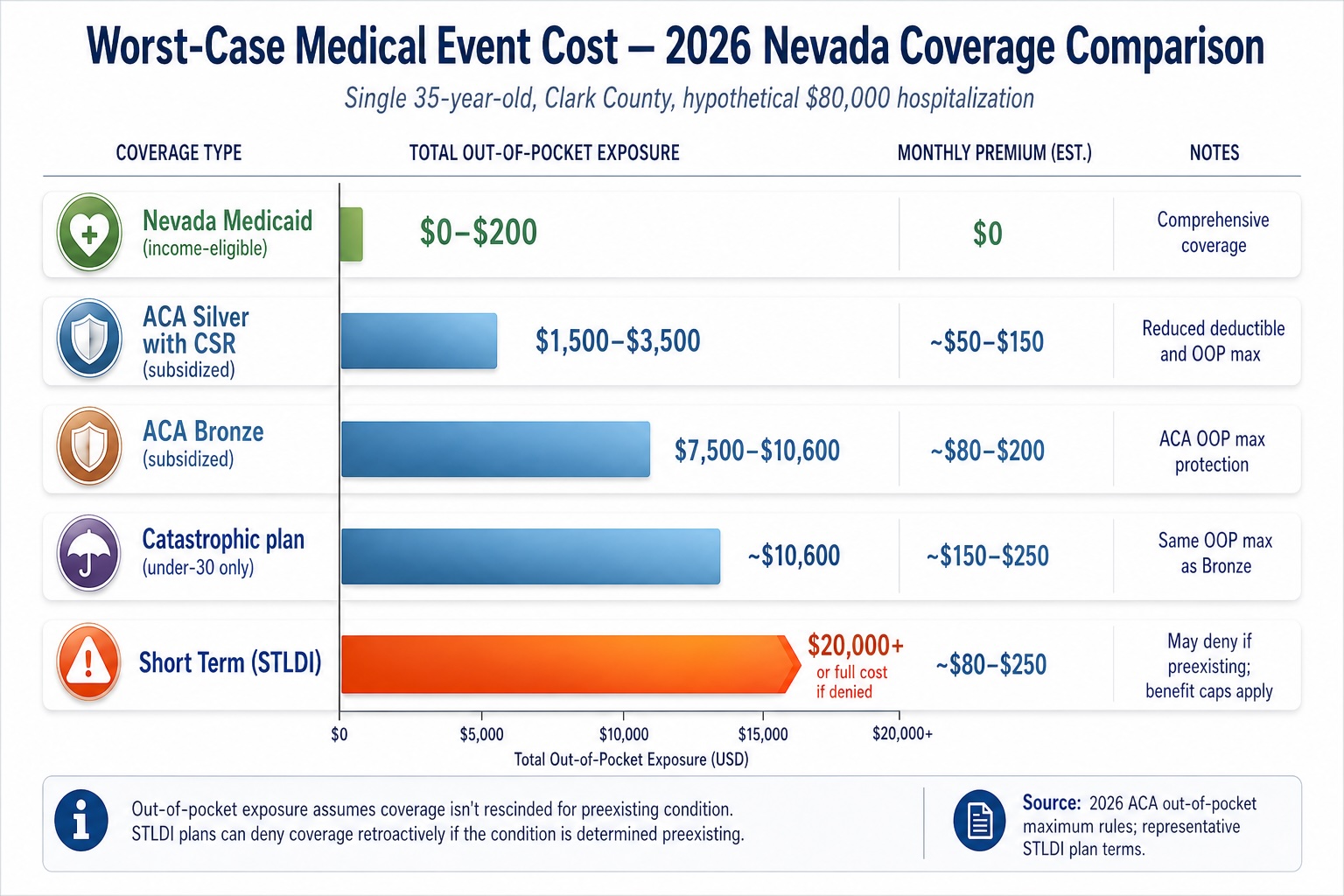
The premium-only comparison favors STLDI for the narrow demographic of healthy 30–55 year olds without subsidies. The total-cost-during-an-event comparison favors any ACA-compliant alternative for nearly everyone. Most Nevadans considering STLDI focus on the monthly premium because it’s the most visible number — but the much larger numbers in worst-case scenarios are what actually determine whether a coverage choice protects you.
The independent KFF analysis of short-term health insurance covers the federal regulatory history and consumer-protection concerns in detail. The Nevada Health Link STLDI fact page publishes the state’s official consumer warnings about these plans, and the HealthCare.gov coverage-outside-OE guide walks through the SEP and Medicaid alternatives that beat STLDI for most Nevadans.
Frequently Asked Questions
Common questions about short term health insurance Nevada residents face cover the duration limits under federal and state rules, what STLDI plans actually cover, whether Medicaid is available between jobs, the difference between catastrophic and short-term plans, and how a Special Enrollment Period works in Nevada. Answers below reflect 2026 federal STLDI rules and current Nevada Administrative Code.
How long can a short term health insurance Nevada plan last in 2026?
Federal rules effective September 1, 2024 cap STLDI plans at three-month initial terms with a maximum total duration of four months including renewals or extensions. Nevada Administrative Code separately limits STLDI to 185 days, but the stricter federal four-month rule applies in practice. The federal rule also bans “stacking” — buying consecutive STLDI policies from the same insurer or affiliated insurers within 12 months — to prevent using STLDI as a long-term substitute for comprehensive coverage. If you need coverage longer than four months, STLDI is structurally not the right tool.
Is short term health insurance Nevada coverage cheaper than ACA plans?
The monthly premium on STLDI is often lower than ACA Bronze or Silver full-price premiums for healthy adults under 50, but the comparison rarely favors STLDI once subsidies and total-cost exposure are included. For 2026, 82% of Nevada Health Link enrollees received premium tax credits averaging $516 per month, dropping the typical net premium to about $148 — competitive with or lower than most STLDI premiums. STLDI premiums look low because they exclude maternity, mental health, prescriptions, and preexisting conditions; the savings disappear instantly during a serious medical event.
Can short term health insurance Nevada plans deny me for preexisting conditions?
Yes. Unlike ACA-compliant plans on Nevada Health Link, short term health insurance in Nevada is medically underwritten — meaning the insurance company can review your medical history and decline applications based on preexisting conditions, charge higher premiums for them, or exclude coverage for conditions retroactively determined preexisting. This is one of the most important practical differences between STLDI and Nevada Health Link plans, and it’s the single biggest reason the state recommends checking ACA-compliant alternatives first.
What’s the difference between catastrophic and short-term insurance in Nevada?
Catastrophic plans are ACA-compliant and sold on Nevada Health Link to Nevadans under 30 (or anyone with a hardship exemption). They cover the ten essential health benefits, can’t deny for preexisting conditions, include three primary care visits per year before the deductible, and follow ACA out-of-pocket maximum rules ($10,600 in 2026). Short term health insurance Nevada plans are sold off-exchange, can deny for preexisting conditions, exclude essential benefits, and have higher out-of-pocket maximums (~$20,000). Same monthly premium range; dramatically different protection.
Does losing my job qualify me for a Special Enrollment Period in Nevada?
Yes. Loss of employer-sponsored health insurance is a qualifying life event triggering a 60-day SEP in Nevada Health Link. Documentation is a termination letter or final coverage date from the former employer. The SEP runs 60 days from the coverage-loss date — so enrolling earlier in the window prevents gaps. After job loss, household income often drops, which means the SEP-triggered enrollment frequently qualifies for substantially larger premium tax credits than the same family received during employment. This usually beats STLDI on both monthly cost and total cost during a medical event.
Can I get short term health insurance Nevada coverage during open enrollment?
STLDI is technically available year-round including during open enrollment, but most Nevadans shouldn’t buy it during OE. If you can enroll in a Nevada Health Link plan during open enrollment, you should — even if the monthly premium is slightly higher, the comprehensive coverage and subsidy-eligibility almost always make ACA-compliant coverage the better economic choice. The narrow case for STLDI during OE: a healthy adult who is genuinely between two jobs with confirmed coverage starting within four months, no preexisting conditions, and household income above the subsidy ceiling.
Related Nevada Health Insurance Resources
Explore the rest of the Nevada coverage library — the statewide overview, the Nevada Health Link marketplace, carrier comparisons, and affordability programs.
Complete 2026 overview of coverage options, carriers, and enrollment.
Nevada Health Link MarketplaceEnrollment windows, subsidies, and how to apply through the state exchange.
Best Nevada Health Insurance PlansAll ten 2026 carriers compared on network, cost, and coverage area.
Affordable Nevada CoveragePremium costs by county, subsidy eligibility, and ways to lower your rate.
Get an Honest Comparison Before Choosing Short-Term in Nevada
A licensed Nevada agent will check your SEP eligibility, confirm whether you qualify for Medicaid, and compare catastrophic plan availability — and will recommend short-term coverage only when no ACA-compliant alternative fits your situation.
Broker Disclosure
ForHealthInsurance.com is an independent health insurance agency serving Nevada residents. We are not affiliated with any carrier or government agency. We help you compare plans and enroll in coverage that meets your needs at no extra cost to you.