Missouri Health Insurance: 2026 Plans, Costs & Coverage Guide
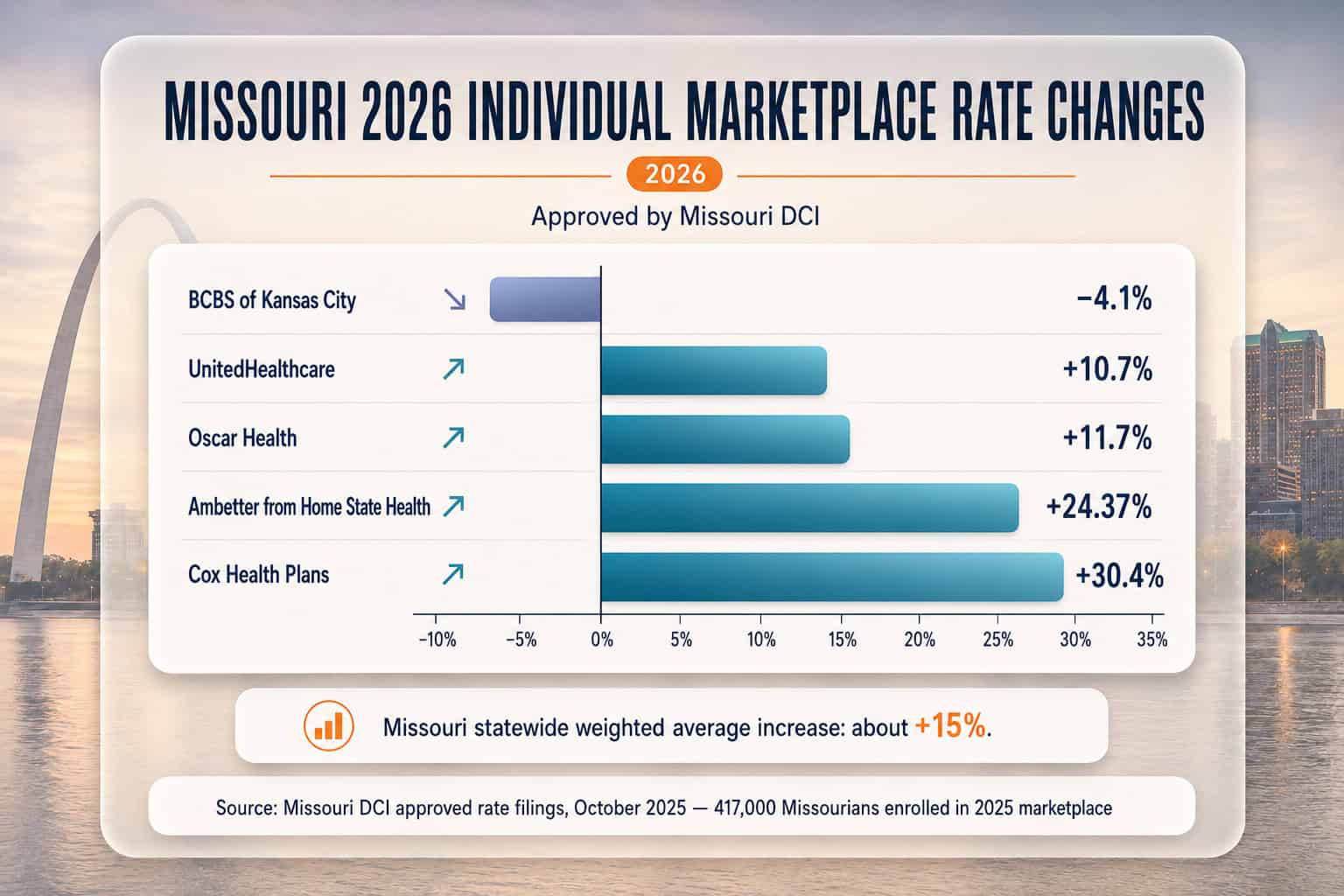
Missouri health insurance for 2026 remains a competitive nine-carrier market on HealthCare.gov, though premiums are rising across the board — except for one notable exception. Blue Cross Blue Shield of Kansas City lowered rates 4.1% for 2026 in 30 western Missouri counties, while Ambetter from Home State Health rose 24.37% and Cox Health Plans jumped 30.4% in southwest Missouri. Approximately 417,000 Missourians enrolled in marketplace coverage for 2025, and an additional 1.26 million are enrolled in MO HealthNet Medicaid. This guide covers what’s available, what it costs, how MO HealthNet and the Show Me Healthy Kids CHIP program fit together, and how to choose among the remaining carriers.

What brings you to Missouri health insurance today?
How the Missouri Health Insurance Market Works in 2026
Missouri health insurance is sold through HealthCare.gov, the federal marketplace, because Missouri does not operate a state-based exchange. Nine carriers offer plans for 2026 — a competitive field compared to many states — though only two (UnitedHealthcare and Ambetter from Home State Health) serve nearly every Missouri county. The Missouri Department of Commerce and Insurance (DCI) regulates carrier rates and plan filings, while HealthCare.gov handles consumer-facing enrollment. Approximately 417,000 Missourians purchased marketplace coverage for 2025.
Missouri’s nine 2026 marketplace carriers include Ambetter from Home State Health, UnitedHealthcare, Blue Cross Blue Shield of Kansas City, Anthem Blue Cross Blue Shield of Missouri, Cigna, Oscar Health, Cox Health Plans, Aetna, and Medica. Coverage availability varies dramatically by region — St. Louis-area residents typically see seven carriers competing for their business, while rural counties may have only the two statewide carriers (UHC and Ambetter) available. Every county in the state has at least two carriers offering individual plans for 2026, per the Missouri Department of Commerce and Insurance.
Missouri residents enroll through HealthCare.gov during Open Enrollment (Nov 1 – Jan 15 for 2026 coverage; shortened to Nov 1 – Dec 15 for 2027 coverage under federal rule changes). The Cover Missouri Coalition, a project of the Missouri Foundation for Health, provides free enrollment assistance through certified Navigators and application counselors statewide. Households earning under 138% FPL are routed to MO HealthNet — Missouri’s Medicaid program — which allows year-round enrollment through the Department of Social Services. Missouri employers exploring coverage for their teams can review group, SHOP, and ICHRA options in the Missouri small business health insurance guide.
Missouri Health Insurance Carriers for 2026
Nine carriers offer Missouri health insurance through HealthCare.gov for 2026. Only UnitedHealthcare covers every county statewide; Ambetter from Home State Health covers all but six rural counties. Blue Cross Blue Shield of Kansas City is the only 2026 carrier lowering rates — a 4.1% decrease across 30 western Missouri counties. Anthem BCBS of Missouri serves the east with a PPO product, while Ambetter, Cox, and most others offer HMO-only structures.
| Carrier | 2026 Rate Change | Primary Region | Network Type |
|---|---|---|---|
| Blue Cross Blue Shield of Kansas City | −4.1% (lowered) | 30 western Missouri counties | PPO and HMO |
| Anthem Blue Cross Blue Shield of Missouri | Varies by plan | Eastern Missouri (St. Louis metro) | PPO and HMO |
| Ambetter from Home State Health | +24.37% | 109 of 115 counties | HMO (off-exchange) |
| UnitedHealthcare | +10.7% | Every Missouri county | HMO |
| Oscar Health | +11.7% | Select metro counties | HMO |
| Cox Health Plans | +30.4% | 5 southwest Missouri counties | HMO (local network) |
| Cigna | Varies by plan | Select counties | HMO/POS |
| Aetna | Varies by plan | Select counties | HMO |
| Medica | Varies by plan | Select counties | HMO |
BCBS of Kansas City’s 4.1% rate decrease for 2026 is a rarity — one of just four carriers nationwide to lower marketplace premiums this year. The decrease reflects the carrier’s strong operational position in western Missouri and tight integration with Saint Luke’s Health System, Research Medical Center, and other KC-area provider networks. For Kansas City metro residents, BCBS KC is frequently the lowest-cost Silver option on the Missouri marketplace while also offering PPO network flexibility unavailable from HMO-only carriers.
How Much Does Missouri Health Insurance Cost in 2026?
Missouri health insurance premiums average approximately $755/month for UnitedHealthcare and Ambetter Silver plans — the two statewide carriers — before subsidies. BCBS of Kansas City’s rate cut puts western Missouri Silver premiums closer to $560/month. After premium tax credits, most Missouri marketplace enrollees pay a fraction of full premium — the enhanced subsidies cap benchmark Silver premiums at 8.5% of income for most households. Costs vary substantially by county, age, tobacco use, and carrier selection.
| Scenario (40yo Silver) | Full Premium | Est. Subsidy | Net Cost |
|---|---|---|---|
| St. Louis County, $38,000 income | ~$755/mo | ~$485/mo | ~$270/mo |
| Jackson County (KC), $42,000 income (BCBS KC) | ~$560/mo | ~$265/mo | ~$295/mo |
| Greene County (Springfield), $50,000 income | ~$740/mo | ~$385/mo | ~$355/mo |
| Boone County (Columbia), $55,000 income | ~$745/mo | ~$355/mo | ~$390/mo |
| 62yo couple, $82,000 income (subsidy cliff) | ~$2,180/mo | ~$1,600/mo | ~$580/mo |
Missouri’s rate landscape for 2026 splits sharply by carrier. If enhanced premium tax credits expire as scheduled, an unsubsidized 40-year-old Missourian earning $62,600 or more would pay the full $9,060/year premium for an average Ambetter or UHC plan — a 70% increase from the subsidized cost of $5,321. For subsidized enrollees, the impact is more moderate because premium tax credits adjust to match the benchmark Silver plan. The affordable coverage guide details subsidy strategies by income level.
Example: A 40-year-old in St. Louis County earning $38,000 (about 250% FPL) sees a benchmark Silver plan listed near $755 per month. After an estimated $485 monthly premium tax credit, the net cost drops to roughly $270 per month — and because the household is under 250% FPL, choosing a Silver plan also unlocks Cost-Sharing Reductions that lower the deductible and copays. The same shopper in a western county could pay less by choosing BCBS of Kansas City, which cut Silver rates 4.1% for 2026.
See Missouri Health Insurance Options for Your County
Compare 2026 plans from all nine Missouri marketplace carriers, including BCBS KC’s rate cut in western counties. Check subsidy eligibility, see after-subsidy pricing, and find coverage that fits your household budget.
Premium Tax Credits and Subsidies in Missouri
Missouri marketplace enrollees who qualify for premium tax credits can significantly reduce their 2026 coverage costs. Eligibility depends on household income relative to the Federal Poverty Level — households between 100% and 400% FPL typically qualify, and enhanced subsidies through 2025 extended eligibility above 400% FPL. The subsidy caps the household’s benchmark Silver premium at 8.5% of income. An estimated 60,000–80,000 Missouri families would lose subsidy eligibility if enhanced credits expire without Congressional extension.
Premium tax credits work by capping the amount a household pays for the benchmark (second-lowest-cost) Silver plan as a percentage of income. Cost-sharing reductions apply additional discounts to deductibles, copays, and out-of-pocket maximums for enrollees under 250% FPL who choose Silver plans. Missouri residents who have recently lost subsidies may qualify for the CMS-expanded catastrophic plan eligibility under the 2026 hardship exemption — a new option announced specifically in response to expiring subsidies. Subsidies reconcile at tax time via IRS Form 8962, so projecting annual income accurately during enrollment matters.
Subsidy cliff warning for 2026–2027: If enhanced subsidies expire, a 60-year-old Missouri couple earning $82,000 (just above 400% FPL for two) could see their premium jump from approximately $580/month to over $2,000/month — a $17,000/year increase. Missourians near the cliff should carefully model projected income with a Cover Missouri Coalition navigator or licensed agent. HSA contributions and deductible traditional IRA contributions can keep MAGI below the threshold and preserve thousands in subsidies.
Real-World Example: A Greene County family of four (two adults ages 38 and 40, two children) earning $64,000 sits near 198% FPL. A UnitedHealthcare Silver family plan listing around $1,890 per month drops to roughly $330 after an estimated $1,560 monthly premium tax credit. Because the household is under 250% FPL, that Silver plan also adds Cost-Sharing Reductions — typically a stronger value than a Bronze plan near $175 per month with a far higher deductible.
MO HealthNet and Missouri Medicaid
MO HealthNet is Missouri’s Medicaid program, covering roughly 1.26 million Missourians as of December 2025. Missouri expanded Medicaid by voter ballot initiative (Amendment 2, 2020), extending eligibility to adults 19–64 up to 138% FPL — about $21,597 for a single adult or $44,367 for a family of four in 2026. Around 348,555 Missourians are in the Adult Expansion Group as of January 2026, with comprehensive coverage and no monthly premium for most enrollees.
Missouri’s Medicaid expansion arrived through a contested implementation. Voters approved Amendment 2 in November 2020 by a 53–47 margin; the legislature initially defunded expansion, but the Missouri Supreme Court ruled the voter-approved amendment constitutional, and MO HealthNet expansion became effective October 1, 2021. The Department of Social Services administers MO HealthNet, while long-term care programs run through the Department of Health and Senior Services. Missouri’s Show Me Healthy Kids CHIP program extends coverage to children in households earning up to 300% FPL.
Applying for MO HealthNet happens through the Missouri Department of Social Services — not through HealthCare.gov, though HealthCare.gov screens eligibility and routes applicants to DSS when appropriate. MO HealthNet and Show Me Healthy Kids allow year-round enrollment regardless of the Marketplace Open Enrollment Period. Under federal HR 1 rules taking effect by December 31, 2026, MO HealthNet will implement six-month eligibility redeterminations for expansion adults and an 80-hour monthly work requirement for approximately 300,000 expansion enrollees. The affordable coverage guide details when MO HealthNet is a better fit than a subsidized Marketplace plan.
Missouri Health Insurance by Region
Missouri health insurance options vary significantly by region. St. Louis metro has the most competition — seven carriers. Kansas City residents benefit from BCBS of Kansas City’s rate cut and a four-carrier minimum. Springfield and southwest Missouri rely on UHC, Ambetter, and Cox Health Plans. Central Missouri around Columbia has three carriers. The six rural counties without Ambetter have the fewest options — often only UnitedHealthcare plus one other.
St. Louis is Missouri’s most competitive insurance market. Seven carriers — Anthem BCBS of Missouri, UHC, Ambetter, Oscar, Cigna, Aetna, and Medica — maintain networks across Wentzville, St. Charles, St. Louis County, and the city. The major health systems include BJC HealthCare (Barnes-Jewish, Missouri Baptist), SSM Health, Mercy Hospital St. Louis, and St. Luke’s Hospital. Anthem BCBS of Missouri offers the broadest PPO network in eastern Missouri, an advantage for residents who want out-of-network flexibility or who travel frequently across state lines.
Kansas City is BCBS of Kansas City’s home market, where its 4.1% rate decrease for 2026 makes it the competitive leader. The carrier integrates tightly with Saint Luke’s Health System, Research Medical Center, and Truman Medical Centers. Kansas City residents who also work or seek care in Overland Park, Kansas benefit from BCBS KC’s dual-state network. Springfield relies heavily on Cox Health Plans — the local system-based carrier — alongside UHC and Ambetter, though Cox’s 30.4% rate increase is the steepest in the state. The Missouri carrier comparison guide covers network strength and PPO access by region in detail.
Short-Term Health Insurance in Missouri
Missouri is one of the more permissive states for short-term plans, allowing initial terms up to 364 days with renewals up to 36 months total — far longer than the federal default. Even so, these plans remain non-ACA-compliant: they can deny coverage for pre-existing conditions, exclude essential benefits, and impose dollar caps. For most Missourians, a subsidized HealthCare.gov plan is more comprehensive and often cheaper once premium tax credits apply.
Short-term coverage makes sense only in narrow situations: a brief gap between jobs, or a missed Open Enrollment window with no Qualifying Life Event. Missouri’s unusually long renewal allowance can make a short-term plan tempting as a quasi-permanent option, but that trade-off carries real risk — a serious diagnosis mid-term can leave a short-term enrollee without renewable coverage and facing the next Open Enrollment with a gap. Anyone weighing a short-term plan in Missouri should first check HealthCare.gov for a Special Enrollment Period or MO HealthNet eligibility, since either provides ACA coverage a short-term plan cannot match.
How to Enroll in Missouri Health Insurance for 2026
Enrolling in Missouri marketplace coverage happens through HealthCare.gov. Open Enrollment for 2026 ran November 1, 2025 through January 15, 2026; for 2027 it shortens to November 1 through December 15, 2026 under federal rule changes. Outside that window, Missourians need a Qualifying Life Event — marriage, birth, job loss, loss of MO HealthNet — for a 60-day Special Enrollment Period. MO HealthNet and Show Me Healthy Kids allow year-round enrollment.
For 2027 coverage, the federal government shortened Open Enrollment by approximately four weeks. All plans selected during November 1 – December 15, 2026 will take effect January 1, 2027. There is no automatic renewal for 2026 enrollees; every Missouri household must actively select and confirm a plan, update income and household information, and confirm subsidy eligibility. The Missouri marketplace guide walks through the enrollment process step by step. Free navigator assistance is available through the Cover Missouri Coalition (Missouri Foundation for Health) at 1-800-466-3213 or FindLocalHelp.CoverMissouri.org.
Frequently Asked Questions About Missouri Health Insurance
How much does Missouri health insurance cost in 2026?
Missouri marketplace premiums average approximately $755/month for UnitedHealthcare and Ambetter Silver plans — the two statewide carriers — before subsidies. BCBS of Kansas City’s 4.1% rate cut puts western Missouri Silver premiums closer to $560/month. After premium tax credits, most Missouri marketplace enrollees pay significantly less. An unsubsidized Missourian earning $62,600+ would pay the full $9,060/year premium without subsidies.
Which carriers offer Missouri health insurance for 2026?
Nine carriers offer individual plans in Missouri for 2026: Blue Cross Blue Shield of Kansas City, Anthem Blue Cross Blue Shield of Missouri, Ambetter from Home State Health, UnitedHealthcare, Oscar Health, Cox Health Plans, Cigna, Aetna, and Medica. Only UnitedHealthcare and Ambetter serve nearly every Missouri county. BCBS of Kansas City is the only carrier to lower rates for 2026 (−4.1%).
What is MO HealthNet and who qualifies?
MO HealthNet is Missouri’s Medicaid program, covering approximately 1.26 million Missourians. Adults 19–64 qualify with household income up to 138% FPL — approximately $21,597 for a single adult or $44,367 for a family of four in 2026. Missouri expanded Medicaid via voter ballot initiative (Amendment 2, 2020). Apply through the Missouri Department of Social Services. Year-round enrollment is available regardless of Marketplace Open Enrollment.
Does Missouri have its own health insurance exchange?
No. Missouri uses HealthCare.gov, the federally-facilitated marketplace. Missouri does not operate a state-based exchange. The Missouri Department of Commerce and Insurance regulates carrier rates and plan filings, while HealthCare.gov handles consumer enrollment. Free enrollment assistance is available through the Cover Missouri Coalition, which runs a statewide navigator network funded in part by the Missouri Foundation for Health.
Why did BCBS of Kansas City lower rates while others raised them?
BCBS of Kansas City is one of only four carriers nationwide lowering marketplace rates for 2026. The 4.1% decrease reflects the carrier’s strong operational position, tight integration with Saint Luke’s Health System and other KC-area provider networks, and favorable claims experience in its 30-county western Missouri service area. For KC metro residents, BCBS KC is typically the lowest-cost Silver option for 2026.
When does Missouri Open Enrollment end?
Open Enrollment for 2026 Missouri marketplace coverage ran November 1, 2025 through January 15, 2026. For 2027 coverage, the federal government shortened the window to November 1 through December 15, 2026 — six weeks instead of ten. All plans selected during that window take effect January 1, 2027. Outside Open Enrollment, a Qualifying Life Event is required to enroll. MO HealthNet allows year-round enrollment.
Can I keep my doctor with Missouri marketplace plans?
Keeping your current doctor depends on whether that provider is in your new plan’s network. Anthem Blue Cross Blue Shield of Missouri and BCBS of Kansas City offer the broadest PPO networks with out-of-network coverage. Ambetter, UnitedHealthcare, Cox Health Plans, Oscar, and other HMO carriers require in-network care except for emergencies. Always verify your specific providers in each carrier’s directory before enrolling.
Related Missouri Health Insurance Resources
Explore related guides for Missouri marketplace enrollment, finding affordable coverage and subsidies, comparing top-rated carriers, and PPO plan flexibility to help navigate health insurance decisions across the Show-Me State.
HealthCare.gov enrollment, deadlines, and qualifying life events.
Affordable Coverage & SubsidiesLow-cost plans, premium tax credits, and ways to cut costs.
Best Carriers & PPO PlansHow Missouri’s top carriers rank by network and quality.
PPO PlansReferral-free specialist access and out-of-network coverage nationwide.
Compare 2026 Missouri Health Insurance Plans
See all nine Missouri marketplace carriers, check MO HealthNet Medicaid eligibility at 138% FPL, and get after-subsidy pricing from a licensed enrollment assistant. Free, no cost to you.
Broker Disclosure
ForHealthInsurance.com is an independent health insurance agency serving Missouri residents. We are not affiliated with any carrier or government agency. We help you compare plans and enroll in coverage that meets your needs at no extra cost to you.