North Carolina Health Insurance: 2026 Plans, Carriers & Costs
North Carolina health insurance for 2026 is defined by three forces colliding at once: a Medicaid expansion that brought 600,000+ residents into coverage since December 2023, three carrier exits that dropped the marketplace from nine insurers to six, and a weighted average rate increase of about 28% — driven partly by the expiration of enhanced federal subsidies. About 760,000 North Carolinians enrolled in marketplace coverage for 2026 through HealthCare.gov, down roughly 22% from the prior year’s 975,000. Blue Cross and Blue Shield of North Carolina remains the only carrier available in all 100 counties; Ambetter, UnitedHealthcare, Cigna, Oscar Health, and AmeriHealth Caritas serve select regions. Insurance Commissioner Mike Causey oversees rate approvals and consumer protections. This guide covers what’s changed, what coverage costs, who qualifies for subsidies or Medicaid, small-business options, and how to navigate the most consequential enrollment period in recent NC history.

What brings you to North Carolina coverage today?
I want to compare carriers
Blue Cross NC, Ambetter, Oscar, UHC, Cigna, AmeriHealth
See carrier options ↓Nine Carriers to Six: What Changed in NC for 2026
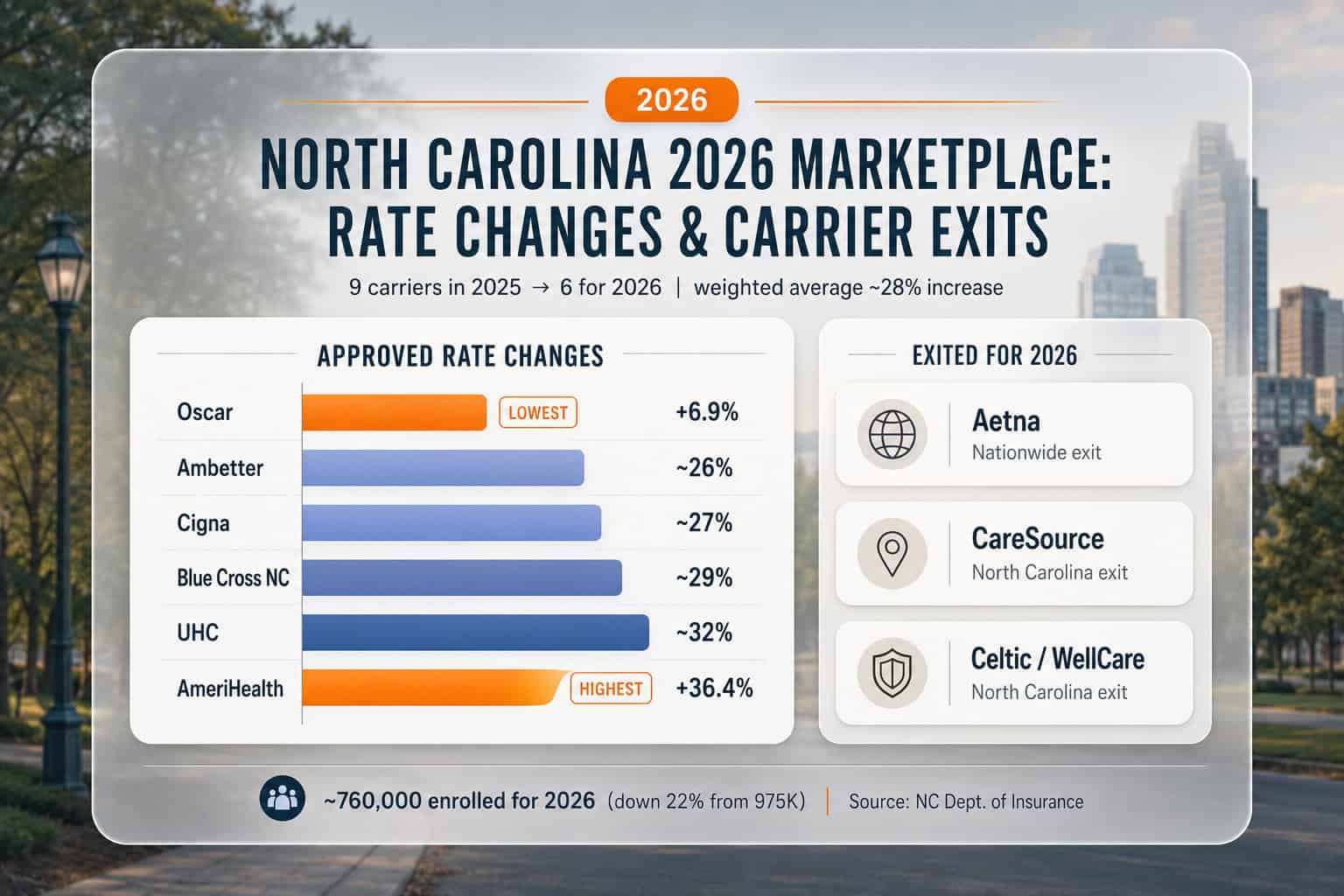
North Carolina health insurance lost three marketplace carriers entering 2026. Aetna CVS Health left ACA exchanges nationwide, CareSource exited the NC individual market, and Celtic/WellCare of North Carolina withdrew. The remaining six — Blue Cross NC, Ambetter, UnitedHealthcare, Cigna, Oscar Health, and AmeriHealth Caritas — filed rate increases averaging about 28% statewide before subsidies. Enrollment fell roughly 22% to about 760,000 as enhanced subsidies expired.
The carrier exits hit different parts of the state unevenly. Aetna had covered 70 counties, and CareSource served thousands of enrollees in select areas. Enrollees with these carriers who did not actively choose a new plan during Open Enrollment were auto-mapped to default replacements that may not include their doctors, hospitals, or prescriptions. Blue Cross NC remains the only carrier operating in all 100 counties — making it the default option for rural North Carolinians from the mountains to the Outer Banks. In metro areas like Charlotte, Raleigh-Durham, and Greensboro, enrollees still have 3–6 carriers to compare. The NC marketplace enrollment guide walks through carrier availability by county.
Blue Cross NC and the Five Regional Carriers Competing in 2026
North Carolina health insurance for 2026 comes from six carriers on HealthCare.gov. Blue Cross and Blue Shield of North Carolina — the state’s only not-for-profit health insurer — serves all 100 counties with over 60% market share. Ambetter from Centene offers competitive Silver pricing across broad county coverage. Oscar Health has the lowest 2026 rate increase at +6.9% and the cheapest Silver in Charlotte at $575/month. UnitedHealthcare, Cigna, and AmeriHealth Caritas serve select regions.
| Carrier | 2026 Rate Change | County Coverage | 40yo Silver (approx) |
|---|---|---|---|
| Blue Cross NC | ~29% avg | All 100 counties | $584/mo (Raleigh) |
| Ambetter (Centene) | ~26% | Broad — cheapest in ~41% of NC | $540/mo (cheapest Silver) |
| Oscar Health | +6.9% (lowest) | Select areas (Charlotte, Asheville) | $575/mo (Charlotte) |
| UnitedHealthcare | ~32% | Select rating areas | Varies by region |
| Cigna Healthcare | ~27% | Select counties (Chatham, Orange, Nash, Johnston) | Varies by county |
| AmeriHealth Caritas | +36.4% (highest) | Select areas | Varies by region |
Blue Cross NC’s dominance is structural — it’s the only carrier in many rural counties, particularly across eastern North Carolina and the western mountains. As a not-for-profit licensee of the Blue Cross Blue Shield Association, Blue Cross NC invests in community health programs and operates without shareholder profit pressure, and its Blue Local, Blue Home, and Blue Value network tiers offer different levels of provider access and pricing. For enrollees in Charlotte, the Triangle, and the Triad (Greensboro-Winston-Salem), multiple carriers create genuine price competition — Ambetter and Oscar consistently undercut Blue Cross NC on Silver premiums in metro areas. The NC carrier comparison guide breaks down network differences by region.
What North Carolinians Pay in 2026 — The Subsidy Shift
North Carolina health insurance premiums for 2026 average about $800/month for a 40-year-old Silver plan before subsidies. After premium tax credits, most subsidized enrollees pay far less — the average NC premium subsidy is about $660/month in 2026. But the expiration of enhanced subsidies at the end of 2025 hit NC enrollees hard: the subsidy cliff returned, eliminating help above 400% FPL, and after-subsidy costs rose substantially across many income levels.
The numbers tell the story. In 2025, about 70% of NC marketplace enrollees paid less than $50/month out of pocket after subsidies. For 2026, NC marketplace rates rose by a weighted average of about 28%, and with the enhanced credits gone the average net premium enrollees actually pay jumped roughly 85%.
Worked example — 50-year-old in Wake County at the cliff
A 50-year-old Wake County resident earning $63,000 — just over the 2026 cliff of $62,600 (400% FPL for a single adult) — now pays the full $1,000+/month premium with no tax credit, a $12,000+ annual cost. Under the enhanced subsidies, that same person’s benchmark premium would have been capped near 8.5% of income — roughly $445/month. The swing of about $6,700 over a year is what the cliff’s return means for higher earners.
For subsidized enrollees below 400% FPL, credits still cap premiums as a percentage of income, but the benchmark amounts have shifted. The NC affordable coverage guide covers MAGI-optimization strategies for managing the cliff.
North Carolina health insurance quotes vary widely by county and age, since carrier availability is uneven and ACA rules cap the age ratio at 3:1. Using the statewide cheapest Silver (Ambetter), the table below shows how age alone reshapes a quote before subsidies — and Charlotte and the Triangle typically run cheaper than rural counties where Blue Cross NC is the sole carrier.
| Age (cheapest Silver, before subsidy) | Approx. Monthly Quote | After Subsidy (example at ~$42K income) |
|---|---|---|
| 21 years old | ~$375/mo | Often under $100/mo |
| 30 years old | ~$430/mo | ~$120–$160/mo |
| 40 years old | ~$540/mo | ~$287/mo (Durham, ~$40K income) |
| 50 years old | ~$755/mo | Varies; cliff risk near 400% FPL |
| 60 years old | ~$1,145/mo | Full price above 400% FPL |
Premium tax credits reconcile at tax time via IRS Form 8962. Cost-sharing reductions apply automatically to Silver plans under 250% FPL — about 46% of NC marketplace enrollees received CSR benefits in 2025. For variable-income North Carolinians, accurate MAGI projection prevents year-end clawback, and a licensed assistant can pull exact North Carolina health insurance quotes for your county, age, and household.
Compare North Carolina Coverage for Your County
See 2026 plans from all available carriers in your area — Blue Cross NC, Ambetter, Oscar, UHC, Cigna, and AmeriHealth Caritas. Check subsidy eligibility and after-subsidy pricing from a licensed enrollment assistant at no cost — serving Charlotte, the Triangle, the Triad, Asheville, Fayetteville, Wilmington, and rural NC.
NC Medicaid Expansion: 600,000 Enrolled Since December 2023
North Carolina expanded Medicaid on December 1, 2023 — one of the last states to do so — covering adults ages 19–64 with income up to 138% FPL (about $20,782 single or $42,780 for a family of four). More than 600,000 North Carolinians enrolled in the first year, reaching the two-year projection in half the time. NC Medicaid covers doctor visits, hospital care, dental, vision, hearing, prescriptions, maternity, and behavioral health with no monthly fee and copays capped at $4.
The expansion transformed the North Carolina health insurance landscape. Before December 2023, NC was a non-expansion state with a coverage gap — adults above Medicaid’s pre-expansion thresholds but below 100% FPL had no subsidized path to insurance. That gap closed overnight, and nearly 300,000 residents previously receiving Medicaid Family Planning benefits were auto-enrolled into full coverage on Day 1. Rural counties saw dramatic enrollment gains — Edgecombe, Robeson, and Swain counties now have over 12% of their adult populations on Medicaid. Enrollment is year-round through NC DHHS at ePASS, by phone at 1-888-245-0179, or through local Department of Social Services offices.
NC Health Choice — North Carolina’s CHIP program — covers children with household income up to 211% FPL. NC Health Choice was folded into the Medicaid program in April 2023, simplifying enrollment, and children whose parents earn too much for Medicaid but qualify for CHIP are enrolled through the same ePASS application. Total NC Medicaid and CHIP enrollment exceeds 2.9 million — roughly one in four North Carolinians.
Covering an NC Team: Small-Group, SHOP & ICHRA
North Carolina employers with 1–50 workers have three coverage paths: a traditional small-group plan (Blue Cross NC dominates statewide), the federal SHOP marketplace with its Small Business Health Care Tax Credit, or an ICHRA that reimburses employees for individual marketplace plans. ICHRA is especially powerful in North Carolina because metro employees can access up to six individual carriers — more choice than any single group plan — while the employer’s cost stays fixed and predictable.
| Approach | Best For | 2026 Notes |
|---|---|---|
| Traditional small group | Employers wanting one carrier plan for all staff | Blue Cross NC dominant; starts the first of any month |
| SHOP marketplace | Under 25 FTEs seeking the tax credit | Up to 50% premium credit (35% for tax-exempt) |
| ICHRA | Employers wanting fixed cost + employee choice | ~$400–$600/mo per employee; up to 6 metro carriers |
NC businesses purchasing through the federal SHOP marketplace may qualify for the Small Business Health Care Tax Credit — worth up to 50% of premium contributions (35% for tax-exempt organizations) for employers with fewer than 25 full-time-equivalent employees, average annual wages under $62,000, and at least 50% of employee-only premiums covered. For a qualifying 8-employee NC business, that credit can save $3,000–$9,000 a year. An ICHRA, meanwhile, lets an employer set a fixed monthly amount per employee — tax-deductible to the business, tax-free to the worker — applied to individual plans, which fits NC’s six-carrier metro markets especially well. North Carolina has no state employer mandate, and the federal ACA mandate applies only to employers with 50 or more FTEs, so coverage is voluntary for most NC businesses.
Enrolling in NC Coverage: Key 2026 and 2027 Dates
North Carolina’s three carrier exits make the 2027 enrollment window especially high-stakes for auto-mapped enrollees. Open Enrollment for 2026 ran November 1, 2025 through January 15, 2026; for 2027, the window shortens to November 1 – December 15, 2026 — six weeks instead of ten. Outside these windows, a Qualifying Life Event triggers a 60-day Special Enrollment Period. NC Medicaid and NC Health Choice accept applications year-round through ePASS or local DSS offices.
The shortened 2027 window is particularly consequential in North Carolina given the three carrier exits. Enrollees auto-mapped to replacement plans for 2026 should actively verify their provider networks and re-evaluate carriers during the 2027 Open Enrollment. The NC Navigator Consortium provides free enrollment assistance, though navigator capacity has been reduced by federal funding cuts. Licensed agents access all available carriers in your county and handle subsidy calculations at no cost, and HealthCare.gov’s call center at 1-800-318-2596 operates 24/7. The HealthCare.gov window-shopping tool shows real-time NC pricing without requiring an account.
From the Triangle to the Outer Banks: NC Coverage by Region
North Carolina health insurance carrier availability varies dramatically by region. Charlotte and the Triangle (Raleigh-Durham-Chapel Hill) have 4–6 carriers competing. The Triad (Greensboro-Winston-Salem-High Point) has 3–4. Asheville has Oscar as the cheapest option. Rural eastern NC and many mountain counties have only Blue Cross NC. Major health systems — Duke Health, UNC Health, WakeMed, Atrium Health, Novant Health, Cone Health, and ECU Health — contract with different carriers in different regions.
Charlotte is NC’s largest metro and a major financial-services hub; Atrium Health (now part of Advocate Health) anchors healthcare in the region, and Oscar Health offers the cheapest Silver in Charlotte at $575/month. The Research Triangle — anchored by Duke University, UNC-Chapel Hill, and NC State — drives a large tech and biotech workforce, many of whom are self-employed consultants and startup founders buying individual coverage, and Blue Cross NC has the cheapest Silver in Raleigh at $584/month. Asheville’s tourism and creative economy generates significant individual-market demand. In eastern NC, ECU Health (formerly Vidant) serves a region where Blue Cross NC is often the sole marketplace carrier, so the practical choice there is which Blue Cross NC network tier fits your providers and budget.
Common Questions From North Carolina Residents
How much does North Carolina health insurance cost in 2026?
A 40-year-old Silver plan averages about $800/month before subsidies. Ambetter offers the cheapest Silver statewide at about $540/month. Blue Cross NC Silver runs $584/month in Raleigh, and Oscar Silver is $575/month in Charlotte. After premium tax credits, most subsidized enrollees pay far less — the average NC premium subsidy is about $660/month. The statewide weighted average rate increase for 2026 is about 28%.
Which carriers sell health insurance in North Carolina for 2026?
Six carriers: Blue Cross NC (all 100 counties, 60%+ market share), Ambetter from Centene (broad coverage, cheapest in ~41% of counties), Oscar Health (select areas including Charlotte and Asheville, lowest rate increase at +6.9%), UnitedHealthcare (select rating areas), Cigna (select counties), and AmeriHealth Caritas (select areas). Three carriers — Aetna, CareSource, and Celtic/WellCare — exited for 2026.
Did North Carolina expand Medicaid?
Yes. NC Medicaid expansion took effect December 1, 2023. Adults ages 19–64 with income up to 138% FPL (about $20,782 single / $42,780 family of four) qualify. More than 600,000 North Carolinians enrolled in the first year. Coverage includes doctor visits, dental, vision, prescriptions, and behavioral health with no monthly fee and copays capped at $4. Apply year-round at ePASS or by calling 1-888-245-0179.
What happened to the enhanced ACA subsidies?
Enhanced premium tax credits — in place since 2021 under the American Rescue Plan — expired at the end of 2025. This eliminated subsidies for people above 400% FPL (the subsidy cliff returned) and reduced help for many below 400% FPL. In 2025, about 70% of NC enrollees paid less than $50/month after subsidies. For 2026, NC marketplace rates rose by a weighted average of about 28%, and the average net premium enrollees pay rose roughly 85%. Congress has not restored the enhanced credits.
What is NC Health Choice?
NC Health Choice is North Carolina’s CHIP program covering children with household income up to 211% FPL. The program was folded into NC Medicaid in April 2023, simplifying enrollment, and children are enrolled through the same ePASS application used for Medicaid. Total NC Medicaid and CHIP enrollment exceeds 2.9 million — roughly one in four North Carolinians.
Do North Carolina small businesses have to offer health insurance?
No. North Carolina has no state employer mandate, and the federal ACA mandate applies only to employers with 50 or more full-time-equivalent employees. Most NC businesses fall below that threshold and face no penalty. Employers that do offer coverage can choose a traditional small-group plan, the SHOP marketplace with its tax credit, or an ICHRA that reimburses employees for individual plans across up to six metro carriers.
When does Open Enrollment end for North Carolina?
Open Enrollment for 2026 ran November 1, 2025 through January 15, 2026. For 2027, the window shortens to November 1 – December 15, 2026. Plans selected by December 15 take effect January 1, 2027. NC Medicaid allows year-round enrollment, and Qualifying Life Events trigger 60-day Special Enrollment Periods. The NC Navigator Consortium and licensed agents provide free enrollment help.
Why did my carrier leave North Carolina?
Three carriers exited the NC individual marketplace for 2026: Aetna CVS Health (leaving ACA exchanges nationwide), CareSource (exiting NC), and Celtic/WellCare (withdrawing from NC). If your carrier left and you did not actively select a new plan during Open Enrollment, you may have been auto-mapped to a default replacement. Verify your provider network and consider switching during a Special Enrollment Period or the next Open Enrollment.
Related North Carolina Health Insurance Resources
Go deeper on any part of North Carolina coverage — carriers, the marketplace, individual and affordable plans, short-term gaps, and PPO options.
Blue Cross NC, Ambetter, and Oscar compared on networks, PPO access, and value.
NC Marketplace & HealthCare.govHow to enroll, qualify for subsidies, and claim premium tax credits in North Carolina.
Individual Health Insurance in NCPrivate ACA plans for Triangle, Charlotte, and self-employed North Carolinians.
Affordable Coverage in NCNC Medicaid expansion, subsidies, and the lowest-cost routes to full ACA coverage.
Short-Term Coverage in NCTemporary plans for gaps between jobs — and why subsidized ACA or Medicaid usually wins.
PPO Health Insurance PlansNationwide PPO coverage and BlueCard out-of-network access for broad provider choice.
Find Your 2026 North Carolina Coverage
Compare all available carriers in your county, check NC Medicaid eligibility, and get after-subsidy pricing from a licensed enrollment assistant. Free, no cost — serving Charlotte, the Triangle, the Triad, Asheville, Fayetteville, Wilmington, and every NC county.
Broker Disclosure
ForHealthInsurance.com is an independent health insurance agency serving North Carolina residents. We are not affiliated with any carrier or government agency. We help you compare plans and enroll in coverage that meets your needs at no extra cost to you.