Catastrophic Health Insurance Texas 2026: Under-30 Plans
Catastrophic health insurance Texas plans are an ACA-compliant low-premium coverage tier available to Texans under 30 or to those qualifying for a HealthCare.gov hardship exemption. Premiums run $210–$340 monthly for a 25-year-old in 2026, with a $10,600 annual deductible equal to the federal out-of-pocket maximum. Plans include three pre-deductible primary care visits, full ACA preventive coverage, and complete catastrophic health insurance Texas protection — but Advanced Premium Tax Credit subsidies do not apply, so listed premium is full out-of-pocket cost.

What brings you here today?
Who Can Buy a Catastrophic Plan in Texas
Catastrophic health insurance Texas eligibility runs through one of two doors: being under age 30 at the start of the coverage year, or qualifying for a HealthCare.gov hardship exemption. The under-30 rule is automatic — a 27-year-old in Austin or Dallas needs no paperwork. The hardship exemption most commonly applies to Texans in the Medicaid coverage gap — roughly 1.5 million adults below 138% FPL in non-expansion Texas — who submit Form CMS-10454 to unlock catastrophic plan access.
The under-30 rule is the simpler path for catastrophic health insurance Texas enrollment. Any Texas resident who has not yet turned 30 on January 1 of the coverage year can enroll in catastrophic health insurance Texas plans during open enrollment (November 1 through January 15 for 2026 coverage on HealthCare.gov) or during a qualifying special enrollment period. A 29-year-old in Austin or Dallas can browse and select catastrophic plans directly on HealthCare.gov alongside Bronze, Silver, and Gold options with no separate paperwork. Coverage stays in force through the year even if the enrollee turns 30 during the plan year — but at next open enrollment, they would need to switch to Bronze, Silver, Gold, or Platinum (or qualify for a hardship exemption to continue catastrophic).
The hardship exemption pathway is more involved but opens catastrophic plan access to Texans of any age. HealthCare.gov certifies hardship exemptions across roughly 14 categories. Texas-specific application: the Medicaid coverage gap is one of the qualifying hardship categories — adults below 138% of federal poverty level in non-expansion states (Texas is one of ten such states) automatically qualify. This is structurally important because the Texas Medicaid coverage gap is the largest in the country, affecting roughly 1.5 million adults according to Kaiser Family Foundation analysis. Many of those Texans qualify for hardship exemption certification, which then allows them to purchase catastrophic health insurance Texas plans as their cheapest qualifying coverage path.
Texas hardship exemption categories that unlock catastrophic
The 14 HealthCare.gov hardship categories most often applied in Texas: (1) Medicaid coverage gap in non-expansion states; (2) homelessness in the past 6 months; (3) eviction or foreclosure in the past 6 months; (4) domestic violence; (5) death of a close family member; (6) fire, flood, or natural disaster damage to home; (7) bankruptcy in the past 6 months; (8) substantial medical expenses (over 7.5% of household income); (9) unexpected increases in essential expenses caring for ill or disabled family members; (10) the failure of another insurer; (11) ineligibility for Medicaid solely because the state didn’t expand coverage; (12) other situations preventing coverage purchase; (13) being a victim of domestic abuse with separate filing status; (14) coverage canceled and replacement plans unaffordable.
What Catastrophic Coverage Includes
Texas catastrophic plans cover all 10 essential health benefits required by the Affordable Care Act, identical to Bronze, Silver, Gold, and Platinum tiers — maternity, mental health, prescriptions, hospital, ambulatory care, rehabilitation, pediatric, preventive, lab, and emergency services. The structural difference is the deductible: $10,600 per person for 2026, equal to the federal out-of-pocket maximum. Before the deductible, three primary care visits and all ACA preventive services are covered at standard cost-sharing or no cost-sharing.
The “catastrophic” label can be misleading because it suggests stripped-down coverage. In practice, ACA-compliant catastrophic health insurance Texas plans are functionally high-deductible Bronze plans with two specific consumer-friendly features built in. First, three primary care visits per year are covered before the deductible at the standard PCP copay (typically $30–$50 per visit). Second, all ACA preventive services — annual physicals, vaccinations, cancer screenings, contraception, depression and anxiety screening, women’s health visits — are covered at 100% with no cost-sharing from the first day of coverage. These two features mean a healthy Texas under-30 enrollee can use routine and preventive care normally without ever touching the deductible.
Beyond the deductible, catastrophic coverage is identical to a Platinum plan for the rest of the year. Once the $10,600 deductible is met, the plan covers 100% of in-network care — no copays, no coinsurance, no remaining out-of-pocket cost. This is structurally different from Bronze, Silver, or Gold plans, which typically include coinsurance (20%–40%) and copays even after the deductible is met. The trade-off: a major medical event still requires fronting the full $10,600 deductible before coverage kicks in, which is why catastrophic plans pair best with a Health Savings Account or savings buffer for the deductible.
2026 Catastrophic Plan Costs in Texas
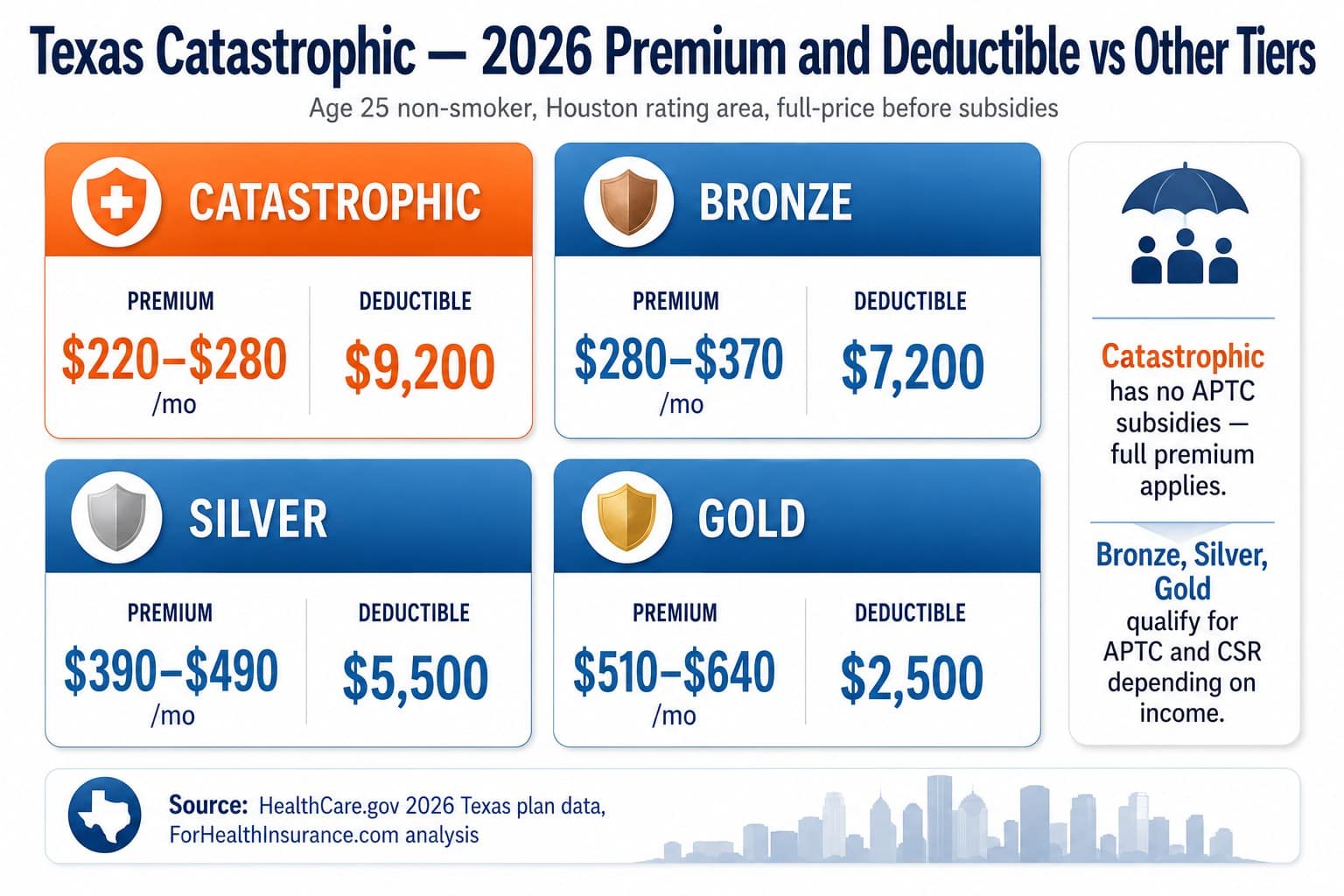
Catastrophic health insurance Texas premiums in 2026 typically run $210–$340 monthly for a 25-year-old non-smoker, with rating area variation across the state’s 26 separate geographic zones. Houston, Dallas-Fort Worth, and Austin generally see lower catastrophic premiums than rural West Texas or the Rio Grande Valley. Advanced Premium Tax Credit subsidies do not apply to catastrophic plans, so the listed monthly premium is the full out-of-pocket cost regardless of household income.
| Texas Metro / Rating Area | Catastrophic Premium (age 25) | Bronze Premium (age 25, pre-subsidy) | Premium Gap |
|---|---|---|---|
| Houston metro | $220–$280/mo | $280–$370/mo | $60–$90 less than Bronze |
| Dallas-Fort Worth metro | $210–$270/mo | $270–$360/mo | $60–$90 less than Bronze |
| Austin metro | $230–$290/mo | $290–$380/mo | $60–$90 less than Bronze |
| San Antonio metro | $220–$280/mo | $280–$370/mo | $60–$90 less than Bronze |
| El Paso metro | $240–$310/mo | $300–$400/mo | $60–$90 less than Bronze |
| Rural West Texas / Panhandle | $280–$340/mo | $350–$450/mo | $70–$110 less than Bronze |
The premium gap between catastrophic and full-price Bronze in Texas is consistently $60–$110 per month — meaningful for tight budgets but smaller than many under-30 Texans expect. The catch is that subsidies change the math entirely. A 25-year-old Texan earning $30,000 (200% of federal poverty level) would qualify for substantial APTC on Bronze, potentially reducing the Bronze premium to $40–$80 monthly after subsidies — well below the unsubsidized $220–$280 catastrophic health insurance Texas premium. For subsidy-eligible Texans, subsidized Bronze almost always beats catastrophic. For Texans above subsidy ceilings, the under-30 rule doesn’t help (catastrophic ineligibility kicks in at age 30), so the catastrophic option naturally selects for younger, higher-earning households or those qualifying for hardship exemption.
Example: Houston College Graduate, Age 24
A 24-year-old recent graduate in Harris County starts a freelance graphic design career projecting $28,000 in net income for 2026 — approximately 186% of the federal poverty level. At that income she qualifies for APTC subsidies, so the comparison is not catastrophic vs. Bronze at full price. An Ambetter Bronze plan after her estimated $280/month APTC credit runs approximately $45/month with a $7,900 deductible. An Ambetter Catastrophic plan runs approximately $215/month with no subsidy available — a $170/month gap, or $2,040/year more for catastrophic. The Bronze plan wins on both premium and effective deductible. Catastrophic only makes economic sense for her if she earns above $60,240 — at which point no subsidy applies and catastrophic’s $230/month beats Bronze’s $600+/month at full price.
Get a Catastrophic Texas Plan Quote
A licensed Texas broker confirms catastrophic eligibility (under-30 rule or hardship exemption), then compares 2026 catastrophic premiums from BCBSTX, Ambetter, and Oscar Health by rating area — and checks whether a subsidized Bronze plan would actually deliver better total value. Free, no obligation.
Catastrophic vs Bronze vs Short-Term in Texas
For under-30 Texans above the $60,240 subsidy ceiling, Ambetter and BCBSTX catastrophic plans run $210–$280/month in Harris and Travis counties versus $280–$370/month for Bronze at full price. Subsidized Bronze almost always wins for income-eligible Texans. Short-term plans cost $90–$200/month but exclude maternity, mental health, prescriptions, and pre-existing conditions. The right pick turns entirely on income relative to the $60,240 single-adult ACA subsidy ceiling.
Catastrophic — Best for under-30, above subsidies
A 25-year-old Austin software developer earning $85,000 (above the 400% FPL subsidy ceiling) gets no APTC on Bronze, so catastrophic’s $230/mo premium beats Bronze’s $290/mo by $720/year. The $10,600 deductible is the trade-off — manageable for a healthy young professional with a savings buffer. The three free PCP visits and full preventive coverage handle routine care without touching the deductible. Best fit: healthy under-30 Texans, above-subsidy income, savings buffer for deductible exposure.
Bronze — Best for subsidy-eligible Texans
A 27-year-old Dallas hospitality worker earning $28,000 (about 186% of federal poverty level) qualifies for substantial APTC on Bronze, reducing the $290/mo Bronze premium to $50–$90/mo. Same plan, dramatically lower cost — better than catastrophic’s unsubsidized $220/mo. Bronze also has lower deductibles ($7,000–$7,900 versus $10,600 catastrophic) and is open to Texans of any age. Best fit: subsidy-eligible Texans regardless of age, willing to trade slightly higher monthly premium for subsidies and lower deductible.
Short-term — Cheaper but not ACA-compliant
A 26-year-old Houston freelancer between contracts considers a $130/mo short-term plan over a $230/mo catastrophic plan. The $100/month savings disappear if a single significant medical event hits — short-term plans exclude maternity, mental health, prescriptions, and any pre-existing conditions, with lifetime coverage caps around $1–$2 million. Texas allows short-term plans up to 36 months. Best fit: healthy adults bridging brief coverage gaps with no anticipated medical needs and no chronic conditions.
HSA-eligible HDHP — The hybrid option
For Texas under-30 adults with above-subsidy income who want catastrophic premium economics but also want to build tax-advantaged medical savings, an HSA-eligible high-deductible Bronze HMO/EPO can work as a hybrid. Premium runs slightly higher than catastrophic, but HSA contributions are tax-deductible (up to $4,400 self-only in 2026). Self-employed Texans can stack the HSA deduction with the self-employment health insurance deduction for combined tax advantages catastrophic doesn’t offer.
The Hardship Exemption Pathway for Over-30 Texans
Texans over 30 can qualify for catastrophic plan eligibility through a HealthCare.gov hardship exemption — submit Form CMS-10454 with supporting documentation, receive an exemption certificate number, then enter that number during marketplace enrollment to unlock catastrophic plan selection. The Medicaid coverage gap is the most common Texas-specific qualifying category, automatically covering adults below 138% of federal poverty level in non-expansion states.
For the roughly 1.5 million Texans in the Medicaid coverage gap, the hardship exemption pathway is structurally important. Texas’s decision not to expand Medicaid means adults below 138% of federal poverty level have no affordable coverage path under normal ACA rules — they earn too much for traditional Texas Medicaid (limited mostly to parents below 17% FPL, pregnant women, and people with disabilities) but too little for APTC subsidies, which require income at 100% FPL or above. The Medicaid coverage gap is itself a HealthCare.gov-recognized hardship category, meaning Texans in the gap can apply for an exemption certificate and then enroll in a catastrophic plan as their cheapest ACA-compliant option.
The Form CMS-10454 application process takes 2–4 weeks for HealthCare.gov to certify. For the Medicaid coverage gap category — the most common Texas pathway — applicants typically need a Texas Health and Human Services Commission (HHSC) Medicaid denial letter, household income documentation, and proof of Texas residency such as a Texas driver’s license or utility bill. A homelessness exemption requires a letter from a Texas shelter or social services agency such as Houston’s Star of Hope or Austin’s ARCH; a bankruptcy exemption requires court filing documentation from the appropriate Texas federal district court. The HealthCare.gov hardship exemption portal provides Form CMS-10454 and the required documentation lists for each qualifying category.
Catastrophic still requires the $10,600 deductible — plan accordingly
For Texans qualifying through hardship exemption, catastrophic plans solve the “need ACA-compliant coverage but Bronze is unaffordable” problem — but the $10,600 deductible remains. An adult in the Texas Medicaid coverage gap with catastrophic coverage still pays $10,600 out of pocket before catastrophic protection kicks in for major events. For Texans with limited savings, the practical pre-deductible benefits — three primary care visits per year and full preventive coverage — may be the most-used features. Texas Federally Qualified Health Centers (FQHCs) provide sliding-scale primary care that can supplement catastrophic coverage for routine needs beyond the three pre-deductible visits.
Texas Carriers Offering Catastrophic Plans
Three carriers dominate catastrophic health insurance Texas availability on HealthCare.gov in 2026: Blue Cross Blue Shield of Texas (BCBSTX), Ambetter (Centene), and Oscar Health. The catastrophic carrier lineup is narrower than Bronze — not every Texas marketplace carrier offers a catastrophic product since enrollment is small. BCBSTX leads on network depth, Ambetter on lowest premium, and Oscar on digital member experience for major Texas metros.
Catastrophic carrier filings are reviewed annually by the Texas Department of Insurance (TDI) for rate adequacy, network sufficiency, and consumer complaint history. TDI publishes quarterly complaint indices for BCBSTX, Ambetter, and Oscar — a useful benchmark showing that BCBSTX typically carries a lower complaint ratio than Ambetter in most Texas metros, reflecting the network depth difference. All three Texas catastrophic carriers maintain active TDI licensing and meet HealthCare.gov network adequacy standards across the Houston, Dallas-Fort Worth, Austin, and San Antonio rating areas they serve.
Blue Cross Blue Shield of Texas (BCBSTX)
Statewide / NetworkBCBSTX catastrophic plans are available across all 26 Texas rating areas with the broadest provider network — Memorial Hermann, Houston Methodist, Baylor Scott & White, Texas Health Resources, and HCA Healthcare. Premium typically sits at the higher end of the catastrophic range ($240–$290/mo for age 25 in major metros), but in-network breadth means the three pre-deductible primary care visits and preventive coverage work with most Texas providers. Strongest fit when provider continuity matters.
- HCSC parent / Texas Blues
- Broadest statewide network
- Higher catastrophic premium
- All major hospital systems in-network
Ambetter (Centene)
Lowest premium / MetroAmbetter offers the lowest-premium catastrophic plans in most Texas rating areas, often $30–$50 below BCBSTX for equivalent age and metro. Network is narrower — Ambetter contracts most heavily in Houston, Dallas-Fort Worth, Austin, and San Antonio with limited rural Texas reach. For under-30 Texans in major metros prioritizing lowest monthly premium, Ambetter catastrophic typically wins on price while still meeting ACA-compliant coverage requirements.
- Centene marketplace brand
- Lowest catastrophic premium
- Major metro focus
- Narrower rural Texas coverage
Oscar Health
Digital / Major metrosOscar catastrophic plans are available in Houston, Dallas-Fort Worth, Austin, and San Antonio with digital member tools and 24/7 telehealth integration included. Premium sits between Ambetter and BCBSTX. Strong fit for tech-corridor under-30 Texans who handle most member interactions through an app and prefer integrated telehealth — Oscar’s telehealth visits don’t count against the three pre-deductible PCP visit limit, effectively expanding routine care access for catastrophic members.
- Major Texas metros only
- Digital-first member experience
- 24/7 telehealth included
- Mid-range catastrophic premium
Frequently Asked Questions
Common questions from Texas catastrophic buyers cover the under-30 age cutoff, the Medicaid coverage gap hardship exemption pathway for the 1.5 million Texans below 138% FPL, what the $10,600 deductible means in practice versus Ambetter and BCBSTX Bronze plans, 2026 premium ranges across Harris County, Travis County, and Bexar County metros, and whether catastrophic beats short-term insurance for unsubsidized Texans.
Who is eligible for catastrophic health insurance in Texas?
Catastrophic health insurance Texas eligibility requires either being under age 30 at the start of the coverage year, or qualifying for a hardship exemption certified through HealthCare.gov. Hardship exemptions cover situations including homelessness, eviction or foreclosure in the past 6 months, domestic violence, the death of a close family member, bankruptcy in the past 6 months, unexpected disaster damage, ineligibility for Medicaid in a non-expansion state like Texas (the coverage gap), and several other qualifying conditions. Once approved, a hardship exemption allows Texans over 30 to purchase catastrophic plans through HealthCare.gov. The exemption number is required during plan selection on the federal exchange.
What does Texas catastrophic health insurance cover?
Texas catastrophic plans cover all 10 essential health benefits required by the Affordable Care Act, but with a significantly higher deductible than Bronze, Silver, or Gold plans. For 2026, the catastrophic deductible equals the annual out-of-pocket maximum at $10,600 per person. After the deductible is met, the plan covers 100% of in-network care for the rest of the year. Three primary care visits per year are covered before the deductible at the standard copay. All ACA preventive services — annual physicals, vaccinations, cancer screenings, contraception, mental health screening — are covered with no cost-sharing from day one. Maternity, mental health, prescriptions, and hospital care are all included subject to the deductible.
How much does catastrophic health insurance Texas cost in 2026?
Texas catastrophic plan premiums for 2026 typically run $210 to $340 per month for a 25-year-old non-smoker, with significant variation by rating area. Houston metro, Dallas-Fort Worth metro, and Austin metro generally see lower catastrophic premiums than rural West Texas or the Rio Grande Valley. Premiums also vary by carrier — BCBSTX catastrophic plans usually carry the highest premium with the broadest network, while Ambetter catastrophic plans run $30–$60 cheaper in most metros. Advanced Premium Tax Credit subsidies do not apply to catastrophic plans, so the listed monthly premium is the full out-of-pocket cost regardless of income.
What is the catastrophic plan hardship exemption in Texas?
The hardship exemption is a HealthCare.gov certification that allows Texans over 30 to enroll in catastrophic plans they would otherwise be ineligible for. Texas-relevant hardship categories include the Medicaid coverage gap (adults below 138% of federal poverty level in non-expansion states like Texas), homelessness, eviction or foreclosure in the past 6 months, bankruptcy, domestic violence, death of a close family member, fire or flood damage to your home, medical expenses exceeding 7.5% of household income, and several other qualifying life events. Apply through HealthCare.gov by submitting Form CMS-10454 or by phone — once approved, the exemption number unlocks catastrophic plan selection during marketplace enrollment.
Is catastrophic better than short-term insurance in Texas?
For most eligible Texans, catastrophic is the better choice over short-term limited-duration insurance because catastrophic plans are ACA-compliant — they cover all 10 essential health benefits including maternity, mental health, prescriptions, and pre-existing conditions, with no lifetime coverage cap. Short-term plans in Texas can be cheaper monthly ($90–$200 versus $210–$340 catastrophic) but exclude maternity, mental health, prescription drugs, and pre-existing condition coverage, with lifetime caps typically at $1–$2 million. The premium gap is usually $80–$200 per month, which is small relative to the protection difference. Catastrophic also includes three pre-deductible primary care visits and full ACA preventive coverage — short-term plans usually do not.
Compare 2026 Catastrophic Texas Plans
A licensed Texas broker confirms catastrophic eligibility, checks whether a subsidized Bronze plan would actually deliver better total value, and compares 2026 catastrophic plans from BCBSTX, Ambetter, and Oscar Health by rating area. Hardship exemption pathway support included for over-30 Texans. Free, no obligation.
Free Texas catastrophic comparison — eligibility check, subsidy math, and carrier comparison in one call.
Explore Texas Coverage In Depth
Statewide overview of Texas health insurance — marketplace, Medicaid, and off-exchange options compared.
Texas Marketplace EnrollmentHealthCare.gov enrollment guide for Texas — APTC subsidies, open enrollment, and SEPs.
Individual Texas Health InsuranceIndividual plan options — marketplace, off-exchange PPO, and direct carrier enrollment.
Texas PPO PlansOff-exchange PPO for Texans above subsidy ceilings — BCBSTX, Cigna, and UnitedHealthcare compared.
Self-Employed Texas Health Insurance1099 contractors and freelancers — HealthCare.gov subsidies, HSA-HDHP, and Schedule 1 deduction.
Cheap Texas Health InsuranceLowest-cost Texas plans — subsidized Bronze and Silver alternatives to catastrophic coverage.
Short-Term Texas Health InsuranceNon-ACA bridge coverage — cheaper than catastrophic but with major coverage gaps.
Private Texas Health InsuranceOff-exchange private coverage for Texans above ACA subsidy thresholds.
Family Texas Health InsuranceFamily coverage when one adult chooses catastrophic — spouse and dependent strategies.
Texas Retiree Health InsurancePre-Medicare bridge ages 55–64 — TRS-Care, ERS, APTC subsidies, COBRA vs marketplace.
Texas Small Business Health InsuranceGroup plans for 1–50 employees — PPO, HMO, SHOP, and ICHRA options compared.
National PPO Health Insurance PlansNationwide PPO guidance applying across all 50 states — carriers, networks, and rate structures.
Broker Disclosure
ForHealthInsurance.com is an independent health insurance agency serving Texas residents. We are not affiliated with any carrier or government agency. We help you compare plans and enroll in coverage that meets your needs at no extra cost to you.